Cosimo Drinks’ 2018 intro deck is a classic market-gap play. The founders argue that while the Indian beverage market is dominated by giants like Coca-Cola and Pepsi, there is a massive opening for independent, branded 'sparkling fruit drinks' inspired by local favorites like Fresh Lime Soda. The deck relies heavily on external validation, using a collage of news headlines to prove that consumer tastes are shifting and 'sin taxes' are forcing incumbents to pivot. While the deck establishes a strong 'Why Now' through market comparisons with Europe and the USA, it lacks specific product formula…
Key takeaways
- The deck identifies 'increasing sin taxes' and changing consumer preferences as primary drivers for market disruption (Slide 3).
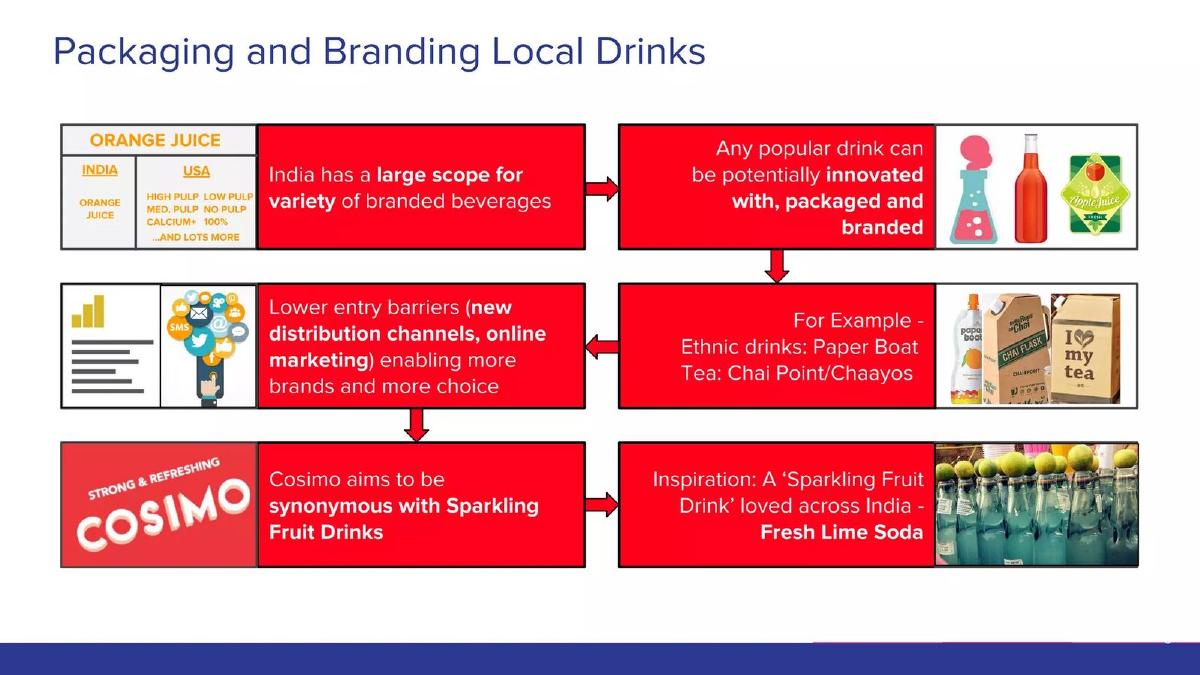
- Cosimo aims to fill the gap for branded versions of popular local drinks, specifically Fresh Lime Soda (Slide 4).
- The founders argue that lower entry barriers, such as online marketing and new distribution channels, enable new brands to compete with giants (Slide 4).
- A comparative analysis shows that while the USA and Europe have large independent brands like Orangina and Izze, India is dominated by 'side brands' from conglomerates (Slide 5).
- Appy Fizz is cited as the only standalone brand currently dominating the Indian sparkling fruit market (Slide 5).
- The team combines high-level finance experience from Flipkart with operational experience in FMCG contract manufacturing (Slide 9).
- The deck lacks any mention of revenue, valuation, or the specific amount of capital being raised (Slide 11).
- There is no detailed roadmap or go-to-market strategy beyond the general mention of 'online marketing' (Slide 4).
Executive Summary: The Localized Beverage Thesis
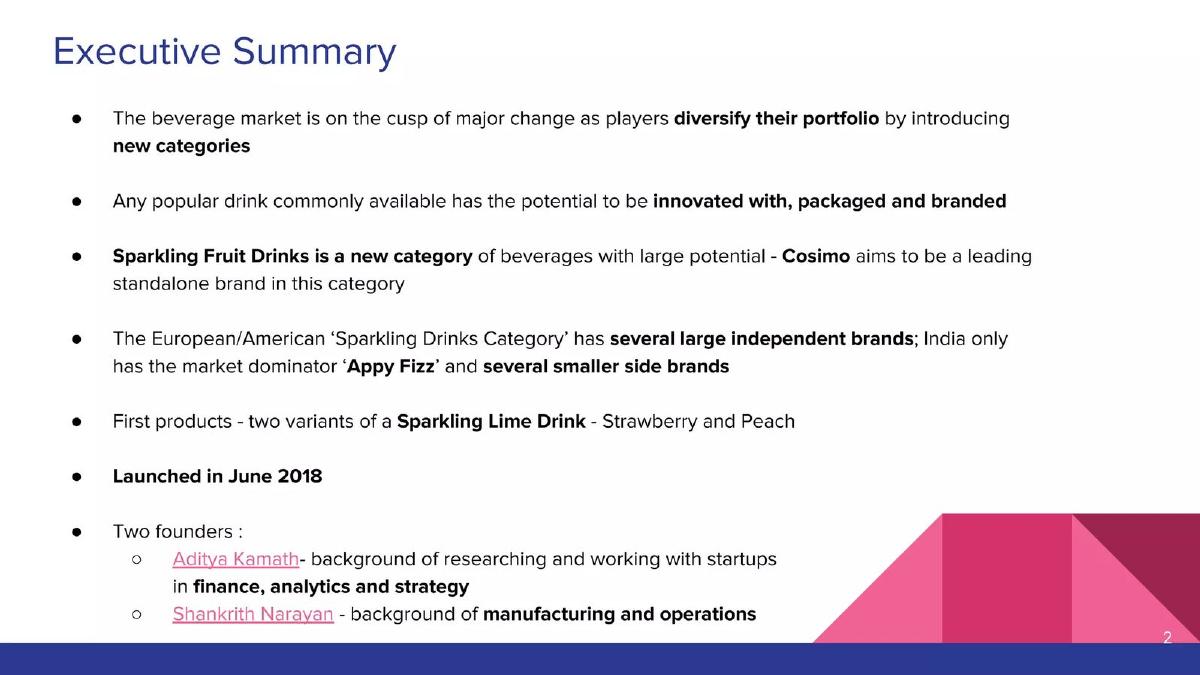
The Cosimo Drinks intro deck, dated May 2018, is a strategic document focused on the evolution of the Indian Fast-Moving Consumer Goods (FMCG) sector. Rather than leading with a product, the deck leads with a market shift. The central thesis is that the Indian beverage market is ripe for the same 'premiumization' and 'localization' trends that have already transformed the tea and ethnic drink categories. By comparing the Indian landscape to the more mature markets of Europe and the United States, the founders attempt to illustrate a 'missing' category of independent sparkling fruit brands.
Slide 1: Title and Branding
The deck opens with a minimalist title slide: COSIMO DRINKS - INTRO DECK . The date is clearly marked as MAY 2018 . The visual style is clean, using a deep blue background with geometric accents. This slide establishes the company's name but provides no tagline or immediate value proposition, requiring the reader to proceed to understand the sector.
Slide 3: The Macro Environment for Beverages
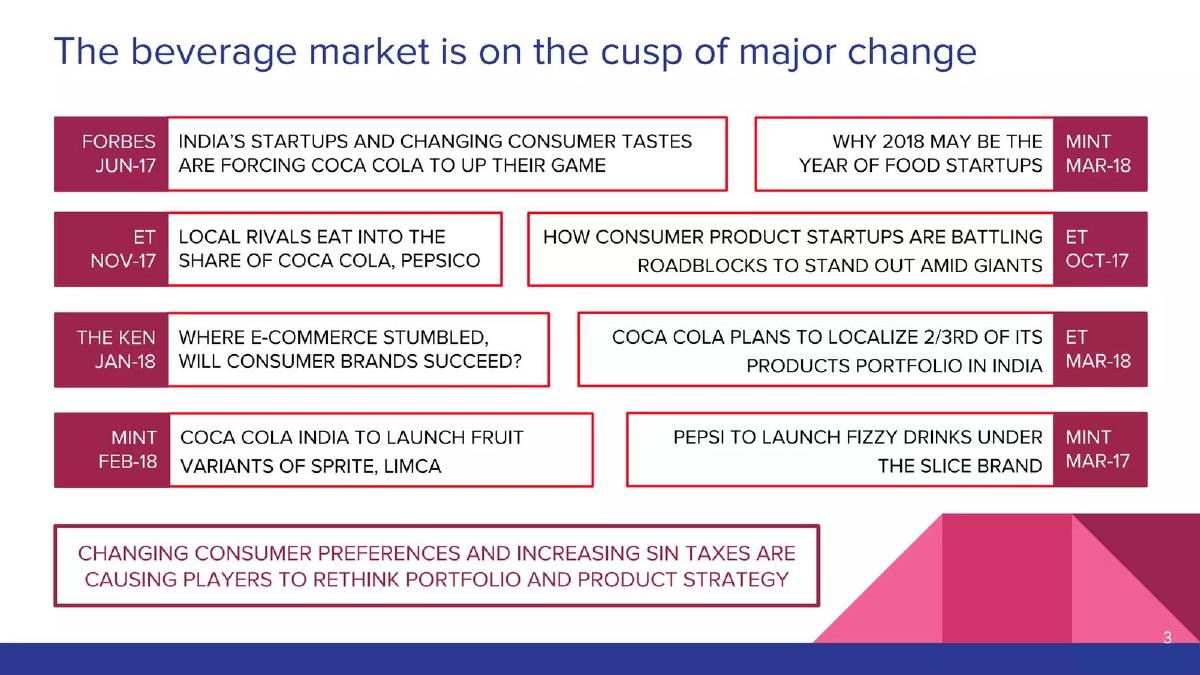
Slide 3 is a 'social proof' and market validation slide. It features a collage of headlines from major publications like Forbes, Mint, The Ken, and Economic Times (ET). The headlines focus on three main themes: 1) Indian startups challenging Coca-Cola and Pepsi, 2) Changing consumer tastes favoring local flavors, and 3) The impact of 'sin taxes' on traditional sugary sodas. The slide concludes with a summary statement: "CHANGING CONSUMER PREFERENCES AND INCREASING SIN TAXES ARE CAUSING PLAYERS TO RETHINK PORTFOLIO AND PRODUCT STRATEGY." This sets the stage for a new entrant to provide a healthier or more localized alternative to standard colas.
Slide 4: Packaging and Branding Local Drinks
This slide explains the 'How' and 'What' of the business model. It uses a flowchart to argue that India has a large scope for variety in branded beverages. It draws a comparison to the US orange juice market, which offers high pulp, low pulp, and calcium-fortified versions, whereas India's market is less segmented. The slide highlights Paper Boat (ethnic drinks) and Chai Point/Chaayos (tea) as successful examples of branding local favorites. Cosimo’s specific target is identified here: "Cosimo aims to be synonymous with Sparkling Fruit Drinks," with the specific inspiration being "Fresh Lime Soda." The slide also notes that lower entry barriers, specifically online marketing and new distribution channels, make this the right time to launch.
Slide 5: The Global vs. Local Gap
Slide 5 provides a visual competitive analysis. It splits the market into India versus Europe/USA. In the Western column, it shows Orangina, Izze, San Pellegrino, and Sparkling Ice as large, independent standalone brands that dominate their respective niches. In the Indian column, it shows that while Appy Fizz and Frooti Fizz exist as standalone brands, most other fruit-based sparkling drinks are 'Side Brands' owned by giants (e.g., Real Volo by Dabur, Fanta Green Mango by Coca-Cola, and Nimbooz by Pepsi). The takeaway is that India lacks a diverse ecosystem of independent, premium sparkling fruit brands, representing a significant market opportunity.
Slide 9: The Team
The team slide introduces two founders, focusing on a balance of strategy and execution. Aditya Kamath is positioned on the 'Demand Side,' covering finance, marketing, and strategy. His credentials include an MSc in Economics from IIT Kanpur (2015) and two years as an Investment Analyst at Flipkart , where he worked on portfolio management and sector research in grocery and fintech. Shankrith Narayan is positioned on the 'Supply Side,' covering manufacturing and operations. He holds a B.Tech in Mechanical Engineering from VIT (2014) . Crucially, his work experience includes a stint at a family business, Ameya Group , which is described as providing "contract manufacturing for major FMCG brands." This suggests the team has an insider's understanding of how to actually produce beverages at scale.
Slide 11: Conclusion
The deck ends abruptly with a "Thank You!" slide. There is no call to action, no mention of how much money is being raised, and no contact information other than the emails listed on the team slide. This reinforces the 'Intro' nature of the deck; it is designed to pique interest and secure a meeting rather than close a round on its own.
What Cosimo Drinks Does Well
The deck is exceptionally strong at category positioning . By using the 'Side Brand' vs. 'Standalone Brand' framework, the founders clearly articulate why a new player can exist alongside Coca-Cola and Pepsi. They don't claim they will kill the giants; they claim the giants are too distracted by their core portfolios to properly nurture niche sparkling fruit brands. The use of analogous success stories (Paper Boat and Chai Point) provides a mental shortcut for investors to understand the potential trajectory of the brand. Furthermore, the team slide is well-structured, specifically highlighting 'Demand Side' vs. 'Supply Side' to show that the two most critical pillars of a physical product business are covered by the founders' respective backgrounds.
What is Missing from the Deck
As an 'Intro Deck,' there are several glaring omissions that would be required for a formal Series A or even a Seed round. First, there is no product imagery beyond a logo. We see the inspiration (Fresh Lime Soda) and the competitors, but we don't see the Cosimo bottle, the label design, or the actual liquid. Second, there is a total lack of unit economics . In the beverage industry, margins, shipping costs, and shelf-life are the difference between a viable business and a cash-burn machine. Third, the Go-To-Market (GTM) strategy is vague. Mentioning 'online marketing' is insufficient for a product that typically relies on physical distribution, retail footprints, and cold-chain logistics. Finally, there is no financial ask or roadmap . An investor has no idea if the company is looking for $500k to run a pilot or $5M to build a factory.
Founder's Guide: What to Copy
Founders in the consumer goods space should look at Slide 5 as a masterclass in 'Gap Analysis.' If you are entering a crowded market, you must show that the 'crowd' is actually ignoring the specific segment you want to own. By categorizing incumbents' products as 'Side Brands,' Cosimo makes a compelling case that those products will never receive the marketing budget or innovation focus required to win the category. Additionally, the Headline Collage on Slide 3 is a very effective way to build a 'Why Now' slide without having to write original market research; it uses the credibility of established financial news outlets to do the heavy lifting for you. Lastly, the functional split on the team slide (Slide 9) is a great way to show how two founders' skills complement each other without overlapping, which reduces perceived 'key man risk' for investors.
Frequently asked questions
- What is the core product Cosimo Drinks is proposing?
- According to Slide 4, the brand aims to be synonymous with 'Sparkling Fruit Drinks.' The specific inspiration mentioned is a branded, packaged version of 'Fresh Lime Soda,' a popular unorganized beverage across India. The deck positions this as part of a broader trend of packaging and branding local drinks, similar to how Paper Boat handled ethnic drinks or Chai Point handled tea.
- How does the deck justify the timing of this startup?
- Slide 3 uses a 'Why Now' approach by citing eight different news headlines from 2017 and 2018. These headlines suggest that Indian startups are forcing Coca-Cola to 'up their game,' local rivals are eating into the market share of Pepsi, and new 'sin taxes' on sugary drinks are forcing a portfolio rethink among major incumbents.
- What competitive advantage does the team claim?
- The team slide (Slide 9) highlights a balance between 'Demand Side' and 'Supply Side' expertise. Aditya Kamath brings finance and strategy experience from two years as an Investment Analyst at Flipkart. Shankrith Narayan provides the operational backbone, having worked in a family business (Ameya Group) that performed contract manufacturing for major FMCG brands.
- How does Cosimo view the competitive landscape in India?
- Slide 5 categorizes the market into 'Standalone Brands' and 'Side Brands.' It notes that in India, Appy Fizz is the only dominant standalone brand. Other products like Fanta Green Mango (Coca-Cola) or Nimbooz Masala Soda (Pepsi) are classified as 'Side Brands,' implying they do not receive the full focus of the parent company, creating an opening for an independent player.
- What is missing from this deck that an investor would need?
- This is an 'Intro Deck,' and it shows. It is missing critical investment data including unit economics (COGS, margins), a specific go-to-market plan, a product roadmap, and a financial ask. There are no mentions of current traction, pilot results, or projected revenue, making it a conceptual pitch rather than a business execution pitch.