Coralogix's Series C deck is a masterclass in technical positioning within a crowded market. By contrasting 'Legacy Solutions' against 'Modern Observability,' the company clearly defines its value proposition: decoupling indexing from real-time analytics. The deck leans heavily on its proprietary 'Streama' technology to promise up to 70% storage savings and proactive monitoring. With over 2,000 paying customers and processing 3 million events per second as of 2021, the traction slides provide the necessary social proof to back their technical claims. While the deck lacks explicit financial pr…
Key takeaways
- The deck positions Coralogix as a successor to legacy tools like Splunk and Sumo Logic by moving from 'Ingest, Index, Analyze' to 'Ingest, Analyze, Index' (Slide 2).
- A central value proposition is the 'Streama' technology, which claims to provide real-time insights without the need for storage or indexing (Slide 2).
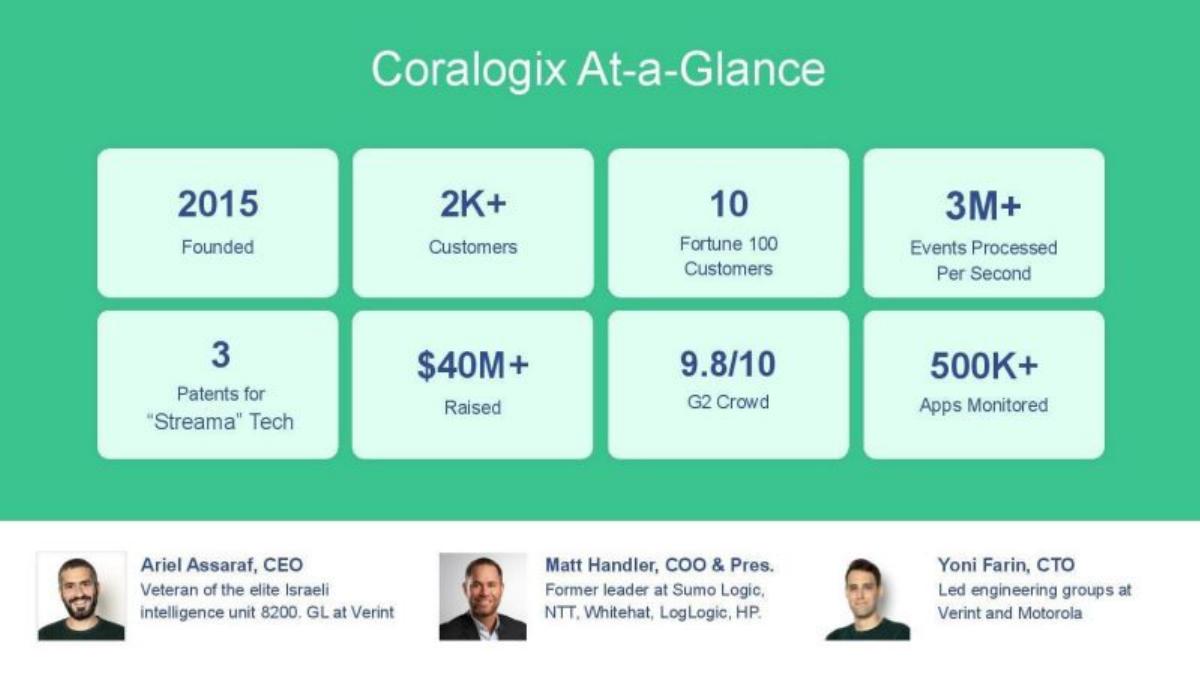
- Traction is significant, with 2,000+ customers, 10 Fortune 100 clients, and 3 million events processed per second (Slide 4).
- The platform emphasizes cost efficiency, citing up to 70% storage savings compared to legacy solutions (Slide 3).
- The leadership team includes veterans from the Israeli intelligence unit 8200 and former leaders from Sumo Logic and Verint (Slide 4).
- A detailed case study of Monday.com shows a 60% reduction in MTTR and $100k saved per year (Slide 19).
- The product roadmap outlines a transition toward a 'Cloud Data Platform for Any Data, Any Syntax, Any Storage' by 2023 (Slide 20).
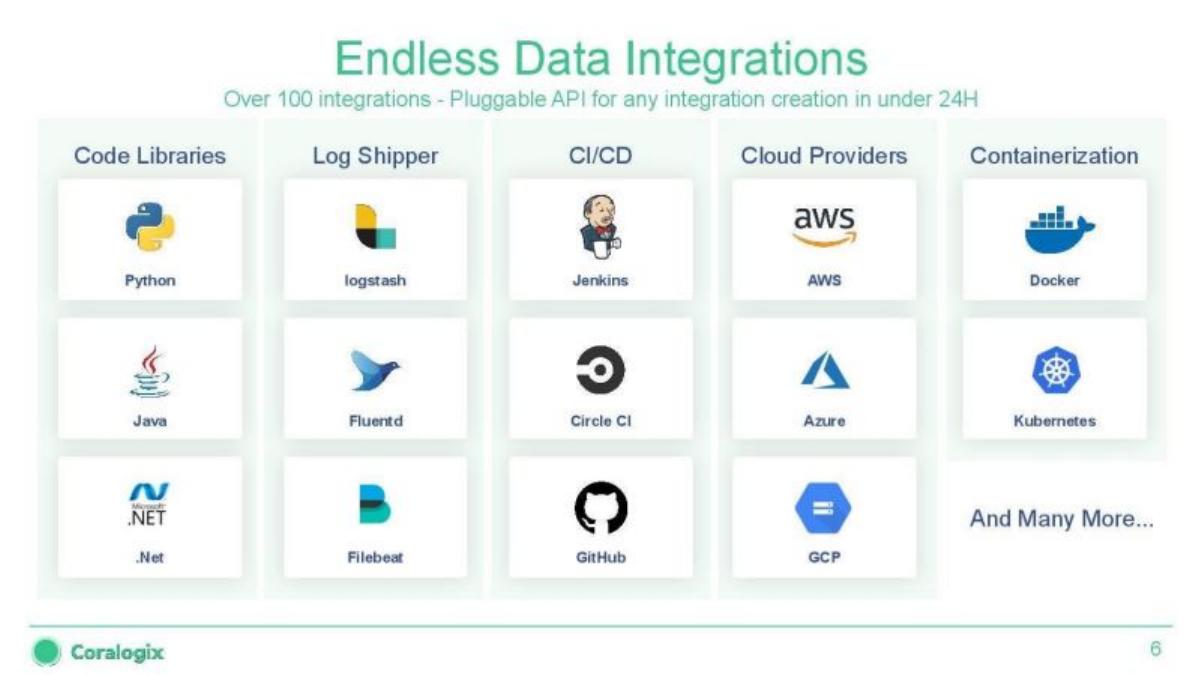
- The deck highlights broad compatibility with over 100 integrations and a pluggable API for new integrations in under 24 hours (Slide 6).
The Strategic Shift: From Storage to Streaming
The Coralogix Series C pitch deck is a highly technical yet commercially focused document that seeks to disrupt the established observability market. At the time of this $55M raise in 2021, the company was positioning itself not just as another logging tool, but as a fundamental architectural shift in how enterprises handle machine data. The narrative is built around the 'Streama' technology, which addresses the primary pain point of modern DevOps: the prohibitive cost of storing and indexing massive volumes of data just to find a few critical insights.
Slide 1: Title and Core Value Proposition
The deck opens with a clear, descriptive title: Stateful Streaming Analytics Platform for Logs, Metrics, and Security Data . The subtitle, Modern observability with no reliance on storage or indexing , immediately identifies the company's unique selling point. The visual design is clean, using a professional palette of greens and blues, signaling a mature enterprise software product.
Slide 2: The Evolution of Issue Resolution
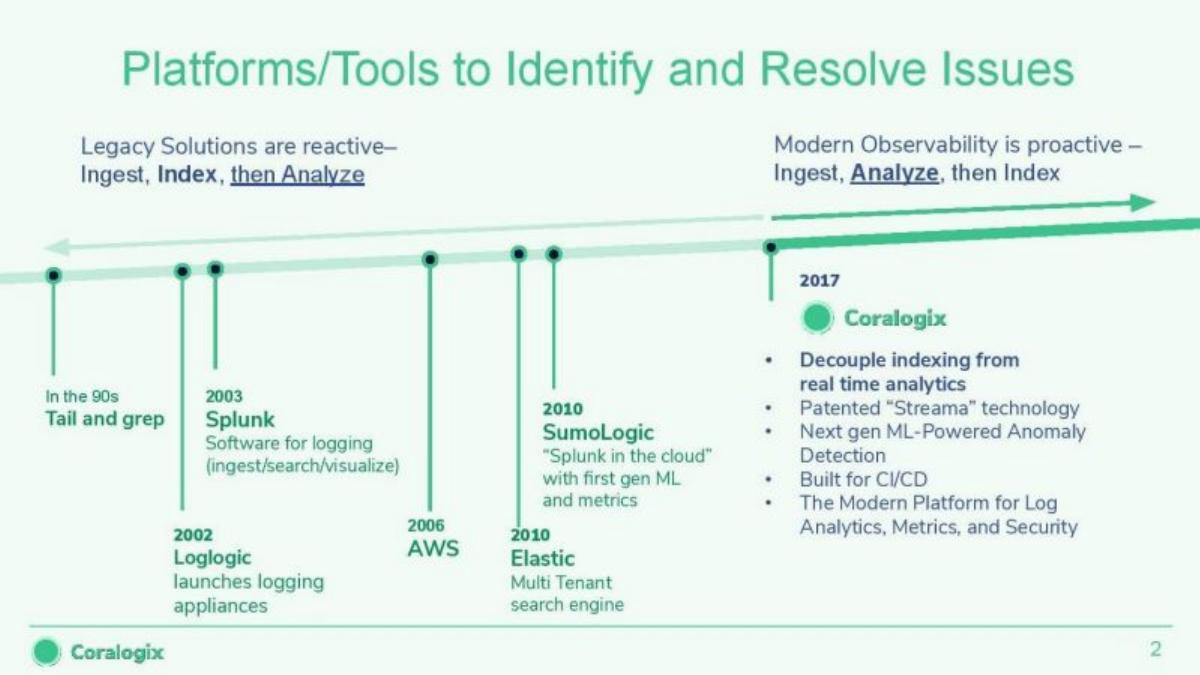
Slide 2 is one of the most important slides in the deck. It presents a timeline of the industry, starting with 'Tail and grep' in the 90s, moving through Splunk (2003), AWS (2006), and Sumo Logic (2010). It categorizes these as 'Legacy Solutions' that are reactive because they Ingest, Index, then Analyze . Coralogix, founded in 2017, is positioned as the 'Modern' alternative that flips the script: Ingest, Analyze, then Index . This slide successfully frames the competition as technologically outdated.
Slide 3: Legacy vs. Modern Observability
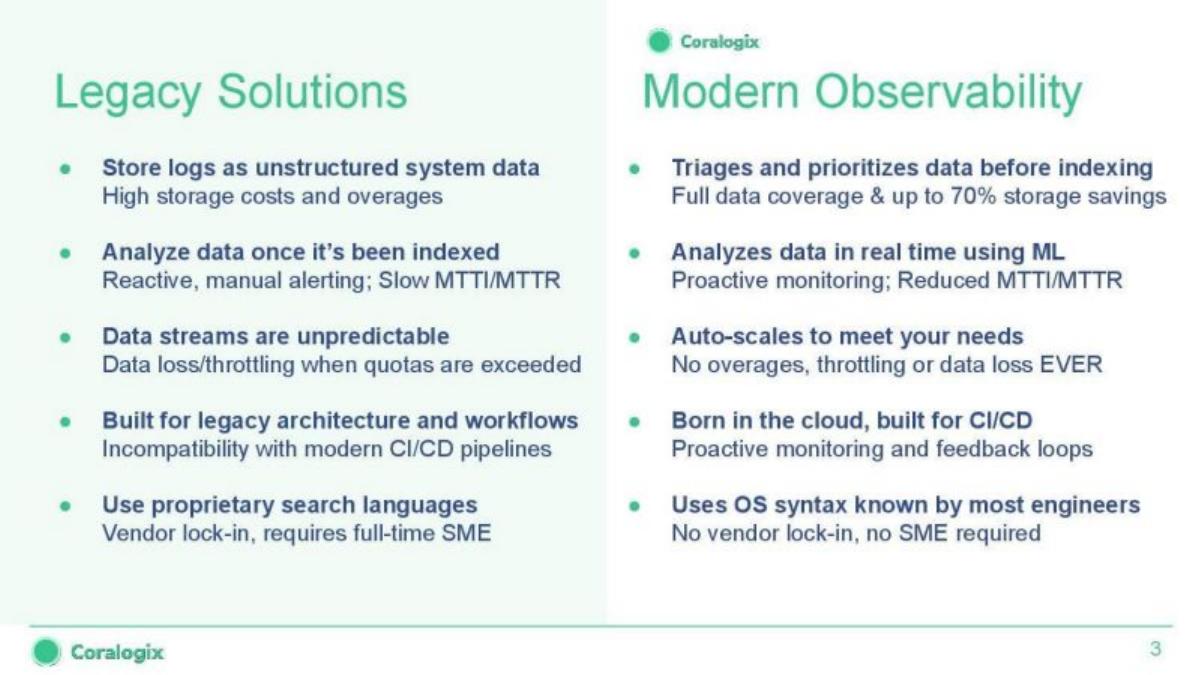
This slide uses a side-by-side comparison to hammer home the benefits of the Coralogix approach. Key points include:
Cost: Legacy solutions have 'High storage costs and overages,' while Coralogix offers 'up to 70% storage savings.' · Speed: Legacy is 'Reactive' with 'Slow MTTI/MTTR,' while Coralogix is 'Proactive' with 'Reduced MTTI/MTTR.' · Scalability: Coralogix claims 'No overages, throttling or data loss EVER.' · Syntax: Coralogix uses 'OS syntax known by most engineers,' avoiding the 'vendor lock-in' of proprietary languages.
Slide 4: Coralogix At-a-Glance
Traction is presented through eight high-impact tiles. The figures quoted are:
2015: Founded. · 2K+: Customers. · 10: Fortune 100 Customers. · 3M+: Events Processed Per Second. · 3: Patents for 'Streama' Tech. · $40M+: Raised (prior to this round). · 9.8/10: G2 Crowd rating. · 500K+: Apps Monitored.
Below these metrics, the leadership team is introduced. Ariel Assaraf (CEO) is noted as a veteran of the elite Israeli intelligence unit 8200. Matt Handler (COO & Pres.) brings experience from Sumo Logic and HP, while Yoni Farin (CTO) has a background at Verint and Motorola. This combination of deep technical roots and enterprise sales experience is a strong signal for Series C investors.
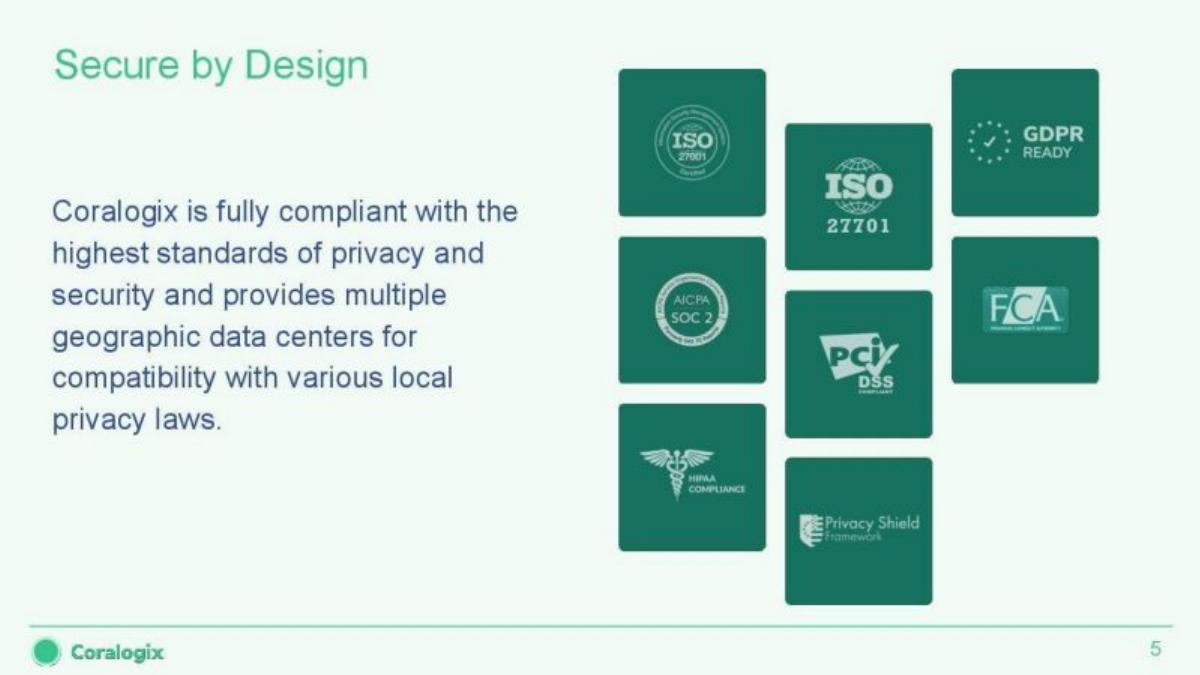
Slide 5: Secure by Design
For enterprise software, security is a binary gate. Slide 5 lists the company's compliance credentials, including ISO 27001, ISO 27701, SOC 2, PCI DSS, HIPAA, GDPR, and FCA . This slide is designed to remove friction during the due diligence process by proving the platform is ready for highly regulated industries.
Slide 6: Endless Data Integrations
Observability tools are only as good as the data they can ingest. Slide 6 showcases logos for Python, Java, .NET, Logstash, Fluentd, Filebeat, Jenkins, Circle CI, GitHub, AWS, Azure, GCP, Docker, and Kubernetes . The claim of 'Over 100 integrations' and a 'Pluggable API for any integration creation in under 24H' addresses concerns about ecosystem compatibility.
Slide 7: Any data, Any dashboard, Any syntax
This slide emphasizes flexibility. It explicitly states, Not a data warehouse, a data platform . It mentions support for Kibana, Grafana, SQL clients, and Tableau , reinforcing the message that Coralogix integrates into existing workflows rather than forcing engineers to learn new tools.
Slide 8: The Coralogix Platform
The platform is broken down into three functional pillars: Log Analysis (proactive insights), Metrics (unlimited cardinality for no extra cost), and Security (securing cloud environments in minutes). This slide serves as a high-level product overview.
Slide 9: Technical Architecture (Streama)
Slide 9 provides a schematic of the data flow. It shows data moving from Load Balancers to an Ingress Service , then through the Streama Technology (Logs Parser) before being branched into Index (S3 Bucket or Hot Index) and Insights (Alerts, Anomalies, Visualization). This technical depth is appropriate for a Series C deck where investors will be looking at the 'how' as much as the 'what.'
Slide 10: Solutions Powered by Streama
This slide lists six use cases: Log Analysis & Metrics, CI/CD Acceleration, Cost (TCO) Optimization, Network & Cloud Security, Contextual Data Analysis, and Homegrown Alternative. It broadens the scope of the company from a simple tool to a multi-purpose infrastructure solution.
Slides 11-14: Feature Deep Dives
These slides provide visual evidence of the platform's capabilities:
Slide 11: Log Clustering & Anomaly Detection using ML to detect unusual behavior without static thresholds. · Slide 12: ML-Powered Alerting, including dynamic thresholds and query flow alerts. · Slide 13: Metrics with 'Unlimited Granularity, Cardinality, and Labeling' at a fixed 'Pay per GB' price. · Slide 14: Seamless Visualization and the 'Logs2Metrics' feature which converts log data to trackable metrics before indexing.
Slides 15-17: Security and Context
Slide 15 focuses on Cloud Security , specifically mirroring traffic from sources like Cloudtrail and GuardDuty . Slides 16 and 17 introduce the concept of 'Small Data, Big Value,' arguing that sources like Slack, GitHub, and Intercom provide essential context for system observability. This is a clever expansion of the 'data platform' narrative.
Slide 18: Customer Logos
Social proof is provided by a grid of recognizable logos, including Adobe, Lufthansa, Decathlon, Monday.com, Fiverr, Postman, and Capgemini . The headline claims 2,000+ paying Customers , which is a significant milestone for a Series C company.
Slide 19: Case Study - Monday.com
The deck includes a specific success story for Monday.com . It highlights:
$130M Annual Revenue (of the customer). · 10X Log volume growth (3TB to 30TB per month). · 60% Reduced MTTR. · $100K Saved per year. · 48 hours to achieve full coverage.
This slide is exceptionally powerful because it quantifies both the operational and financial impact of the product.
Slide 20: The Roadmap
The roadmap looks forward to 2023. Key milestones include Fields 'TCO' in H2 2021, Tracing in H1 2022, Streaming SDKs in H2 2022, and the Real-time Metastore in H1 2023. The ultimate goal is to become a 'Data Platform as-a-Service' that solves the problem of 'data growing faster than revenue.'
Slide 21: Conclusion
The deck ends with a simple 'Thank You!' slide featuring an isometric illustration of engineering tools, maintaining the technical aesthetic of the presentation.
What Coralogix Does Well
The deck is masterful at category creation and positioning . By defining a 'Modern Observability' category that is distinct from 'Legacy Solutions,' they make their competitors look like dinosaurs. The focus on 'Analyze then Index' is a clear, repeatable mantra that sticks in an investor's mind. Furthermore, the inclusion of a detailed case study with hard numbers (Slide 19) provides the necessary evidence to support their bold claims about cost savings and efficiency.
What is Missing from the Deck
Despite being a Series C deck, there are several standard elements missing:
Financials: There is no slide showing ARR growth, churn rates, or net dollar retention (NDR). While the customer count is high, investors at this stage typically want to see the revenue quality and growth trajectory. · The Ask: The deck does not explicitly state how much they are raising or how they plan to use the capital (e.g., expanding the sales team, R&D, international expansion). · Unit Economics: There is no mention of Customer Acquisition Cost (CAC) or Lifetime Value (LTV). · Competitor Matrix: While they group competitors into 'Legacy,' a more detailed feature-by-feature comparison against modern rivals like Datadog or New Relic is absent.
Founder Takeaways: What to Copy
1. The 'Flip the Script' Narrative: If your technology changes the fundamental order of operations in your industry (like Ingest-Analyze-Index), use a timeline or a side-by-side comparison to make that change feel like an inevitable evolution. 2. Quantified Case Studies: Don't just list logos. Show what your product did for a specific, recognizable customer. The Monday.com slide is the strongest piece of evidence in the entire deck because it links technical performance to financial savings. 3. Technical Depth for Late Stage: By Series C, investors expect you to know your architecture. Coralogix doesn't shy away from showing how their 'Streama' engine actually works, which builds credibility with technical partners at VC firms. 4. Compliance as a Feature: If you are selling to the enterprise, make your security and compliance slide unassailable. Listing seven major certifications on one slide tells the investor that you won't get stuck in a six-month security review with a potential Fortune 500 client.
Frequently asked questions
- What is the core technical innovation Coralogix presents?
- The core innovation is 'Streama' technology. Unlike legacy systems that require data to be indexed and stored before it can be analyzed, Streama analyzes data in real-time as it streams. This allows for proactive monitoring and anomaly detection without the immediate overhead of high storage costs, which the deck claims can be reduced by up to 70%.
- How does Coralogix differentiate itself from competitors like Splunk or Elastic?
- Coralogix differentiates by changing the order of operations. Slide 2 shows a timeline where legacy tools are 'reactive' (Index then Analyze), while Coralogix is 'proactive' (Analyze then Index). They also emphasize the use of open-source syntax to avoid vendor lock-in, contrasting this with the proprietary search languages required by older platforms.
- What level of traction had the company achieved by the Series C?
- As of the 2021 deck, Coralogix had over 2,000 paying customers, including 10 from the Fortune 100. They were processing 3 million events per second across 500,000 monitored applications. They also highlighted a 9.8/10 rating on G2 Crowd, indicating high user satisfaction alongside their enterprise growth.
- Is there a specific 'Ask' slide in this deck?
- No, the provided 22-slide deck does not include a specific 'Ask' slide detailing the valuation, the exact amount being raised in this specific round, or the planned allocation of funds. While catalogue facts state the round was $55M, the deck itself focuses entirely on the product, market positioning, and existing traction.
- How does the deck address security and compliance?
- Security is a major pillar of the deck. Slide 5 lists numerous certifications including ISO 27001, SOC 2, HIPAA, GDPR, and PCI DSS. Furthermore, Slide 8 and Slide 15 position 'Security' as one of the three core platform modules alongside Log Analysis and Metrics, specifically highlighting cloud environment protection and traffic mirroring.