Coram AI, a North American cybersecurity startup, raised $13.8M in a 2024 Series A round using a concise 6-slide deck. The presentation positions the company as a provider of 'AI Agents for the Physical World,' focusing on the massive $120B labor market for security and operations professionals. The deck emphasizes technical scalability, claiming to process 100,000 hours of video daily using on-premise Large-Vision and Language Models (LVLMs). While the deck is visually polished and highlights a strong customer testimonial from North Cross School, it notably omits a detailed team slide, speci…
Key takeaways
- The deck positions the product as 'AI Agents' rather than just a security camera platform to tap into the $120B labor market (Slide 5).
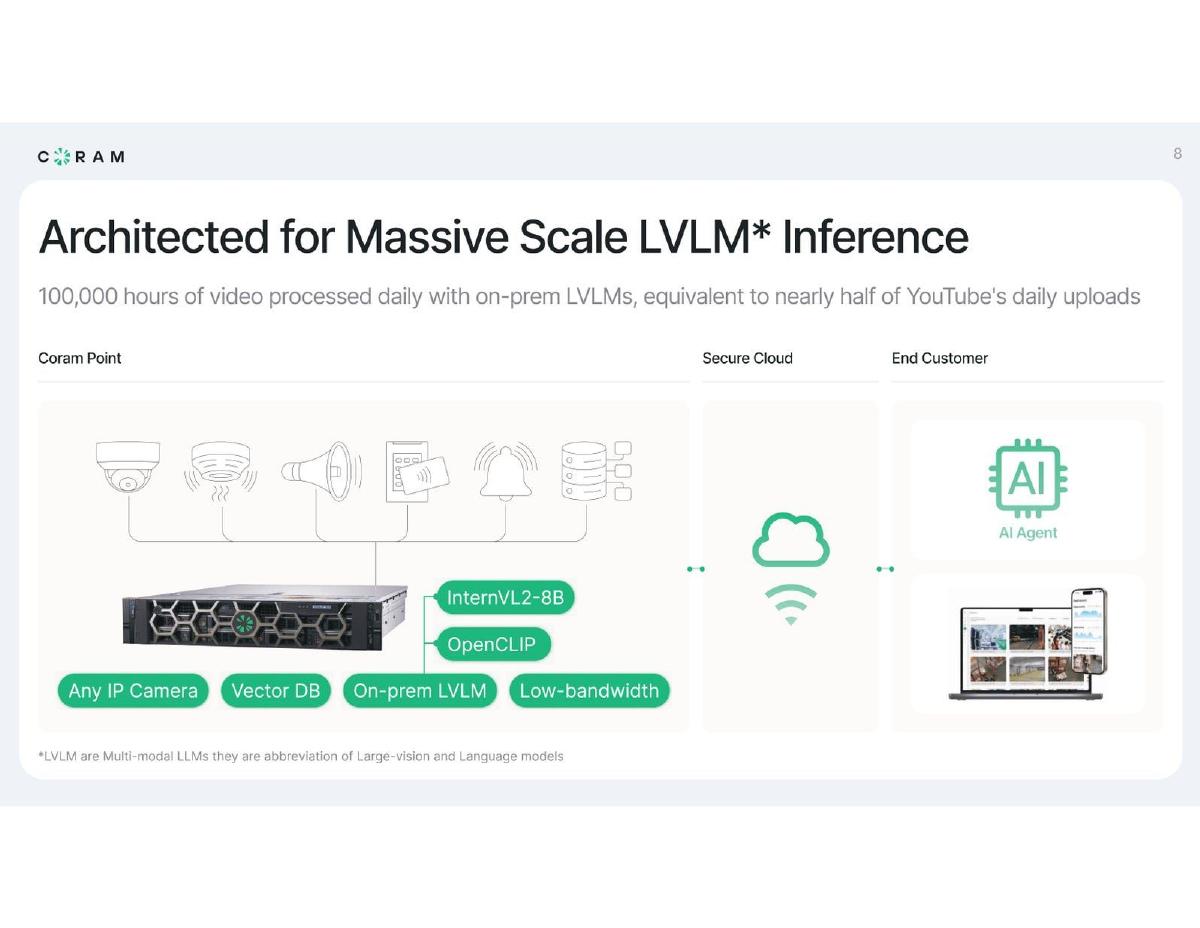
- Coram AI claims to process 100,000 hours of video daily, which it equates to nearly half of YouTube's daily uploads (Slide 8).
- The technology stack utilizes on-premise LVLMs (Large-Vision and Language Models) including InternVL2-8B and OpenCLIP (Slide 8).
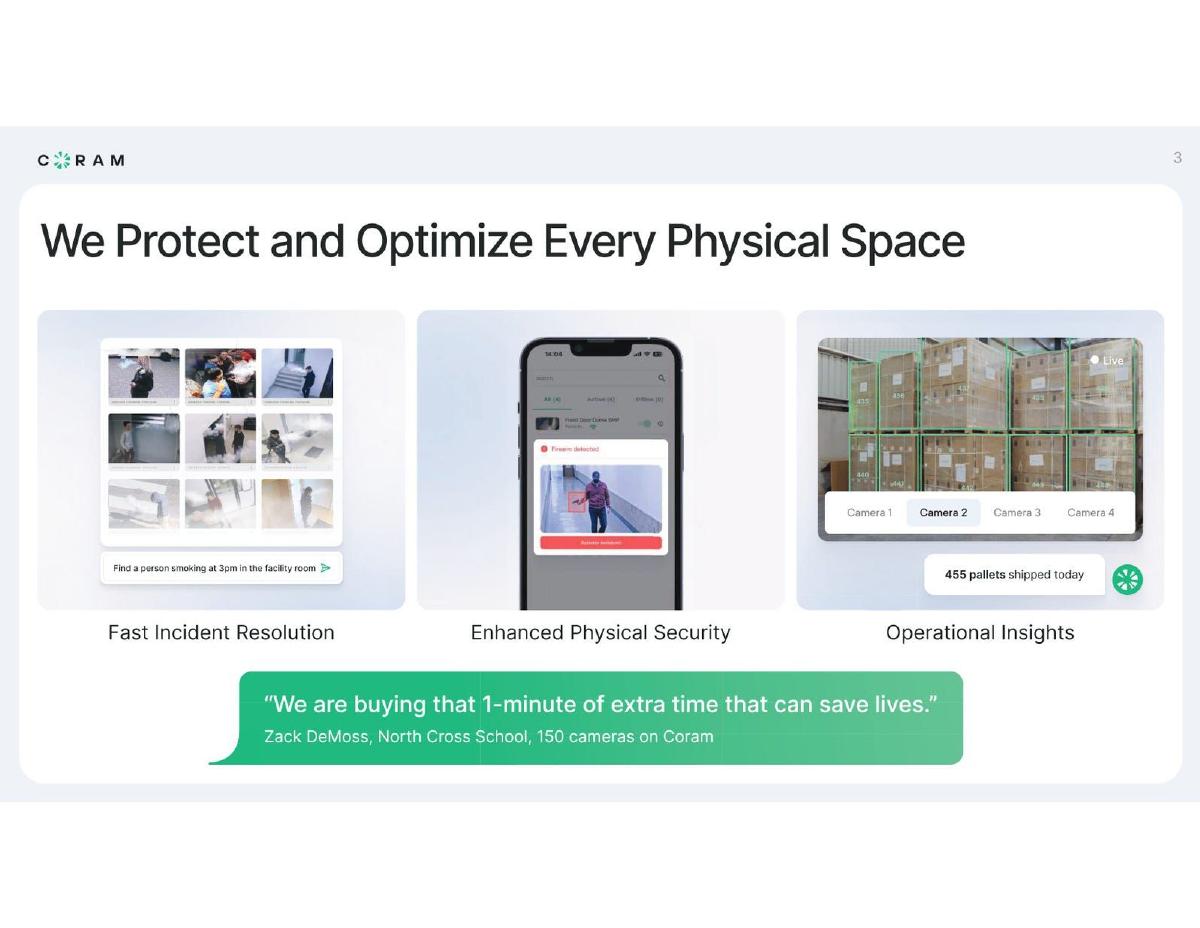
- A customer testimonial from Zack DeMoss at North Cross School highlights the deployment of 150 cameras on the Coram system (Slide 3).
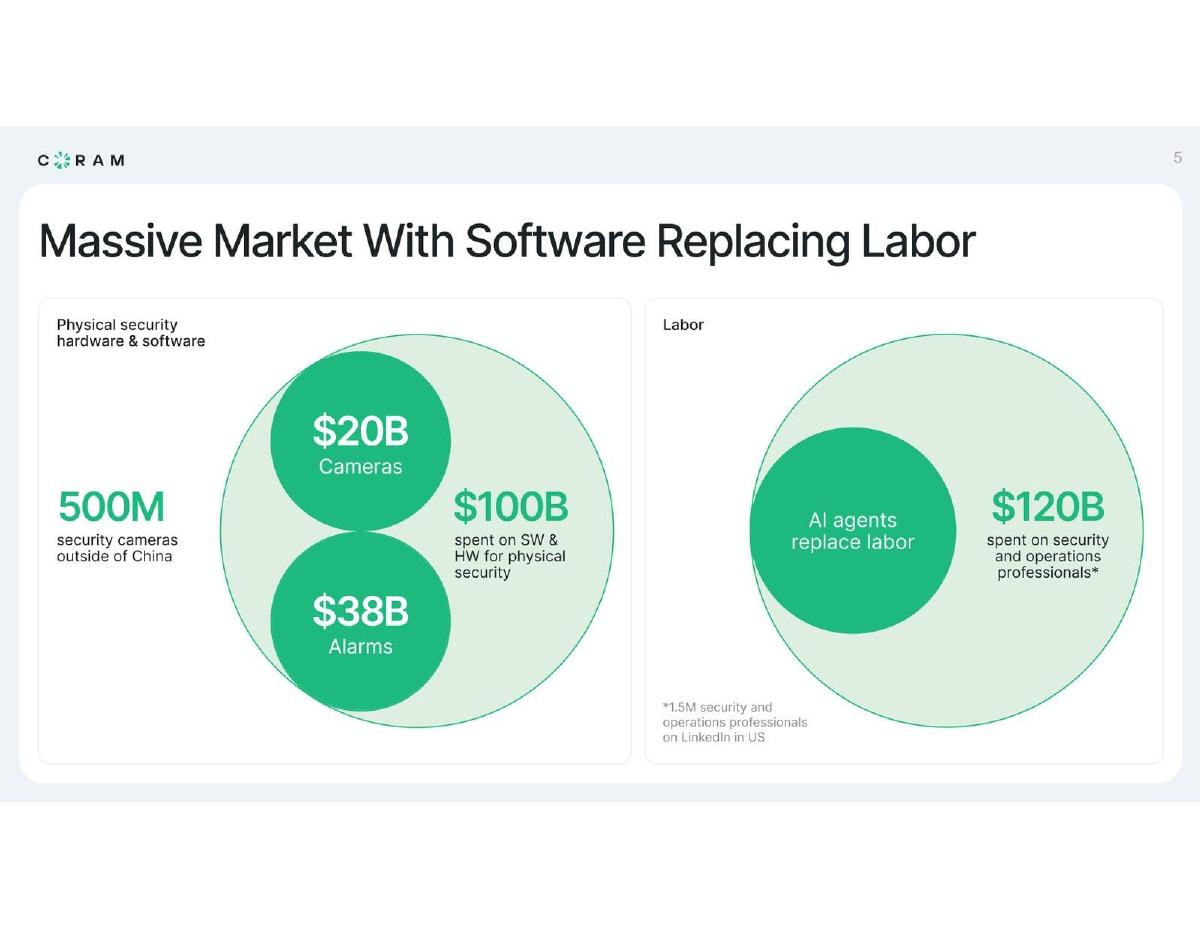
- The market opportunity is framed by 500 million security cameras existing outside of China (Slide 5).
- The deck uses a highly condensed 6-slide format, skipping traditional elements like a dedicated team slide or detailed roadmap (Slides 1-14).
- The product is designed to work with 'Any IP Camera,' lowering the barrier to entry for existing facilities (Slide 8).
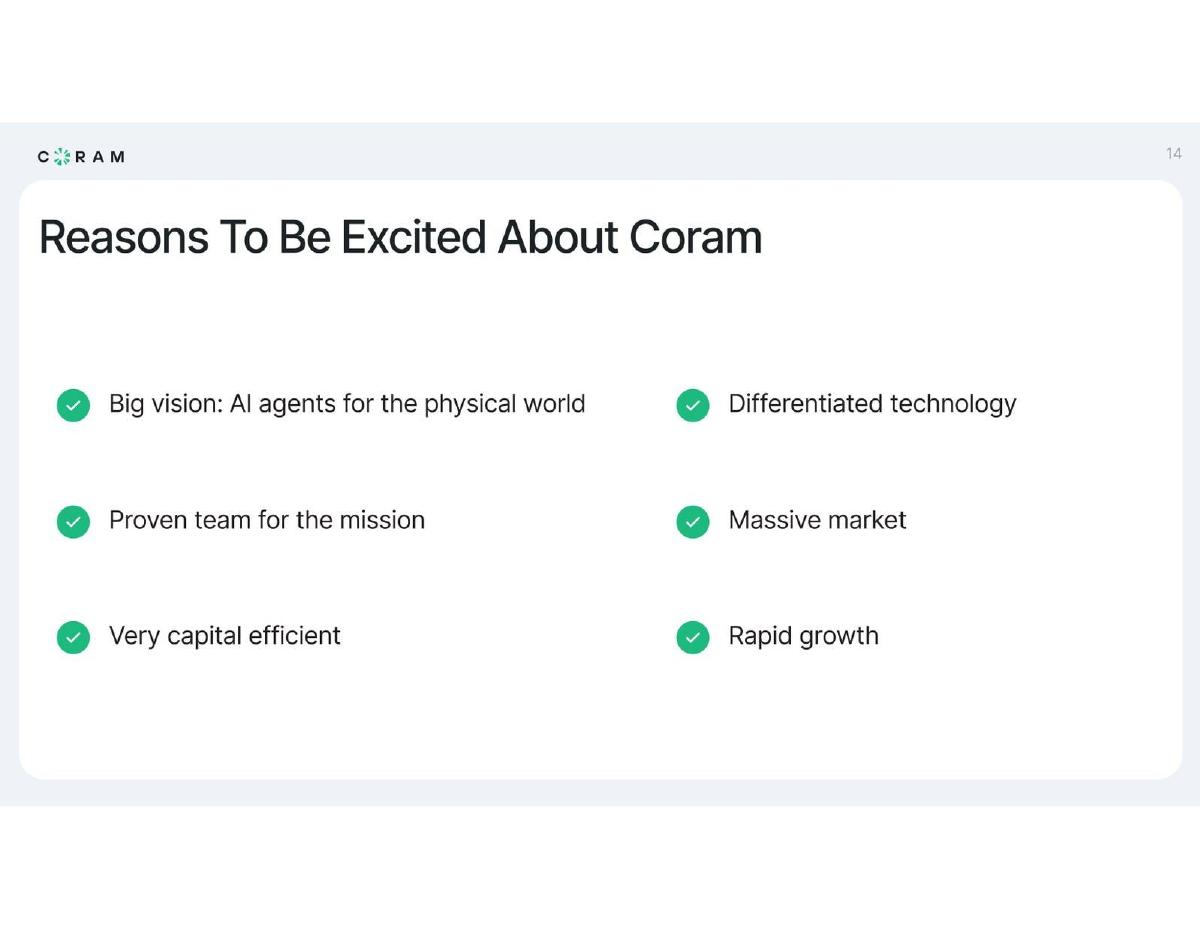
- The closing slide asserts 'Rapid growth' and 'Very capital efficient' status, though no specific revenue figures are provided in this version of the deck (Slide 14).
Introduction: The 6-Slide Series A
Coram AI’s Series A deck is a study in brevity. In an era where pitch decks often bloat to 20 or 30 slides, Coram AI secured $13.8M in 2024 with a highly visual, 6-slide presentation. The company, based in North America, operates at the intersection of AI and Cybersecurity, specifically targeting the physical security market. The deck focuses heavily on the shift from passive monitoring to autonomous 'AI Agents' that can interpret the physical world in real-time.
Slide 1: Title and Positioning
The opening slide establishes the brand identity and the core value proposition: "AI Agents For The Physical World." The visual features a laptop, a smartphone, and a branded dome camera, immediately signaling that this is a hardware-software hybrid solution. The mention of "Series A" sets the stage for the investment context, though no specific financial figures are present here.
Slide 2: The Autonomous AI Agent Concept
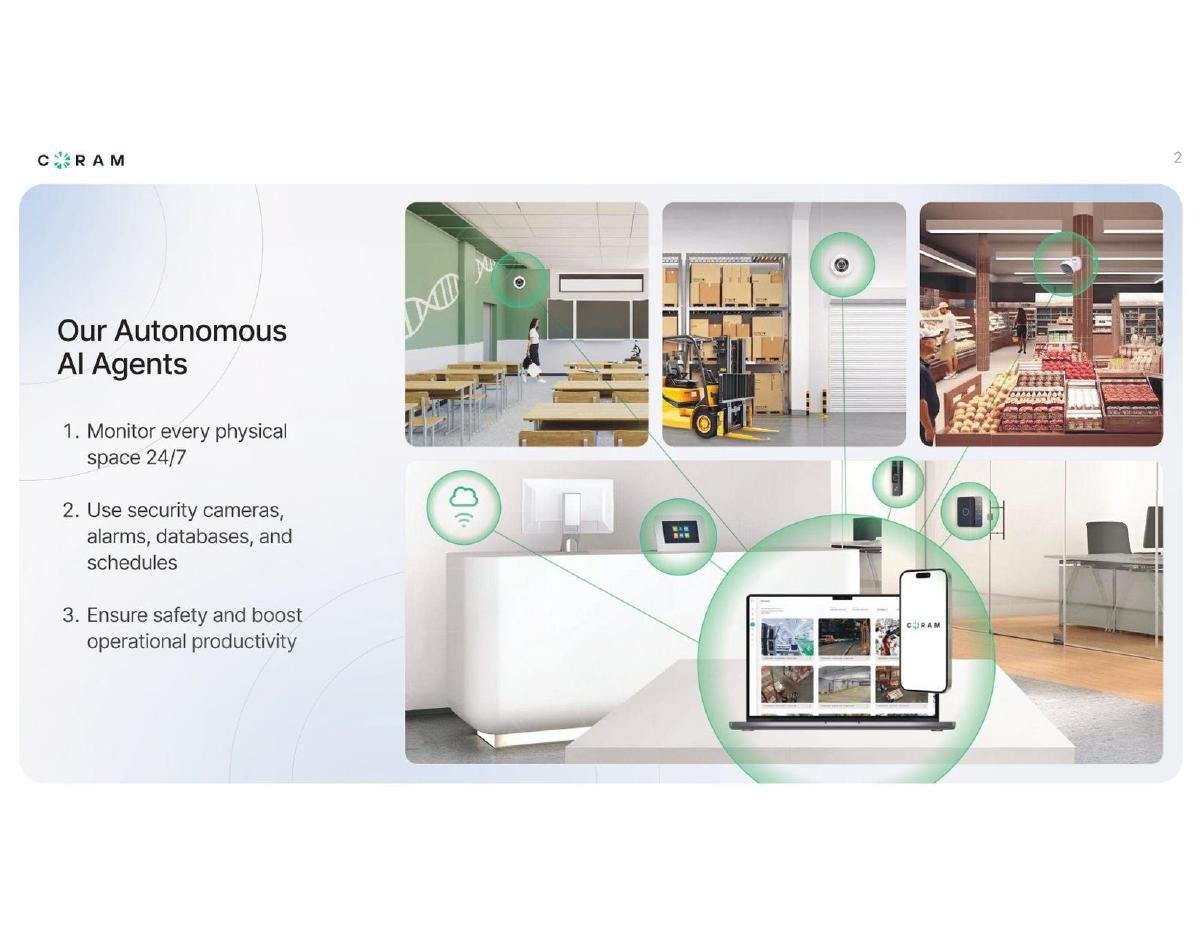
Slide 2 defines what Coram AI actually does. It breaks the functionality down into three steps: monitoring every physical space 24/7, utilizing existing infrastructure (cameras, alarms, databases), and ensuring safety while boosting productivity. The imagery shows diverse environments—a classroom, a warehouse, and a retail store—indicating a broad horizontal market application. By highlighting the use of "existing security cameras," the company addresses a major friction point: the cost of hardware replacement.
Slide 3: Use Cases and Social Proof
This slide moves from theory to application, categorizing the product's value into three buckets: Fast Incident Resolution, Enhanced Physical Security, and Operational Insights. The visuals show the software in action: a search query for "a person smoking at 3pm," a firearm detection alert on a mobile device, and an automated count of "455 pallets shipped today." The inclusion of a quote from Zack DeMoss at North Cross School, mentioning "150 cameras on Coram," provides critical social proof and demonstrates the scale of current deployments.
Slide 5: The Market Opportunity (Labor vs. Software)
Slide 5 (numbered as 5 in the set, though it is the fourth image) presents the macroeconomic thesis. It identifies 500 million security cameras outside of China and a $100B spend on physical security hardware and software. However, the real 'hook' for investors is the right-hand graphic: a $120B market spent on 1.5M security and operations professionals. Coram AI positions its "AI agents" as a direct replacement for this labor, suggesting a much larger Total Addressable Market (TAM) than traditional security software companies usually claim.
Slide 8: Technical Architecture and Scale
The technical slide (numbered 8) focuses on the efficiency of their Large-Vision and Language Model (LVLM) inference. The company claims to process 100,000 hours of video daily. To put this in perspective for investors, they compare it to "nearly half of YouTube's daily uploads." The architecture diagram shows an on-premise "Coram Point" server running InternVL2-8B and OpenCLIP, which allows for sophisticated AI processing without requiring massive cloud bandwidth. This "on-prem LVLM" approach is a key technical differentiator for handling high-resolution video feeds.
Slide 14: The Summary Wrap-up
The final slide (numbered 14) serves as a summary of the investment thesis. It lists six "Reasons To Be Excited About Coram," including a big vision, a proven team, capital efficiency, differentiated technology, a massive market, and rapid growth. This slide acts as a checklist for the verbal pitch, reinforcing the narrative that the company is both technically superior and commercially viable.
What Coram AI Does Well
Clarity of Vision: The deck avoids technical jargon in the early slides, focusing instead on the outcome: "AI Agents for the Physical World." This framing elevates the company from a simple "SaaS for cameras" to a broader AI play.
Scale Benchmarking: Comparing their video processing volume to YouTube (Slide 8) is a brilliant way to communicate technical capability to non-technical investors. It provides an immediate sense of the engineering challenges the team has already solved.
The Labor Arbitrage Thesis: By explicitly targeting the $120B spent on human security guards and operations staff (Slide 5), Coram AI justifies a higher valuation. They aren't just fighting for a piece of the security software budget; they are going after the payroll budget.
Hardware Agnostic: Explicitly stating they work with "Any IP Camera" (Slide 8) removes the biggest barrier to sales in the physical security space. It tells investors that the sales cycle will be shorter because it doesn't require a total infrastructure overhaul.
What is Missing from the Coram AI Deck
The Team Slide: While the summary slide mentions a "Proven team," the actual names and pedigrees of the founders are missing from this 6-slide set. For a Series A, investors typically want to see the specific experience that qualifies this team to build on-premise LVLMs.
Financial Traction: The deck mentions "Rapid growth" and "Capital efficient" (Slide 14), but there are no charts showing Monthly Recurring Revenue (MRR), customer growth rates, or churn. Even a redacted growth curve would have strengthened the "Rapid growth" claim.
Unit Economics: There is no mention of the pricing model. Is it a per-camera subscription? A per-server fee? Understanding how the $120B labor market translates into Coram AI revenue is a missing link in the narrative.
The Competitive Landscape: The physical security AI space is crowded with incumbents and well-funded startups like Verkada. The deck does not explicitly address how Coram AI wins against these specific competitors beyond the technical mention of on-premise LVLMs.
Founder Takeaways
Focus on the 'Agent' Narrative: If you are building in AI, don't just sell a tool; sell an agent. Coram AI successfully frames their software as a replacement for human labor, which is a much more compelling investment thesis than simply "better analytics."
Use Social Proof Early: The North Cross School testimonial on Slide 3 is effective because it includes a specific number (150 cameras). This proves the product isn't just a pilot; it's being used at scale in a sensitive environment like a school.
Visual Simplicity: This deck is extremely light on text. It uses high-quality renders and clear diagrams to tell the story. Founders should note how much information is conveyed through the pallet-counting and firearm-detection visuals without needing paragraphs of explanation.
Bridge the Gap Between Cloud and Edge: For hardware-adjacent startups, explaining the data flow is crucial. Slide 8 does this well by showing what happens on-premise versus what happens in the cloud, addressing potential investor concerns about bandwidth costs and data privacy.
Frequently asked questions
- How much did Coram AI raise with this deck?
- As reported by Business Insider, Coram AI raised $13.8M in a Series A round in 2024. The deck itself identifies the round as 'Series A' on the title slide but does not specify the dollar amount or valuation.
- What is the core technology behind Coram AI?
- According to Slide 8, the company uses an on-premise 'Coram Point' server that runs Large-Vision and Language Models (LVLMs) like InternVL2-8B and OpenCLIP. This allows for high-volume video processing (100,000 hours daily) while maintaining low-bandwidth cloud connectivity.
- Who are the target customers for Coram AI?
- The deck shows applications in schools (North Cross School), warehouses, and retail environments. Slide 3 specifically highlights 'Fast Incident Resolution' and 'Operational Insights' like counting pallets shipped, suggesting a dual use for security and business operations.
- Does the deck include a team slide?
- No. While Slide 14 mentions a 'Proven team for the mission,' there is no slide in this 6-page set that lists the founders, their backgrounds, or previous company exits.
- What is the 'labor' angle mentioned in the market slide?
- Slide 5 argues that while $100B is spent on physical security hardware and software, a larger $120B is spent on the 1.5M security and operations professionals in the US. Coram AI aims to capture this larger segment by using AI agents to replace human labor.