Counteract's pitch deck for its inaugural fund, Counteract One, is a highly disciplined example of thematic venture capital fundraising. By focusing exclusively on the nascent Carbon Dioxide Removal (CDR) market, the firm avoids the 'generalist climate' trap and presents a specialized value proposition. The deck successfully balances high-level impact goals—catalysing 5 gigatonnes of CO2e removal by 2050—with rigorous investment mechanics, such as their SFDR Article 9 status and a carry structure tied to impact. Most notably, the deck showcases 12 warehoused investments, proving their ability…
Key takeaways
- The fund is positioned as a £35m EU Article 9 SFDR vehicle, signaling the highest level of sustainability integration (Slide 3).
- Counteract claims to be the first dedicated carbon removal investment team globally, with 12 portcos already in place at the time of the deck (Slide 3).
- The market opportunity is framed as a $1tn+ industry by 2050, driven by a massive gap between current removal efforts and IPCC requirements (Slide 5).
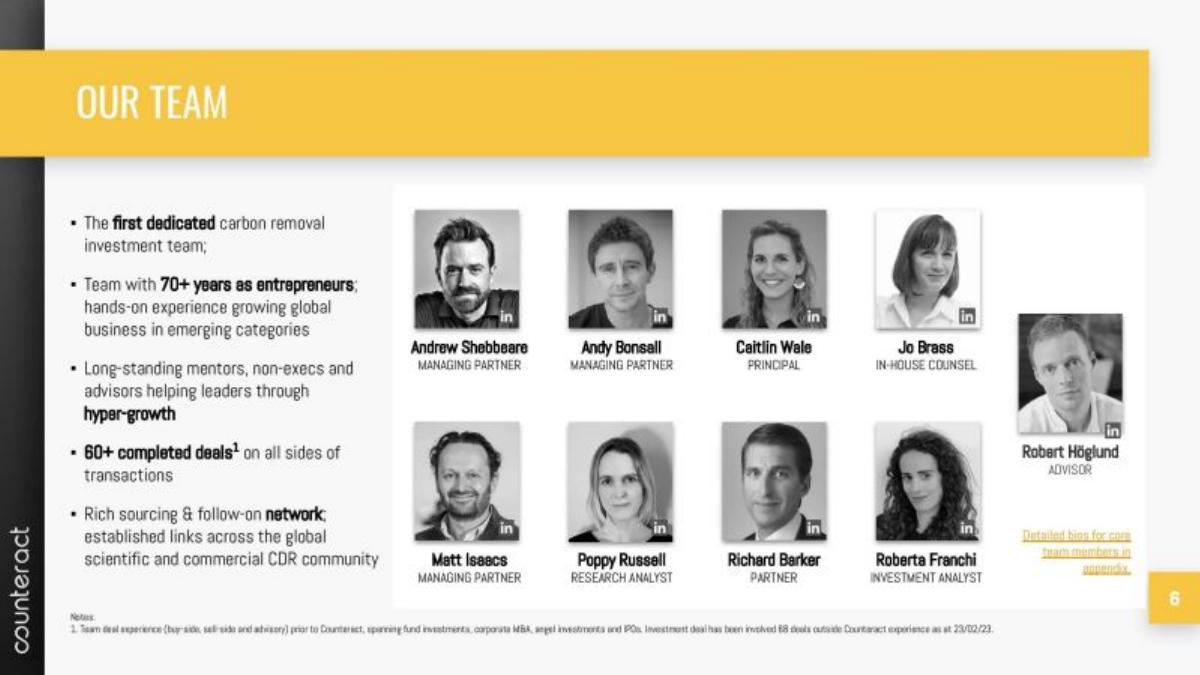
- The team emphasizes 70+ years of entrepreneurial experience and 60+ completed deals to establish credibility in a technical sector (Slide 6).
- Investment pathways are clearly mapped across six categories: Oceans, Forests, Soil, Biomass, Direct Air Capture, and Rocks (Slide 7).
- The deck provides a transparent look at their dealflow funnel, showing 400+ evaluated deals leading to 12 investments (Slide 10).
- A unique 'carry tied to CO2e impact' model is mentioned, aligning GP incentives with the fund's environmental mission (Slide 9).
- The portfolio slide lists 12 specific companies, including names like Adaptavate, Mote, and Vesta, providing tangible proof of their thesis (Slide 11).
The Anatomy of a Thematic Climate Fund Deck
Counteract’s 12-slide deck is a masterclass in thematic fund positioning. In an era where 'Climate Tech' has become a broad and sometimes diluted term, Counteract narrows its focus to Carbon Dioxide Removal (CDR). This teardown examines how they used this specialization to raise $42M for their first fund, Counteract One.
Slide 1: Title and Context
The cover slide is minimalist, titled 'Counteract One.' It includes a specific note: 'For information only, shared with Business Insider February 2023.' This indicates the deck was used during a period of high-profile fundraising and public relations efforts. The branding is clean, utilizing a high-contrast yellow and white palette that persists throughout the presentation.
Slide 2: Legal Disclaimers
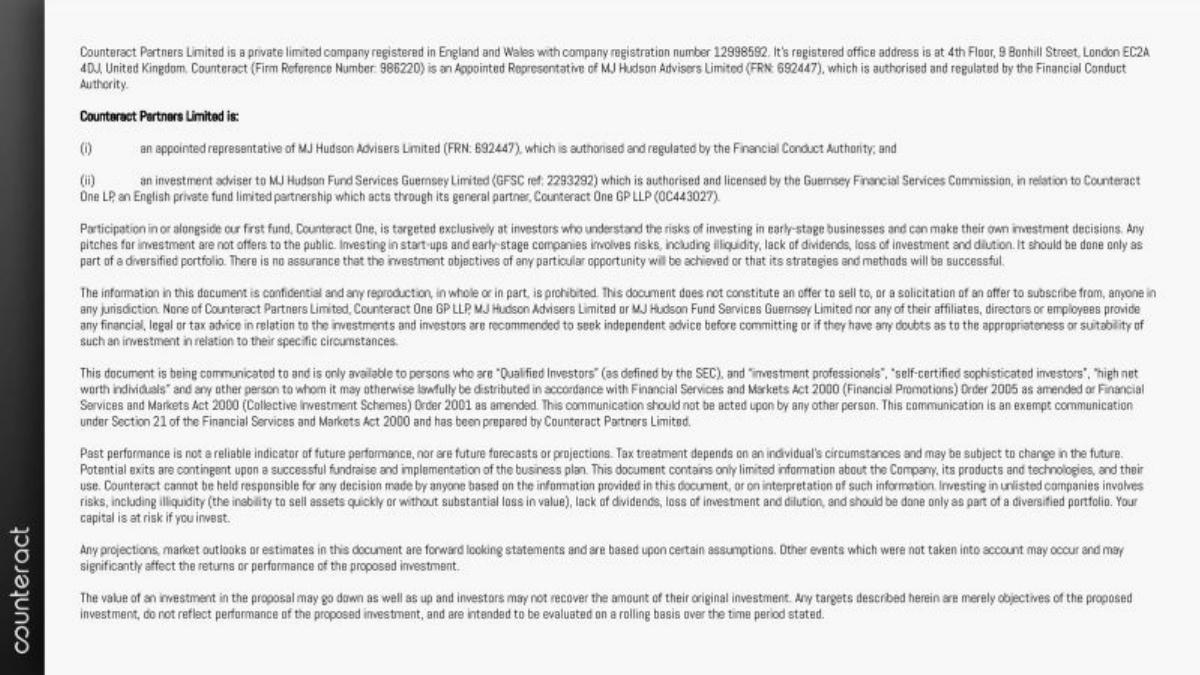
As a venture capital fund deck, Slide 2 is a dense legal disclaimer. It identifies Counteract Partners Limited as an appointed representative of MJ Hudson Advisers Limited, authorized and regulated by the Financial Conduct Authority (FCA). It explicitly states that the fund is targeted at 'Qualified Investors' and 'Investment Professionals,' emphasizing the regulatory compliance required for private fund marketing in the UK and EU.
Slide 3: The Executive Summary
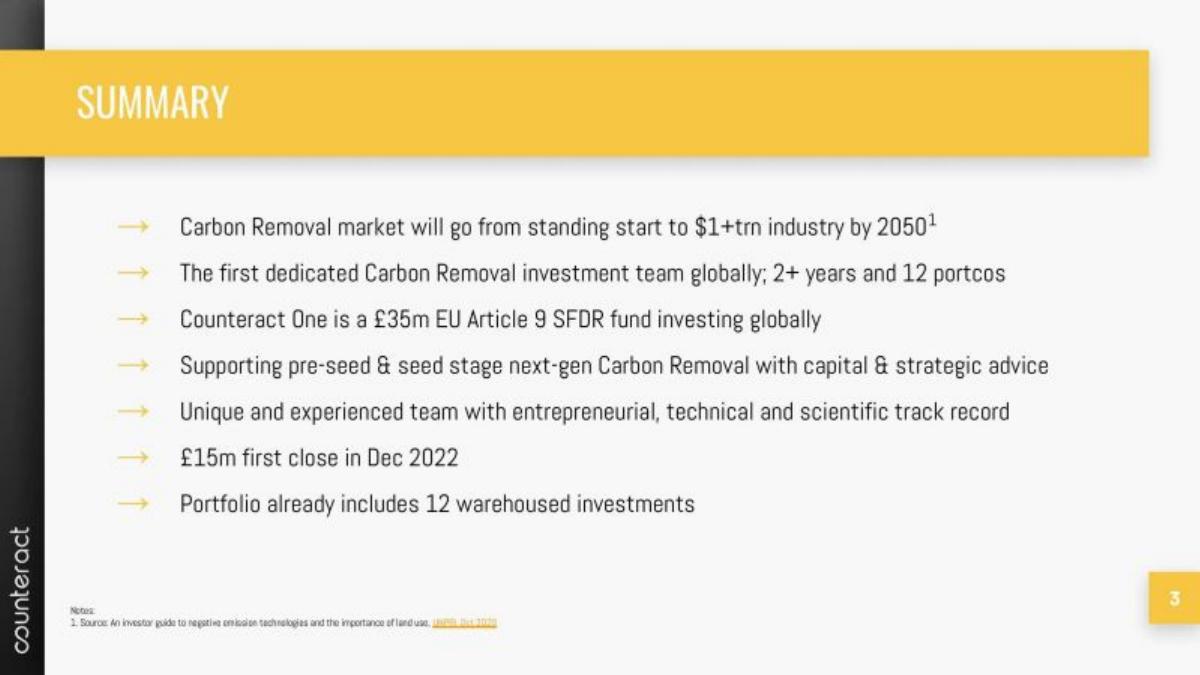
Slide 3 serves as a high-level summary of the fund’s value proposition. It hits several critical data points immediately:
The Carbon Removal market is projected to be a $1+trn industry by 2050 . · The team claims to be the first dedicated Carbon Removal investment team globally . · The fund is a £35m EU Article 9 SFDR fund (though the catalogue facts indicate they ultimately raised $42M). · They achieved a £15m first close in Dec 2022 . · The portfolio already contains 12 warehoused investments .
This slide is effective because it answers the 'Why now?' (market size), 'Why us?' (first dedicated team), and 'Is this real?' (warehoused deals and first close) questions in one view.
Slide 4: The North Star Metric
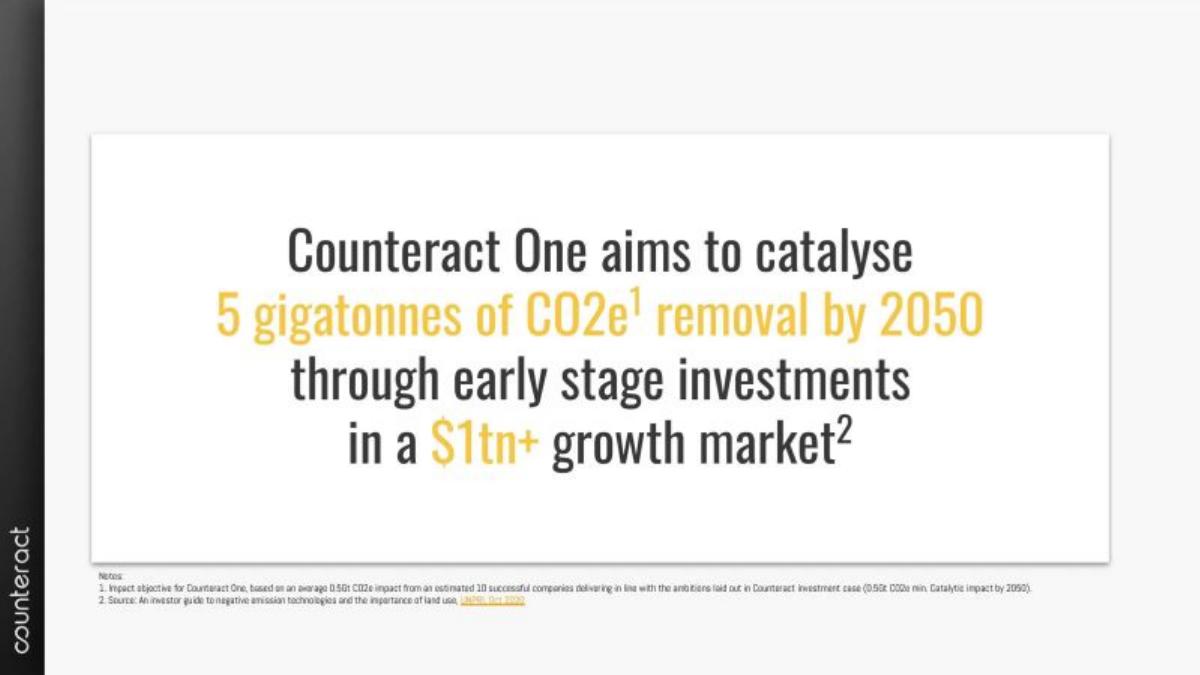
Slide 4 is a 'vision' slide. It states a singular, bold goal: 'Counteract One aims to catalyse 5 gigatonnes of CO2e removal by 2050 through early stage investments in a $1tn+ growth market.' By quantifying their impact goal (5Gt), they move beyond vague sustainability claims into measurable climate science. Footnote 1 clarifies this is based on an average 0.5Gt impact from 10 successful companies.
Slide 5: The Market Gap (The 'Why')
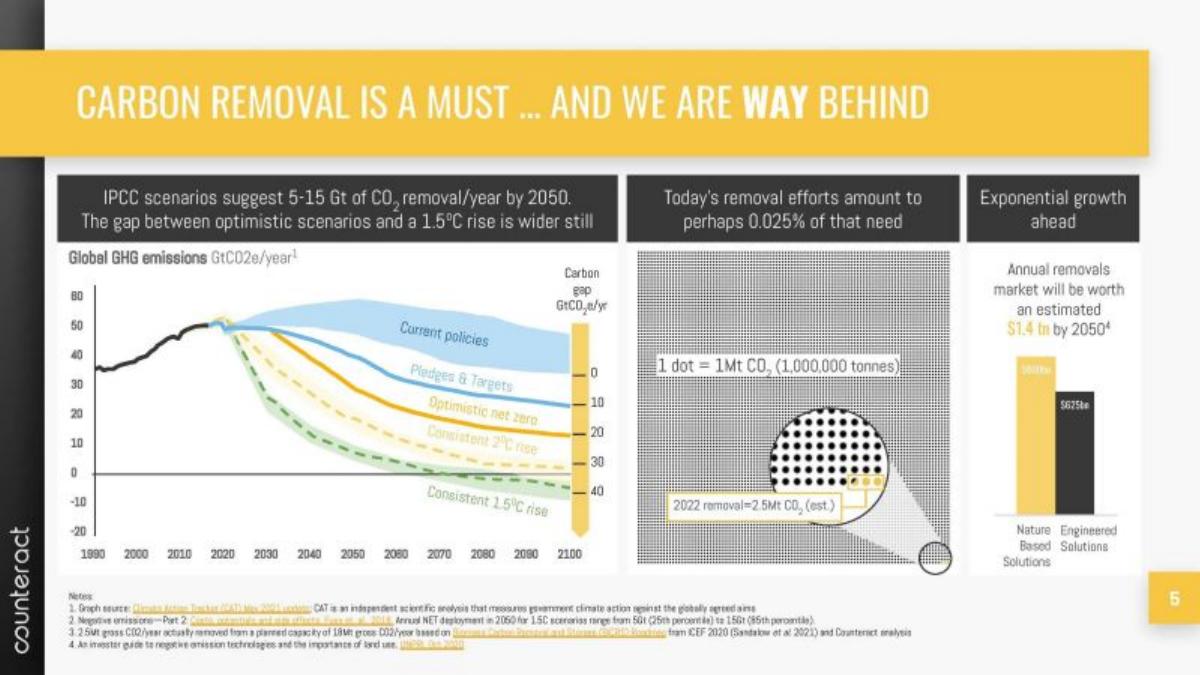
This slide uses IPCC scenarios to illustrate the 'Carbon Gap.' It shows that current policies and pledges are insufficient to meet 1.5°C or even 2°C targets. The most striking visual is the 'Today’s removal efforts' box, where a single dot represents 1Mt of CO2. The 2022 removal is estimated at 2.5Mt, which the slide notes is only 0.025% of the total need . This creates a powerful sense of urgency and a clear 'undersupplied' market signal for investors.
Slide 6: The Team
The team slide emphasizes experience over just academic credentials. They highlight 70+ years as entrepreneurs and 60+ completed deals . The team is led by Managing Partners Andrew Shebbeare, Andy Bonsall, and Matt Isaacs. The inclusion of an In-House Counsel (Jo Brass) and a Research Analyst (Poppy Russell) suggests a fund that is built for operational and technical rigor, not just capital deployment.
Slide 7: The Investment Universe
Slide 7 provides a visual taxonomy of the CDR sector. They categorize their 'Pathways Open for Investment' into six buckets: Oceans, Forests, Soil, Biomass, Direct Air Capture, and Rocks . Under each bucket, they list specific technologies like 'Alkalinization,' 'Biochar,' and 'Accelerated weathering.' This demonstrates to LPs that the fund has a comprehensive map of a complex technical landscape.
Slide 8: Deep Dive Theses
To further prove their expertise, Slide 8 offers 'Example Investment Theses' for Soil and Direct Air Capture (DAC). For Soil, they identify 'Current MRV (Monitoring, Reporting, and Verification) expensive or inaccurate' as a key insight. For DAC, they note that 'Full system mass-energy balance considerations' are required. This level of detail is designed to reassure LPs that the GPs understand the technical hurdles of the companies they back.
Slide 9: Investment Approach and Principles
This slide outlines the 'Guiding Investment Principles.' Key takeaways include:
Stage: Seed/pre-seed. · Geography: Global focus with European tilt. · Incentives: Carry tied to CO2e impact. · Compliance: SFDR Article 9 and PRI alignment.
The mention of 'Carry tied to CO2e impact' is a sophisticated LP-GP alignment tool that is becoming a gold standard in impact investing.
Slide 10: The Dealflow Funnel
Slide 10 is perhaps the most important slide for institutional LPs. it shows the 'Broadly Sourced Dealflow' from Feb '21 to Nov '22. 400+ deals were evaluated , 210+ qualified, 49 validated, 16 diligenced, and 12 invested. It also breaks down origination sources (43% Community, 17% Accelerators) and why deals were declined (56% failed the 'Self-sustaining' criteria). This transparency builds immense trust in the fund's discipline.
Slide 11: The Current Portfolio
The final content slide lists the 12 companies already in the portfolio. This includes:
Adaptavate: Drop-in replacement for Gypsum plasterboard. · Mote: Waste biomass to carbon negative hydrogen. · Vesta: Using coastal systems to weather carbon-removing sand. · Parallel Carbon: DAC solution combining mineral carbonation with electrochemistry.
By showing the actual companies, Counteract moves from theory to practice, proving they can win deals in a competitive, technical market.
What Counteract Does Well
Counteract’s deck is exceptionally strong in its thematic clarity . They do not try to be everything to everyone; they are the 'Carbon Removal' fund. This specificity allows them to use technical language and metrics (Gt of CO2e, MRV, SFDR Article 9) that would be out of place in a generalist deck but are highly persuasive to sophisticated climate LPs.
The transparency of the dealflow funnel (Slide 10) is a standout feature. Most first-time funds struggle to prove they have a 'proprietary' edge. By showing exactly where their 400+ leads came from and why they rejected most of them, Counteract demonstrates a professionalized investment process that rivals much larger, established firms.
What is Missing
While the deck is excellent for a fund raise, it omits a few key financial details often requested by LPs:
Fund Terms: There is no mention of management fees or the specific hurdle rate, though 'carry tied to impact' is noted. · Target Returns: While the market size is mentioned, there are no explicit target IRRs or multiples for the fund. · Exit Strategy: The deck focuses heavily on the 'entry' and 'impact' but does not detail how these early-stage CDR companies will eventually reach liquidity (e.g., strategic M&A from oil majors or IPOs).
What Founders and GPs Should Copy
1. The 'Warehoused Deal' Strategy: If you are raising a fund, having 10-12 deals already 'in the bag' (or at least identified and terms agreed) is the single best way to close LPs. It turns a 'vision' into a 'product.'
2. Quantified Impact: Don't just say you want to save the planet. Counteract’s '5 gigatonnes by 2050' gives LPs a specific number to track. This makes the impact feel as rigorous as the financial return.
3. The Taxonomy Slide: Slide 7 (Pathways Open for Investment) is a brilliant way to educate the investor while simultaneously proving your expertise. It frames the entire sector through the GP's lens, making it harder for the LP to look at competitors who don't have as clear a map.
Frequently asked questions
- What is the specific investment stage for Counteract One?
- According to Slide 3 and Slide 9, Counteract One focuses on pre-seed and seed stage investments. They position themselves as providers of both capital and strategic advice for next-generation carbon removal technologies, aiming to be the first institutional check for founders in this specialized niche.
- How does Counteract measure its success beyond financial returns?
- The fund has a stated impact objective to catalyse 5 gigatonnes of CO2e removal by 2050 (Slide 4). This is further institutionalized by tying the General Partners' carry (performance fees) to these CO2e impact targets and maintaining SFDR Article 9 status, which requires sustainable investment as a core objective (Slide 9).
- What does the 'warehoused investments' mention mean for LPs?
- Slide 3 and Slide 10 note that the portfolio already included 12 'warehoused' investments. For Limited Partners (LPs), this reduces 'blind pool' risk. Instead of betting solely on the team's future ability to find deals, LPs can see the exact companies they are already buying into, such as those listed on Slide 11.
- How technical is the team's background?
- While the deck highlights 70+ years of entrepreneurial experience, it also emphasizes scientific and technical track records. Slide 6 lists specific roles like 'Research Analyst' and 'Advisor' (Robert Höglund), and Slide 8 demonstrates deep technical 'Key Insights' into Soil and Direct Air Capture (DAC) pathways.
- What is the geographic focus of the fund?
- Slide 9 states the fund has a 'Global focus with European tilt.' This is reflected in the dealflow metrics on Slide 10, which show a significant portion of validated deals originating from the United Kingdom and Europe, though they also track opportunities in the US, Canada, and Israel.