DispatchHealth’s 2021 Series D deck is a masterclass in high-level narrative and market validation. Raising $200 million for a mobile healthcare platform requires proving that you aren't just a 'doctor on wheels' but a systemic solution to the $4 trillion unsustainable healthcare spend. The deck focuses heavily on the shift from facility-based care to the home, citing a $140 billion addressable in-home market. By highlighting a 174% revenue CAGR and a Net Promoter Score of 96, DispatchHealth demonstrates both rapid scale and extreme customer satisfaction—a rare combination in healthcare. Whil…
Key takeaways
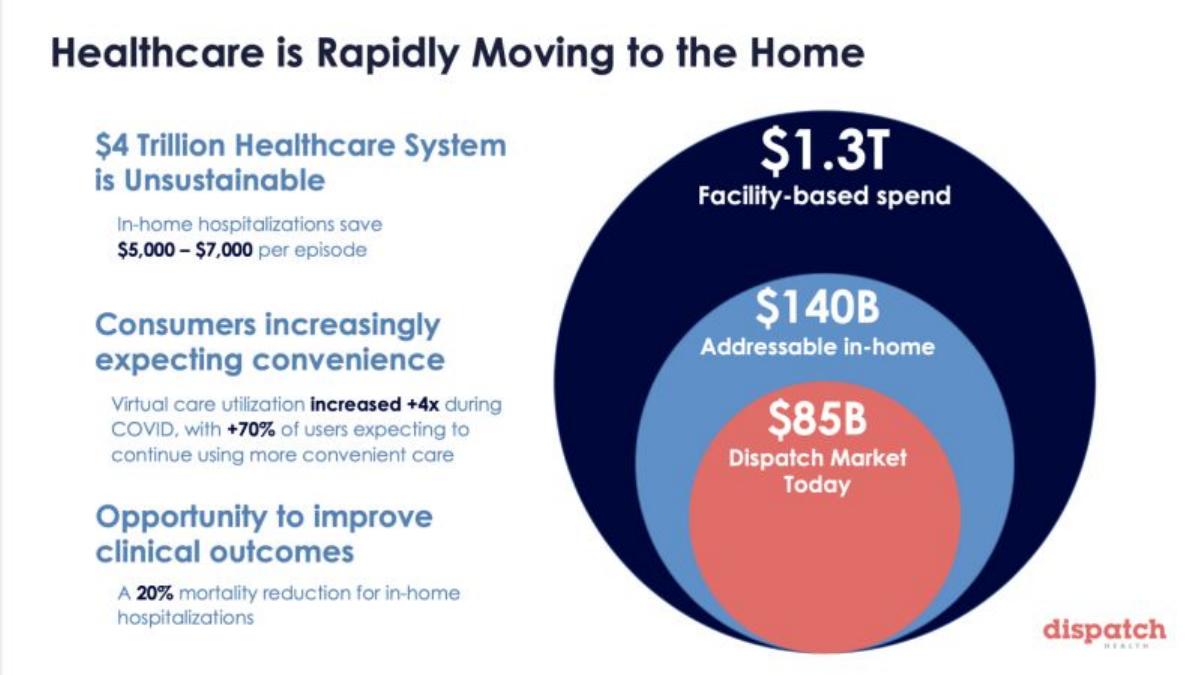
- The company identifies a $1.3 trillion facility-based spend as the primary target for disruption on slide 3.
- DispatchHealth claims in-home hospitalizations save between $5,000 and $7,000 per episode (slide 3).
- Clinical outcomes are a core value prop, with the deck citing a 20% mortality reduction for in-home hospitalizations on slide 3.
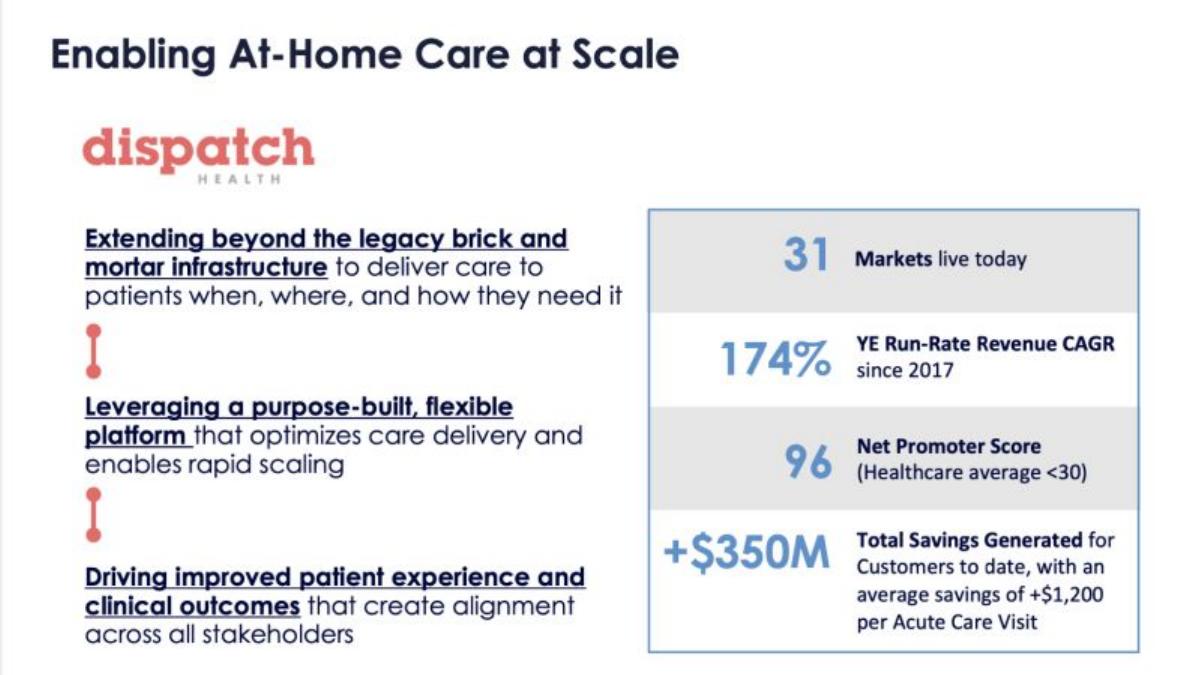
- The company reported a 174% Year-End Run-Rate Revenue CAGR since 2017 as of the 2021 deck (slide 4).
- Customer satisfaction is exceptionally high for the sector, with a Net Promoter Score of 96 compared to a healthcare average of less than 30 (slide 4).
- As of the presentation, the service was live in 31 markets (slide 4).
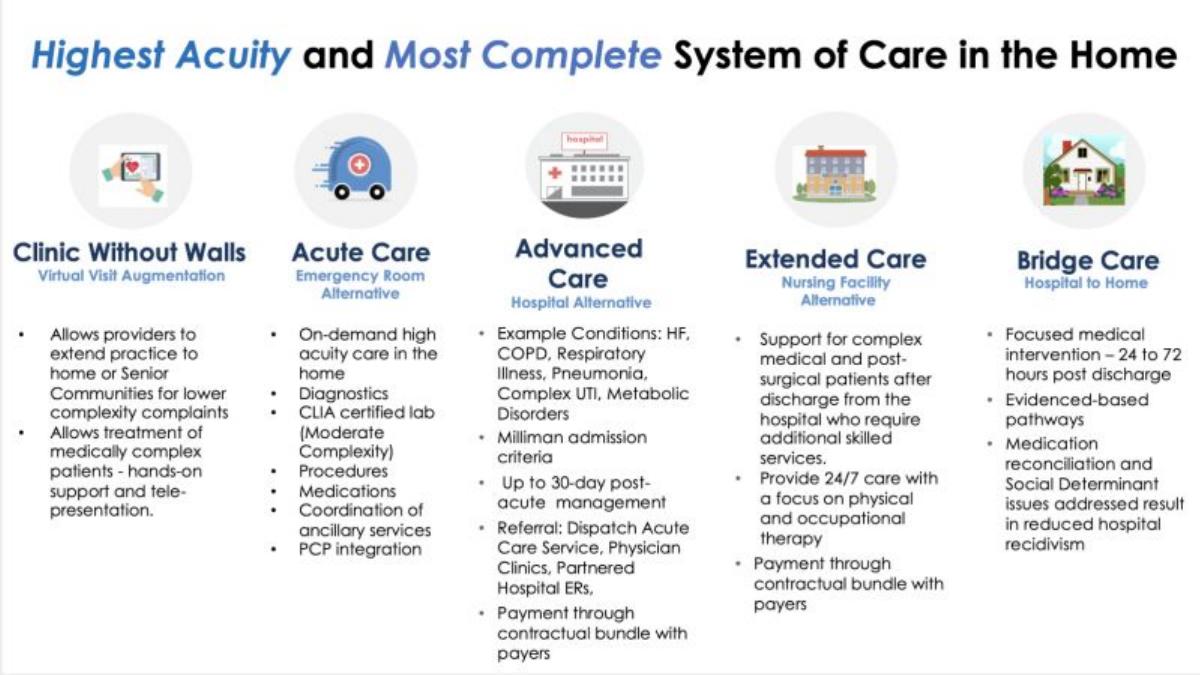
- The business model spans five distinct care tiers, ranging from 'Clinic Without Walls' to 'Bridge Care' (slide 5).
- Total savings generated for customers to date exceeded $350 million at the time of the raise (slide 4).
The High-Acuity Home Care Narrative
DispatchHealth’s Series D deck is a concise, 6-slide presentation that focuses on the macro-economic shift in American healthcare. In 2021, following the surge in virtual care utilization during the COVID-19 pandemic, the company sought $200 million to solidify its position as the leader in high-acuity in-home care. The deck does not get bogged down in technical specifications; instead, it focuses on the massive cost savings and superior patient outcomes that come from bypassing traditional brick-and-mortar hospitals.
Slide 1: Title and Mission
The opening slide features a high-resolution photograph of two elderly women, immediately signaling the primary demographic for high-utilization healthcare. The headline, "Home is Where Your Health is," is supported by the sub-headline: "Transforming the Facility-Based Care Model." This establishes the company’s adversarial but constructive relationship with traditional hospitals—they aren't just a supplement; they are a transformation of the existing model.
Slide 2: The Vision
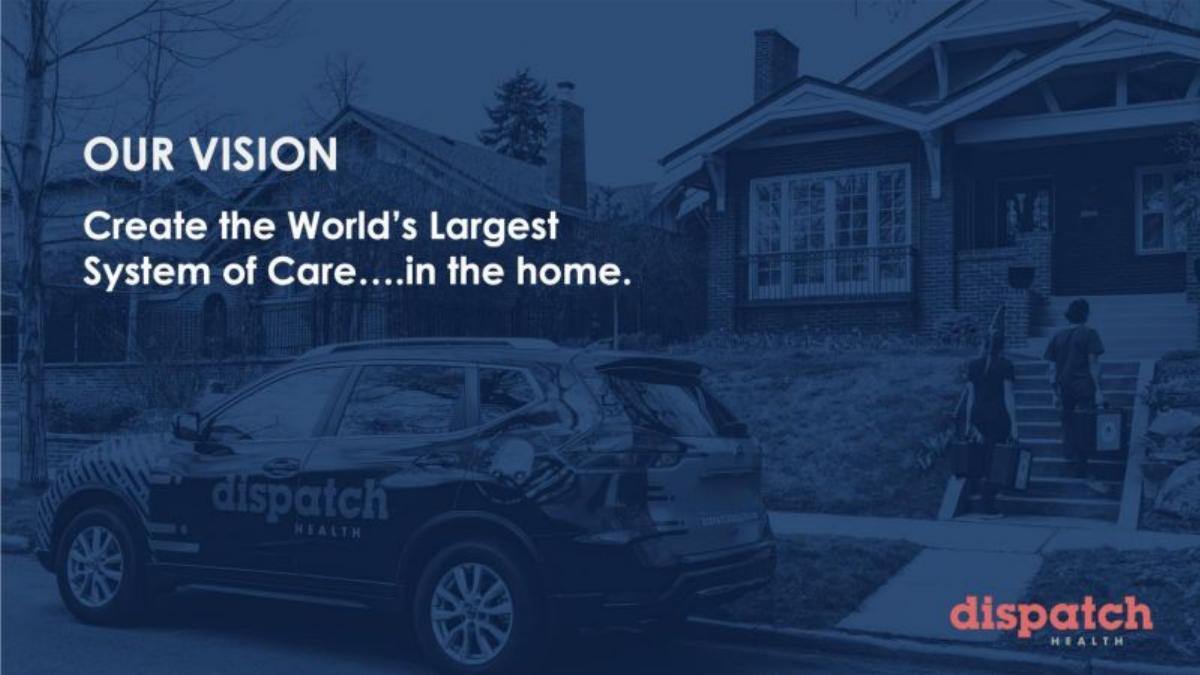
Slide 2 presents a clear, ambitious vision statement: "Create the World’s Largest System of Care....in the home." The background image shows a DispatchHealth branded vehicle parked in front of a residential home with two healthcare professionals carrying equipment up the stairs. This visual reinforces the 'mobile' aspect of their service, distinguishing them from pure-play software telehealth companies. It emphasizes that they bring the physical tools of the hospital to the patient's door.
Slide 3: Market Opportunity and Macro Trends
This is the 'Why Now' and 'How Big' slide. DispatchHealth identifies the "$4 Trillion Healthcare System" as "Unsustainable." They provide three compelling data points to support their model:
In-home hospitalizations save $5,000 – $7,000 per episode. · Virtual care utilization increased +4x during COVID , with over 70% of users expecting to continue using convenient care. · A 20% mortality reduction for in-home hospitalizations, proving that the model is safer, not just cheaper.
The right side of the slide uses a concentric circle diagram to visualize the market. It starts with the $1.3T Facility-based spend , narrows to a $140B Addressable in-home market, and identifies the "Dispatch Market Today" as $85B . This is a sophisticated way of showing that while they are currently targeting a specific $85B niche, the total ceiling for their disruption is over a trillion dollars.
Slide 4: Traction and Scaling Metrics
Slide 4, titled "Enabling At-Home Care at Scale," provides the hard evidence that the model works. The company lists four key performance indicators:
31 Markets live today: Demonstrating geographic footprint. · 174% YE Run-Rate Revenue CAGR since 2017: Proving explosive growth leading up to the Series D. · 96 Net Promoter Score: This is a staggering figure, especially when the slide notes the "Healthcare average <30." It suggests that patients significantly prefer this model to traditional ER or clinic visits. · +$350M Total Savings Generated for Customers: This is the 'killer stat' for insurance companies and payers, noting an average savings of +$1,200 per Acute Care Visit.
Slide 5: The System of Care
This slide explains the product depth. DispatchHealth isn't just one service; it is five. They categorize their offerings to show how they cover the entire patient journey:
Clinic Without Walls: Virtual visit augmentation for lower complexity. · Acute Care: An ER alternative providing on-demand high-acuity care, including diagnostics and a CLIA certified lab. · Advanced Care: A hospital alternative for complex conditions like COPD and pneumonia, offering up to 30-day post-acute management. · Extended Care: A nursing facility alternative for post-surgical patients, providing 24/7 care and physical therapy. · Bridge Care: A 24 to 72-hour post-discharge medical intervention to reduce hospital recidivism.
By detailing these, DispatchHealth proves they can handle "Highest Acuity" cases, which is where the majority of healthcare spending occurs.
Slide 6: Source Attribution
The final slide is a promotional slide for the source of the deck, bestpitchdeck.com, and does not contain company-specific information.
What DispatchHealth Does Well
The deck is exceptionally strong at value quantification . In healthcare, the 'customer' is often the payer (insurance) rather than the patient. By citing specific dollar savings per episode ($5k-$7k) and total savings to date ($350M+), DispatchHealth speaks directly to the bottom line of their most important stakeholders. Furthermore, the use of the Net Promoter Score (96) is a brilliant way to quantify 'patient experience,' which is often a nebulous concept in pitch decks.
What is Missing from the Deck
As a 6-slide excerpt of a Series D deck, several critical components are omitted:
Team Slide: There is no mention of the founders, medical directors, or executive leadership. At Series D, investors want to see a world-class management team capable of handling massive regulatory and operational complexity. · The Ask: The deck does not explicitly state the $200M figure or how the funds will be allocated (e.g., market expansion, technology R&D, or hiring). · Unit Economics: While they show revenue growth and customer savings, they do not show their own margins. Investors would want to see the cost of dispatching a vehicle and medical team versus the reimbursement rate. · Competition: There is no competitive landscape slide. While they mention 'facility-based care' as the incumbent, they don't address other home-health startups or traditional home-health agencies moving into high-acuity care.
What Founders Should Copy
Founders should emulate the concentric circle market sizing on slide 3. Many founders present a 'TAM' that feels inflated and disconnected from their actual product. DispatchHealth starts with the massive problem ($1.3T) but then honestly narrows it down to the $85B market they can actually serve today. This builds credibility with sophisticated investors. Additionally, the clear categorization of service tiers on slide 5 is a great way to show a 'platform' play. Instead of saying 'we do everything,' they show five specific products that together form a comprehensive system.
Final Thoughts
DispatchHealth’s deck is a 'momentum deck.' It relies on the sheer scale of the opportunity and the proven velocity of their growth to tell the story. For a Series D, the goal is often to prove that the 'machine' works and just needs more fuel (capital) to expand into every major market. With 31 markets already live and a 174% CAGR, this deck provides exactly the kind of evidence a growth-stage investor requires.
Frequently asked questions
- What is the primary problem DispatchHealth is solving?
- According to slide 3, DispatchHealth is addressing the 'unsustainable' $4 trillion healthcare system. Specifically, they target the $1.3 trillion spent on facility-based care. By moving high-acuity care into the home, they aim to reduce costs by $5,000 to $7,000 per episode while improving clinical outcomes, such as a 20% reduction in mortality.
- How does DispatchHealth differentiate its service offerings?
- Slide 5 outlines a five-tier system of care. This includes 'Clinic Without Walls' (virtual augmentation), 'Acute Care' (ER alternative), 'Advanced Care' (hospital alternative for conditions like COPD and pneumonia), 'Extended Care' (nursing facility alternative), and 'Bridge Care' (hospital-to-home transition). This breadth allows them to handle higher complexity than standard telehealth providers.
- What are the key growth metrics shown in the deck?
- The deck highlights three primary growth and performance metrics on slide 4: presence in 31 markets, a 174% year-end run-rate revenue CAGR since 2017, and over $350 million in total savings generated for customers. These figures demonstrate both geographic expansion and significant financial impact for payers.
- What is the 'Dispatch Market Today' according to their analysis?
- On slide 3, the company uses a nested circle diagram to define their market. They identify the 'Dispatch Market Today' as an $85 billion opportunity. This sits within a larger $140 billion 'Addressable in-home' market, which itself is a subset of the $1.3 trillion 'Facility-based spend'.
- Who are the target customers for DispatchHealth?
- While the deck features images of elderly patients (slide 1), the catalogue facts state they cater to individuals of all ages. Slide 5 indicates their 'customers' are often payers or health systems, as they mention 'contractual bundles with payers' and generating $350M+ in savings for these entities.