Diversiteam’s pitch deck is a brief, six-slide presentation that positions the company as a global marketplace for vetted engineering talent. The narrative centers on the talent shortage in Singapore and the broader demand for specialized roles like AI, Machine Learning, and IoT. With a stated pool of over 1,300 engineers, the company emphasizes a rigorous vetting process involving 21 metrics and external reference checks via 'robin.' While the deck effectively showcases the product interface and the scale of its current talent pool, it is notably missing critical investor information, includ…
Key takeaways
- The company identifies a specific talent shortage in Singapore, citing ManpowerGroup data that it is at its highest since 2008 (Slide 2).
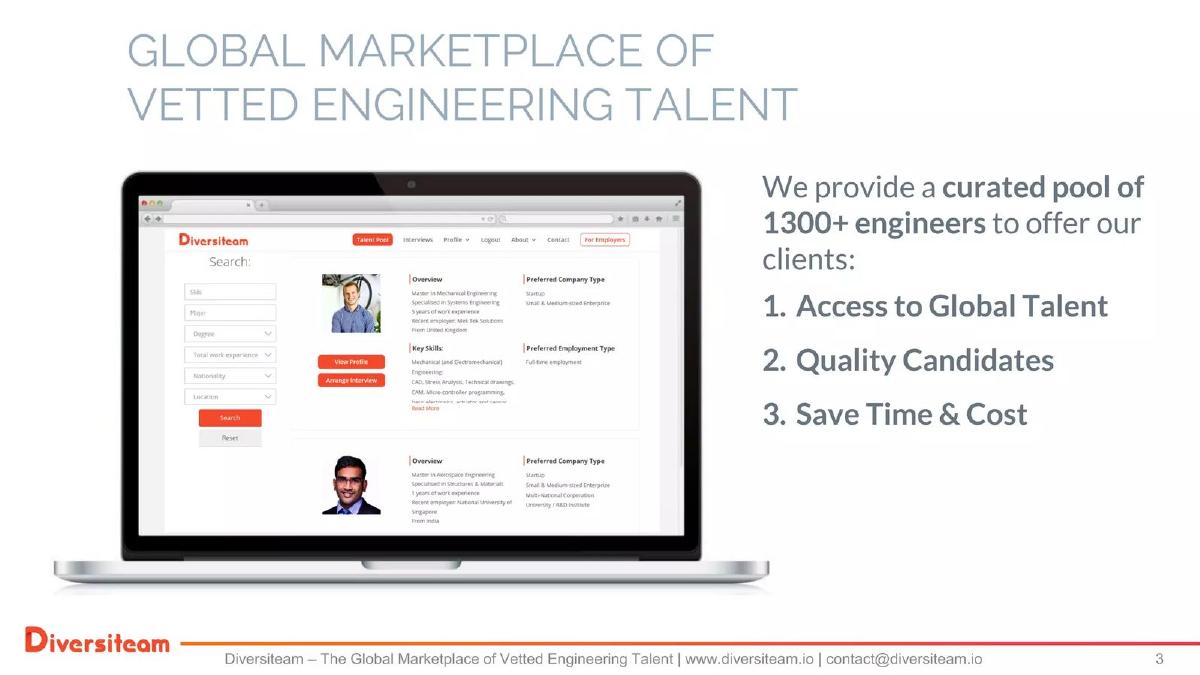
- Diversiteam claims a curated pool of 1,300+ engineers available to their clients (Slide 3).
- The platform targets high-demand technical roles including Software Development, AI, Machine Learning, VR/AR, and IoT (Slide 2).
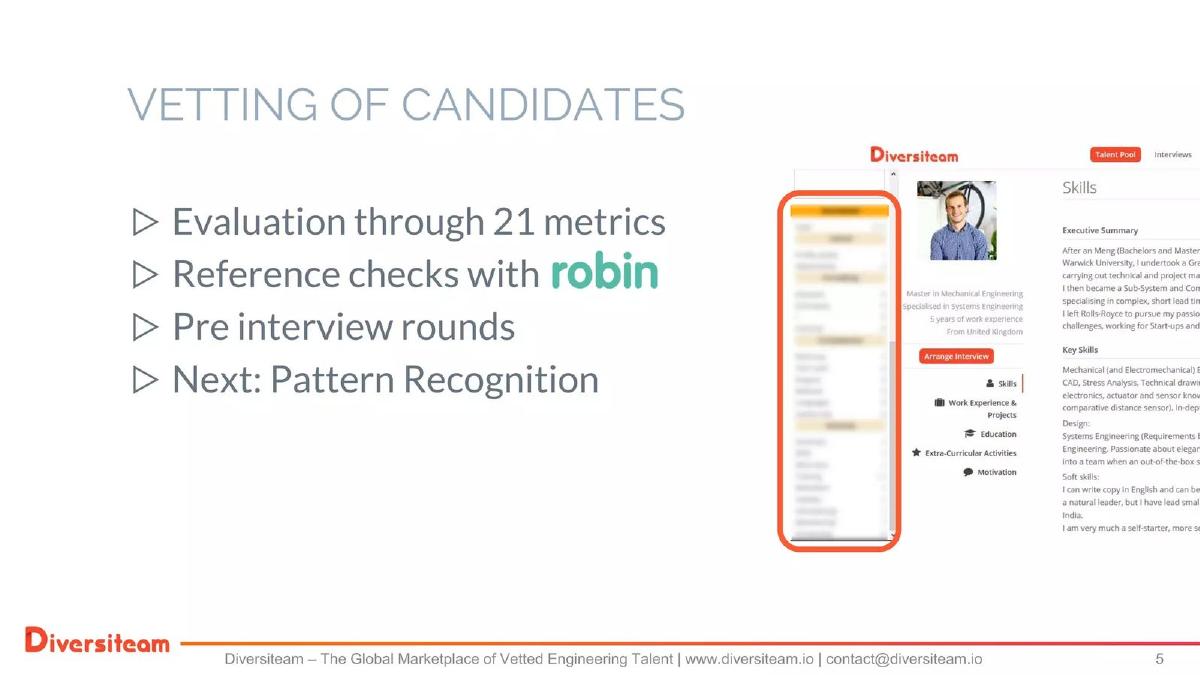
- Candidate vetting is performed through 21 distinct metrics and pre-interview rounds (Slide 5).
- The deck utilizes external validation for reference checks through a partner or tool named 'robin' (Slide 5).
- Future product development plans include the implementation of pattern recognition for candidate evaluation (Slide 5).
- The presentation lacks essential fundraising components such as a team overview, revenue model, and funding requirements (Slides 1-6).
Diversiteam Pitch Deck Analysis
The Diversiteam pitch deck is a minimalist, 6-slide presentation that focuses heavily on the product interface and the immediate problem of technical talent scarcity. Published around 2019, the deck positions the company as a bridge between emerging markets and global engineering needs. While it succeeds in demonstrating that a functional platform exists with an active user base, it leaves many strategic questions unanswered for a professional investor.
Slide 1: Title Slide
The title slide establishes the company's core value proposition: "Connecting emerging markets with global engineering talent." The branding is clean, featuring a high-resolution image of a diverse professional team, which aligns with the company name. The logo is prominent, and the sub-headline clearly defines the sector (HR Tech/Recruitment) and the specific niche (Engineering).
Slide 2: The Problem
Slide 2, titled "Companies' Challenge," focuses on the difficulty of finding competent engineering talent. The slide uses a specific data point to anchor the problem: "Singapore's talent shortage is at its highest since 2008," attributing the stat to ManpowerGroup. By narrowing the geographic focus to Singapore, the deck suggests a beachhead market strategy. It also lists specific "in demand roles" that the platform addresses: Software Development, AI & Machine Learning, VR / AR, and IoT. This slide effectively creates urgency by highlighting a decade-high scarcity in high-value technical fields.
Slide 3: The Solution and Marketplace
This slide introduces the "Global Marketplace of Vetted Engineering Talent." It features a laptop mockup showing the platform's search interface. Key features visible in the UI include filters for skills, major, degree, nationality, and location. The slide claims a "curated pool of 1300+ engineers." The three primary benefits listed for clients are access to global talent, quality candidates, and savings in time and cost. This is a standard marketplace pitch, emphasizing supply-side scale and quality control.
Slide 4: Product Deep Dive (Candidate Profile)
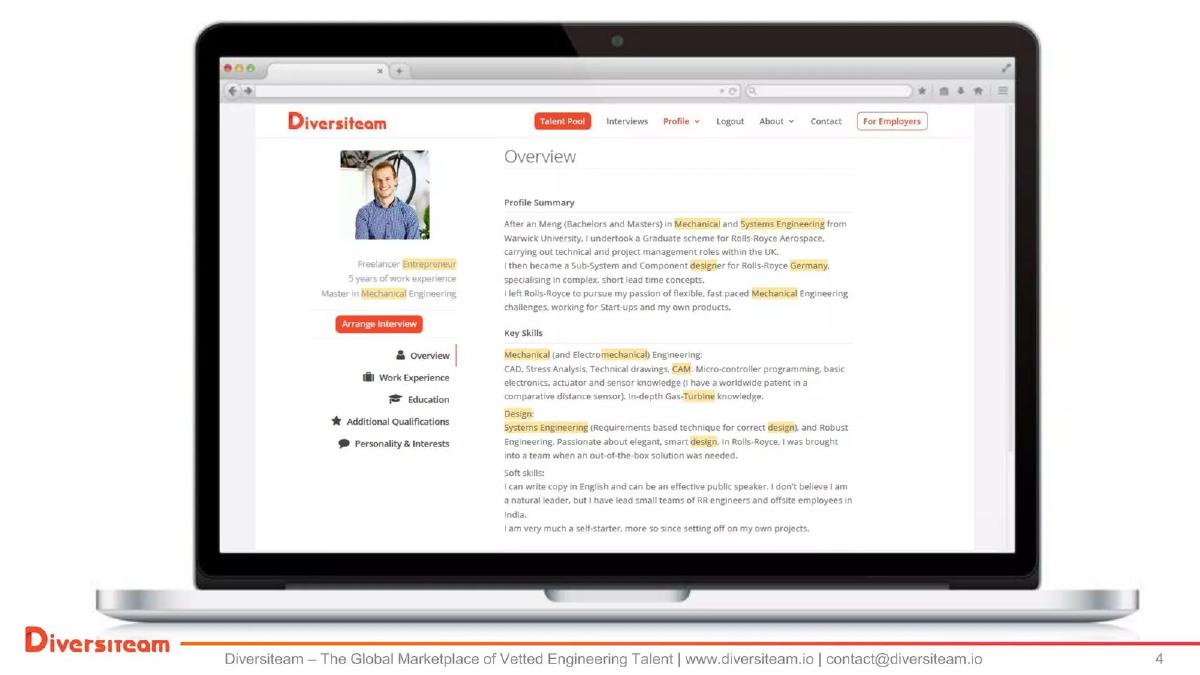
Slide 4 provides a closer look at a specific candidate profile within the platform. The UI displays a comprehensive overview including a profile summary, key skills (highlighting Mechanical and Systems Engineering), work experience, education, and even "Personality & Interests." This slide is intended to prove the depth of data Diversiteam collects on its talent. It shows that the platform isn't just a list of names, but a rich database that allows employers to make informed decisions before an interview is even arranged.
Slide 5: Vetting Process
One of the most critical slides for a recruitment marketplace is the vetting explanation. Diversiteam outlines a four-step process: evaluation through 21 metrics, reference checks using a tool or service called "robin," pre-interview rounds, and a future roadmap item ("Next: Pattern Recognition"). By quantifying the metrics (21) and mentioning external validation (robin), the company attempts to build trust in their "vetted" claim. However, the slide does not detail what those 21 metrics actually are, which is a common omission in early-stage decks.
Slide 6: Call to Action
The final slide is a standard contact page with the slogan "Let's get future-ready for tomorrow's global economy!" It provides an email address and a URL for employers. Notably, it does not include a "thank you" or a summary of the investment opportunity, reinforcing the feeling that this deck may have been used for sales as much as for fundraising.
What Diversiteam Does Well
The deck is visually consistent and avoids the clutter that plagues many early-stage presentations. By focusing on a specific geographic pain point (Singapore) and specific technical niches (AI, IoT), the founders demonstrate an understanding of where the highest margins in recruitment likely exist. The inclusion of actual product screenshots (Slides 3 and 4) is a strong move, as it proves the startup has moved past the ideation phase and has a working MVP (Minimum Viable Product) capable of handling 1,300+ profiles.
Specific Problem Anchoring: Using a ManpowerGroup statistic provides immediate credibility to the "talent shortage" claim. · Product Transparency: Showing the actual search and profile UI helps investors visualize the user journey for the employer. · Supply Metrics: Stating a specific number of engineers (1,300+) gives a sense of the company's current traction and scale.
What is Missing from the Deck
As a fundraising tool, this deck is significantly incomplete. It functions more as a product teaser than a comprehensive business case. The most glaring omissions include:
The Team Slide: Investors back people, especially at the early stage. There is no information regarding who the founders are or why they are qualified to build a global engineering marketplace. · Business Model: The deck never explains how Diversiteam makes money. Is it a percentage of the first year's salary? A subscription fee for access to the database? A flat fee per hire? This is a fundamental requirement for any pitch. · Market Size: While the deck mentions a talent shortage, it doesn't quantify the Total Addressable Market (TAM). Investors need to know if this is a billion-dollar opportunity or a small boutique agency. · Competition: The recruitment space is incredibly crowded (LinkedIn, Hired, Toptal, etc.). Diversiteam fails to mention how it differs from these incumbents. · The Ask: There is no mention of how much money is being raised, the valuation, or what the milestones will be once the capital is deployed.
Founder Takeaways
Founders can learn two distinct lessons from the Diversiteam deck. First, the value of brevity and visual clarity. You don't need 40 slides to explain what your product does. Second, the danger of being too product-focused. A pitch deck is not a user manual; it is a document meant to sell a business opportunity. If you use this deck as a template, you must add the "missing" sections mentioned above to be taken seriously by venture capital firms. Specifically, ensure you have a slide dedicated to your unique insights into the market and a slide that introduces your team's "unfair advantage."
Final Verdict: This is a solid product overview that lacks the financial and strategic depth necessary for a successful seed or Series A fundraise. It serves as a good example of how to present a clean UI, but a poor example of how to structure a complete investment narrative.
Frequently asked questions
- What is the primary problem Diversiteam aims to solve?
- Diversiteam addresses the difficulty companies face in finding competent engineering talent. Slide 2 specifically highlights the talent shortage in Singapore, which reached a post-2008 peak, and lists in-demand roles like AI, Machine Learning, and IoT that are particularly hard to fill through traditional means.
- How does Diversiteam vet its engineering talent?
- According to Slide 5, the vetting process is four-fold: evaluation through 21 specific metrics, reference checks conducted with 'robin,' multiple pre-interview rounds, and a planned future integration of pattern recognition technology to further refine candidate selection.
- What is the current scale of Diversiteam's marketplace?
- Slide 3 states that Diversiteam provides a curated pool of over 1,300 engineers. The slide suggests this scale allows them to offer clients access to global talent, quality candidates, and savings in both time and recruitment costs.
- What information is missing from the Diversiteam pitch deck?
- The deck is missing several standard components required for a professional fundraise. There is no slide introducing the founding team, no explanation of the business model or pricing, no market size analysis, no competitor comparison, and no financial ask or use of funds.
- Who is the target audience for this deck?
- Given the inclusion of a 'For Employers' button in the UI screenshots (Slide 3 and 4) and the focus on talent shortages, this deck appears to be a hybrid between a sales presentation for potential clients and an early-stage investor teaser.