Dispatchr’s 16-slide deck from 2015 is a visually driven presentation that prioritizes emotional resonance and market urgency over granular data. By using stark imagery of wildfires and destroyed neighborhoods, the founders establish a high-stakes problem: the vulnerability of the power grid. The deck successfully positions the company as a bridge between 'Geospatial Data' and 'Field Prevention,' supported by a massive $78 billion market claim and an $8 million sales pipeline. However, the deck is notably light on operational mechanics. It lacks a dedicated business model slide, detailed unit…
Key takeaways
- The deck uses high-impact imagery of natural disasters to establish a 'high-stakes' problem immediately (Slides 3-4).
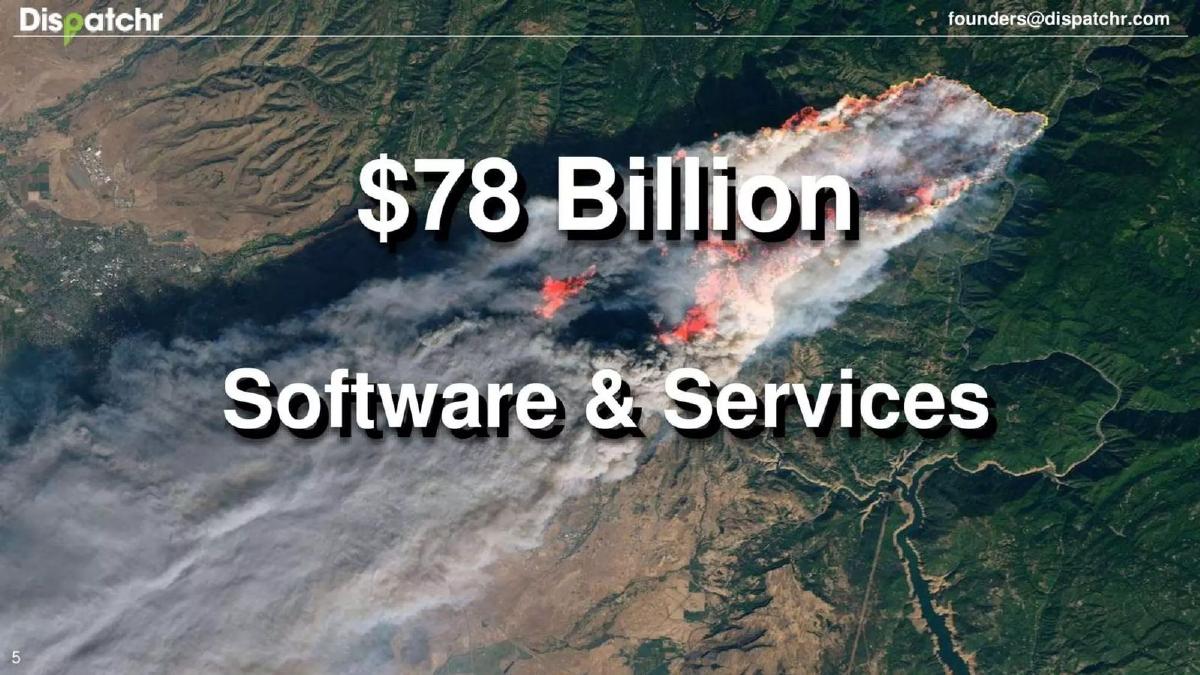
- It identifies a massive $78 billion market for 'Software & Services' within the utility sector (Slide 5).
- The core value proposition is framed as a binary transition from 'Paper-based' to 'Predictive' workflows (Slide 7).
- The product is described as a three-step loop: Geospatial Data to Predictive Analytics to Field Prevention (Slide 8).
- The team slide emphasizes pedigree and intellectual property, including a 'Patented' stamp and a previous 'EXIT' (Slide 9).
- Traction is demonstrated through an '$8 Million Pipeline' featuring major logos like PG&E, Duke Energy, and FPL (Slide 10).
- The deck completely omits a financial 'ask' or a breakdown of how the raised capital will be deployed.
- There is no competition slide, leaving the investor to guess how Dispatchr differentiates from legacy ERP or GIS providers.
The Visionary Approach to Utility Infrastructure
Dispatchr’s 2015 seed deck is a fascinating example of a 'narrative-first' pitch. In an industry as traditionally slow-moving and bureaucratic as public utilities, the founders chose to lead with high-definition imagery and a clear, urgent mission. The deck is less about the 'how' and more about the 'why' and the 'who.' It positions the company as a necessary technological evolution for a grid under siege by climate change and aging infrastructure.
Slides 1-4: Establishing the Stakes
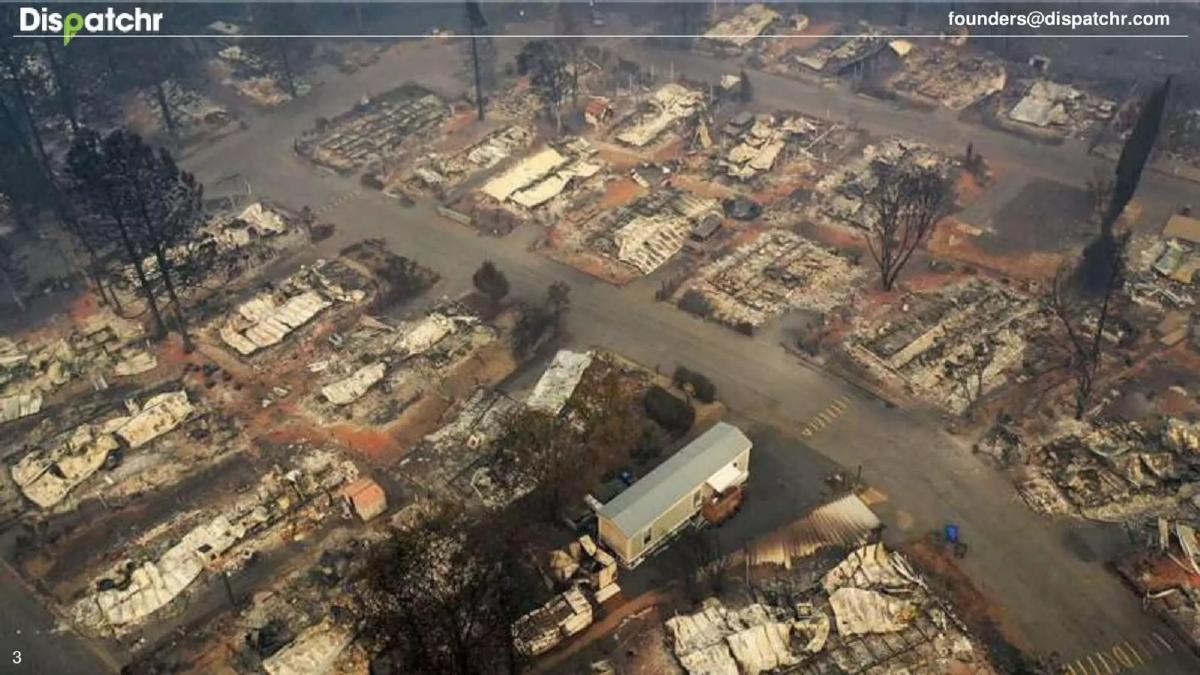
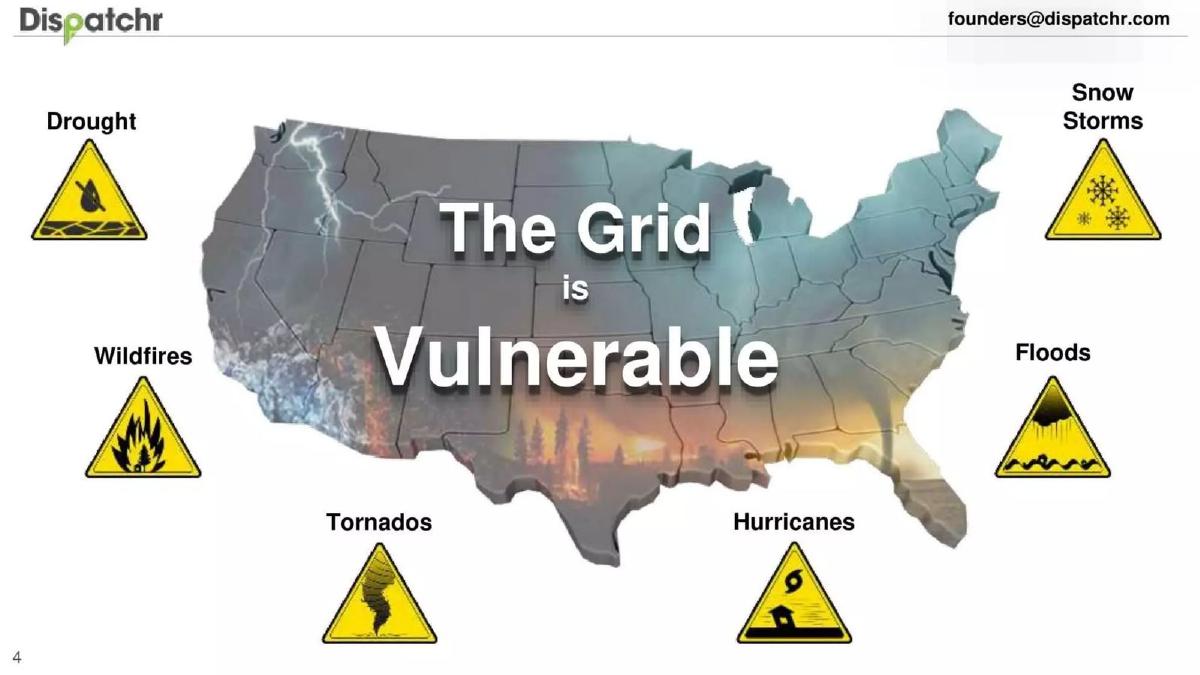
The deck opens with a title slide (Slide 1) that immediately defines the company's purpose: 'Helping Utilities PREVENT DISASTERS.' The background image shows a field worker using a mobile device to inspect a utility pole in a dense forest, setting the scene for a mobile-first enterprise solution. Slides 2 and 3 provide a stark 'before and after' contrast. Slide 2 shows a pristine forest, while Slide 3 shows the aerial aftermath of a neighborhood leveled by fire. This emotional hook is followed by Slide 4, which features a map of the United States surrounded by warning icons for Drought, Wildfires, Tornados, Hurricanes, Floods, and Snow Storms. The central text, 'The Grid is Vulnerable,' serves as the deck's primary thesis.
Slides 5-8: Market Size and The 'Paper' Problem
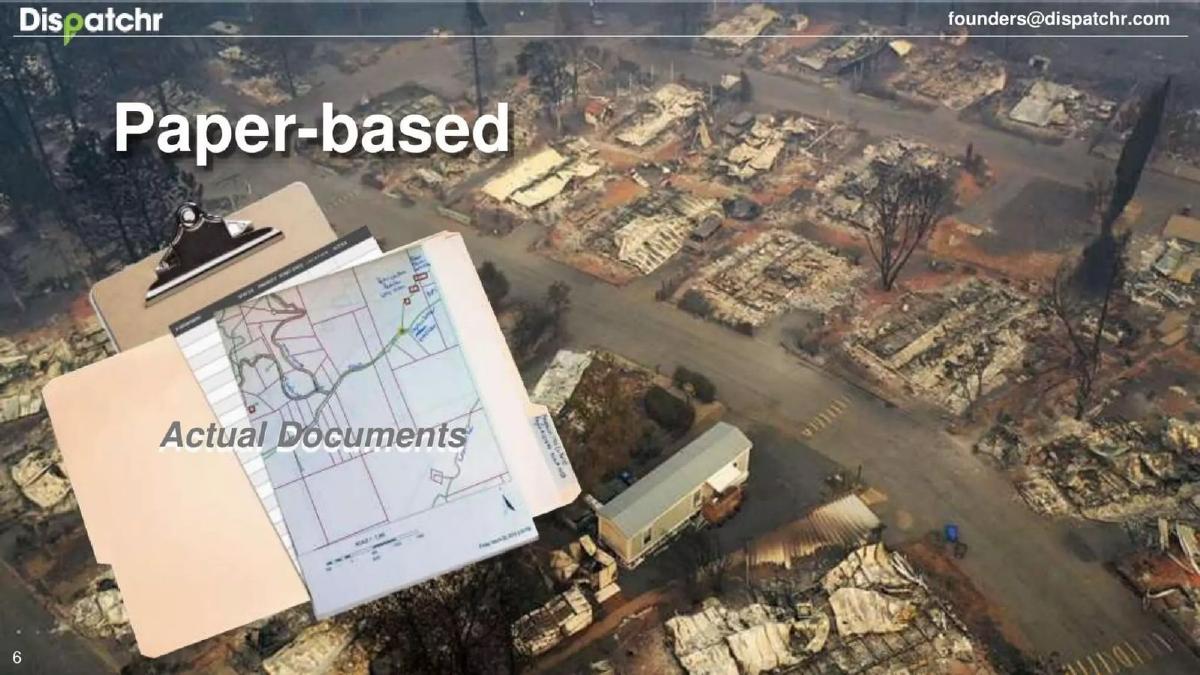
Slide 5 introduces the market opportunity with a bold '$78 Billion' figure for 'Software & Services.' By overlaying this number on an image of a massive wildfire smoke plume, the deck links the financial opportunity directly to the cost of failure. Slide 6 identifies the specific technical bottleneck: 'Paper-based' documentation. It shows a physical clipboard with handwritten notes and maps, labeled as 'Actual Documents.' Slide 7 presents the solution as a direct transition from 'Paper-based' to 'Predictive,' showing a tablet interface that digitizes the inspection process. Slide 8 explains the technical flow: Geospatial Data feeds into Predictive Analytics, which results in Field Prevention. This simple three-icon diagram is the closest the deck gets to a technical architecture slide.
Slides 9-10: The Team and The Pipeline
The team slide (Slide 9) is minimalist, featuring CEO Ralph Garvin Jr. and COO Leonard Lee. Rather than listing bullet points of their resumes, the slide uses logos to convey authority. These include Stanford University, the US Navy, PG&E, ComEd, and PECO. Most notably, it includes a 'Patented' stamp and a large 'EXIT' box, signaling to investors that the founders have successfully built and sold a company before. Slide 10 provides the 'proof of life' for the business, claiming an '$8 Million Pipeline.' The slide is crowded with the logos of major utility players, suggesting that Dispatchr has already cleared the significant hurdle of enterprise sales cycles in the utility sector.
Slides 11-16: The Conversion and The Mission
Slides 11, 12, and 13 reiterate the core value proposition through a 'Convert This To This' sequence. Slide 11 shows the paper clipboard again, Slide 12 shows the tablet, and Slide 13 adds a large green dollar sign with the text 'While making a lot of $.' This is the only mention of profitability or revenue generation in the deck, though it lacks any specifics on how that money is made (e.g., SaaS seats, per-asset fees, or percentage of savings). The deck concludes with Slides 14, 15, and 16, which are identical repetitions of the title imagery but with the tagline 'Ending the Era of the Power Outage.' This repetition is likely intended for a live presentation to leave a lasting impression of the company's mission.
What Works in the Dispatchr Deck
1. Emotional Urgency: By using real photos of disaster zones, the deck moves the conversation from 'software efficiency' to 'public safety.' This is a powerful way to justify the high price tags associated with enterprise utility contracts. 2. Clear Binary: The 'Paper vs. Predictive' framing (Slide 7) makes the product's value proposition instantly understandable. It doesn't require the investor to be an expert in geospatial analytics to see the benefit. 3. Logo Authority: The use of blue-chip utility logos on the pipeline slide (Slide 10) is a massive de-risking signal. In the utility space, getting a meeting is half the battle; showing a pipeline with these names suggests the product has passed initial gatekeepers.
What is Missing from the Dispatchr Deck
1. The 'Ask': There is no slide indicating how much money the company is raising or what the terms are. This is a significant omission for a fundraising deck, though it may have been handled in a separate document or during the verbal pitch. 2. Business Model: The deck says they will make 'a lot of $' (Slide 13) but never explains the pricing model. Investors need to know if this is a high-margin SaaS play or a service-heavy implementation model. 3. Competitive Landscape: The deck acts as if Dispatchr is the only company trying to solve this. There is no mention of legacy GIS (Geographic Information System) giants like Esri or other emerging startups in the predictive maintenance space. 4. Financial Projections: There are no charts showing projected revenue growth, burn rate, or headcount expansion. The $8 million pipeline is the only hard financial metric provided.
What Founders Should Copy
1. Visual Minimalism: Dispatchr avoids the 'wall of text' trap. Each slide has one clear message supported by a high-quality image. This ensures the audience listens to the founder rather than reading the slides. 2. Problem-Solution Alignment: The deck does an excellent job of showing the 'Actual Documents' (Slide 6) that cause the problem. Showing the messy reality of a customer's current workflow is always more effective than describing it in abstract terms. 3. Mission-Driven Branding: The tagline 'Ending the Era of the Power Outage' is a 'Big Hairy Audacious Goal' (BHAG). It elevates the company from a tool provider to a category-defining infrastructure play.
Final Analysis
The Dispatchr deck is a 'teaser' deck designed to get a meeting, not a 'due diligence' deck designed to close a lead. It relies heavily on the 'wow factor' of its market size and the credibility of its founders. While the lack of financial data and competitive analysis would be a red flag in a Series A deck, for a 2015 seed round, the focus on a massive, underserved market and a clear technological shift (paper to digital) was likely enough to generate significant investor interest.
Frequently asked questions
- What is the primary problem Dispatchr aims to solve?
- Dispatchr targets the vulnerability of the electrical grid to natural disasters like wildfires, droughts, and hurricanes. Slide 4 explicitly states 'The Grid is Vulnerable,' and Slide 6 highlights that current management methods are dangerously 'Paper-based,' leading to inefficiencies in disaster prevention and response.
- How does Dispatchr quantify its market opportunity?
- The deck cites a $78 billion market for 'Software & Services' on Slide 5. While it doesn't provide a bottom-up build for this figure, it uses the scale of the number to justify the venture-scale potential of modernizing utility workforce management.
- What evidence of traction does the company provide?
- Traction is presented as an '$8 Million Pipeline' on Slide 10. This is visualized alongside the logos of ten major US utility companies, including National Grid, ConEdison, and Georgia Power, suggesting deep industry engagement even at the seed stage.
- Who are the founders and what is their background?
- The deck features Ralph Garvin Jr. (CEO) and Leonard Lee (COO). Their background is represented through logos rather than text, showing affiliations with Stanford, the US Navy, and major utilities like PG&E and ComEd, along with a mention of a previous successful exit (Slide 9).
- What critical information is missing from this pitch deck?
- The deck is missing several standard components: a specific funding ask, a slide on competition, a detailed business model (pricing/revenue structure), and a roadmap for product development. It functions more as a 'vision deck' than a comprehensive business plan.