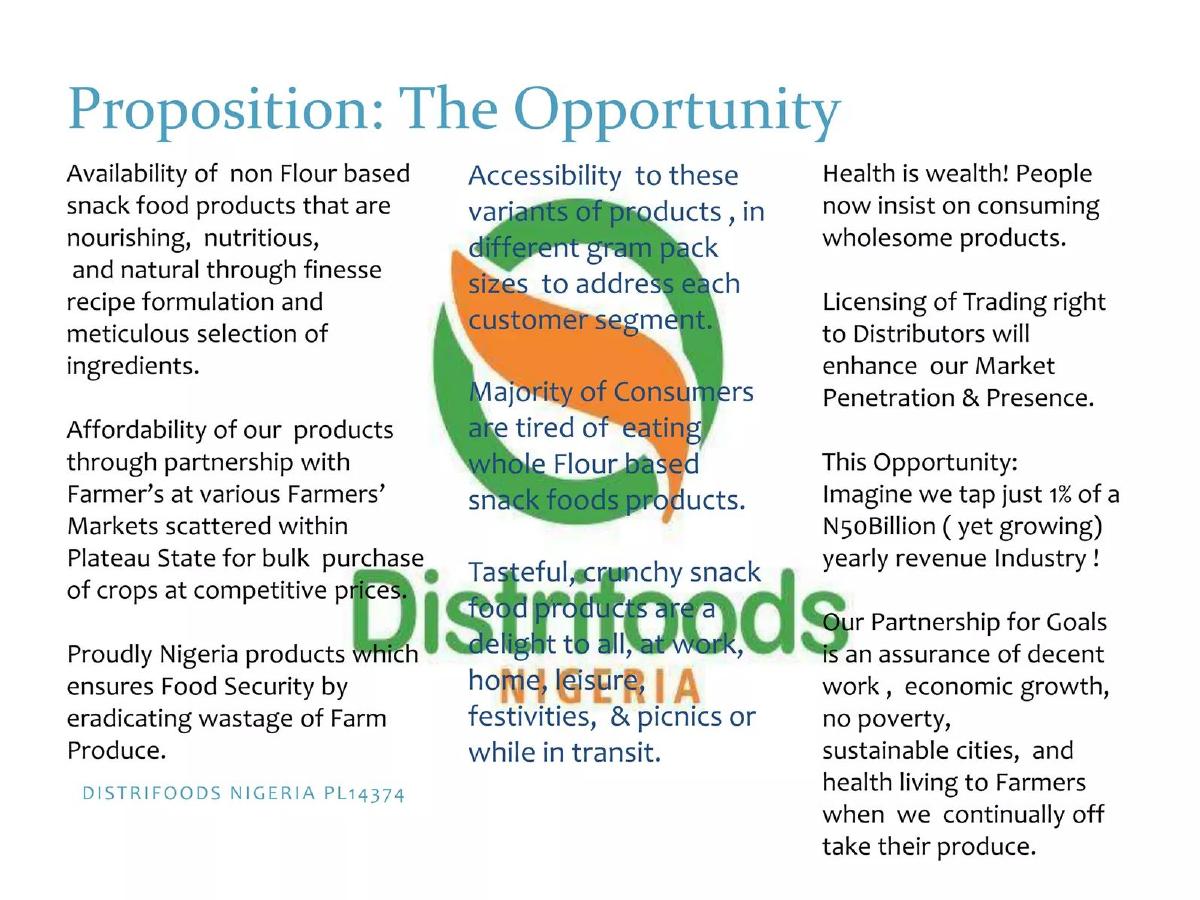
Distrifoods Nigeria is an agro-processing firm targeting the Nigerian and broader West African snack market. The deck, dated Q2 2017, outlines a plan to scale production of their 'Xpressbite' brand, specifically focusing on peanuts, potato crisps, and instant oats. The company seeks NGN 40 million to transition from manual to mechanized production, aiming for a 40% increase in capacity to 10 metric tons per month. While the deck provides a clear breakdown of capital expenditure—including NGN 14 million for machinery and NGN 7 million for delivery trucks—it lacks specific historical revenue da…
Key takeaways
- The company operates in the agro-processing subsector, manufacturing snacks under the registered trademark Xpressbite (Slide 2).
- Distrifoods claims a 99% customer retention rate for its repeat-sale products (Slide 5).
- The competitive analysis identifies global brands like Pringles and Nutella as high-cost imports, positioning Xpressbite as a natural, affordable alternative (Slide 4).
- A funding requirement of NGN 40 million is specified, with NGN 14 million allocated to machinery such as deep fryers and packaging machines (Slide 7).
- The production goal is to reach 10 metric tons of peanuts per month, representing a 40% increase in capacity (Slide 6).
- Market targeting is split between Nigeria's youth population (50% under 30 years) and export markets including Chad, CAR, and Niger (Slide 3).
- The deck projects annual revenue growth of 15-25% through market penetration and varied pack sizes (Slide 2).
- Distribution strategy includes 'School Storming,' road shows, and a fleet of van salesmen (Slide 5).
Distrifoods Nigeria: A Regional Manufacturing Teardown
The Distrifoods Nigeria pitch deck, dated Q2 2017, represents a classic industrial scaling play within the African agro-processing sector. The company seeks to bridge the gap between raw agricultural output in Plateau State and the high demand for processed snacks in urban Nigerian centers. The deck is structured as a functional business proposal, focusing heavily on operational requirements and market positioning rather than high-level visionary storytelling.
Slide 1: Title Slide
The cover slide introduces Distrifoods Nigeria as "A Leadership Company making money from the Food Manufacturing Business in Africa." The branding is straightforward, featuring a green and orange circular logo. The subtitle explicitly mentions "making money," which signals a pragmatic, profit-oriented approach, though it lacks the polish of modern tech-startup taglines.
Slide 2: Proposition: Business Idea
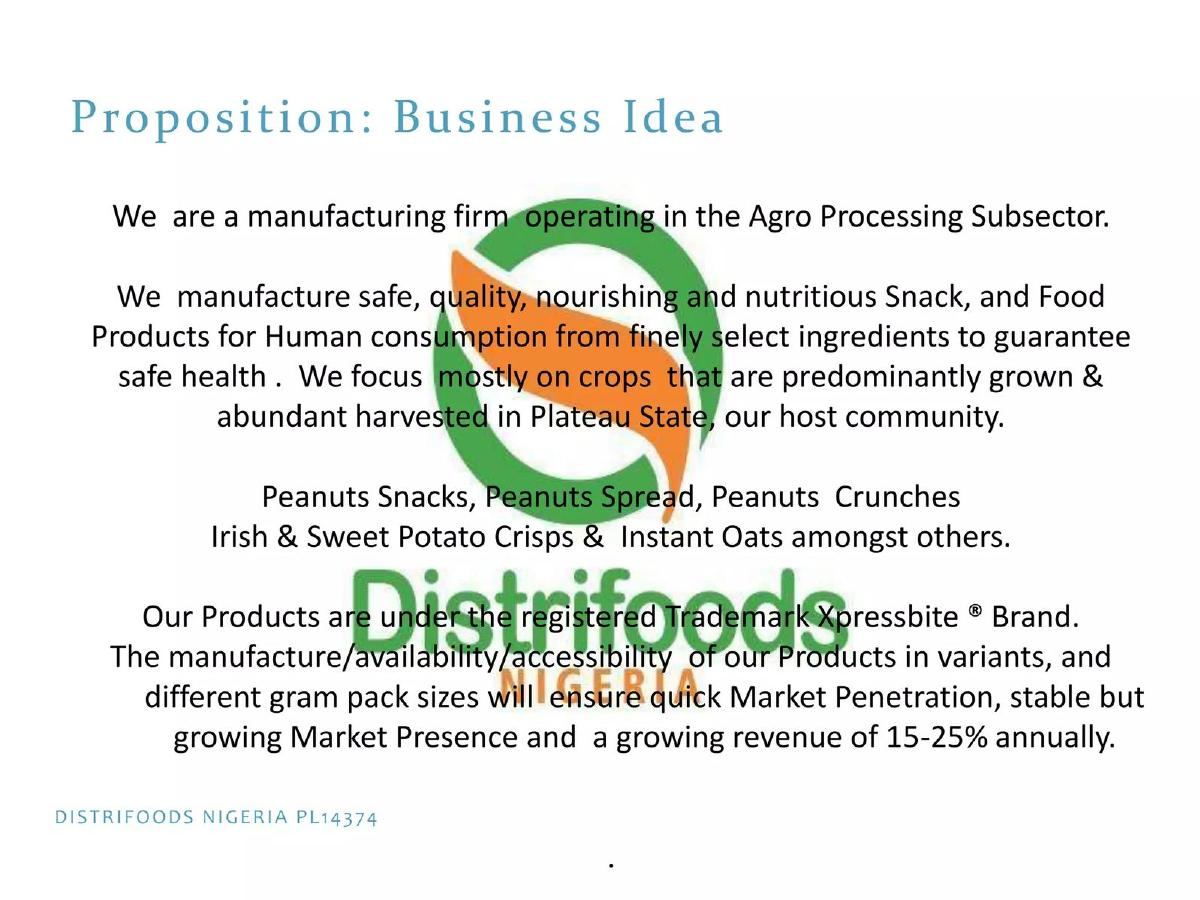
This slide defines the company as a manufacturing firm in the agro-processing subsector. Key details include:
Product Range: Peanuts (snacks, spread, crunches), potato crisps (Irish and sweet), and instant oats. · Brand: Products are sold under the registered trademark "Xpressbite." · Sourcing: Ingredients are sourced from Plateau State, their host community. · Financial Target: The slide claims a growing revenue of 15-25% annually.
The mention of "different gram pack sizes" is a critical detail for the Nigerian market, where sachet economy and price-point sensitivity are major drivers of market penetration.
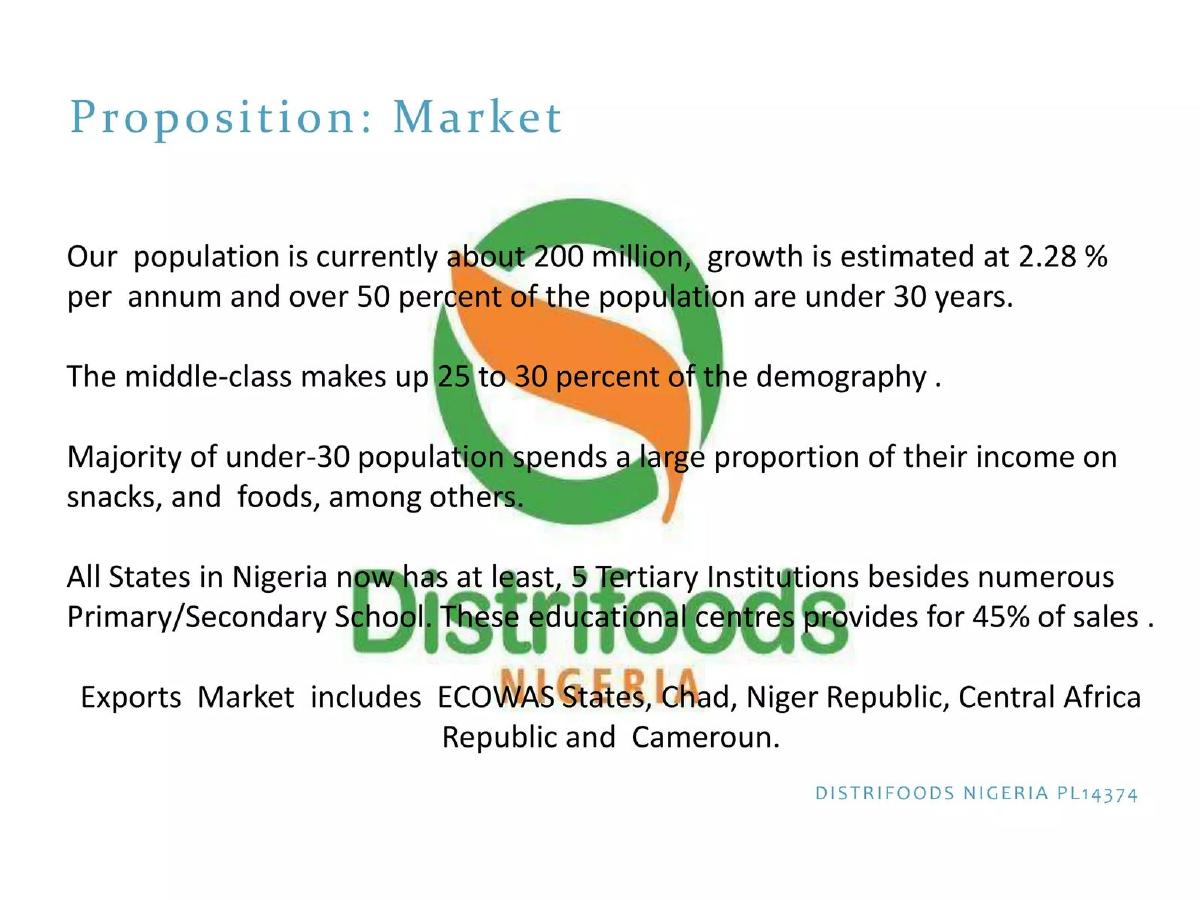
Slide 3: Proposition: Market
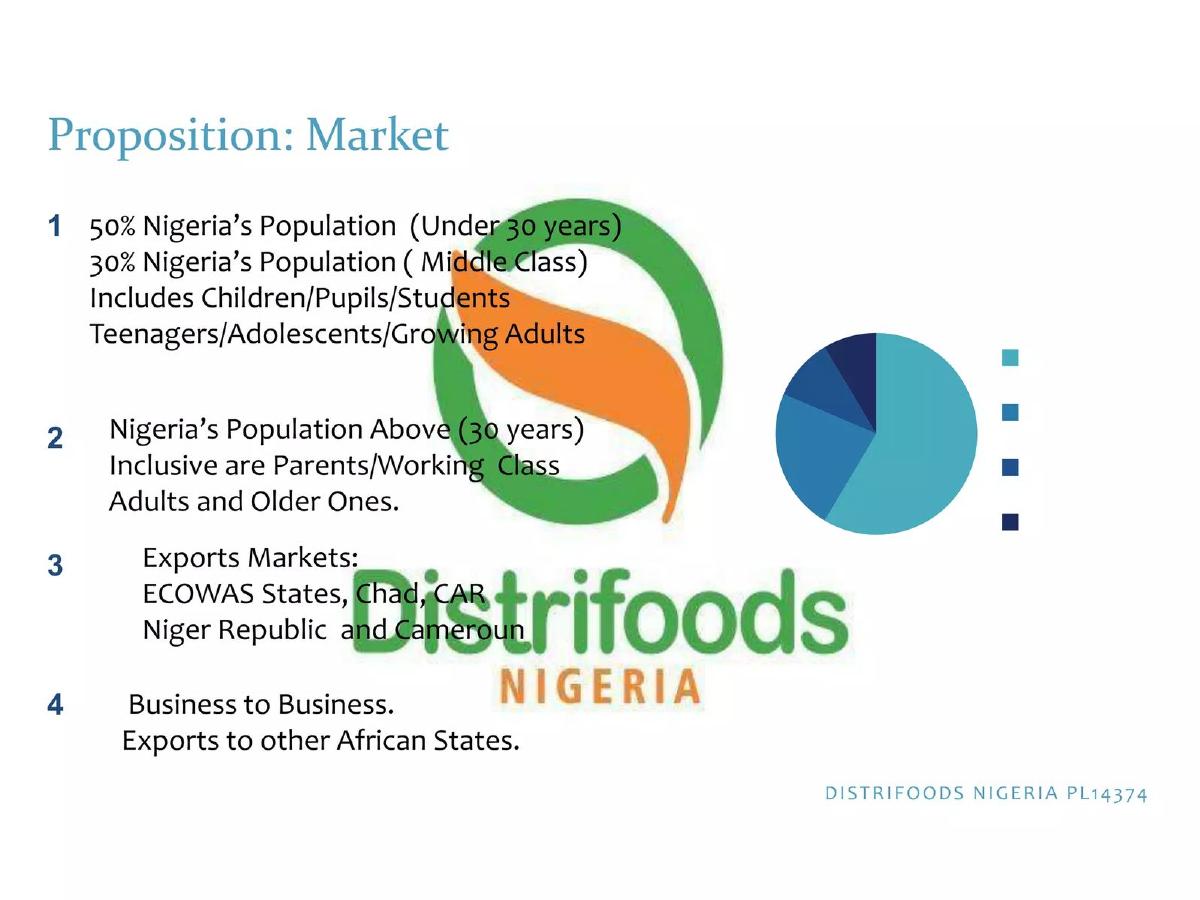
Distrifoods segments its market into four categories: 1) Nigeria’s youth (50% under 30 years), 2) The working class and parents, 3) Export markets (ECOWAS states, Chad, CAR, Niger, and Cameroun), and 4) B2B exports. While the slide includes a pie chart, it is unlabelled, rendering the visual data ineffective. However, the text clearly identifies a massive demographic tailwind in Nigeria's young population.
Slide 4: Proposition: Customer & Competition
This slide provides a surprisingly detailed competitive landscape. It categorizes competitors into three tiers:
Uacfoods: Noted for local presence but mostly flour-based products. · Nkate Burger: Criticized for being an import from Ghana with poor product appearance and only one SKU. · Global Brands (Pringles, Nutella, Skippy): Described as expensive imports for the rich with no local presence.
Distrifoods positions itself as the "natural" alternative with "100% locally available" raw materials and "competitive packaging." A notable admission on this slide is the statement: "They all have better funding than us," which serves as the justification for the capital raise.
Slide 5: Organization: Getting to Market
Part One: Focuses on shelf life (6+ months) and variety in SKUs to encourage bulk ordering from distributors. · Part Two: Claims a 99% customer retention rate and accessibility in neighborhood stores and mini-marts. · Part Three: Outlines active promotion through "School Storming," road shows, and a fleet of van salesmen.
The mention of "Post Secondary Institutions" and "Primary & Secondary Schools" suggests a heavy focus on the education sector as a primary sales channel.
Slide 6: Milestone: Company Timeline
The timeline covers Q3 2017 through "2019 Ahead." Key milestones include:
Completion of certifications (NAFDAC, SON, ETLS, NEPC). · Mechanization of the peanut production line to reach 10 metric tons per month (a 40% increase). · Expansion into mechanized production for potato crisps and oats. · Exporting to the ECOWAS market.
The focus on mechanization is the core theme of this deck, moving the business from a manual or semi-manual operation to an industrial scale.
Slide 7: Milestone: Funding Requirement (N40M)
The final slide in this set breaks down the NGN 40 million ask:
NGN 14 Million: Machinery (Digital scales, deep fryers, planetary mixers, and multiple packaging machines). · NGN 9 Million: Packaging materials (Laminate and Kraft Alu pouches, corrugated cartons). · NGN 7 Million: Delivery trucks for distribution. · NGN 10 Million: Raw materials and operating cash.
The inclusion of a pie chart on this slide mirrors the breakdown, providing a clear visual of how the capital will be deployed across the business.
What Distrifoods Nigeria Does Well
The deck is exceptionally clear about its operational needs. Unlike many early-stage decks that ask for "growth capital" without specifics, Distrifoods lists the exact types of machinery they intend to buy (e.g., "AFFSCBS with NFBC" packaging machines). This level of detail builds credibility regarding the founders' understanding of the manufacturing process. Furthermore, the competitive analysis is grounded in reality; they recognize that while they cannot outspend global brands, they can outcompete them on price and local availability.
What is Missing from the Deck
The most glaring omission is a Team Slide . In any investment round, especially one involving physical manufacturing, the experience of the management team is paramount. There is no mention of who is running the company or their background in food science or logistics. Additionally, the deck lacks Unit Economics . While they mention a 15-25% revenue growth target, they do not disclose the cost to produce one unit versus the wholesale price, which is essential for evaluating the scalability of a manufacturing business. Finally, the Market Slide contains a pie chart with no data labels, which is a missed opportunity to quantify the TAM (Total Addressable Market).
Founder Takeaways: What to Copy
Founders in the manufacturing or hardware space should emulate the Funding Requirement slide (Slide 7). Breaking down a raise into specific categories like machinery, packaging, and logistics shows that the business has a concrete plan for the capital. The Competition slide (Slide 4) is also a good model for startups in emerging markets; it identifies why international incumbents are vulnerable (high cost, lack of local presence) and why local competitors are failing (poor packaging, limited SKUs). This creates a clear "gap in the market" narrative that is easy for investors to follow.
Final Analysis
Distrifoods Nigeria presents a pragmatic case for a regional agro-processing business. The deck is less about "disruption" and more about "optimization"—taking existing demand for snacks and fulfilling it more efficiently through local sourcing and mechanization. While the lack of team information and financial history are significant hurdles, the clarity of the operational plan and the specific N40M ask make it a solid foundation for a due diligence conversation.
Frequently asked questions
- What is the primary product line for Distrifoods?
- Distrifoods focuses on snack and food products manufactured from locally sourced ingredients in Plateau State, Nigeria. Their primary offerings include peanut snacks, peanut spread, peanut crunches, Irish and sweet potato crisps, and instant oats. These are sold under the 'Xpressbite' brand name.
- How much funding is Distrifoods seeking and for what purpose?
- The company is seeking NGN 40 million. The allocation is strictly defined: NGN 14 million for machinery (fryers, mixers, packaging machines), NGN 9 million for packaging materials (laminate and kraft pouches), NGN 7 million for delivery trucks, and NGN 10 million for raw materials and operating cash.
- What is the company's competitive advantage according to the deck?
- Distrifoods highlights three main advantages: 100% locally available raw materials, a lack of artificial additives (no aspartame or artificial flavors compared to competitors), and price accessibility. They position themselves against expensive imports like Pringles and local competitors who lack a presence in the Jos-Bukuru metropolis.
- What are the projected growth metrics?
- The deck projects a 15-25% annual revenue growth rate. Operationally, they aim to sustain a 40% increase in production capacity for their peanut line, targeting 10 metric tons per month over a 12-15 month production cycle starting from the Q3 2017 to Q1 2018 period.
- What is missing from this pitch deck?
- The deck lacks a dedicated team slide, which is a significant omission for investors. It also fails to provide historical financial statements, specific unit economics (COGS vs. MSRP), or a clear exit strategy. The 'Market' slide uses a pie chart without labels or percentages, making the data difficult to interpret.