Benvira is an industrial technology company focused on predictive maintenance through its AFA Technology. The deck identifies two primary pain points: the complexity of existing condition monitoring systems and the unreliability of data from standard field sensors, which typically only trigger alarms after a failure has occurred. Benvira proposes a five-step process—Assess, Sensorize, Collect Data, Translate Data, and Predictive Analytics—to provide actionable insights and avoid downtime. The company claims a $7 billion Total Addressable Market (TAM) and a $1 billion Serviceable Obtainable Ma…
Key takeaways
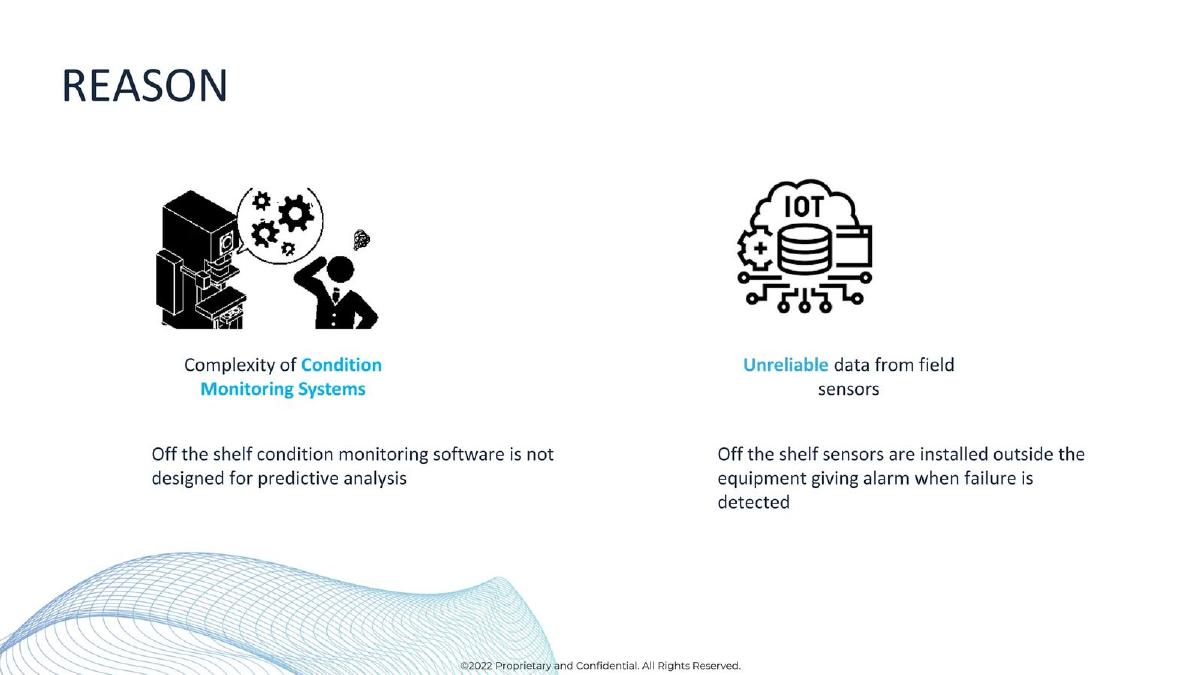
- The company identifies that off-the-shelf sensors are often installed outside equipment, leading to reactive rather than predictive alarms (Slide 2).
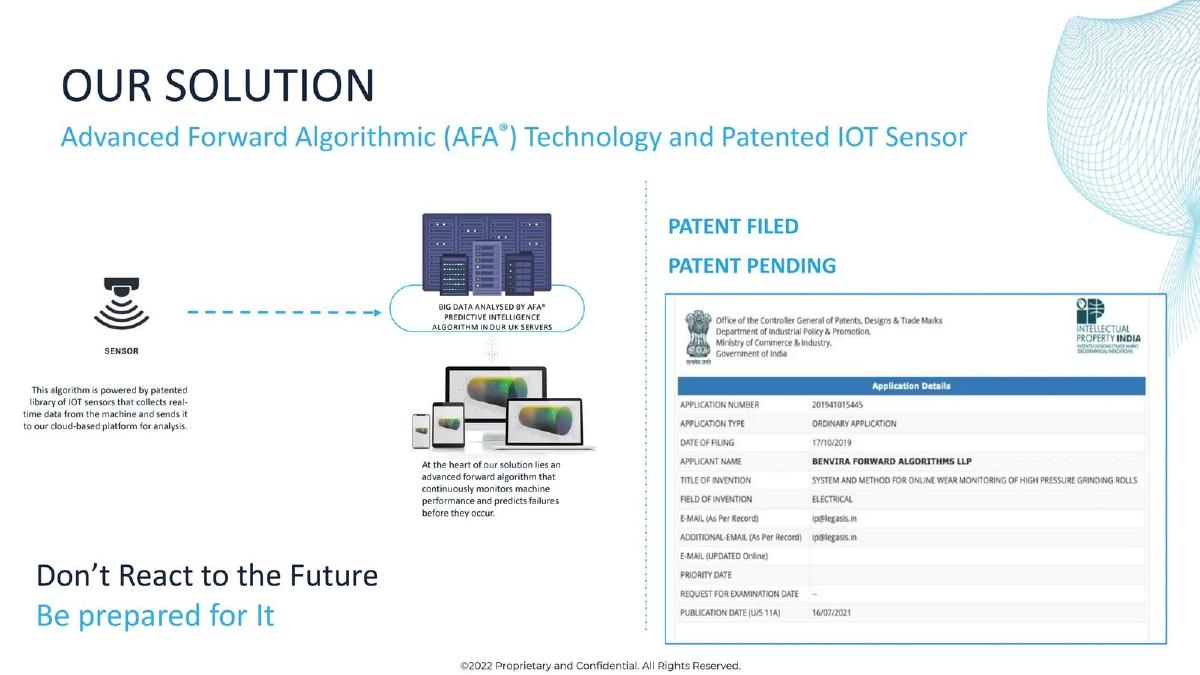
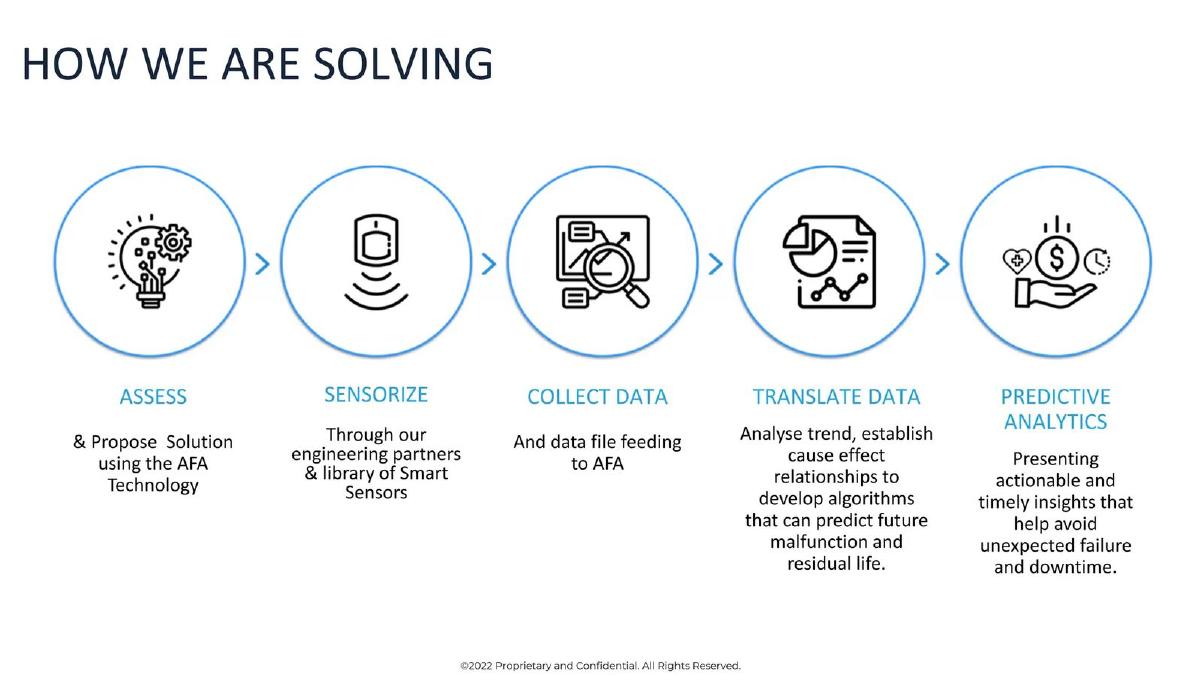
- Benvira utilizes a proprietary 'AFA Technology' and a library of smart sensors to collect and translate industrial data (Slide 3).
- The Total Addressable Market is cited as $7 billion, with a Serviceable Obtainable Market of $1 billion (Slide 4).
- Benvira aims to capture 15% of its target market, approximately $1 billion USD, by the year 2030 (Slide 4).
- Traction is demonstrated through a $2.5 million LOI and $0.5 million in orders currently under execution (Slide 5).
- The sales strategy is diversified across end users (Aditya Birla Group, UltraTech Cement), channel partners (Diffusion), and OEMs (KHD Humboldt Wedag) (Slide 5).
- The core team claims a cumulative 75+ years of experience across process, maintenance, algorithms, and IoT (Slide 6).
- The leadership team includes alumni from the University of Oxford and IE Business School, covering CEO, COO, CTO, CSO, and CFO roles (Slide 6).
Slide-by-Slide Teardown
Slide 1: Title Slide
The title slide is minimalist, featuring the Benvira logo and the text 'INVESTOR DECK.' A copyright notice at the bottom indicates the content was produced in 2022. The visual design uses a blue and white color palette with a wave-like geometric pattern, establishing a professional, corporate tone suitable for the industrial tech sector.
Slide 2: The Reason (Problem)
Benvira identifies two core problems in the industrial maintenance space. First, the 'Complexity of Condition Monitoring Systems,' noting that off-the-shelf software is rarely designed for true predictive analysis. Second, 'Unreliable data from field sensors.' The slide explains that standard sensors are typically installed on the exterior of equipment, which results in alarms being triggered only after a failure is detected, rather than providing early warning signs. This sets the stage for a solution that moves deeper into the machinery or data layer.
Slide 3: How We Are Solving
This slide outlines a five-step process for their solution: Assess (proposing solutions using AFA Technology), Sensorize (using engineering partners and a library of smart sensors), Collect Data (feeding data to AFA), Translate Data (analyzing trends and cause-effect relationships to predict malfunctions), and Predictive Analytics (presenting actionable insights to avoid downtime). The mention of 'residual life' calculation is a key value proposition for industrial operators looking to optimize asset replacement cycles.
Slide 4: Market Opportunity
The deck defines the TAM as a $7 billion market opportunity and the SOM as $1 billion . A specific, ambitious goal is stated: 'We are targeting to capture 15% market share approx 1 Billion USD by 2030.' To justify the timing, the slide includes a clipping from 'Mint' regarding the flourish of deep-tech startups in India, noting that the country has over 3,000 deep-tech startups. This suggests a geographic focus or origin in the Indian market, specifically highlighting Bengaluru and Delhi-NCR as hubs.
Slide 5: Sales Channel & Customer Base
This slide provides concrete evidence of market interest. It lists End Users such as Aditya Birla Group, UltraTech Cement, and Dalmia Bharat. Channel Partners include Diffusion, and OEMs include KHD Humboldt Wedag. Most importantly, it lists a Letter of Intent (LOI) of $2.5 million and orders under execution of $0.5 million . The right side of the slide asserts that the company is 'Geography and Sector Agnostic,' listing Cement, Power, Mining, and Metals as target verticals.
Slide 6: Core Team
The team slide emphasizes '75+ years' of cumulative experience. The leadership includes:
Prashant Garg (CEO): Industrial Engineer, Oxford MBA, 15+ years in business management. · Prity Singh (COO): Electronics Engineer, 16+ years in the energy industry. · Marko Krznaric (CTO): PhD in Computing, 25+ years in algorithms and predictive analysis. · Manuel Fuertes (CSO): Oxford MBA, expertise in business strategy and M&A. · Luis Gomez (CFO): IE Business School, 20+ years in financial and risk analysis.
The team appears well-balanced between technical depth (PhD CTO) and high-level business education (Oxford/IE).
Slide 7: Contact Slide
The final slide provides a phone number, a direct email for the COO (Prity Singh), and the company website. It maintains the consistent branding seen in the title slide.
What Benvira Does Well
Benvira succeeds in grounding a 'deep-tech' pitch in tangible commercial reality. By listing specific, recognizable industrial giants like Aditya Birla Group and UltraTech Cement on slide 5, they move beyond theoretical applications. The inclusion of a $2.5 million LOI is a strong signal that their 'AFA Technology' has passed initial technical scrutiny by large-scale enterprise buyers.
The problem statement on slide 2 is also particularly effective. Instead of a vague 'downtime is expensive' slide, they point to a specific technical flaw in current systems: sensors are installed on the outside of equipment and act as reactive alarms rather than predictive tools. This creates a logical 'gap' that their 'Smart Sensors' and 'AFA Technology' are positioned to fill.
What is Missing from the Deck
The most glaring omission is The Ask . While the deck is labeled an 'Investor Deck,' it does not specify how much capital the company is seeking, the valuation range, or how the funds will be allocated (e.g., R&D, sales expansion, or manufacturing). Without this, the deck functions more as a company profile than a fundraising tool.
Additionally, there is no Competitive Landscape . The industrial IoT and predictive maintenance space is crowded with both startups and legacy players (like GE Digital or Siemens). Benvira mentions that 'off the shelf' solutions are inadequate, but they do not name specific competitors or provide a feature-comparison matrix to show why their AFA Technology is superior.
Finally, Unit Economics are absent. For a company dealing with hardware (sensors) and software (analytics), investors would want to see the hardware margin versus the software SaaS margin, as well as the typical implementation cost and time for a new industrial site.
What Other Founders Should Copy
Founders should emulate Benvira’s clear categorization of sales channels . By breaking down their go-to-market into End Users, Channel Partners, and OEMs (Slide 5), they demonstrate a sophisticated understanding of how industrial sales work. They aren't just trying to sell one-by-one to factories; they are looking for leverage through OEMs and partners.
The Team Slide structure is also a model of clarity. It highlights specific years of experience and relevant educational credentials without cluttering the slide with long biographies. Using a 'cumulative years of experience' stat (75+ years) is a quick way to establish authority in a field like industrial engineering where seniority and track record are highly valued by investors.
Final Thoughts
Benvira presents a credible case for a deep-tech intervention in a high-value sector. The combination of a highly credentialed team and early seven-figure traction (via LOIs) makes for a compelling narrative. However, to close a round, the founders would need to supplement this deck with a clear financial ask and a much deeper dive into their competitive advantages and unit economics.
Frequently asked questions
- What is the specific problem Benvira is solving?
- Benvira targets the limitations of current industrial monitoring. According to slide 2, existing software is not designed for predictive analysis, and standard sensors are often placed externally, meaning they only detect failures after they happen. Benvira aims to move from reactive alarms to predictive insights that estimate the 'residual life' of machinery.
- How does Benvira generate revenue and reach customers?
- Slide 5 outlines a three-pronged sales channel strategy: selling directly to end users like UltraTech Cement, working through channel partners like Diffusion, and integrating with Original Equipment Manufacturers (OEMs) like KHD Humboldt Wedag. They describe their solution as 'Geography and Sector Agnostic,' targeting metals, cement, power, and mining.
- What is the scale of Benvira's current commercial traction?
- As of the deck's publication, Benvira reports having a Letter of Intent (LOI) valued at $2.5 million. Additionally, they have $0.5 million in orders currently under execution. This suggests they have moved past the pure R&D phase into active industrial deployments.
- Who are the key members of the Benvira leadership team?
- The team is led by CEO Prashant Garg (Oxford MBA, 15+ years experience) and COO Prity Singh (Electronics Engineer, 16+ years experience). The technical side is headed by CTO Marko Krznaric, who holds a PhD in Computing and has 25+ years of experience in algorithms and predictive analysis.
- What information is missing from the Benvira investor deck?
- The deck lacks a 'The Ask' slide, meaning the specific funding amount and use of proceeds are not disclosed. It also omits a competitor analysis, detailed unit economics (CAC/LTV), and a clear product roadmap beyond the general five-step process described on slide 3.