Besstech’s 2016 investor presentation outlines a strategic pivot toward a fabless, licensing-based business model in the lithium-ion battery sector. The company leverages IP exclusively licensed from SUNY for nanostructured electrodes, claiming significant performance gains including 50% more energy and 15-minute charging. The deck highlights a strong intellectual property portfolio with granted patents in the U.S., Japan, and Singapore, and a revenue model built on license fees, design fees, and recurring royalties. While the technical claims and management pedigree—featuring a former Global…
Key takeaways
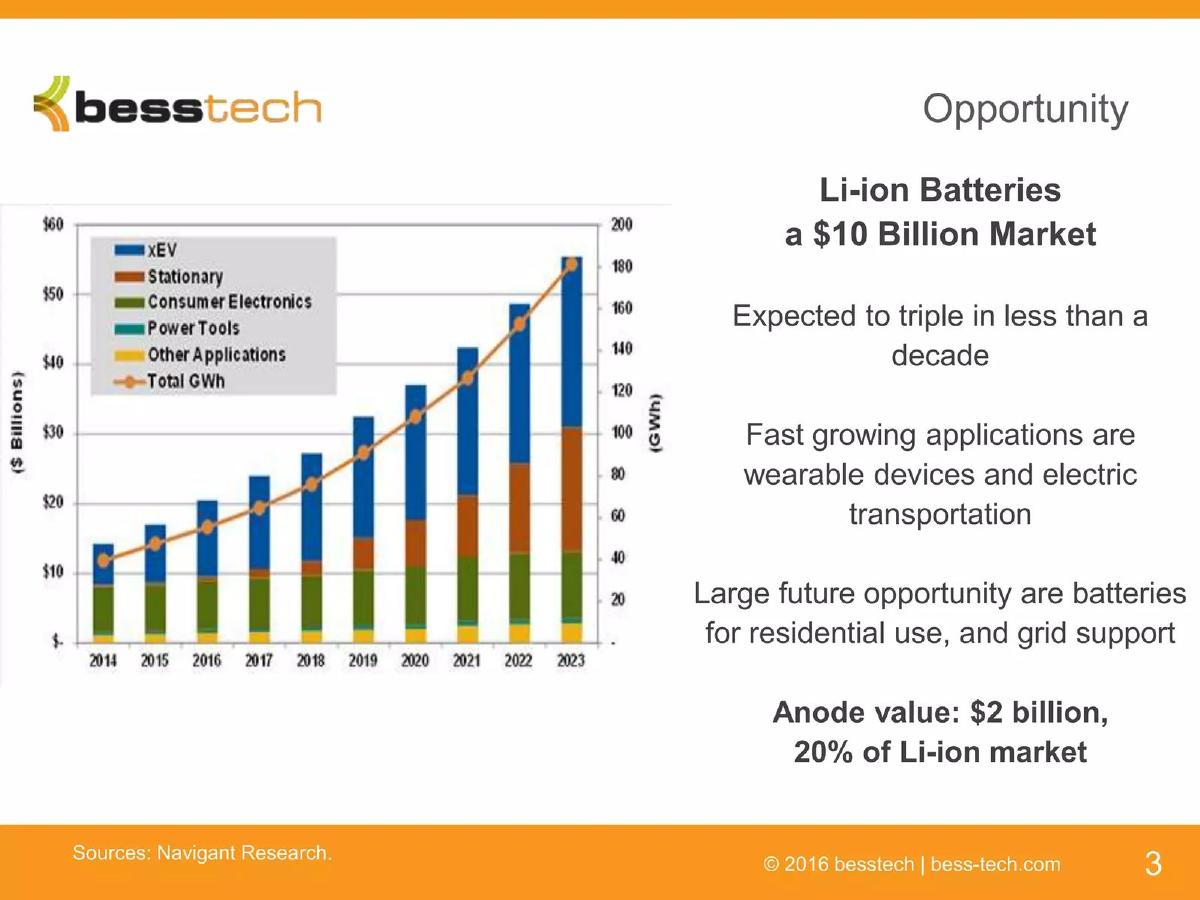
- The company targets a $10 billion Li-ion battery market, specifically identifying the anode value at $2 billion or 20% of the total market (Slide 3).
- Besstech operates a fabless model, utilizing a process adopted from solar cell manufacturing to achieve 1/5th the CapEx for anode production (Slide 7).
- Performance claims include a full battery charge in 15 minutes compared to the industry standard of 1-2 hours (Slide 7).
- The IP portfolio includes a non-provisional application for branched nanostructures granted in the U.S., Japan, and Singapore (Slide 9).
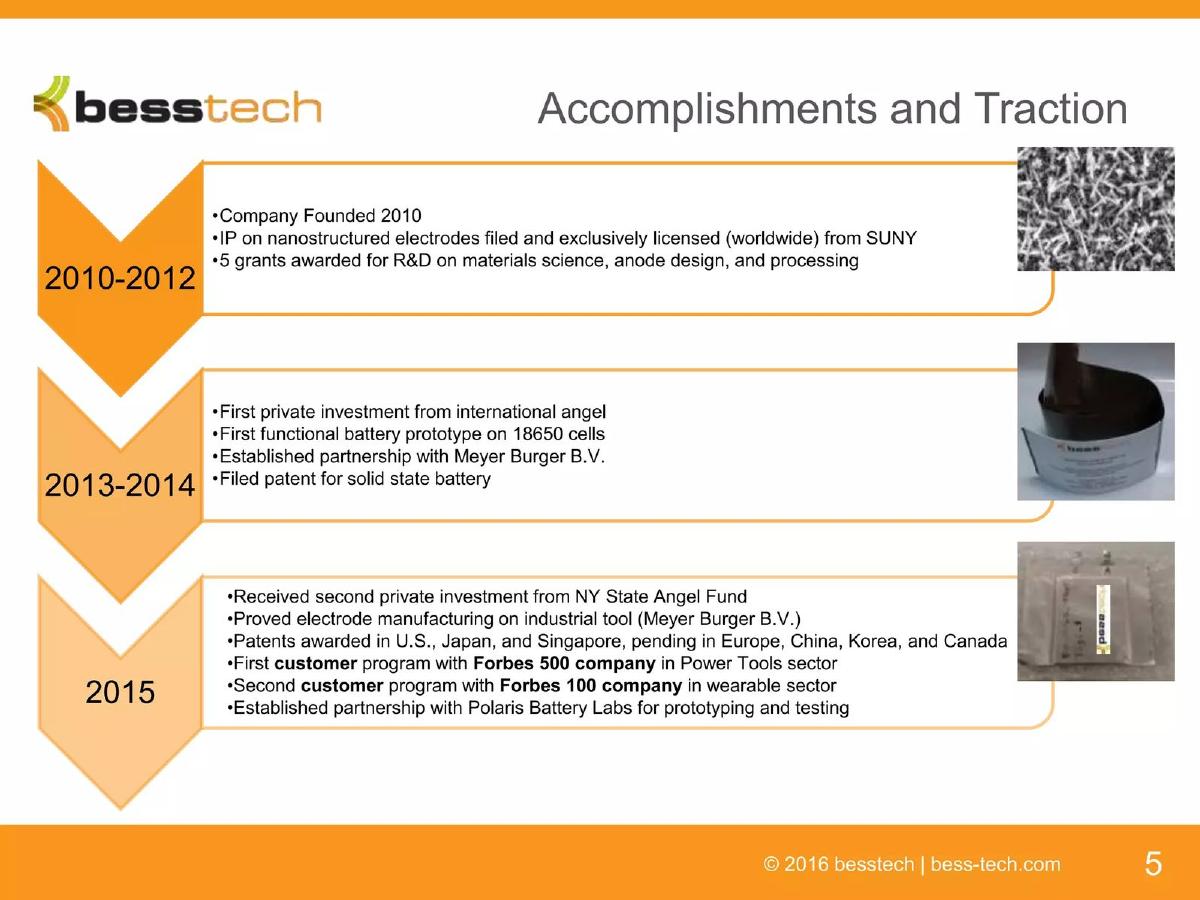
- Traction is demonstrated through customer programs with a Forbes 500 power tools company and a Forbes 100 wearables company (Slide 5).
- The revenue model is diversified across three streams: license fees, development/design fees, and recurring royalties per battery (Slide 11).
- The management team is highly technical, led by CEO Fernando Gómez-Baquero, Ph.D., and CTO Doug Grose, Ph.D., a former CEO of Global Foundries (Slide 13).
- Strategic partnerships are central to their go-to-market, including a joint venture with tool manufacturer Meyer Burger (Slide 11).
Besstech Pitch Deck Analysis
The Besstech Investors Presentation from February 2016 is a classic example of a deep-tech spin-out deck. It focuses heavily on intellectual property, academic pedigree, and a 'fabless' business model designed to mitigate the extreme capital intensity of the battery manufacturing industry. By positioning themselves as an IP provider rather than a manufacturer, Besstech attempts to capture the high-margin segments of the energy storage value chain.
Slide 1: Title and Confidentiality
The cover slide establishes the company's identity and its primary mission: "Enabling the True Potential of Li-ion Batteries." It includes a standard legal disclaimer regarding the confidential nature of the presentation and the fact that it does not constitute an offer to sell securities. The contact information for CEO Fernando Gómez-Baquero, Ph.D., is prominently displayed, signaling a founder-led technical vision.
Slide 3: The Market Opportunity
Besstech frames the opportunity within the broader Lithium-ion battery market, which they value at $10 billion in 2016, with expectations to triple in less than a decade. Crucially, they narrow their focus to the anode, which they state represents $2 billion or 20% of the total Li-ion market. The slide uses a bar chart from Navigant Research to show growth across sectors like xEV (electric vehicles), stationary storage, and consumer electronics. By highlighting wearable devices and electric transportation as fast-growing applications, they align their technology with high-demand consumer trends.
Slide 5: Accomplishments and Traction
This timeline slide tracks the company's progress from its founding in 2010 through 2015. Key milestones include:
2010-2012: Exclusive worldwide licensing of nanostructured electrode IP from SUNY and five R&D grants. · 2013-2014: First private investment from an international angel, a functional 18650 cell prototype, and a partnership with Meyer Burger B.V. · 2015: Second private investment from the NY State Angel Fund, awarded patents in major global markets (U.S., Japan, Singapore), and the initiation of customer programs with a Forbes 500 power tools company and a Forbes 100 wearables company.
This slide is effective because it balances technical validation (prototypes and patents) with commercial validation (Forbes-listed customer programs).
Slide 7: Value Proposition for Customers
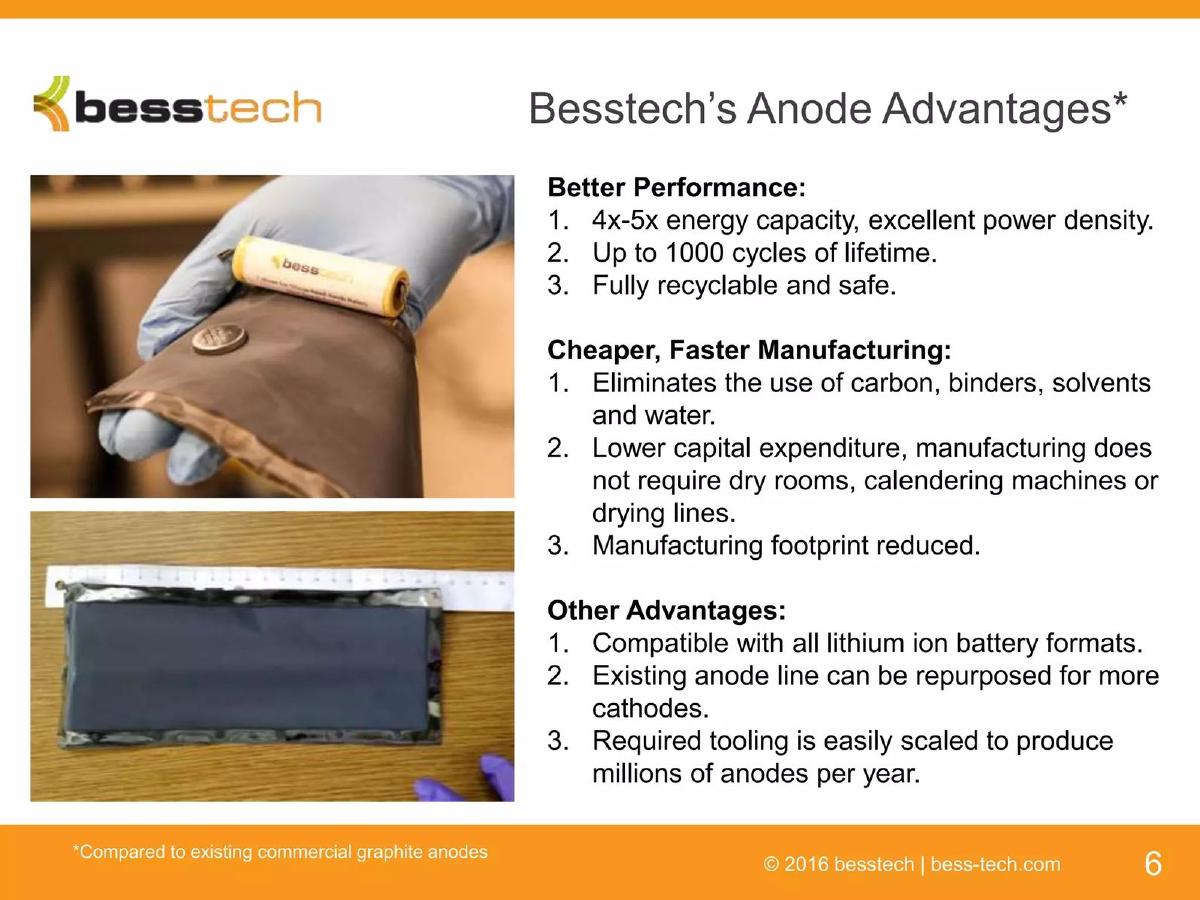
Besstech categorizes its value into three pillars: Performance, Manufacturing, and Sustainability. Better Performance is defined as 50% more energy and a 15-minute charge time. Cheaper, Faster Manufacturing is perhaps their strongest business argument, claiming 1/2 the production cost and 1/5th the CapEx for anode production by adopting processes from the solar cell industry. Safe and Ecofriendly focuses on the lack of harmful solvents and full recyclability. The use of specific metrics (1/5th CapEx, 15-minute charge) provides concrete targets for due diligence.
Slide 9: IP Portfolio and Publications
For a licensing company, this is the most important slide. Besstech provides a detailed table of their patent portfolio. Their primary asset, "Branched Nanostructures for Battery Electrodes," is listed as granted in the U.S., Japan, and Singapore, and is licensed from the SUNY Research Foundation. They also list an owned, pending patent for solid-state batteries. Below the table, they cite four peer-reviewed publications in journals like the Journal of Power Sources and Nanotechnology , reinforcing the scientific rigor behind their claims.
Slide 11: Business and Revenue Model
This slide uses a flow chart to explain their ecosystem. Besstech sits at the center, receiving strategic investment and joint venture support from suppliers and partners like Meyer Burger. The revenue streams are clearly marked in green:
License Fees: From industrial consumers of batteries. · Development and Design Fees: For custom engineering work. · Recurring Royalties: A per-battery fee from manufacturers.
The 'Features' section emphasizes a 'fabless' approach, which is a strategic choice to remain asset-light while pursuing high margins. This model shifts the burden of manufacturing scale-up to established battery manufacturers and tool makers.
Slide 13: Management and Partners
The team slide is heavy on academic and industry experience. CEO Fernando Gómez-Baquero brings 10+ years in nanotechnology. The standout name is CTO Doug Grose, Ph.D., who is the former CEO of Global Foundries and an IBM veteran, providing significant credibility in large-scale semiconductor manufacturing—a field closely related to their proposed production methods. The slide also lists scientific advisors from BMW North America and CNSE. The 'Partners' section includes logos from NYSERDA, NSF, and Meyer Burger, showing a well-integrated network of state, federal, and industrial support.
What Besstech Does Well
Besstech excels at articulating a complex technical solution in terms of business efficiency. By explicitly stating that their manufacturing process is "adopted from solar cell manufacturing," they provide a mental model for investors to understand how they will achieve the 1/5th CapEx reduction. The inclusion of specific patent numbers and peer-reviewed citations (Slide 9) is a best practice for deep-tech companies, as it allows technical auditors to verify claims immediately.
The management team (Slide 13) is exceptionally well-balanced for this stage. Having a former CEO of a major semiconductor foundry (Global Foundries) as CTO suggests that the company isn't just focused on lab-scale science, but understands the realities of industrial-scale production. Furthermore, the traction slide (Slide 5) does a good job of showing a steady progression from government grants to private investment and finally to blue-chip customer programs.
What is Missing from the Deck
The most glaring omission is a clear Financial Ask . While this is labeled an investor presentation, there is no slide indicating how much money they are raising, what the valuation is, or what the specific milestones for the next 18-24 months will be. This makes the deck feel more like a general capabilities briefing than a tactical fundraising tool.
Additionally, there is no Competitive Landscape analysis. The battery space is notoriously crowded, with numerous startups and incumbents working on silicon anodes and nanostructures. Besstech fails to explain why their branched nanostructures are superior to other high-capacity anode materials like silicon nanowires or graphene composites being developed by competitors. Finally, the deck lacks Unit Economics . While they claim 1/2 the production cost, they do not provide a breakdown of the cost per kWh or how their royalty model compares to the existing cost structures of battery manufacturers.
Founder Takeaways
Leverage Pedigree: If your team includes industry titans (like a former Global Foundries CEO), make sure their specific relevant experience is highlighted. Besstech does this well by noting their CTO's background in semiconductor manufacturing, which directly supports their 'fabless' and 'low CapEx' claims.
The 'Fabless' Narrative: For hardware startups, the 'fabless' model is highly attractive to VCs who are wary of the 'valley of death' associated with building factories. Besstech’s Slide 11 is a great template for showing how a small IP-heavy company can sit at the center of a large industrial ecosystem without owning the heavy machinery.
Concrete Performance Metrics: Avoid vague claims like "faster charging." Besstech’s use of "15 minutes vs 1-2 hours" (Slide 7) is much more effective because it defines the delta between the status quo and their solution. Always quantify the value proposition whenever possible.
IP Transparency: Providing a table with patent numbers and status (Slide 9) builds immediate trust. It shows the company is organized and that their 'moat' is legally documented rather than just a theoretical advantage.
Frequently asked questions
- What is Besstech's core technological advantage?
- Besstech focuses on nanostructured electrodes, specifically branched nanostructures for battery anodes. According to Slide 7, this technology enables batteries to hold 50% more energy and achieve a full charge in 15 minutes, significantly faster than the 1-2 hours required by standard Li-ion batteries. Their process is adapted from solar cell manufacturing, which they claim reduces production costs by half.
- How does Besstech plan to make money?
- The company employs a fabless, licensing-based revenue model detailed on Slide 11. They generate income through three primary channels: upfront license fees for specific market sectors, development and design fees for custom electrode integration, and ongoing recurring royalties for every battery produced using their technology. This allows them to avoid the high capital expenditures of building their own factories.
- What is the status of their intellectual property?
- As of the 2016 deck, Besstech held a strong IP position. Slide 9 shows a non-provisional application for 'Branched Nanostructures for Battery Electrodes' (13/817,289) granted in the U.S., Japan, and Singapore, with pending status in Europe, China, Korea, and Canada. This IP is exclusively licensed from the SUNY Research Foundation. They also own a pending patent for solid-state battery fabrication.
- Who are Besstech's key partners and customers?
- Besstech lists several high-profile but unnamed customers and strategic partners. Slide 5 mentions customer programs with a Forbes 500 company in the power tools sector and a Forbes 100 company in wearables. Key partners include Meyer Burger for industrial tooling, Polaris Battery Labs for prototyping, and the SUNY Polytechnic Institute (Slide 13).
- Does the deck include a specific funding request?
- No, the provided slides do not include a specific 'Ask' slide detailing the amount of capital being raised, the valuation, or the intended use of funds. While it is titled an 'Investors Presentation,' it functions more as a technical and strategic briefing. The deck also omits detailed financial projections and a competitive landscape analysis.