Berkwood Resources is a Canadian junior exploration company that, at the time of this February 2016 presentation, held a market capitalization of just C$0.3 million. The deck serves as a technical overview of two primary assets in Quebec: the Lac Guéret Extensions Graphite Project and the Toco Gold Project. Rather than relying on its own proven reserves, the company leans heavily on the 'closeology' strategy, highlighting its proximity to Mason Graphite’s high-grade deposit. The presentation is data-heavy regarding geophysics and land claims but notably lacks a management team slide, a specif…
Key takeaways
- The company was extremely thinly capitalized in early 2016, with a market cap of only C$0.3 million and a 52-week stock price low of $0.005 (Slide 2).
- The primary value proposition for the graphite project is its location adjacent to Mason Graphite, which has a reported 62.875MT of proven and probable reserves (Slide 4).
- Berkwood controls a significant land package in Quebec, totaling 8,057 hectares for graphite and 2,400 hectares for gold (Slides 3 and 6).
- Technical validation relies on a January 2016 ground geophysics survey that identified two major anomaly zones, one measuring 2,000 meters in length (Slide 5).
- The Toco Gold Project is positioned as a secondary asset, located 320 km north of Chibougamau and adjacent to Visible Gold Mines’ Project 167 (Slide 6).
- The deck explicitly states the company is seeking new business opportunities to 'rebuild' following senior management changes (Slide 7).
- Future exploration activities, including trenching and drilling, are noted as being 'subject to financing,' indicating an immediate need for capital (Slide 7).
- There is a complete absence of a team slide, board of directors, or historical spending breakdown in the provided materials.
Berkwood Resources: A Technical Deep Dive into Micro-Cap Exploration
The February 2016 corporate presentation for Berkwood Resources Ltd. is a quintessential example of a junior mining 'closeology' play. At the time of this deck, the company was trading on the TSX Venture Exchange (BKR) with a minimal market capitalization, attempting to attract investors by highlighting the geological potential of its land claims in Quebec. The deck is less about a business model and more about geological probability and regional infrastructure.
Slide 1: Title and Branding
The cover slide establishes the company as Berkwood Resources Ltd., featuring a mountain-themed logo. It identifies the company's ticker (TSX.V BKR) and dates the presentation to February 2016. The imagery of a mountain range reinforces the sector—natural resources—but provides no specific value proposition yet.
Slide 2: Corporate Overview and Market Data
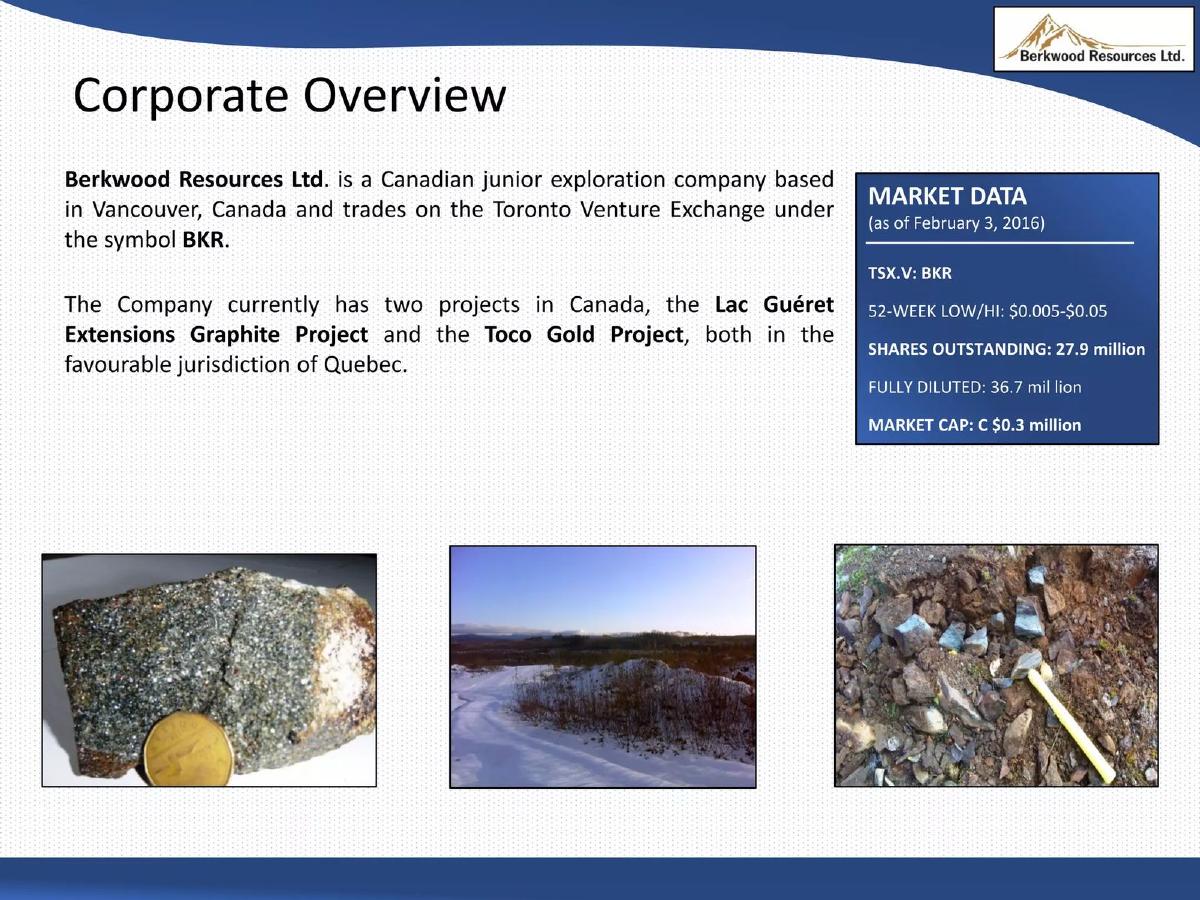
This slide provides the essential 'hard facts' about the company's corporate standing. It identifies Berkwood as a Vancouver-based junior exploration company. The most striking data point is the Market Data box on the right. As of February 3, 2016, the company had a Market Cap of C$0.3 million and a 52-week low/high of $0.005-$0.05 . With 27.9 million shares outstanding and 36.7 million fully diluted, the company was clearly in a micro-cap, high-risk category. The slide also introduces the two core projects: Lac Guéret Extensions (Graphite) and Toco Gold (Gold), both located in Quebec.
Slide 3: Lac Guéret Extensions Project - Location and Access
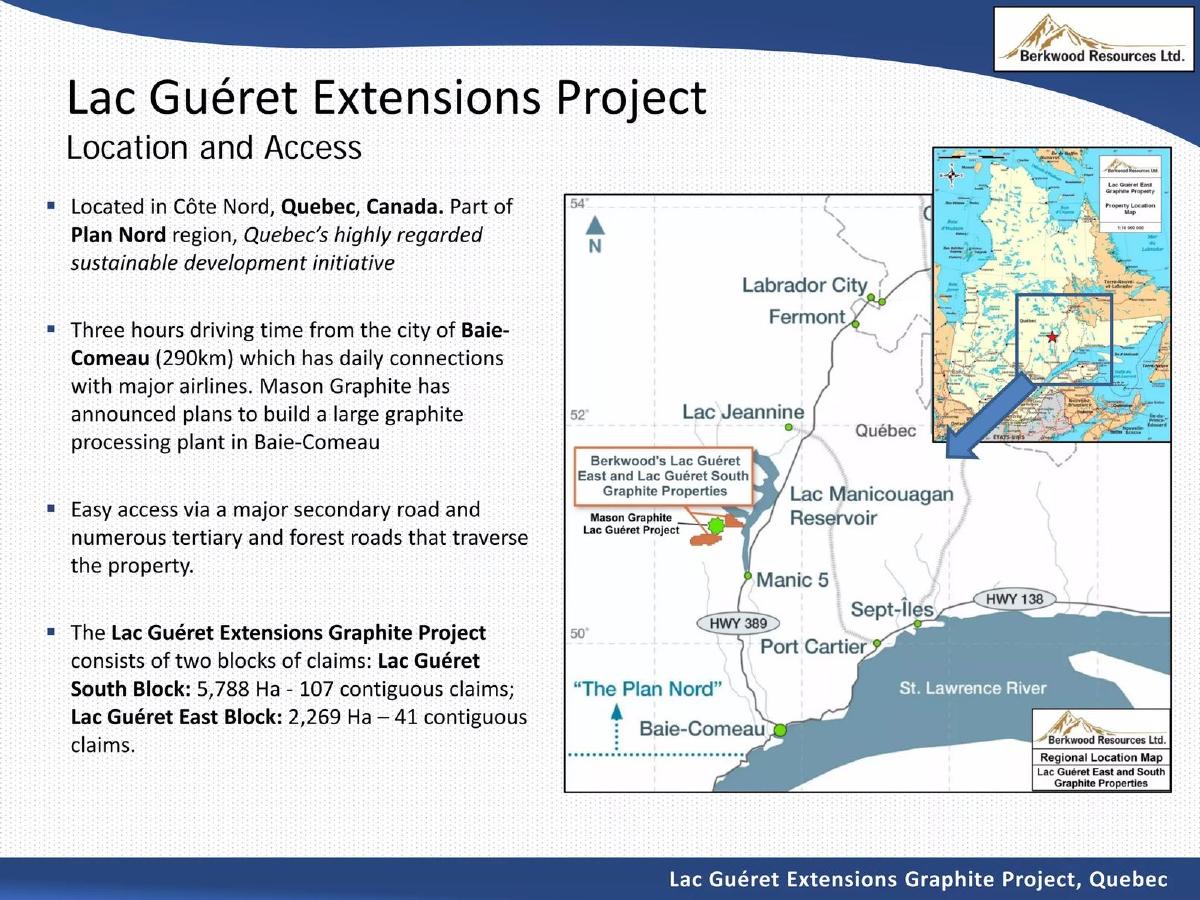
Junior miners live and die by infrastructure. Berkwood uses this slide to highlight that their graphite project is part of Quebec’s Plan Nord , a government initiative for sustainable development. Key logistical points include a three-hour drive from Baie-Comeau (290km) and access via secondary and forest roads. The slide quantifies the land holdings: the South Block (5,788 Ha) and the East Block (2,269 Ha) . By emphasizing the proximity to a planned processing plant in Baie-Comeau, Berkwood attempts to de-risk the eventual 'path to market' for any ore they might find.
Slide 4: The Exploration Target (The Mason Graphite Proxy)
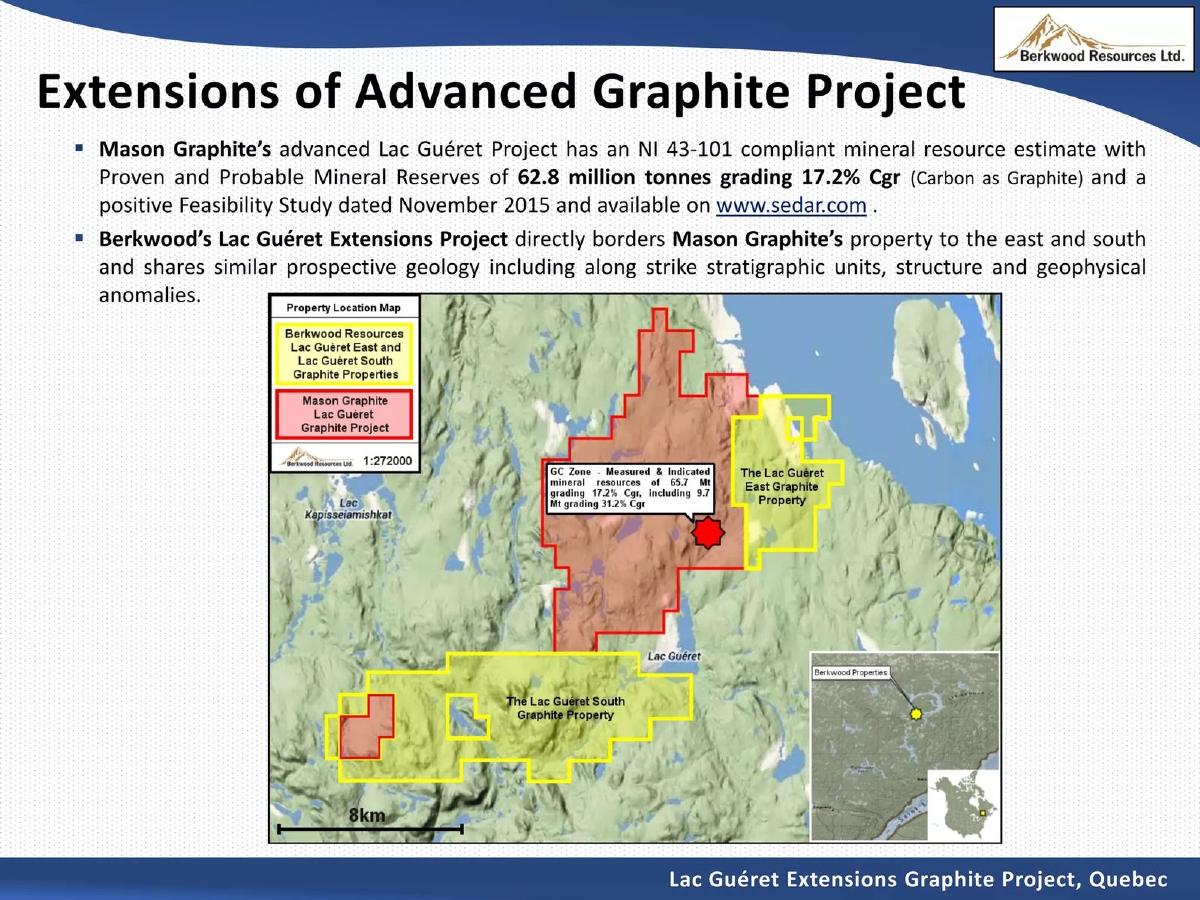
This is the 'anchor' slide for the graphite thesis. Because Berkwood does not yet have its own proven reserves, it uses the neighboring Mason Graphite Project as a benchmark. It notes that Mason’s GC Zone is one of the highest-grade deposits in the world, with 62.875MT of Proven+Probable reserves at 17.2% Cg . The slide details Mason’s 2015 Feasibility Study, which showed an NPV(8%) of C$352M and an IRR of 34.3% . The strategy here is clear: Berkwood is telling investors that if they missed out on Mason, Berkwood owns the land right next door with similar geological anomalies.
Slide 5: Ground Geophysics Survey (MAG-EM)
Slide 5 moves into technical validation. It summarizes the results of a January 2016 survey. The company identified two main zones. Zone 1 is described as having two limbs over 2,000 meters long, while Zone 2 consists of two parallel limbs measuring 1,000 meters in length. Crucially, the text states these anomalies are 'similar in strength and occur in the same geological units as the Mason Graphite zones.' This is the technical 'hook' intended to justify a drilling program.
Slide 6: Toco Gold Project Summary
The deck shifts to the secondary asset, the Toco Gold Project. This project consists of 2,400 Ha across 45 claims . Like the graphite project, the value here is framed by proximity to others. It is adjacent to Visible Gold Mines’ Project 167 . The slide mentions a 2014 discovery of high-grade Au-Ag-Cu-Zn boulders nearby. By positioning themselves in a 'hot' exploration district with new all-season road access, Berkwood suggests that the Toco project provides 'optionality' for investors beyond just graphite.
Slide 7: Future Plans
The final slide in this set addresses the company's forward-looking strategy. It is remarkably candid, stating that Berkwood is 'seeking new business opportunities to rebuild the company' following management changes. For the graphite project, the plan is to conduct trenching and drilling to test the anomalies identified in Slide 5. However, there is a major caveat: these plans are 'subject to financing.' This confirms that the company was effectively out of cash and using this deck to solicit the funds necessary to execute its exploration plan.
What Berkwood Resources Does Well
The deck excels at 'Closeology.' In the world of junior mining, being next to a major discovery is a powerful marketing tool. By providing detailed metrics on Mason Graphite’s feasibility study (Slide 4), Berkwood gives investors a 'blue sky' scenario of what success could look like. They also do a good job of highlighting jurisdictional safety . By repeatedly mentioning Quebec’s 'Plan Nord' and specific road access, they address the common investor fear that a discovery might be 'stranded' in a region with no way to transport the ore.
What is Missing from the Deck
The most glaring omission is a Team Slide . In micro-cap mining, the track record of the geologists and the CEO is often more important than the land itself. The deck mentions 'recent changes in senior management' but fails to name who these people are. Furthermore, there is no Capital Ask . While it mentions being 'subject to financing,' it doesn't state how much they are looking to raise or how that money would be allocated (e.g., how many meters of drilling C$500k would buy). Finally, there is no Timeline . Investors have no idea if the 'Future Plans' are intended for the next three months or the next three years.
Instructions for the Modern Founder
If you are a founder in a capital-intensive industry like mining or deep tech, there are several lessons to take from this deck:
Quantify the Neighbor: If your value is based on being part of an ecosystem (like being a plugin for a major platform or a miner next to a giant deposit), provide the hard numbers for that 'anchor' entity as Berkwood did on Slide 4. It provides a frame of reference for your potential valuation. · Address Infrastructure Early: Don't just talk about your product; talk about how your product gets to market. Berkwood’s focus on roads and nearby processing plants is a strong way to de-risk a project in the eyes of an investor. · Don't Hide Management Changes: Berkwood mentioned management changes but didn't introduce the new team. If you are 'rebuilding,' you must sell the vision and the pedigree of the people doing the rebuilding. A 'Team' slide is non-negotiable. · Be Specific with the Ask: Never end a deck with a vague 'subject to financing' statement. Tell the investor exactly what you need and what milestones that money will hit. For an exploration company, this means stating the number of drill holes or the cost per meter.
Frequently asked questions
- What is the primary commodity focus of Berkwood Resources?
- Based on the presentation, Berkwood Resources is diversified across two main commodities: graphite and gold. The Lac Guéret Extensions project focuses on large-flake, high-quality graphite, while the Toco Gold Project targets gold, silver, copper, and zinc. The deck devotes more technical detail to the graphite anomalies, suggesting it was the lead priority in 2016.
- How does Berkwood justify the potential of its graphite claims?
- Berkwood uses a 'proxy' or 'closeology' argument. Slide 4 details the success of the neighboring Mason Graphite Project, citing its high-grade reserves and robust feasibility study (NPV of C$352M). Berkwood then shows geophysical survey results in Slide 5 that suggest their own anomalies occur in the same geological units as Mason’s high-grade zones.
- What was the financial state of the company at the time of the deck?
- The company was in a distressed or highly speculative state. Slide 2 lists a market cap of just C$0.3 million and a share price that had dipped as low as half a cent ($0.005). With 27.9 million shares outstanding, the company lacked the balance sheet to fund major drilling without significant new investment.
- What infrastructure advantages does the company claim?
- The company emphasizes its location within Quebec’s 'Plan Nord' region. Slide 3 notes that the graphite project is three hours from Baie-Comeau, which has daily airline connections and a planned graphite processing plant. Slide 6 mentions that the gold project is accessible via a new all-season road, which is critical for reducing exploration costs.
- Who is leading Berkwood Resources according to the deck?
- The deck does not identify any specific individuals. Slide 7 mentions 'recent changes in senior management' and a desire to 'rebuild the company,' but it omits the names, backgrounds, or track records of the new leadership team. This is a significant omission for an investor presentation.