Belong Health’s Series A deck represents a shift in healthcare venture strategy: moving from direct-to-consumer insurance disruption to a partnership-heavy infrastructure model. The company raised $40M by pitching a platform that allows regional health systems to launch and operate Dual-Eligible Special Needs Plans (D-SNPs) without building the clinical or technological back-end from scratch. The deck emphasizes a massive market opportunity—$1B in new annual premiums every 10 days—and highlights a signed anchor partnership with MVP Health Care. While significant portions of the financial and…
Key takeaways
- The company identifies a massive market velocity, claiming 10,000 'age-ins' per day add $1B in new annual premiums every 10 days (Slide 9).
- Belong Health positions itself as a 'full-stack health plan operating platform' that supplements existing regional infrastructure (Slide 13).
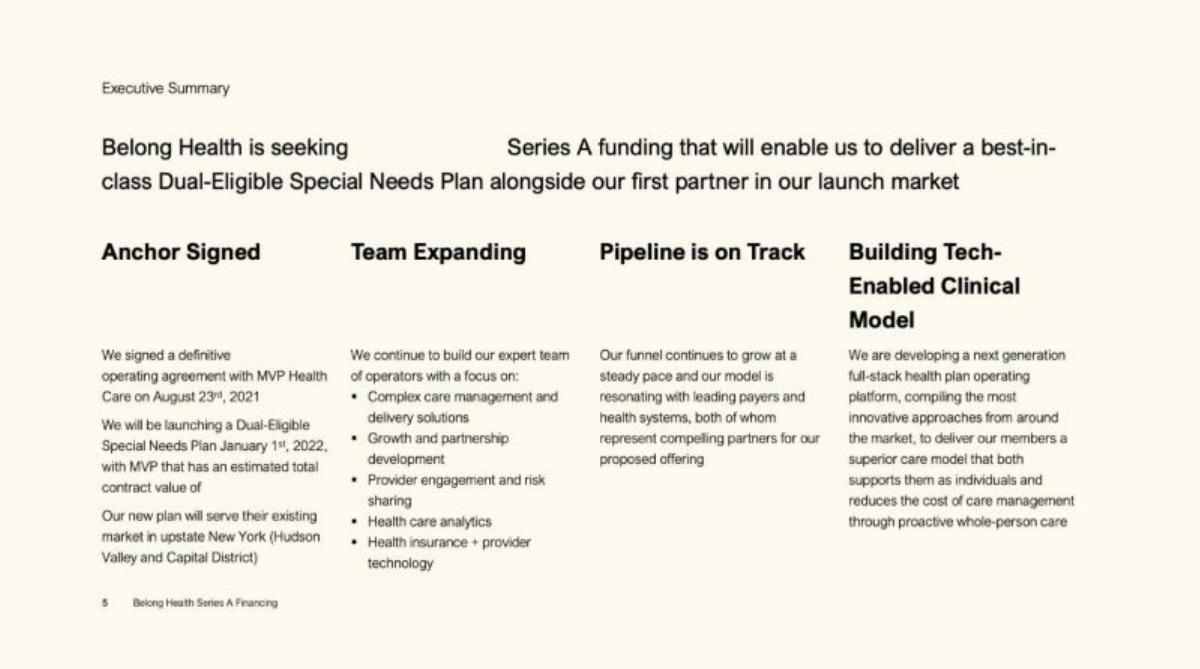
- A definitive operating agreement was signed with MVP Health Care on August 23rd, 2021, serving as the critical 'Anchor' for the Series A (Slide 5).
- The clinical model focuses on five pillars: Care Coordination, Care Management, Transitions of Care, Social Determinants, and Behavioral Health (Slide 15).
- The technology strategy relies on a 'Data Lake' that ingests CMS, Medicaid, and partner claims data to power real-time clinical alerts (Slide 17).
- The deck highlights a gap in the market, showing that 'innovative healthcare models' have small penetration relative to the 62.7 million Medicare-eligible individuals (Slide 11).
- The platform is designed to launch a Dual-Eligible Special Needs Plan by January 1st, 2022, in upstate New York (Slide 5).
- The technical architecture slide details a complex ingestion-to-user-experience flow, including an 'AI Driven Rules Engine' (Slide 19).
Introduction and Executive Summary
Slide 1: Title Slide
The deck opens with a minimalist title slide: Belong Health Series A Materials , dated September 2021. It establishes a professional, corporate tone suitable for the highly regulated healthcare insurance space. The branding is understated, focusing on the company name and the specific purpose of the presentation.
Slide 3: Agenda
The agenda outlines a standard institutional pitch flow: Introduction, Market Overview, Belong Health Offering, Anchor Launch Overview, Pipeline Update, Financial Forecast, and Appendix. This structure suggests a deck designed for deep-dive due diligence rather than a quick 5-minute introductory pitch.
Slide 5: Executive Summary
This is the most information-dense slide in the introductory section. It explicitly states that Belong Health is seeking Series A funding to deliver a Dual-Eligible Special Needs Plan (D-SNP). The slide highlights four key pillars: Anchor Signed (MVP Health Care on August 23rd, 2021), Team Expanding (focusing on complex care and health care analytics), Pipeline is on Track , and Building Tech-Enabled Clinical Model . Notably, it mentions a launch date of January 1st, 2022, for their first plan in upstate New York.
Market Opportunity
Slide 7: Market Overview Transition
A simple transition slide marking the beginning of the market thesis section.
Slide 9: Belong Health Addressable Market
Belong Health uses a 'velocity' metric to describe their market rather than a static TAM. They claim Age-ins add $1B in new annual premium to the market every 10 days . This calculation is based on an assumption of 10,000 age-ins per day and an average PMPM (Per Member Per Month) premium of $800. This slide effectively communicates the scale and the 'automatic' growth of the Medicare sector.
Slide 11: Innovative Healthcare Models
This slide provides a competitive landscape and market penetration analysis. It contrasts Next Generation Insurance Models (like Oscar, Devoted, and Clover) with Advanced Practice Provider Models (like ChenMed and Oak Street Health). The central graphic shows that out of 62.7 million Medicare Eligible individuals, only 26.4 million are in Medicare Advantage, and the 'innovative' players only capture a tiny fraction of that (e.g., Oscar at 3,000 members, Devoted at 39,000). This suggests a massive 'white space' for a platform like Belong Health to enable traditional players to compete with these new entrants.
The Belong Health Offering
Slide 13: Belong Health Platform
This slide defines the product-market fit. Belong Health describes itself as a full-stack health plan operating platform . The visual shows a sandwich model where Belong Health provides the Clinical Management and Care Delivery Assets , sandwiched between Health Plan Infrastructure and Analytics and Technology . The stated goal is to supplement a regional partner’s existing infrastructure rather than replacing it entirely.
Slide 15: Clinical Management
The clinical strategy is broken down into five functional areas: Care Coordination (comprehensive member data), Care Management (preventative care), Transitions of Care (managing hospital-to-home moves), Social Determinants (food security, transportation, housing), and Behavioral Health (virtual and in-person services). This slide emphasizes 'proactive whole-person care' as a means to reduce the cost of care management.
Slide 17: Analytics and Technology
This slide details the data strategy. The Data Platform ingests CMS FFS, Medicaid, and partner claims data into a data lake. The Analytics Platform is designed to provide 'the right data at the right time' to avoid overwhelming users. Finally, the Technology Infrastructure is described as a cloud-native architecture using AI and machine learning to power real-time alerts for care teams.
Slide 19: Technology Infrastructure (Diagram)
A detailed technical schematic shows the flow of data from Administrative, Clinical, and Provider sources into an Integration & Orchestration Platform . It highlights an Enterprise Master Patient Index (EMPI) , a Data Management Platform , and a Care Management Platform featuring an AI Driven Rules Engine . This slide is intended to prove to technical auditors that the 'full-stack' claim is backed by a sophisticated architecture.
Traction and Redactions
Slide 21: Anchor Launch Overview Transition
A transition slide for the section detailing the MVP Health Care partnership. The specific details of this launch are largely contained in the executive summary on slide 5, as the subsequent detailed slides are not provided in this set.
Slide 23: Pipeline Update Transition
Slide 25: Pipeline Update (Redacted)
This slide is marked CONTENT REDACTED . It shows a timeline moving from 'Early Conversation' to 'Moving Towards LOI' and 'LOI Near Completion.' In a live pitch, this would list specific health systems and payers Belong Health was negotiating with.
Slide 27: Financial Forecast (Redacted)
This slide is marked SECTION REDACTED . This would typically contain 3-5 year projections for member growth, PMPM revenue, and EBITDA margins.
Slide 29: Appendix (Redacted)
This slide is marked SECTION REDACTED . Appendices usually contain deeper dives into clinical outcomes, actuarial assumptions, or detailed bios of the leadership team.
What Works and What is Missing
What Works
The 'Velocity' Market Slide: Slide 9 is a masterclass in framing. Instead of saying 'Medicare is a $XXX billion market,' they frame it as a $1B increase every 10 days. This creates a sense of urgency and inevitability for investors.
The Partnership Model: By positioning themselves as a 'supplement' to regional partners (Slide 13) rather than a direct competitor to UnitedHealthcare or Humana, Belong Health lowers its customer acquisition cost and regulatory hurdle. This 'enablement' play was a very popular VC thesis in 2021.
Technical Depth: Slide 19 provides enough architectural detail to move past the 'hand-wavy' stage of a tech pitch. It shows they have thought through the data ingestion and orchestration challenges inherent in healthcare.
What is Missing
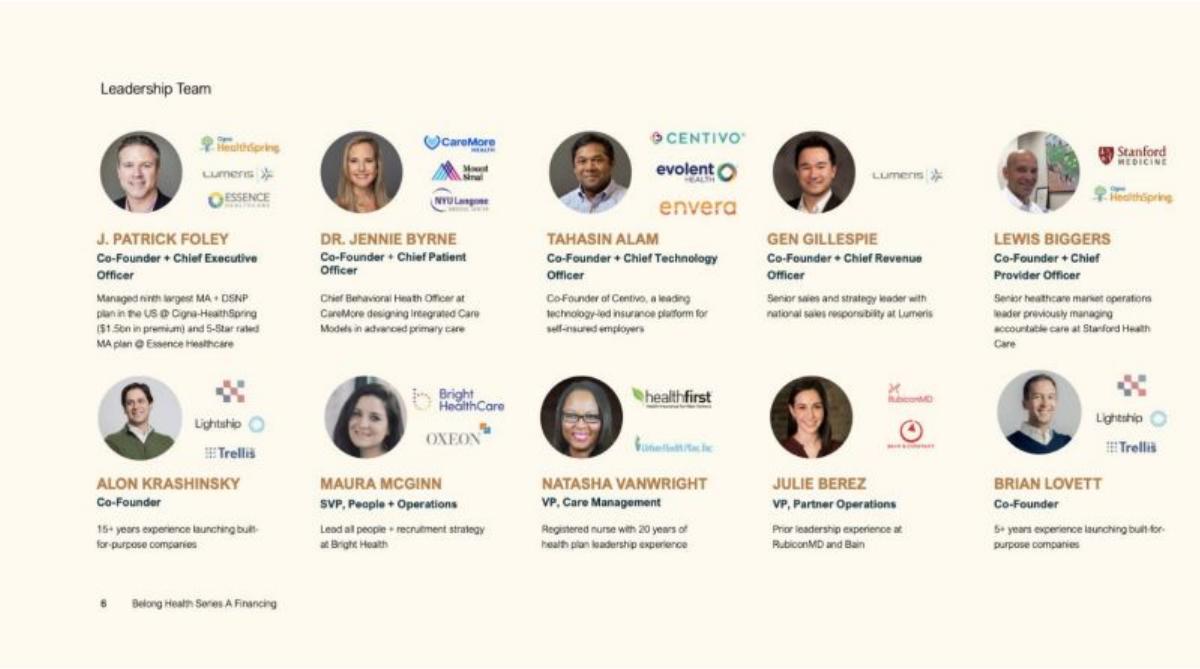
Team Bios: In the provided 15 slides, there is no dedicated team slide. For a Series A in a complex, regulated industry like healthcare, the pedigree of the founders is often the deciding factor. While slide 5 mentions 'operators,' it doesn't name them or their previous exits/experience.
Unit Economics: There is no mention of the specific revenue share or fee structure between Belong Health and its partners. Investors need to know if this is a SaaS-like fee, a percentage of premiums, or a shared-savings model.
The 'Ask': While slide 5 says they are 'seeking Series A funding,' the specific dollar amount and the planned use of proceeds are not listed on the slides provided. (External data indicates the round was $40M).
Founder Takeaways
1. Frame your market through growth, not just size. If you are in a sector with strong demographic tailwinds, use a 'velocity' metric like Belong Health’s '$1B every 10 days' to make the opportunity feel active and urgent.
2. Use the 'Sandwich' diagram for platform plays. If your startup sits between a legacy industry and a new technology, use a visual like Slide 13 to show exactly where you fit in the existing value chain. It clarifies your boundaries and your value-add in one glance.
3. Validate with an 'Anchor.' A Series A is often won or lost on the strength of a single definitive agreement. Belong Health leads with their MVP Health Care deal on the executive summary, which provides the necessary social proof to justify a $40M round.
4. Don't shy away from technical complexity. In B2B infrastructure, a high-level flow chart (Slide 19) that includes specific components like 'EMPI' or 'API Gateway' signals to investors that you aren't just a marketing wrapper on top of legacy software.
Frequently asked questions
- What is Belong Health's core business model?
- Belong Health operates as a B2B2C platform. Instead of being a standalone insurance company, it provides the 'full-stack' infrastructure—including clinical management, care delivery assets, and data analytics—to regional health systems and payers. This allows these partners to offer specialized Medicare plans, like D-SNPs, using Belong Health’s technology and clinical expertise to manage complex member populations.
- How does Belong Health define its market opportunity?
- The company focuses on the 'age-in' phenomenon of the U.S. population. According to slide 9, 10,000 people become Medicare-eligible every day. With an average Per Member Per Month (PMPM) premium of $800, this adds $1 billion in new annual premiums to the market every 10 days, creating a massive, recurring tailwind for Medicare Advantage service providers.
- Who is Belong Health's first major partner?
- The deck identifies MVP Health Care as the anchor partner. A definitive operating agreement was signed in August 2021. The partnership aimed to launch a Dual-Eligible Special Needs Plan in upstate New York (specifically the Hudson Valley and Capital District) by January 2022.
- What are the key components of their technology stack?
- The technology stack is divided into four layers: Health Plan Infrastructure, Clinical Management, Care Delivery Assets, and Analytics/Technology. It features a data lake for ingesting diverse sets (CMS, Medicaid, claims), an AI-driven rules engine for care management, and a cloud-native architecture designed for interoperability with existing partner platforms.
- What is missing from the public version of this pitch deck?
- The public version of the deck has several critical omissions. Slide 25 (Pipeline Update), Slide 27 (Financial Forecast), and Slide 29 (Appendix) are entirely redacted. Additionally, while the 'Team Expanding' section on slide 5 mentions hiring priorities, there is no dedicated team slide in the provided 15 slides to showcase the founders' specific backgrounds.