Belezen is a digital marketplace platform designed to capitalize on Brazil's massive beauty industry, which the deck values at $40 billion per year (Slide 3). The company proposes a three-sided ecosystem connecting consumers, service providers (dubbed 'Zenistas'), and beauty brands. The business model is diversified, relying on service commissions ranging from 10% to 15%, plus a 10% customer fee, alongside B2B revenue streams like product placement and counselor page rentals (Slide 11). While the deck provides strong market-specific context regarding Brazilian consumer habits and infrastructu…
Key takeaways
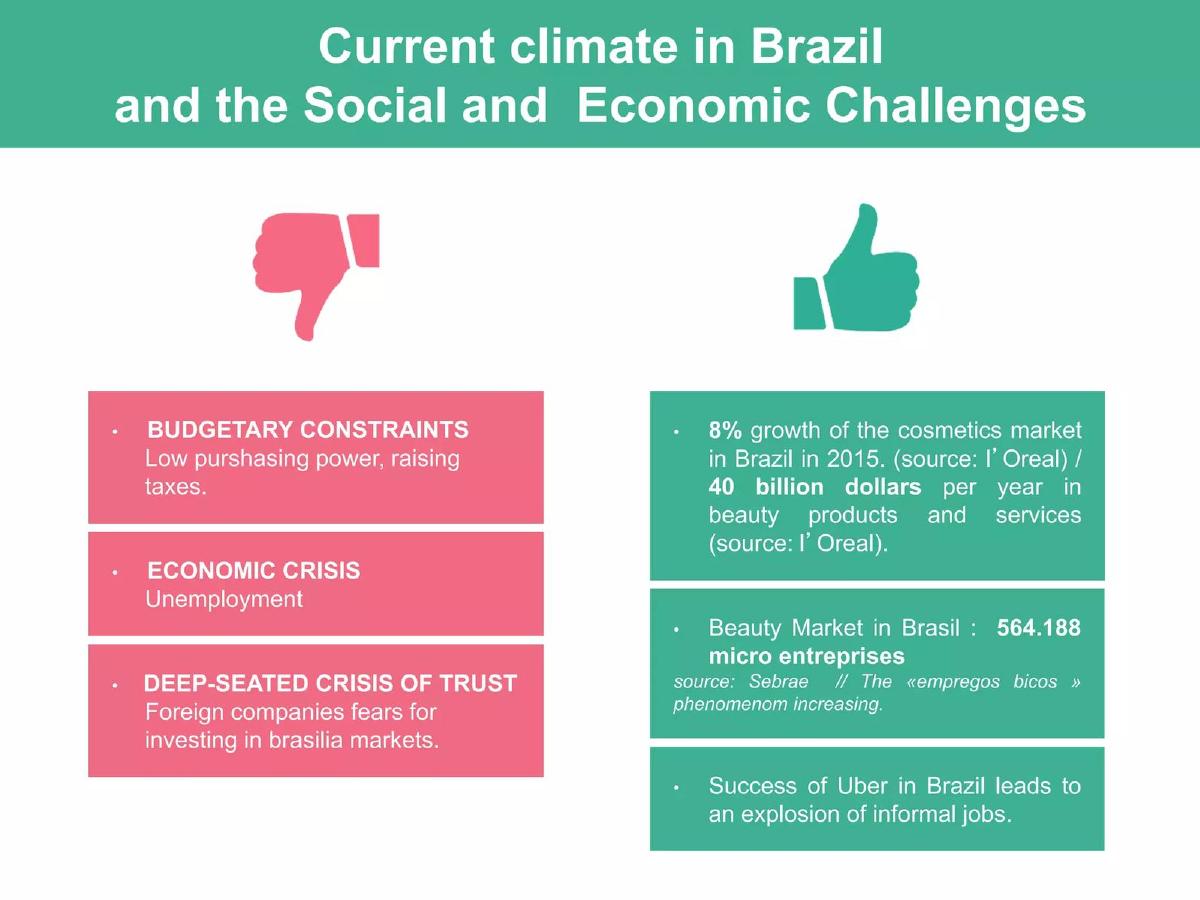
- The Brazilian beauty market is valued at $40 billion per year in products and services as of 2015 (Slide 3).
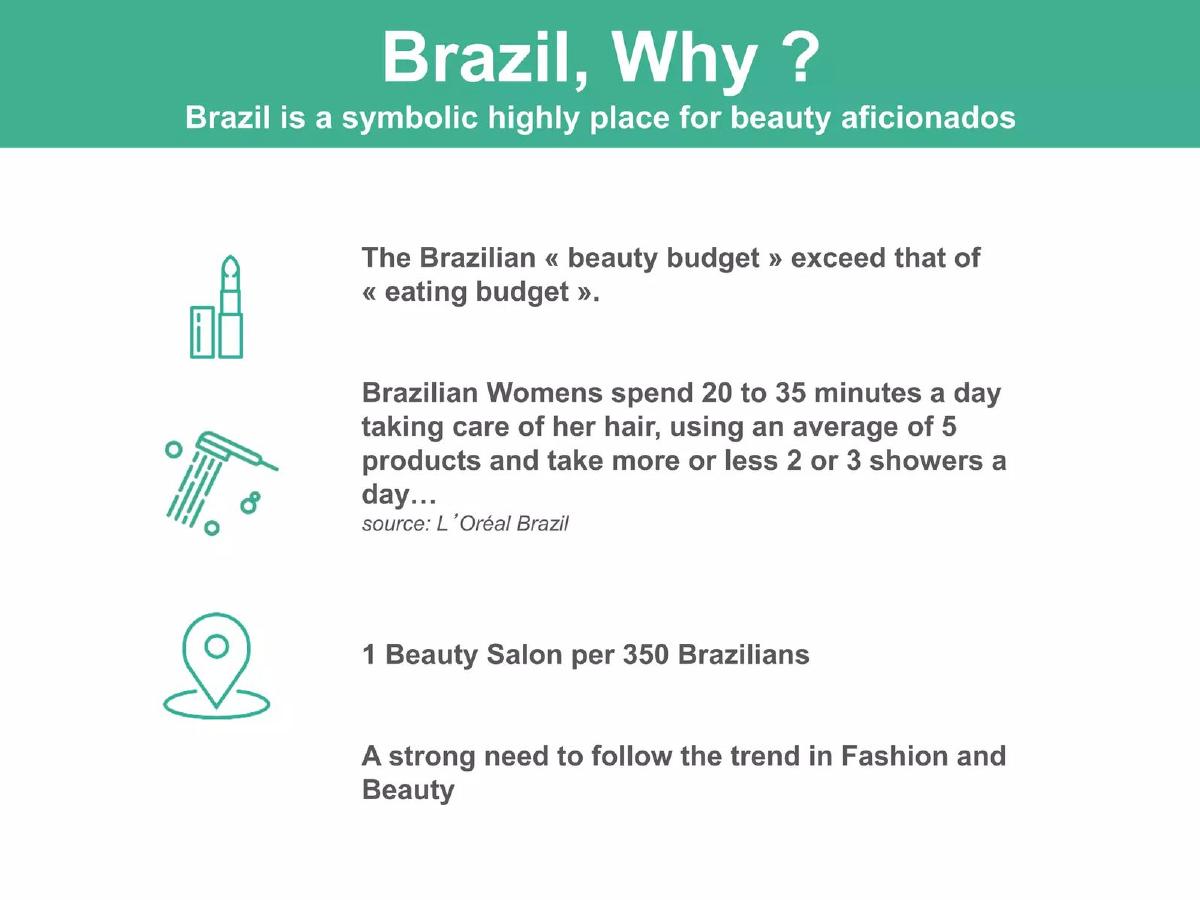
- Brazilian consumers prioritize beauty highly, with a 'beauty budget' that reportedly exceeds their 'eating budget' (Slide 2).
- The platform targets 564,188 micro-enterprises in the Brazilian beauty sector (Slide 3).
- Belezen utilizes a tiered commission model: 10% for salons and 15% for independent professionals or concierge services (Slide 11).
- A 10% service fee is charged directly to the customer on top of the professional commission (Slide 11).
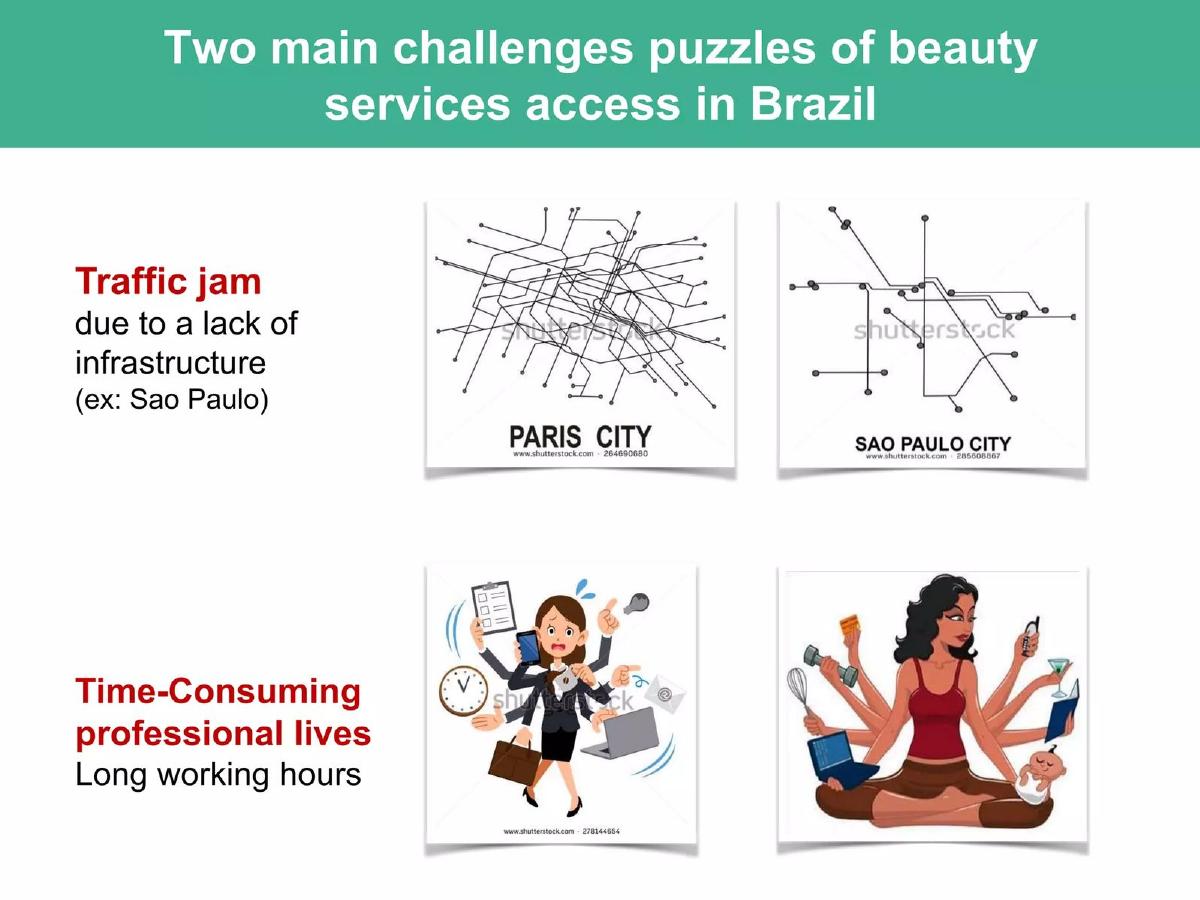
- The deck identifies infrastructure issues, specifically traffic jams in Sao Paulo, as a primary driver for on-demand home services (Slide 4).
- Revenue is supplemented by a B2B model charging €10 per month for brand product counselor pages (Slide 11).
- The team slide is entirely anonymous, displaying only the French and Brazilian flags and the French Tech logo (Slide 12).
Market Context and Opportunity
Slide 1: Title Slide
The deck opens with the Belezen logo—a red speech bubble—and the subtitle 'A digital project for the Beauty market in Brazil.' The background image features a sunset view of Rio de Janeiro, immediately grounding the project in its specific geographic target.
Slide 2: Brazil, Why?
This slide establishes the cultural importance of beauty in Brazil. It claims the Brazilian 'beauty budget' exceeds the 'eating budget.' Citing L'Oréal Brazil, it notes that women spend 20 to 35 minutes a day on hair care, use an average of 5 products, and shower 2 to 3 times daily. A key infrastructure metric is provided: 1 Beauty Salon per 350 Brazilians, indicating a highly fragmented but dense service market.
Slide 3: Current Climate and Challenges
A 'thumbs down' and 'thumbs up' comparison summarizes the macro environment. Negative factors include budgetary constraints, low purchasing power, and an economic crisis. Positive factors include 8% growth in the cosmetics market (2015), a $40 billion annual market size, and the existence of 564,188 micro-enterprises. The slide also mentions the 'success of Uber in Brazil' as a catalyst for the explosion of informal, on-demand jobs.
Slide 4: Two Main Challenges
Belezen identifies the 'puzzles' of beauty service access. The first is 'Traffic jam due to a lack of infrastructure,' specifically comparing the complex transit maps of Paris and Sao Paulo. The second is 'Time-Consuming professional lives,' illustrated by stock imagery of busy women multitasking. The implication is that users cannot easily travel to salons, creating a need for mobile services.
The Solution and Product
Slide 5: Belezen Digital Solution (1/2)
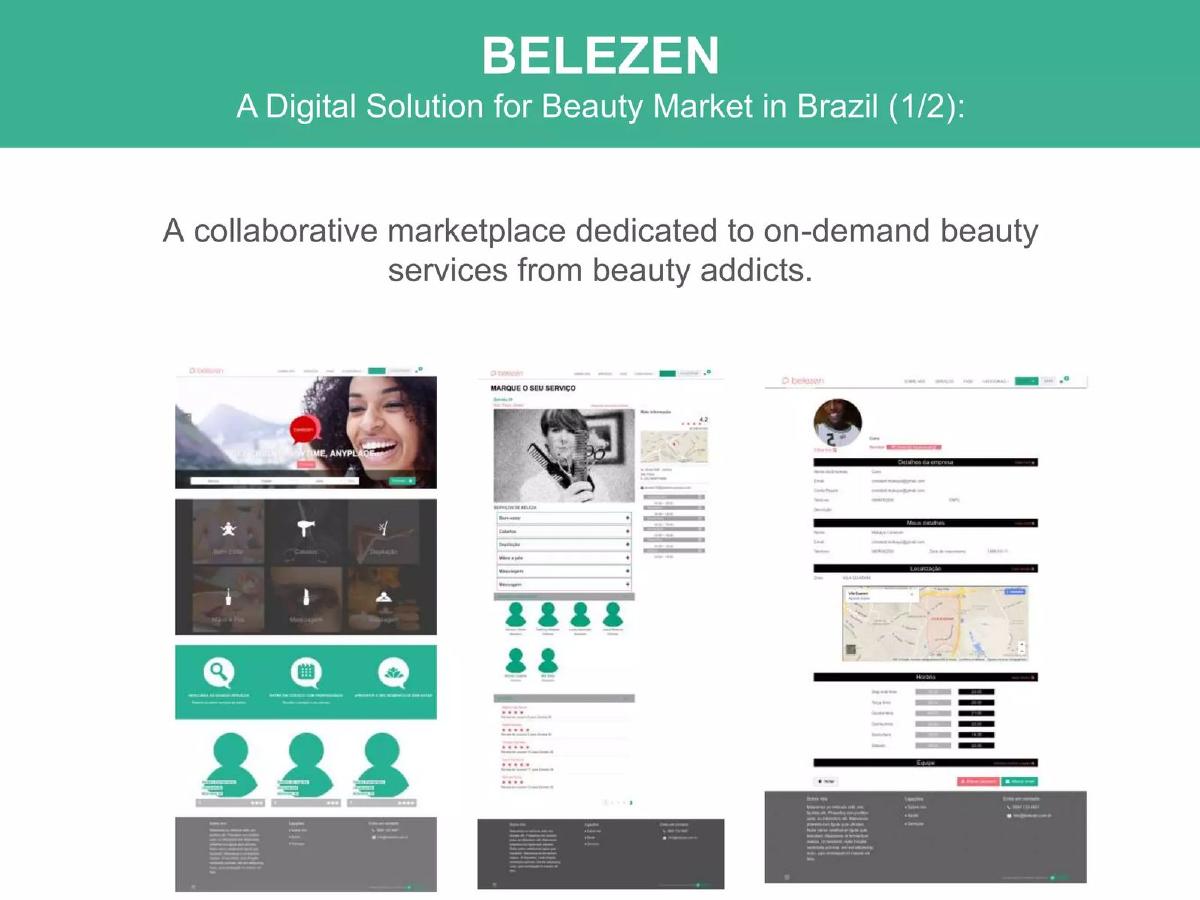
This slide defines the product as a 'collaborative marketplace dedicated to on-demand beauty services from beauty addicts.' It shows three low-resolution screenshots of a web interface: a landing page with service categories (hair, waxing, massage), a professional profile page with ratings, and a booking/map view.
Slide 6: Belezen Digital Solution (2/2)
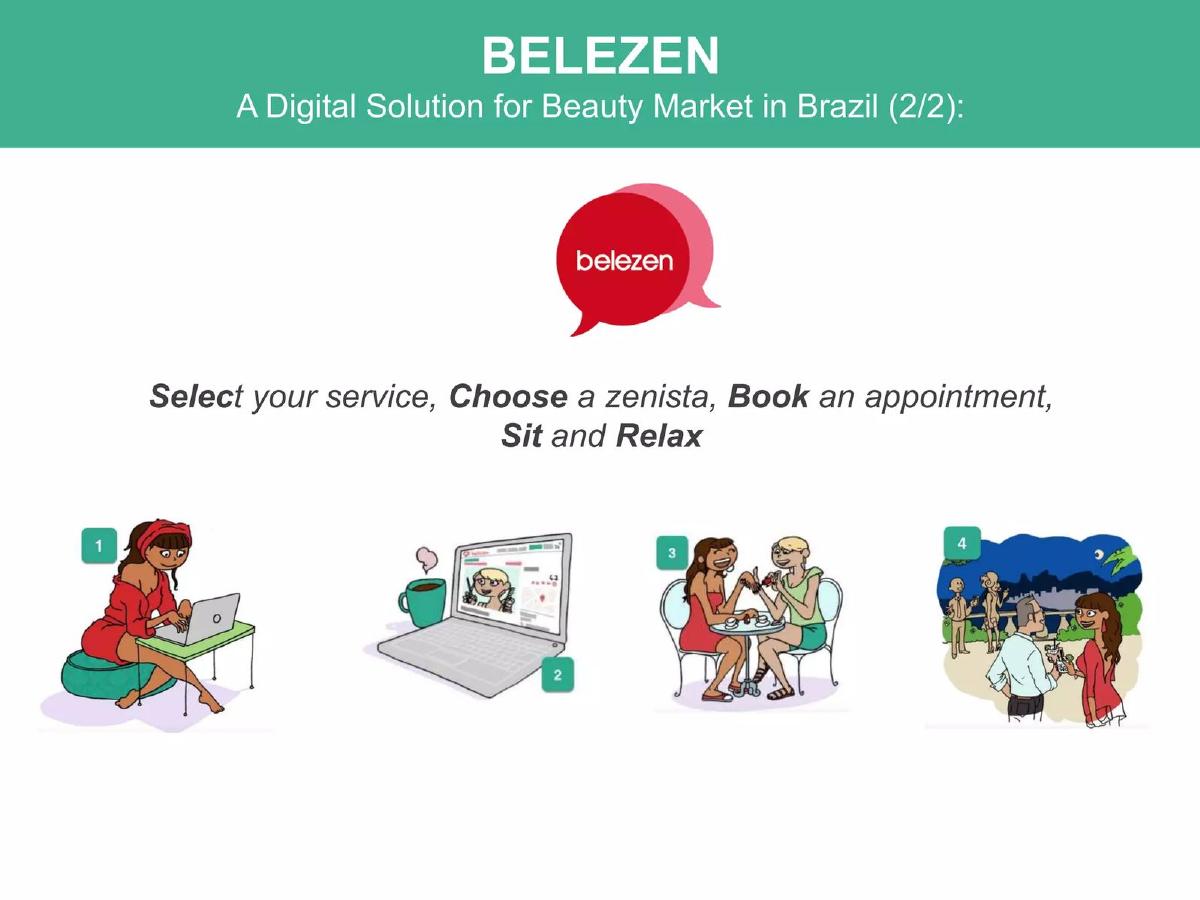
A four-step user journey is illustrated with cartoons: 1. Select service, 2. Choose a 'zenista', 3. Book an appointment, 4. Sit and Relax. The process is framed as a simple, consumer-facing web or mobile experience.
Slide 7: Win-Win Opportunities for Everyones
A circular diagram illustrates the three-sided marketplace. 'Zenistas' provide services to 'Users' for extra income. 'Users' provide visibility to 'Brands.' 'Brands' provide new products and experiences to 'Users' and form partnerships with 'Zenistas' who act as a 'Sales Force.' This suggests a deeper B2B2C play than a simple service directory.
Slide 8: Win-Win for Users
This slide details user benefits: booking anyplace (home/work), booking anytime, tailored services for all budgets, access to a database of professionals, and a system for reviews and ratings.
Slide 9: Win-Win for Zenistas
For service providers, the platform offers schedule and geographic management, free registration, and profile building with photos. It identifies three registration tiers: Apaixonada, Professionel, and Salon, allowing the platform to capture both amateur and professional supply.
Slide 10: Win-Win for Brands
Brands are offered a way to target new clients, a new channel for product promotion/distribution, and a mechanism to gather consumer opinions about their products.
Business Model and Execution
Slide 11: Business Model
The revenue model is split into three categories. First, commissions: 10% for salons, 15% for independent professionals, and 15% for concierge services, plus a 10% fee charged to the customer. Second, communication operations: product placements and sponsored e-mails. Third, brand product counselors: charging €10 per month for a counselor page. It notes that Natura Brasil alone employs 1 million product counselors, highlighting the scale of the potential B2B user base.
Slide 12: Team
This is a major weakness in the deck. The slide contains no names, photos, or credentials. It only displays the French flag, the Brazilian flag, and the 'French Tech' logo. This suggests a cross-border founding team but provides zero evidence of their ability to execute.
Slide 13: Contact
The final slide provides social handles and URLs: @belezen, www.belezen.com.br, and www.blzn.com.br. No phone numbers or specific email addresses are listed.
What Belezen Does Well
The deck excels at market justification. By linking the 'Uberization' of the Brazilian economy to specific infrastructure failures (traffic) and cultural habits (high beauty spend relative to food), the founders build a compelling 'Why Now' case. The inclusion of the 'Brand' pillar in the three-sided marketplace is a sophisticated touch, recognizing that in the beauty industry, product sales and service delivery are inextricably linked. The business model slide is also refreshingly specific, providing exact percentage splits and even a monthly Euro-denominated subscription fee for brand counselors.
What is Missing from the Deck
The omissions in this deck are significant enough to stall a fundraising process. The Team: As noted, Slide 12 is effectively a placeholder. Investors back people, not just ideas, and an anonymous team is a non-starter. The Ask: There is no mention of how much money the company is raising, what the valuation is, or how the funds will be allocated. Traction: There are no metrics regarding current users, completed bookings, or revenue generated. It is unclear if the screenshots on Slide 5 represent a live product or a mockup. Competition: The deck ignores the competitive landscape, which is particularly crowded in the Brazilian on-demand beauty space. Roadmap: There is no timeline for expansion or product development.
Founder Takeaways
Quantify the 'Why Now': Belezen does a great job of using external market shocks (economic crisis, success of Uber) to justify their model. Founders should always look for these macro tailwinds. · Address Infrastructure: If your product solves a physical problem (like traffic), use data to prove it. The comparison between Paris and Sao Paulo transit maps is a strong visual argument for home-based services. · Diversify Revenue Early: Instead of just relying on a single commission, Belezen thought through how to monetize brands and counselors. This shows a deeper understanding of the industry ecosystem. · Never Hide the Team: Even if you are a first-time founder, list your names and relevant experience. Using flags instead of faces signals a lack of confidence or a project that hasn't truly started. · Include a Clear Ask: Every pitch deck must end with a clear statement of what you need from the investor. Without an 'Ask' slide, the deck is a presentation, not a pitch.
Frequently asked questions
- What is the primary problem Belezen is solving?
- Belezen addresses the difficulty of accessing beauty services in Brazil due to severe urban infrastructure issues and time constraints. Slide 4 highlights 'Traffic jams due to a lack of infrastructure' in cities like Sao Paulo and 'Time-consuming professional lives' with long working hours as the two main puzzles preventing easy access to traditional salons.
- How does Belezen make money?
- The company employs a multi-stream revenue model. It takes a 10-15% commission from service providers and charges a 10% fee to customers. Additionally, it generates B2B revenue through product placements, sponsored e-mailings, and a €10 monthly subscription fee for brand product counselors to host pages on the platform (Slide 11).
- Who are the 'Zenistas' mentioned in the deck?
- Zenistas are the service providers on the platform. Slide 9 categorizes them into three types: 'Apaixonada' (enthusiasts), 'Professionel' (independent professionals), and 'Salon' (established businesses). The platform provides them with tools to manage schedules and geographic zones while monetizing their expertise for free registration.
- What market data supports the Belezen business case?
- The deck cites L'Oréal Brazil and Sebrae as sources. Key data points include an 8% market growth in 2015, a total market size of $40 billion, and the fact that there is one beauty salon for every 350 Brazilians. It also notes that Brazilian women spend 20-35 minutes daily on hair care (Slides 2 and 3).
- What are the biggest risks in this pitch deck?
- The most significant risk is the total lack of team transparency; Slide 12 provides no names or bios, making it impossible to assess execution capability. Furthermore, the deck lacks a 'The Ask' slide, meaning investors do not know how much capital is needed or what milestones that capital will achieve.