Beem's 2022 Seed deck is a masterclass in narrative-driven positioning, successfully raising $4M by framing Augmented Reality (AR) as the inevitable solution to 'Zoom fatigue.' The presentation leans heavily on the psychological benefits of AR, claiming a 2x increase in visual attention and emotional intensity compared to standard video. While the deck excels at defining a clear 'Challenge' and 'Opportunity,' it is notably light on hard financial data, unit economics, and specific revenue models in the visible slides. Instead, it relies on the pedigree of a 20-person team and the massive proj…
Key takeaways
- The deck positions AR as a psychological necessity, claiming it stimulates 2x the visual attention and emotional intensity of standard video (Slide 7).
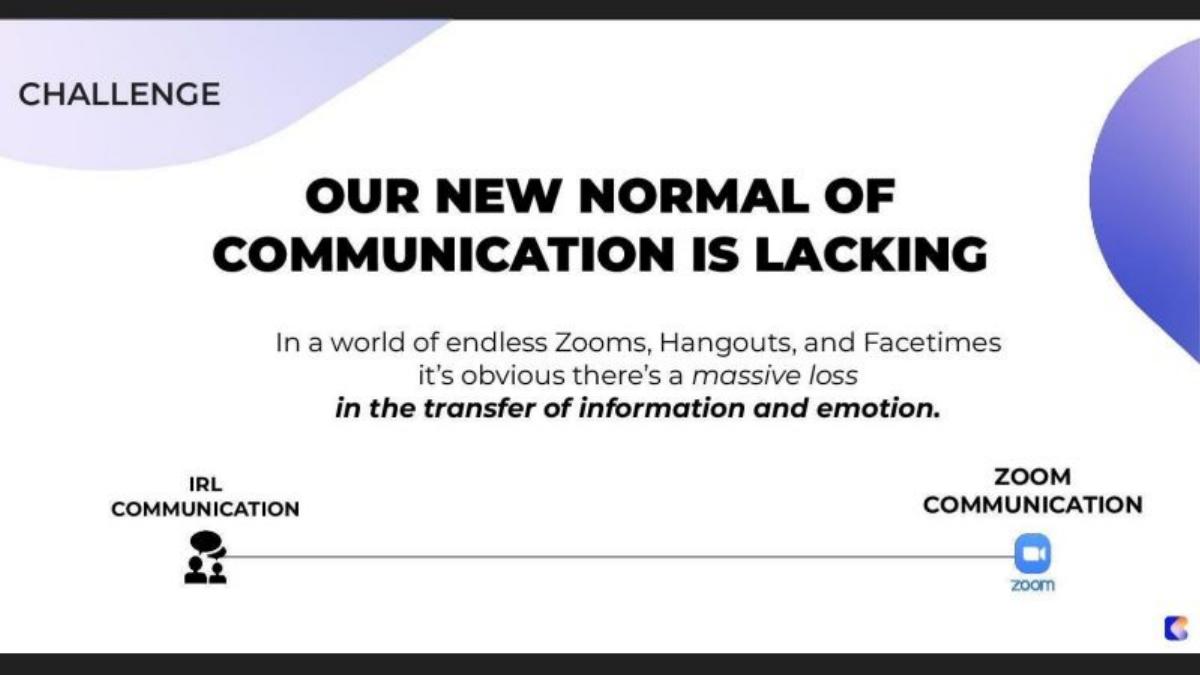
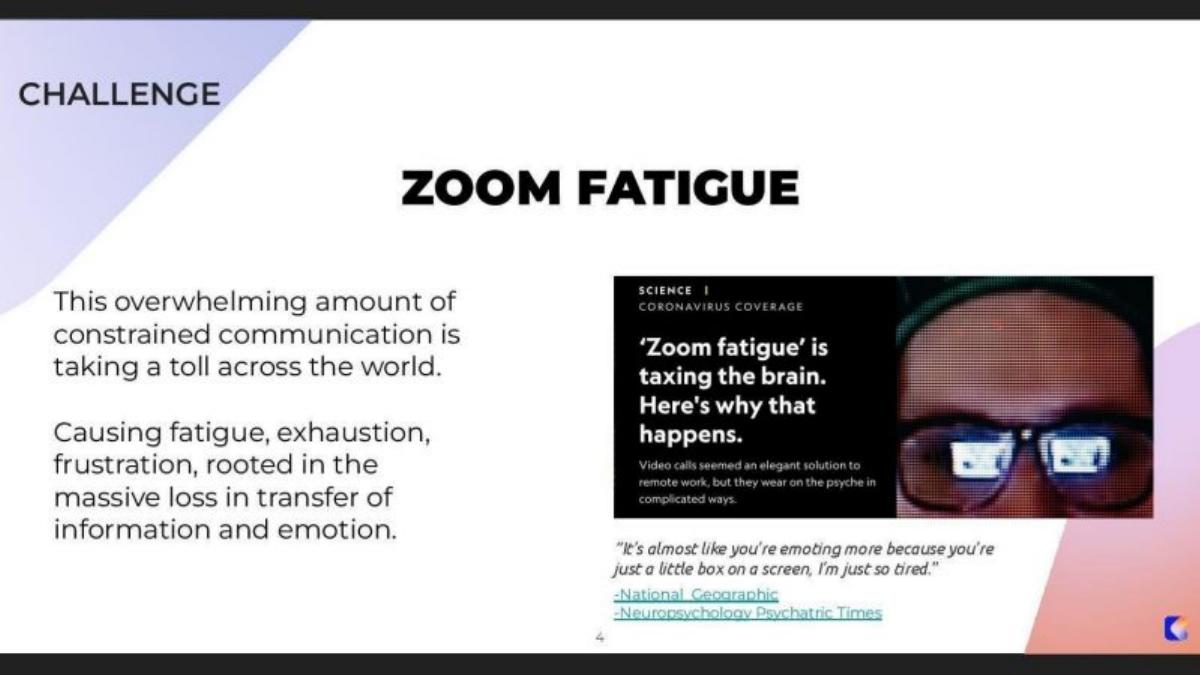
- Beem identifies the 'Challenge' as a massive loss in the transfer of information and emotion in current digital communication (Slide 3).
- The company claims its technology offers a 40% increase in the transfer of information and emotion compared to Zoom (Slide 11).
- Market sizing is aggressive, citing a $843bn video streaming market by 2027 and a $661bn AR/VR market by 2025 (Slide 17).
- The team slide highlights a 20-person staff across London, the US, and Russia, led by a founder with a background in physical commodities trading (Slide 21).
- The 'Use of Funds' slide outlines a 18-24 month roadmap focused on a consumer GTM strategy and 'Beem for Glasses' (Slide 23).
- The deck omits specific revenue figures, customer acquisition costs, or detailed unit economics in the provided slides.
- Beem positions itself as a software solution that creates 'clear utility' rather than 'animated novelties' (Slide 9).
The Narrative of Human Connection
Beem’s pitch deck is a textbook example of selling a 'future state' rather than just a product. In 2022, the term 'Metaverse' was at its peak hype, and Beem capitalized on this by framing their AR communication tool as the essential infrastructure for this new digital era. The deck focuses less on the 'how' of the technology and more on the 'why' of the human experience, specifically targeting the limitations of 2D video conferencing.
Slide 1: The Hook
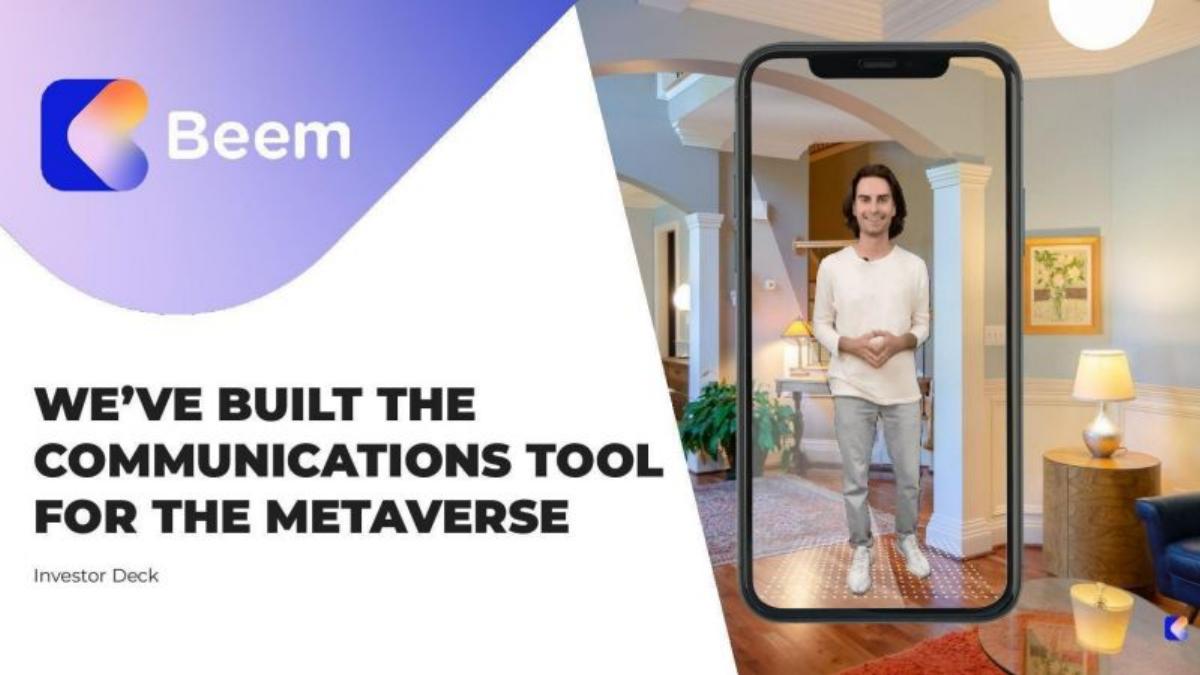
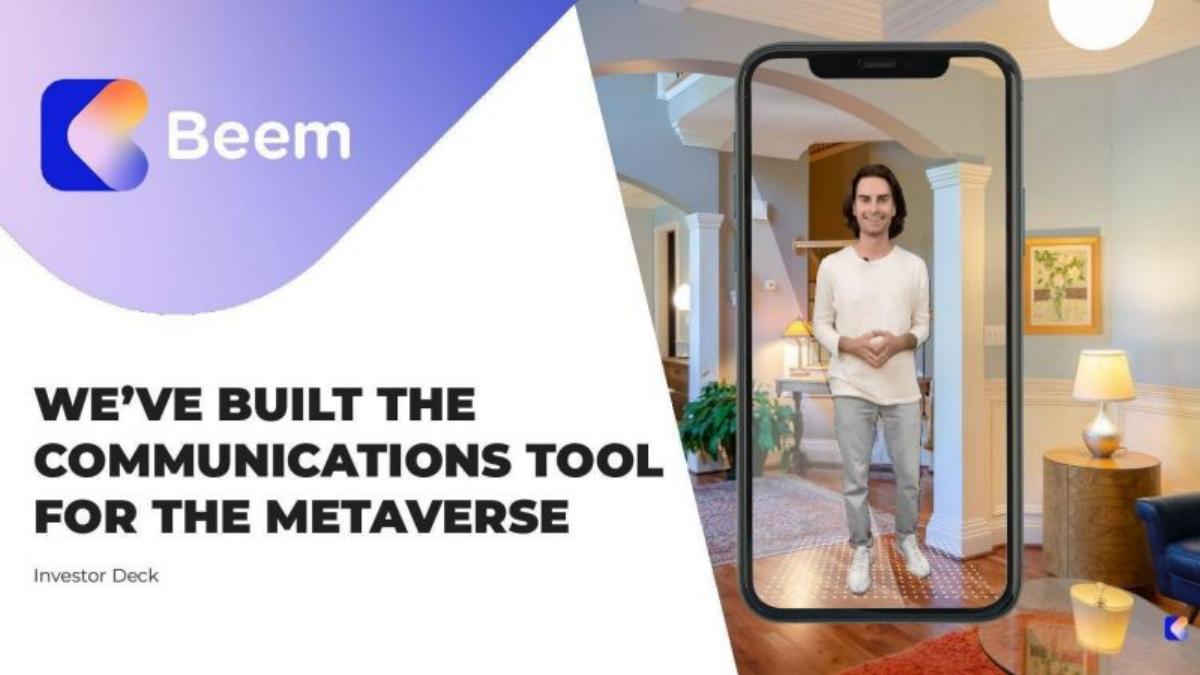
The cover slide immediately establishes the company's ambition: 'WE’VE BUILT THE COMMUNICATIONS TOOL FOR THE METAVERSE.' The visual shows a high-fidelity AR projection of a person in a living room, viewed through a smartphone. This sets the stage for a product that is mobile-first but vision-expansive.
Slides 3-5: Defining the Challenge
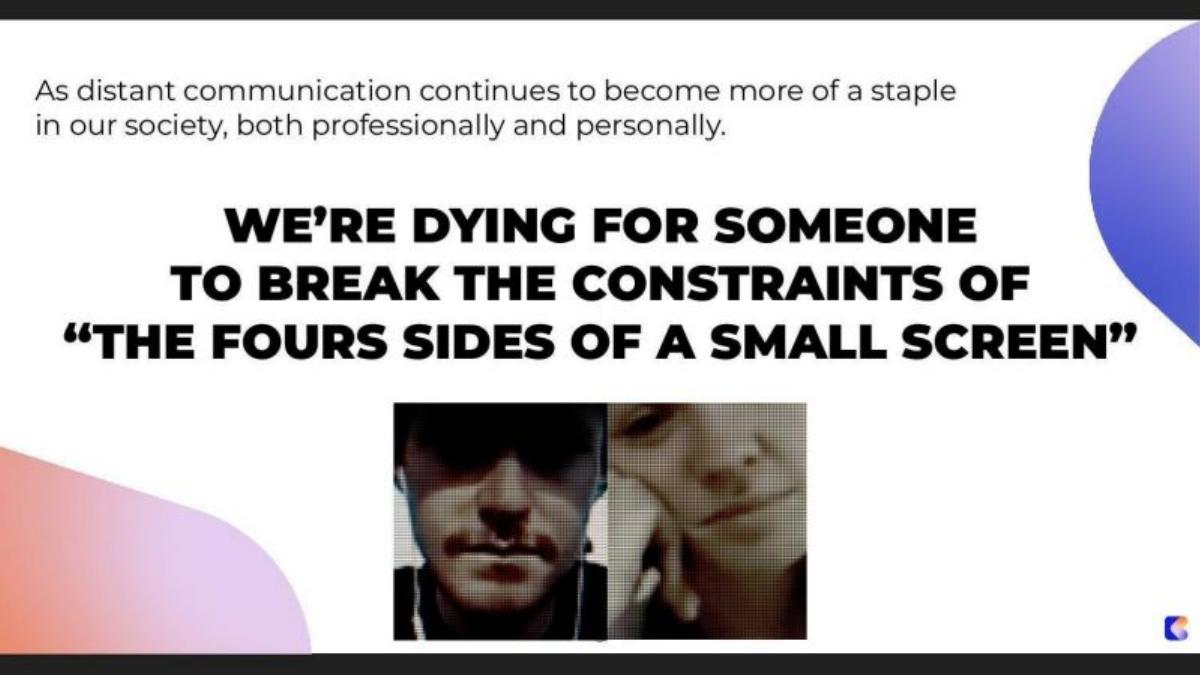
Slide 3, titled 'CHALLENGE,' argues that the 'new normal of communication is lacking.' It uses a simple spectrum graphic placing 'IRL Communication' at one end and 'Zoom Communication' at the far other. The core argument is that digital tools cause a 'massive loss in the transfer of information and emotion.' Slide 5 doubles down on this, using the phrase 'the four sides of a small screen' to describe the current constraints users are 'dying' to break.
Slides 7-9: The AR Opportunity
Slide 7 introduces AR as the solution, claiming it 'Stimulates 2x' visual attention and emotional intensity compared to standard video. This is a critical slide because it attempts to quantify a subjective feeling, providing investors with a 'data-backed' reason to believe in AR's superiority. Slide 9 provides a strategic pivot, stating that for AR to go mainstream, 'THE SOFTWARE NEEDS TO CATCH UP WITH THE HARDWARE.' This positions Beem as the utility layer that makes AR hardware (like glasses) actually useful, rather than just a source of 'animated novelties.'
Slide 11: Market Positioning
Slide 11 returns to the spectrum graphic from Slide 3. This time, Beem is placed much closer to 'IRL Communication' than Zoom. The slide claims a '40% increase in transfer of information and emotion' through their 'Real AR Human' overlay. This is the core of their competitive positioning: they aren't just another video app; they are a 'Real Human Connection' tool.
Slides 13-15: Product and Brand Promise
Slide 13 provides visual evidence of the technology, showing users viewed through what appears to be AR lenses. Slide 15 defines the 'BRAND PROMISE,' which is to overlay a user's 'FULL Presence & Personality' onto the recipient's reality. The keywords here are 'CREDIBLE' and 'IMMERSIVE,' distancing the product from the cartoonish avatars often associated with the metaverse at the time.
Slide 17: Market Size
Beem uses a 'nexus' strategy for their market slide. Instead of claiming one market, they claim two: Video Streaming ($843bn) and AR/VR ($661bn). By positioning themselves at the intersection, they suggest a Total Addressable Market (TAM) that is effectively the sum of modern digital interaction. They cite Fortune Business Insights and Business Wire to ground these large figures in third-party research.
Slide 19: The 'Confidential' Gap
Slide 19 is a placeholder for 'KEYSTONE PARTNERSHIPS,' marked as 'CONFIDENTIAL.' While the specific partners are redacted in this version, the presence of this slide suggests that Beem had already secured significant B2B interest or hardware integrations prior to the Seed round, which is a major de-risking factor for investors.
Slide 21: The Team
The team slide is dense, showcasing a 20-person staff. Founder Jan Amstutz is highlighted not for a typical tech background, but as an 'ex Physical Commodities Trader' and 'Sniper (Rank: Corporal).' This suggests a high-pressure, execution-oriented leadership style. The inclusion of advisors from Roc Nation (Young Guru) and DeBeers (François Delage) hints at a strategy that spans both creator culture and luxury/enterprise retail.
Slide 23: Use of Funds
The final content slide outlines a clear 18-24 month roadmap. The focus is on three pillars: a consumer-facing 'Go To Market' play, the introduction of 'Beem for Glasses,' and continued R&D. This tells investors exactly where their $4M will go: building a user base and preparing for the next generation of wearable hardware.
What Beem Does Well
Psychological Framing: Beem doesn't just sell software; they sell the solution to the emotional deficit of remote work. By using terms like 'emotional intensity' and 'visual attention,' they appeal to the investor's own experiences with Zoom fatigue. Hardware Agnosticism: By emphasizing that 'software needs to catch up with hardware,' Beem avoids being tied to the success of a single device. They position themselves as the essential software layer that will work on smartphones today and AR glasses tomorrow. Clear Differentiation: The spectrum graphic used in Slides 3 and 11 is a simple but effective way to show exactly where they sit in the competitive landscape. They aren't trying to beat Zoom at being a utility; they are trying to beat Zoom at being 'human.'
What is Missing from the Deck
Unit Economics: There is no mention of Customer Acquisition Cost (CAC), Lifetime Value (LTV), or even a specific pricing model in the visible slides. While they mention 'monetize' on the roadmap, the mechanics of how they make money are absent. Traction Metrics: The deck lacks data on current user numbers, retention rates, or pilot program results. For a $4M Seed round, investors usually want to see some evidence of product-market fit beyond theoretical psychological benefits. Competitive Analysis: While they contrast themselves with Zoom, they do not address other AR competitors or the 'Big Tech' players (Meta, Apple, Google) who are also building communication layers for their own AR ecosystems.
Founder's Playbook: What to Copy
Use a 'Challenge/Solution' Narrative: Beem does an excellent job of setting up a problem that everyone understands (bad video calls) before presenting their solution. This makes the product feel like a necessity rather than a luxury. Leverage Market Intersections: If your startup sits between two industries, show the TAM for both. It makes the opportunity feel larger and more resilient. Focus on 'Utility' over 'Novelty': Especially in 'hype' sectors like AR or AI, explicitly stating that you are building for utility rather than just for the sake of the technology helps build credibility with serious investors.
Frequently asked questions
- How much did Beem raise with this deck?
- According to the catalogue data from bestpitchdeck.com, Beem raised $4M in a Seed round in 2022. The deck was used to secure this funding by positioning the company as a leader in the emerging metaverse communication space.
- What is Beem's core product value proposition?
- Beem's value proposition is centered on 'telepresence.' As stated on Slide 15, the brand promise is to overlay a user's 'FULL Presence & Personality' onto a recipient's reality. They argue this is the most credible and immersive way to deliver messages, bridging the gap between IRL (In Real Life) and Zoom communication.
- Who are the key people on the Beem team?
- The team is led by Jan Amstutz, a former physical commodities trader and sniper. The 20-person staff includes CTO Denis Islamov, COO Paul Gardener (ex-McCann), and CPO Damian Hickey (ex-Blippar). They also list advisors from Roc Nation and DeBeers, as shown on Slide 21.
- What specific markets is Beem targeting?
- Slide 17 shows Beem targeting the intersection of two markets: the Video Streaming market (projected at $843bn by 2027) and the AR/VR market (projected at $661bn by 2025). They position themselves as an agile specialist capable of fusing these two sectors faster than incumbents.
- What are the planned uses for the $4M raised?
- As outlined on Slide 23, the funds are earmarked for a 18-24 month runway. Key objectives include launching a consumer-facing platform to build and monetize a community, developing 'Beem for Glasses' to maintain first-mover advantage in wearable tech, and expanding R&D.