Pitch Deck Appendix Examples: What to Put After the Main
What belongs in a pitch deck appendix, what to keep in the main deck, and how to label backup slides so investors can find them.
Pitch Deck Appendix: What to Move Out of the Main Deck, and What to Keep In
Most pitch decks end with a contact slide, and many then carry on: a page that says "Appendix", followed by tables, charts and detail that did not fit the story. Founders ask what should go there. Should the financial model be in the appendix or the main deck? Is it fine to list topics as "available on request"? Does anyone read the appendix at all? This guide uses seven appendix slides from five startup decks to answer those questions, from a full five-year projection table to a closing page that lists the go-to-market plan and financials as "on request".
TL;DR
The appendix is for detail that supports a claim already made in the main deck: the full projection table behind a revenue headline, the survey behind a market claim, the science behind a product claim. It is not a place to hide anything an investor needs to decide whether to take a meeting. Freetrade shows the strong version: its appendix holds a five-year projection table and a third-party survey, each labelled "Appendix A" or "Appendix B" with its source and sample size. Brain Backups uses the appendix to explain its science for readers who need it. Ensembl and Beem show the risk: both list key topics, such as financials and go-to-market, as available on request. That is reasonable for a first meeting, but if a topic decides the investment, it needs at least one line in the main deck.
Seven appendix slides, read in full
Each example quotes the slide, separates what it claims from what it shows, and notes what to copy and what to avoid.
Freetrade executive summary slide — slide 13
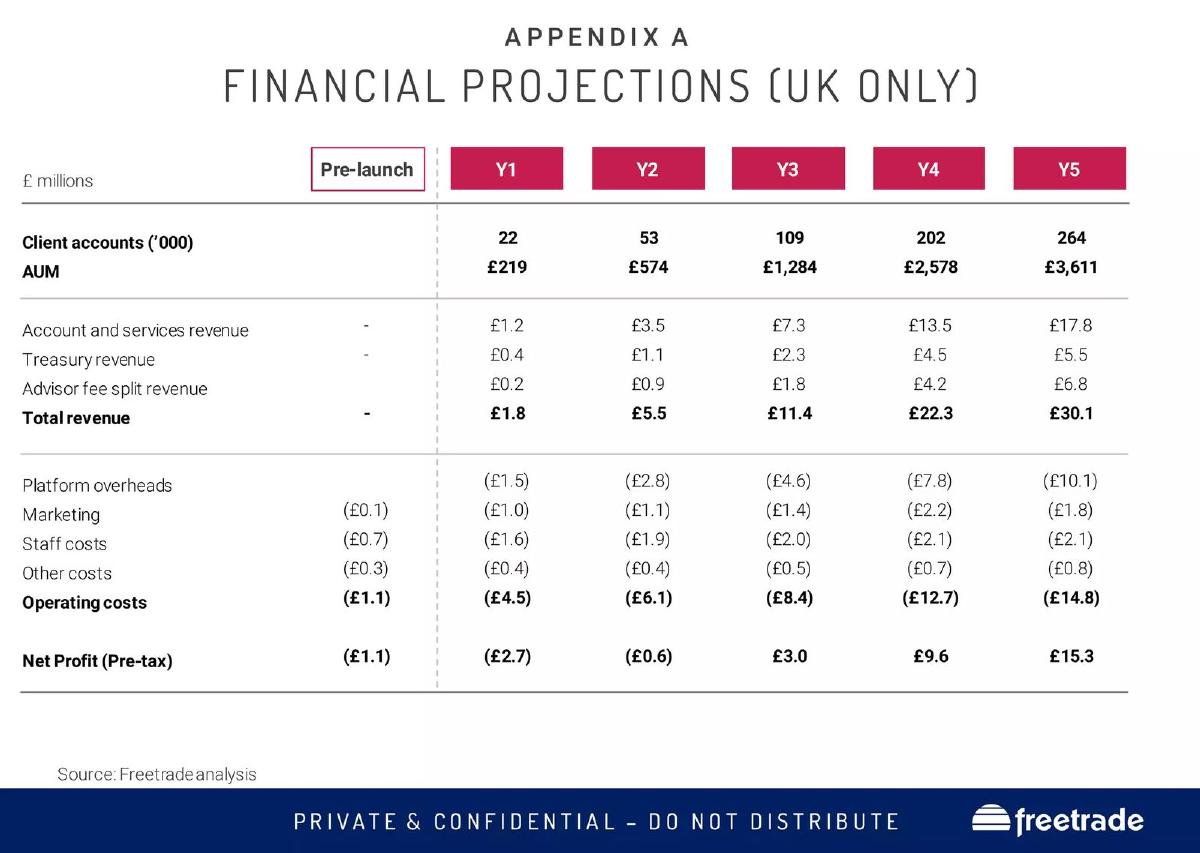
UK share-dealing app, Crowdcube campaign deck. Slide titled "Appendix A Financial Projections (UK only)".
Freetrade deck, slide 13. Exact stored slide matched to this analysis.
Our analysis: The full table behind a profit headline, too dense for the main deck.
Evidence and limitation: Company projections, labelled as its own analysis.
What a founder can adapt: Split revenue by source and label projections as your own.
Supporting analysis
What the deck claims: Pre-launch to year five in £ millions: client accounts 22,000 to 264,000; AUM £219 to £3,611; total revenue £1.8 to £30.1 across three revenue lines; net profit (pre-tax) (£2.7) in year one to £15.3 in year five. "Source: Freetrade analysis".
Presentation choice: Lets an investor test which revenue line carries the plan.
When it does not fit: Leaving the path to profit only in the appendix.
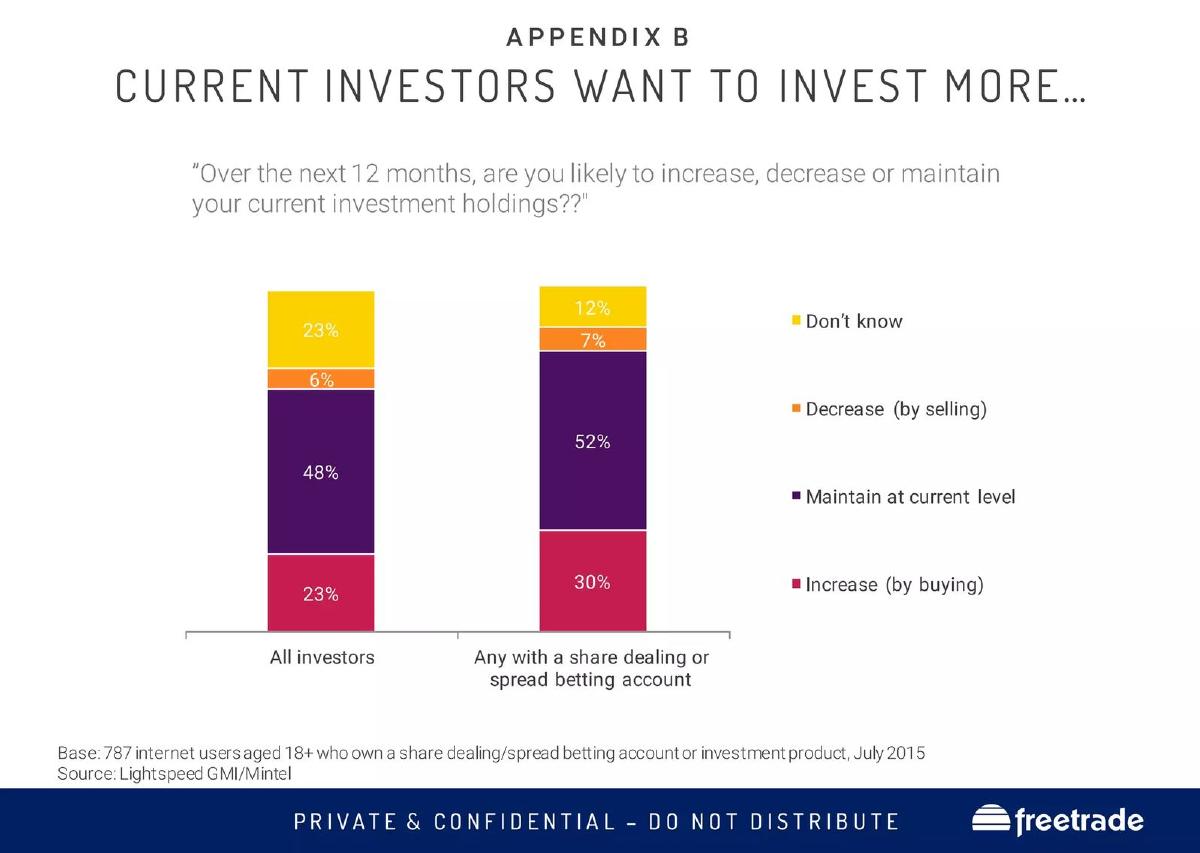
Same deck, "Appendix B". Slide titled "Current investors want to invest more...".
Freetrade deck, slide 20. Exact stored slide matched to this analysis.
Our analysis: Research behind a market claim, fully cited.
Evidence and limitation: Third-party survey with question, sample, date and source given.
What a founder can adapt: Give the exact question, sample size, date and research firm.
Supporting analysis
What the deck claims: Plan to increase holdings: 23% of all investors, 30% of share-dealing or spread-betting account holders; about half plan to maintain. Base: 787 internet users aged 18+ who own an investment product, July 2015. Source: Lightspeed GMI/Mintel.
Presentation choice: The reader can judge the evidence without leaving the page.
When it does not fit: A headline stronger than the chart: most respondents plan no change.
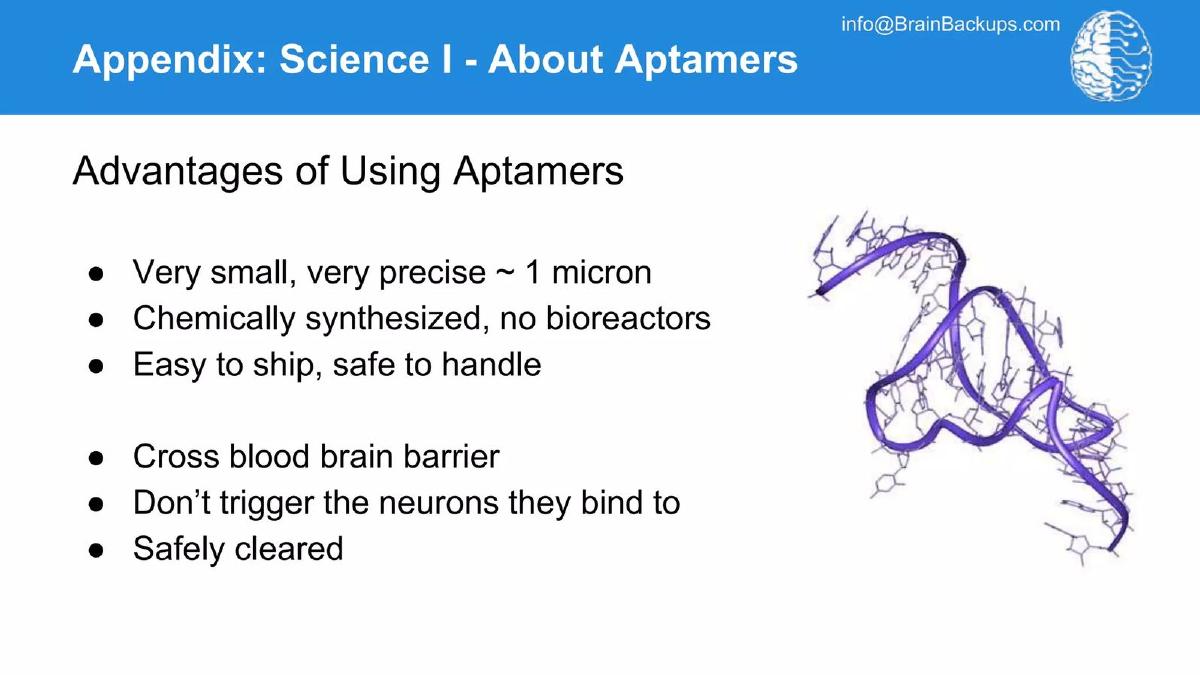
Early-stage neuroscience research company. Slide titled "Appendix: Science I - About Aptamers".
Brain Backups deck, slide 16. Exact stored slide matched to this analysis.
Our analysis: Technical detail moved out of the story for specialist readers.
Evidence and limitation: Scientific claims with no citations on the slide.
What a founder can adapt: Cite a source for each scientific claim.
Supporting analysis
What the deck claims: "Advantages of Using Aptamers": "Very small, very precise ~ 1 micron"; "Chemically synthesized, no bioreactors"; "Easy to ship, safe to handle"; "Cross blood brain barrier"; "Don't trigger the neurons they bind to"; "Safely cleared".
Presentation choice: Serves diligence without slowing the main pitch.
When it does not fit: Claims an adviser cannot trace.
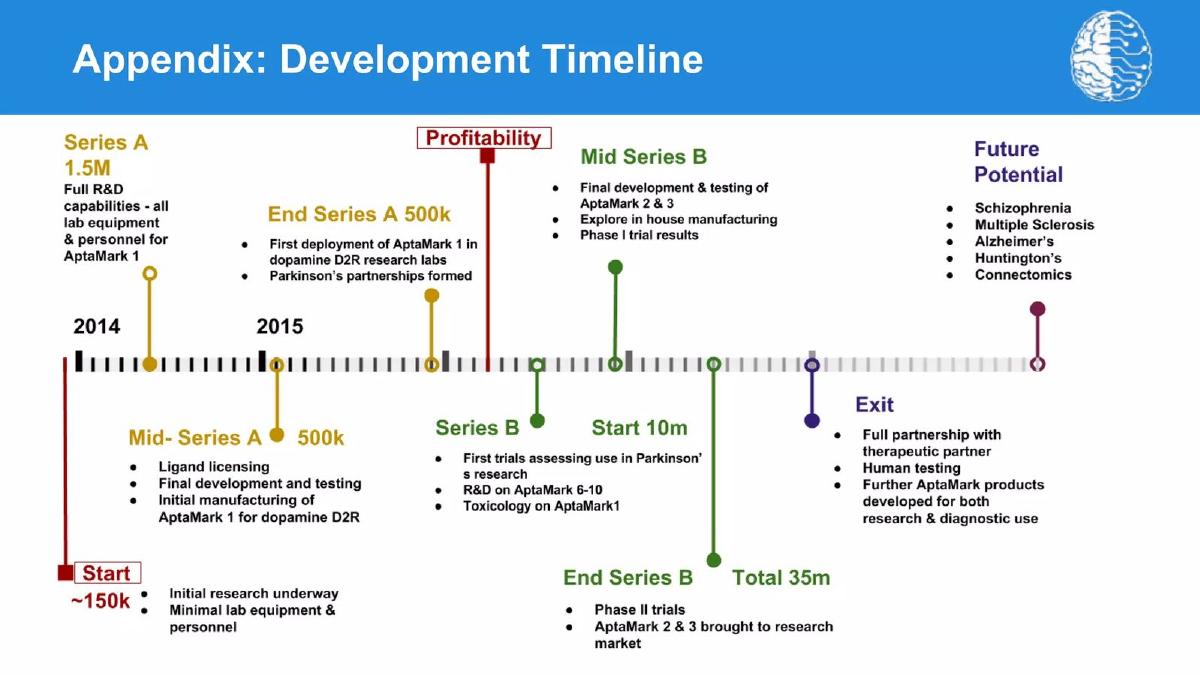
Same deck. Slide titled "Appendix: Development Timeline".
Brain Backups deck, slide 14. Exact stored slide matched to this analysis.
Our analysis: Funding needs and milestones placed in the appendix.
Evidence and limitation: Plan only; small type on a dense timeline.
What a founder can adapt: Put the funding path in the main deck in readable form.
Supporting analysis
What the deck claims: Start ~150k; Series A 1.5M; Series B start 10M, total 35M; "Profitability" marked before Series B; Phase I and Phase II trials; exit via "Full partnership with therapeutic partner".
Presentation choice: A warning: what each round buys is central, not backup.
When it does not fit: Hiding decision-critical numbers in small type at the back.
Ensembl deck, slide 18. Exact stored slide matched to this analysis.
Our analysis: A clear index for an appendix that is held back.
Evidence and limitation: Index only; the sections are not in the deck.
What a founder can adapt: Use an index when the appendix is long, and include the pages.
Supporting analysis
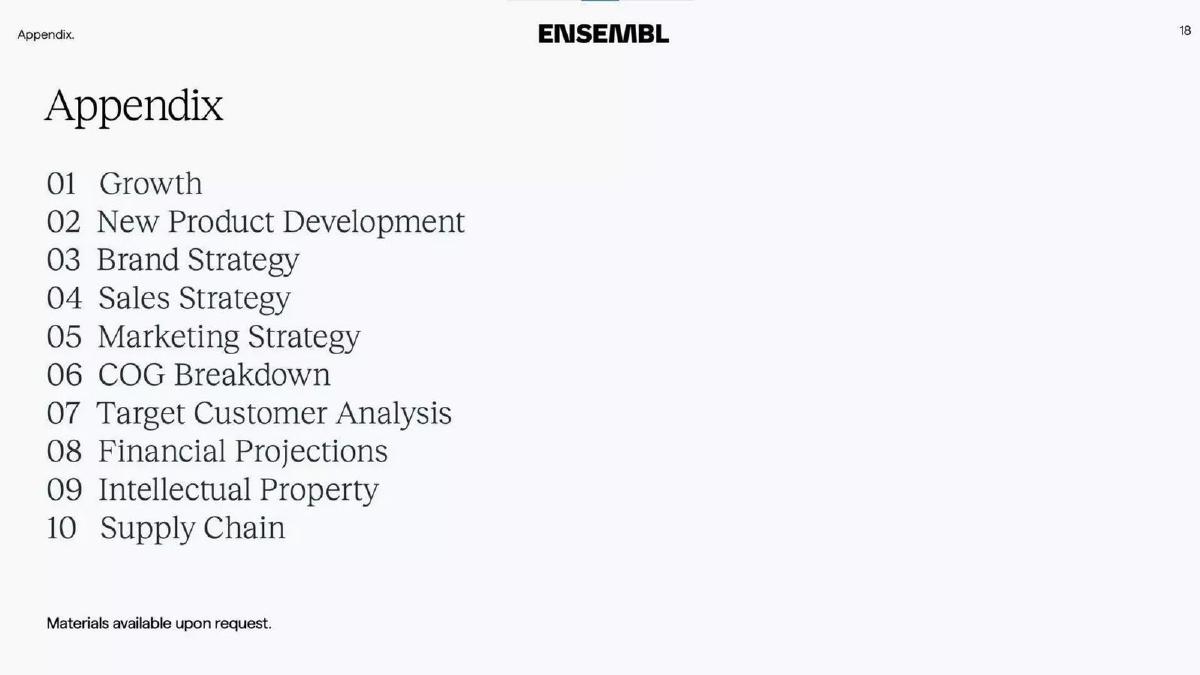
What the deck claims: Ten numbered sections from "01 Growth" to "10 Supply Chain", including "06 COG Breakdown" and "08 Financial Projections". "Materials available upon request."
Presentation choice: Numbering makes backup easy to request and find.
When it does not fit: Listing growth and financials as unseen sections.
Communications tool for the metaverse. Closing slide headed "THANKS" and "Appendix".
Beem deck, slide 24. Exact stored slide matched to this analysis.
Our analysis: Detail held back for a follow-up conversation.
Evidence and limitation: No appendix content; three topics deferred.
What a founder can adapt: Give a one-line headline for each deferred topic in the main deck.
Supporting analysis
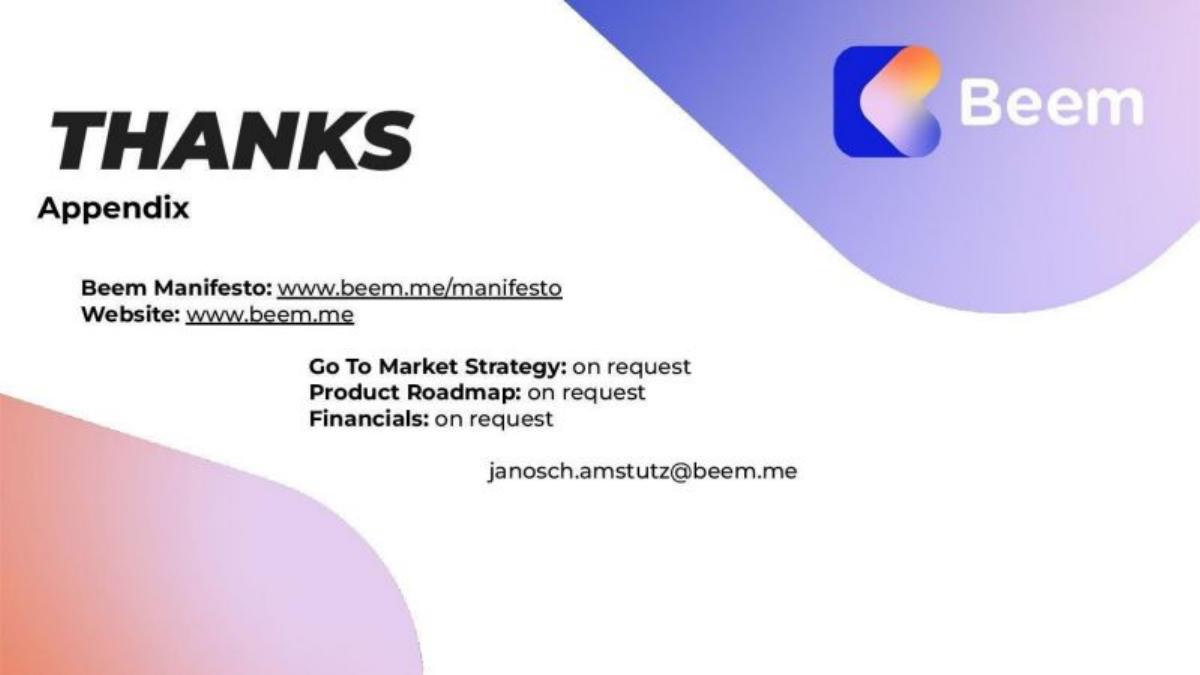
What the deck claims: Links to the manifesto and website; "Go To Market Strategy: on request"; "Product Roadmap: on request"; "Financials: on request"; founder email.
Presentation choice: Gives a reason to reply, but may read as a gap.
When it does not fit: Deferring the financials and go-to-market entirely.
2011 deck for a private-party used-car service. Slide titled "Appendix A: Later Stage Marketing Plan".
Fat Joe's Cars deck, slide 15. Exact stored slide matched to this analysis.
Our analysis: A later-stage plan moved out of the main story.
Evidence and limitation: Channel ideas without costs, targets or order.
What a founder can adapt: Add cost and expected result for each channel.
Supporting analysis
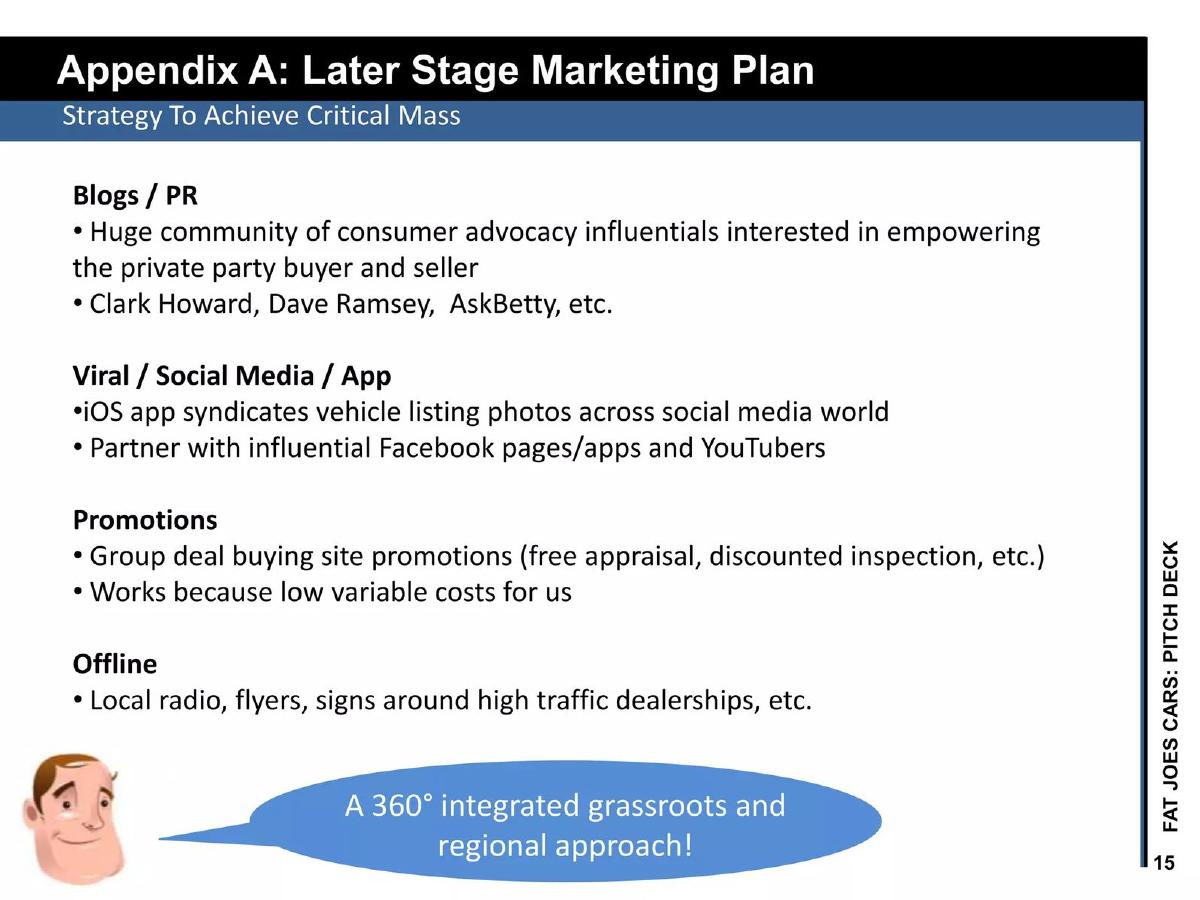
What the deck claims: "Strategy To Achieve Critical Mass": blogs and PR with consumer advocates; an iOS app syndicating listing photos; group-deal promotions ("Works because low variable costs for us"); local radio, flyers and signs near dealerships.
Presentation choice: Keeps the main deck focused on the first steps.
When it does not fit: A list of ideas presented as a plan.
What each slide supports, whether it is sourced, and whether its content belongs in the appendix.
Example
Supports
Source given
Right place?
Freetrade (projections)
Profit path
Own analysis
Yes, with headline in main deck
Freetrade (survey)
Market demand
Yes, with sample
Yes
Brain Backups (science)
Product claims
No
Yes
Brain Backups (timeline)
Funding needs
No
No, main deck
Ensembl
Index
Not applicable
Needs the pages
Beem
Deferred topics
Not applicable
Needs headlines up front
Fat Joe's Cars
Later growth
No
Yes
Key Takeaways
Each appendix slide should back a claim made in the main deck.
Keep anything decision-critical in the main deck, even in one line.
Label backup slides clearly and give sources.
"On request" defers detail; it cannot replace the headline.
Long technical detail belongs in the appendix, not the story.
Sort your slides
Run each slide or topic through these questions.
Decision. Would an investor need this to decide whether to take the next meeting? If yes, keep at least one line in the main deck.
Support. Which claim in the main deck does this appendix slide back up?
Source. Does the slide say where its figures come from, and when?
Label. Is it labelled with a section letter or number so you can refer to it?
Deferred. For anything marked "on request", is the headline already in the main deck?
Copyable framework: Main deck: [headline claim]. Appendix [letter]: [detail that backs it], source [who, when, sample].
Illustrative example 1 — written by us
Before: Appendix: Financials on request. Go-to-market on request.
After: Main deck: "Break-even in year three at 110,000 accounts; first channel is partnerships with two employers." Appendix A: five-year projection table (our analysis). Appendix B: channel plan with cost per account.
What improved: Our illustrative rewrite; all figures are invented for the example. The decision-critical headlines move forward and the appendix holds the detail behind them.
The question this guide answers
Founders building a deck have to decide what stays in the main story and what moves to the back. Other guides in this library touch the edge of this: the ask guide says to put the detailed budget in an appendix, the advisors guide says to move a long advisor list there, and the agenda guide notes when an agenda lists an appendix. None of them answers the question directly: what is an appendix for, what should go in it, what must never be moved there, and how should it be laid out?
Investors use an appendix in two ways. Some read it when the deck is sent ahead of a meeting, to check that a headline number has something behind it. Others use it during or after a meeting, when a question comes up and the founder can turn to a backup slide. Both uses point to the same rule: each appendix slide should answer a question the main deck has already raised.
How we chose and read the examples
We searched the extracted text of the slide library for slides whose title begins with "Appendix", then removed public companies, mining and resource companies and investor presentations from listed firms, which make up most of the matches and use appendices for regulatory tables. We kept seven slides from five startup decks that each show a different use of the appendix. Every slide was rendered from the original deck at full size and read in full before we wrote about it.
We quote what is visible on each slide. We have not checked any company's figures against other sources, and we make no claim that any appendix affected a fundraising result. Where we describe what an investor might ask, that is our judgment, not a reported reaction.
Put the full numbers behind a headline
Freetrade, a UK share-dealing app, raised on Crowdcube with a deck that has two labelled appendix sections. "Appendix A Financial Projections (UK only)" is a full table in £ millions from pre-launch to year five: client accounts rising from 22,000 to 264,000, assets under management from £219 million to £3,611 million, revenue split into account and services revenue, treasury revenue and advisor fee split revenue, then platform overheads, marketing, staff and other costs, ending in net profit (pre-tax) of minus £2.7 million in year one and £15.3 million in year five. The footer reads "Source: Freetrade analysis".
This is what an appendix is best at. A table with sixteen rows and six columns is too dense to present in a meeting, but an investor who wants to test the forecast needs every row. Splitting revenue into three lines lets the reader see which assumption carries the plan. Marking the source as the company's own analysis is honest: it tells the reader these are projections, not results.
The table works because it backs a claim. The main deck should still carry the headline: when the company expects to turn profitable and what that depends on. If the only place the reader can find the path to profit is the appendix, many will never see it.
Back market claims with the underlying research
"Appendix B" in the same Freetrade deck holds market research. One slide, titled "Current investors want to invest more...", shows a stacked bar chart answering the question "Over the next 12 months, are you likely to increase, decrease or maintain your current investment holdings??". Among all investors, 23% say increase, 48% maintain, 6% decrease and 23% don't know; among those with a share dealing or spread betting account, the figures are 30%, 52%, 7% and 12%. The footer gives the base and source: "787 internet users aged 18+ who own a share dealing/spread betting account or investment product, July 2015", from Lightspeed GMI/Mintel.
This is a model of how to cite research in a deck. The slide gives the exact question asked, the sample size, who was asked, the date and the research firm. A reader can judge the evidence without leaving the page. The main deck can then use one line, such as "30% of current account holders plan to invest more", and point to the appendix for the detail.
One caution: the headline overstates the chart slightly. "Current investors want to invest more" describes 23% to 30% of respondents; around half plan to stay where they are. In the main deck, quote the figure rather than the headline.
Explain technical detail for the readers who need it
Brain Backups, an early-stage neuroscience research company, uses its appendix for the science. "Appendix: Science I - About Aptamers" lists the "Advantages of Using Aptamers": "Very small, very precise ~ 1 micron", "Chemically synthesized, no bioreactors", "Easy to ship, safe to handle", "Cross blood brain barrier", "Don't trigger the neurons they bind to" and "Safely cleared".
Moving this to the back is a sound choice. Most investors in a first meeting need to know what the product does and why it matters; a specialist or a technical adviser doing diligence needs to know why the method works. The appendix serves the second reader without slowing down the first. The slide would be stronger with a citation for each property, since these are the claims a scientific adviser will check first.
A second Brain Backups appendix slide, "Appendix: Development Timeline", shows the opposite risk. It maps funding stages to milestones on one dense timeline: a start with about 150k, a Series A of 1.5M, a Series B of 10M, a total of 35M, a point marked "Profitability", Phase I and Phase II trials, and an exit through "Full partnership with therapeutic partner". This is not backup detail. How much money the company needs, and what each round buys, is central to the investment, and it belongs in the main deck in readable form. The slide also places "Profitability" before Series B and before Phase I results, which an investor will question.
Use an index so readers can find what they need
Ensembl, a housewares brand, closes its main deck with a page titled "Appendix" that lists ten numbered sections: Growth, New Product Development, Brand Strategy, Sales Strategy, Marketing Strategy, COG Breakdown, Target Customer Analysis, Financial Projections, Intellectual Property and Supply Chain. A footnote reads "Materials available upon request."
An index is useful when the appendix is long: it tells the reader what exists and lets them ask for what they care about. Numbering helps in a meeting, because a founder can say "that's in section six". But in this deck the index is the appendix; the sections themselves are not included. That turns the page into a list of things the investor cannot yet see. Two of them, Growth and Financial Projections, are among the first things an investor looks for. If they are not covered in the main deck, the reader has no way to judge them before the meeting.
"On request" is fine for detail, not for the headline
Beem, which describes itself as a communications tool for the metaverse, ends its deck with a page headed "THANKS" and "Appendix". It links to the company's manifesto and website, then lists "Go To Market Strategy: on request", "Product Roadmap: on request" and "Financials: on request", followed by the founder's email address.
There are good reasons to hold some material back: a detailed financial model changes often, and a go-to-market plan may name partners who have not agreed to be named. Offering it on request also gives the investor a reason to reply. The risk is that an investor screening many decks reads the absence as a gap. The fix is simple: give the headline in the main deck, such as the first channel and the target for the next 12 months, and keep the full plan for the follow-up.
Park later-stage plans where they don't distract
Fat Joe's Cars, a 2011 deck for a service helping private buyers and sellers of used cars, lists "Appendix" as the last item on its table of contents. "Appendix A: Later Stage Marketing Plan", subtitled "Strategy To Achieve Critical Mass", sets out four channels: blogs and PR (consumer advocates such as "Clark Howard, Dave Ramsey, AskBetty, etc."), viral and social (an iOS app that "syndicates vehicle listing photos across social media world" and partnering with "influential Facebook pages/apps and YouTubers"), promotions on group deal sites ("Works because low variable costs for us") and offline ("Local radio, flyers, signs around high traffic dealerships, etc."). A speech bubble reads "A 360° integrated grassroots and regional approach!"
Putting the later-stage plan in the appendix keeps the main deck focused on what the company will do first, which is the right priority. The page itself is a list of possible channels with no costs, targets or order, so it reads as ideas rather than a plan. Even in the appendix, a line on what each channel costs and what it should deliver would make the page useful for diligence.
What belongs where
Across the five decks, a clear division emerges. The main deck should carry every fact an investor needs to decide whether to take the next meeting: what you do, for whom, the evidence it works, how you will grow, how much you are raising and what it buys, and when you expect to turn profitable. The appendix should carry the detail behind those facts: full projection tables, research methods and samples, technical explanations, unit-cost breakdowns, longer team and adviser lists, and later-stage plans.
A practical test is to read the main deck without the appendix. If a reader would come away unable to answer a question that decides the investment, move a one-line answer forward. Then check each appendix slide: if it does not support something in the main deck, consider dropping it. Label every appendix slide with a section letter and its source, and if the appendix is longer than a few pages, start it with an index.
Common mistakes
Hiding decision-critical facts. Funding needs and the path to profit belong in the main deck.
Appendix with no link to the story. Each backup slide should support a claim already made.
Unsourced research. Give the question, sample, date and source.
Index without pages. Listing sections the reader cannot see adds little.
Everything on request. Give the headline up front and keep the detail for follow-up.
Diagnostic checklist
Every decision-critical fact has a line in the main deck.
Each appendix slide backs a main-deck claim.
Appendix slides are labelled and sourced.
Long appendices start with an index.
Deferred topics have a headline up front.
Frequently asked questions
Do investors read the appendix?
Some do when checking a deck before a meeting, and many use it to answer questions during or after one. Write it for a reader checking a specific claim, not for someone reading start to finish.
Should the financial model go in the appendix?
The full table can, as Freetrade's does. The headline, such as revenue next year and when you expect to break even, should be in the main deck.
Is it fine to write "available on request"?
For detail that changes often or names partners, yes. For anything that decides the investment, give at least the headline in the deck itself.
How long should an appendix be?
As long as needed to back the main claims and no longer. If it runs past a few pages, start with a numbered index.
How we chose these examples
Corpus: published pitch deck teardowns on StartupFundraising.com. Founder-uploaded private decks are excluded.
Selection (2026-10-01): we searched extracted slide text for slides whose title begins with "Appendix", excluded public companies, mining and resource companies and listed-firm investor presentations, and kept seven slides from five startup decks that each show a distinct use of the appendix.
Review: all seven slides were rendered from the source decks at full size on 2026-10-01 and read in full against company, deck and page number (editorial model review, with AI assistance in drafting). No person has yet completed an editorial review of this page. We did not verify any company's figures.