Fat Joe's Cars, pitching in September 2011, sought to disrupt the used car market by providing a dual-exit strategy for sellers: a private party marketplace or an immediate sale to dealers via competitive bidding. The deck highlights a significant market opportunity, noting that of the 80 million total used car sales, 11.1 million are private party transactions. The company identified a 'sweet spot' total addressable market of $1.1 billion. While the deck successfully outlines a clear value proposition for both sellers and dealers, it suffers from a lack of technical leadership, explicitly st…
Key takeaways
- The company positions itself as a transaction service and marketplace platform for used vehicles (Slide 3).
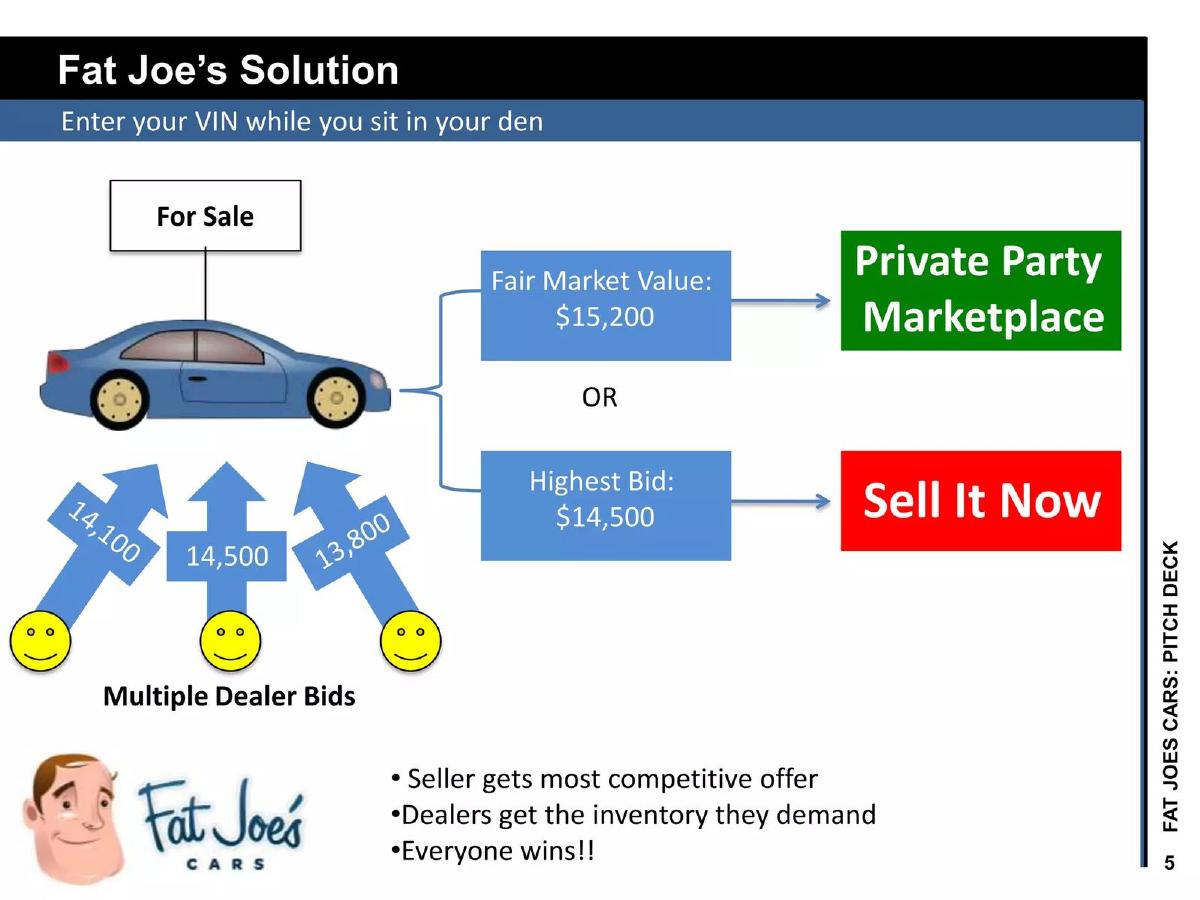
- The solution offers two paths: a Private Party Marketplace at Fair Market Value or a 'Sell It Now' option based on the highest dealer bid (Slide 5).
- Market data cites 80 million total used car sales, with 11.1 million in the private party segment (Slide 7).
- The deck identifies a Total Addressable Market (TAM) of $1.1 billion within the private party 'sweet spot' (Slide 7).
- Competitive positioning uses a quadrant mapping 'Bland vs. Fun' and 'Danger vs. Safe/Fair,' placing the company in the top-right 'Safe/Fair and Fun' niche (Slide 9).
- The team includes a founder with tech startup funding experience and a business development lead with BMW dealership management background (Slide 11).
- The company is at the 'Founder funded / bootstrapped' stage with a functional prototype and initial partners like CARFAX and Esurance (Slide 13).
- A significant team gap is disclosed, as the company is actively 'searching for right CTO' (Slide 11).
Fat Joe's Cars: A September 2011 Pitch Deck Analysis
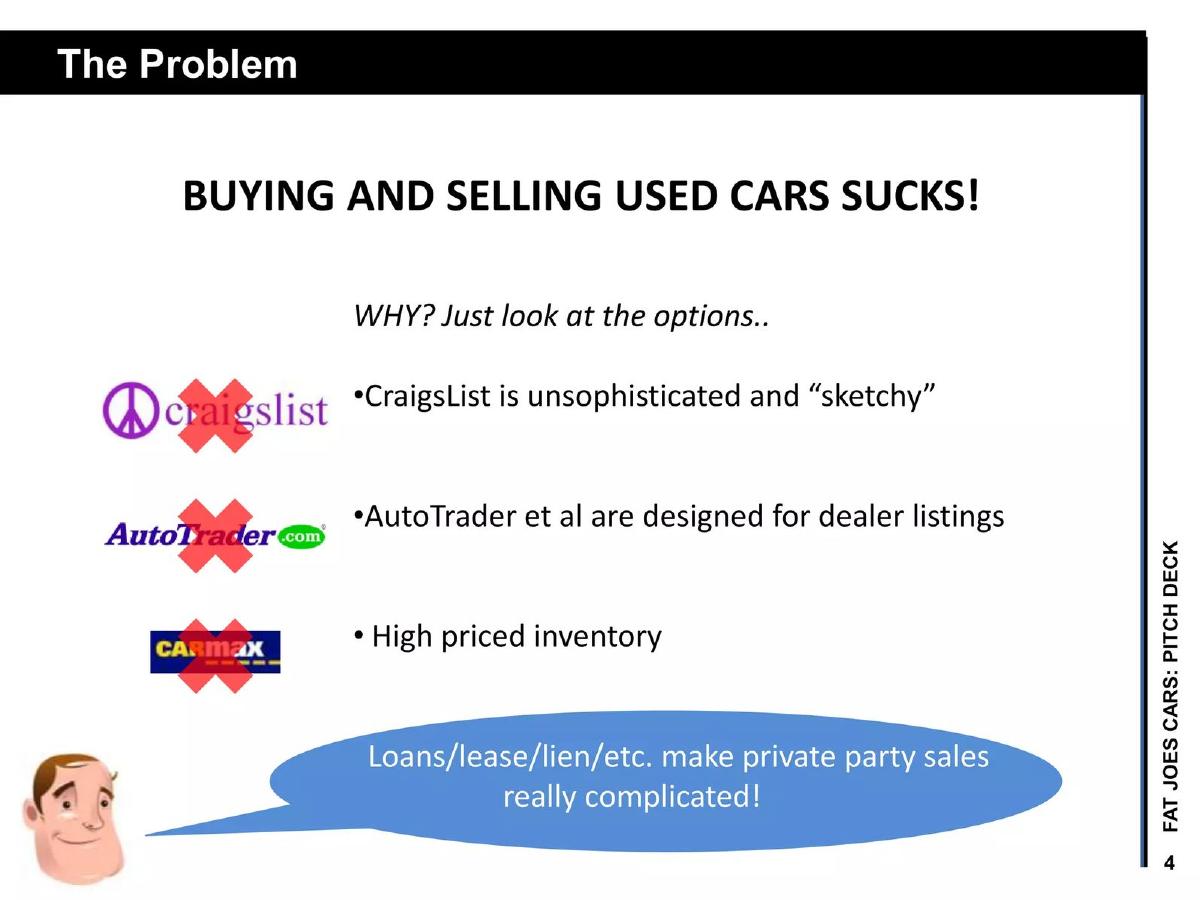
The Fat Joe's Cars pitch deck, dated September 2011, represents a snapshot of the early 2010s push to digitize the fragmented used car market. The company positions itself not just as a listing site, but as a transaction-focused marketplace that attempts to solve the friction inherent in private party sales. By offering a 'Sell It Now' safety net alongside a traditional marketplace, the founders aimed to capture users who were frustrated by the low offers of traditional trade-ins but intimidated by the risks of Craigslist.
Slide 1: Title Slide
The deck opens with the company logo, featuring a cartoon mascot ('Joe') holding a mug and car keys. The branding is clearly intended to be approachable and friendly, contrasting with the often-stuffy or aggressive branding of traditional car dealerships. The date is explicitly listed as September 2011.
Slide 3: Company Overview
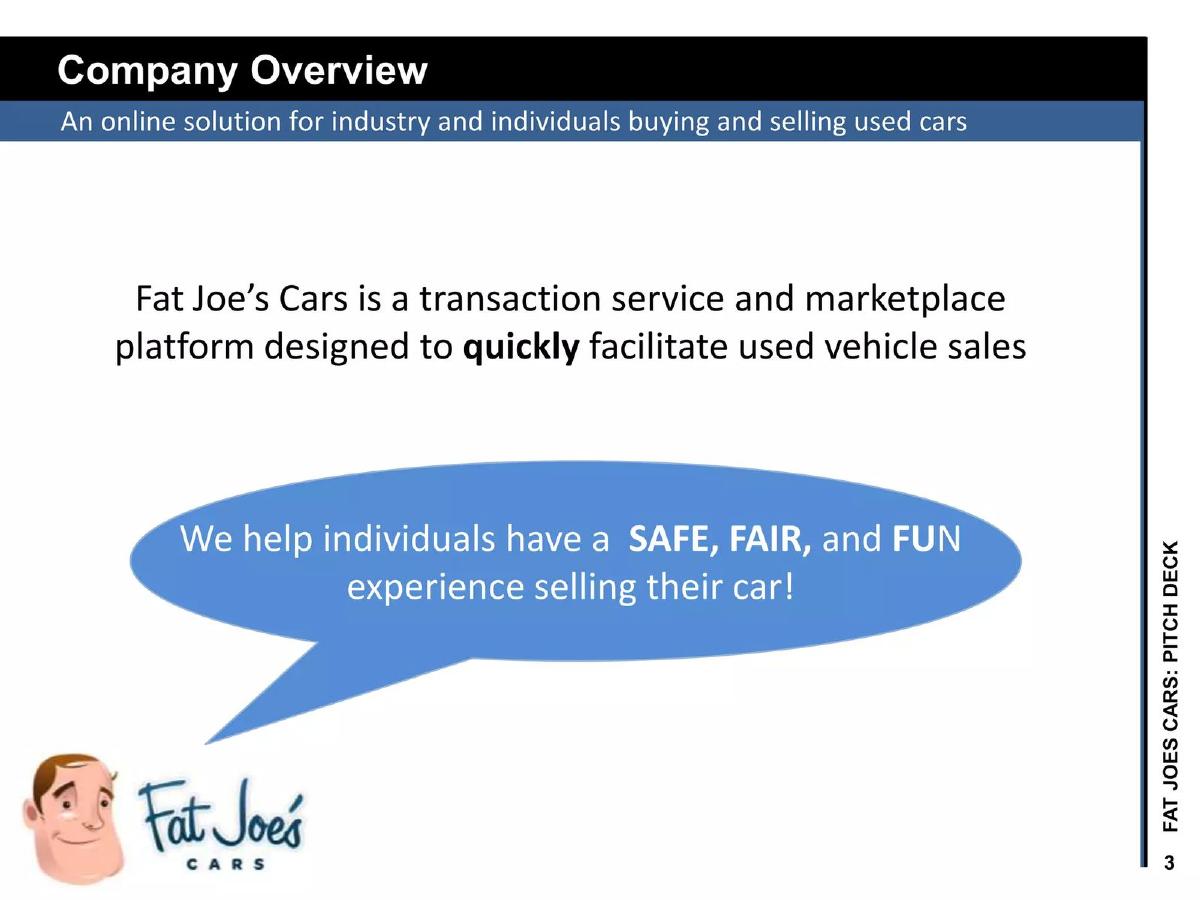
Slide 3 defines the company as an 'online solution for industry and individuals buying and selling used cars.' It describes the platform as a 'transaction service and marketplace platform designed to quickly facilitate used vehicle sales.' The core value proposition is summarized in a speech bubble: 'We help individuals have a SAFE, FAIR, and FUN experience selling their car!' This slide establishes the three pillars of their brand identity.
Slide 5: The Fat Joe's Solution
This slide provides a flow chart of the user experience. A user enters their VIN 'while you sit in your den.' The system then generates two options. Option one is the 'Private Party Marketplace' at a Fair Market Value (illustrated as $15,200). Option two is 'Sell It Now,' which is fueled by 'Multiple Dealer Bids.' In the example, three dealers bid between $13,800 and $14,500, with the highest bid becoming the immediate sale price. The slide concludes that 'Everyone wins!!' because sellers get competitive offers and dealers get the inventory they demand.
Slide 7: Current Market Opportunity
Fat Joe's utilizes a nested circle diagram to illustrate market size. Out of ~80 million total used car sales, 37 million are retail and 11.1 million are private party sales. The 'Sweet Spot' for the company is this 11.1 million private party segment, which they calculate as a $1.1 billion Total Addressable Market (TAM). The slide also lists the online share of the private party segment: Craigslist at 16%, AutoTrader at 8%, and eBay Motors at 5%. A note at the bottom cites Manheim’s 2010 Used Car Market Report and a 2011 USA Today article as data sources.
Slide 9: Competition
The competitive landscape is mapped on a 2x2 matrix. The X-axis ranges from 'Bland' to 'Fun,' and the Y-axis ranges from 'Danger!' to 'Safe/Fair.' Craigslist is placed in the bottom-left (Bland/Danger), while incumbents like AutoTrader and CarMax are categorized as 'Bland.' Fat Joe's Cars occupies the top-right quadrant, claiming the unique position of being both 'Safe/Fair' and 'Fun.' The slide notes that while there are many players, 'no one effectively targeting our niche!'
Slide 11: Our Team
The team consists of three primary members. BobboJetmundsen (Founder) is credited with over a decade of experience in funding and advising tech startups. Sean McCormick (Founder) is noted for founding ViralPrints, a profitable custom merchandise startup. Scott Whitmire (Business Development) is described as an industry veteran who managed the 'best performing BMW dealership in the nation.' Notably, a speech bubble at the bottom states they are 'Searching for right CTO,' indicating a significant gap in their technical leadership at the time of the pitch.
Slide 13: Current Stage
This slide shows a screenshot of the functional prototype website. The company is currently 'Founder funded / bootstrapped.' They claim to have a functional prototype with data providers and industry partners. Logos for initial partners include CARFAX, Esurance, Chrome (a DealerTrack Company), Auto Credit Express, and Hennessy. The headline 'Capital required to reach the next level' suggests the purpose of the deck, though no specific dollar amount is mentioned.
Slide 15: Appendix A: Later Stage Marketing Plan
The final slide in this selection outlines a '360 degree integrated grassroots and regional approach' to marketing. Tactics include engaging consumer advocacy influencers (citing Clark Howard and Dave Ramsey), launching an iOS app to syndicate vehicle photos, and using 'Group deal buying site promotions' for free appraisals or discounted inspections. They also plan for offline marketing via local radio and flyers near high-traffic dealerships.
What Fat Joe's Cars Does Well
The deck excels at simplifying a complex transaction into a clear choice for the consumer. By presenting the 'Private Party' vs. 'Sell It Now' options side-by-side, the company addresses the two biggest pain points in car selling: price and speed. The market sizing is also well-reasoned, focusing on a specific 'sweet spot' (private party sales) rather than claiming the entire 80-million-car market as their immediate target. The inclusion of established partners like CARFAX adds much-needed credibility to a bootstrapped startup.
What is Missing from the Deck
The most glaring omission is the lack of a specific financial ask. Investors need to know how much capital is required and what milestones that capital will achieve. Furthermore, the business model is never explicitly explained in terms of revenue. It is unclear if they take a transaction fee from the seller, a lead-gen fee from the dealer, or a listing fee for the marketplace. The 'Searching for right CTO' admission is also a red flag for a tech platform; usually, a technical co-founder is expected to be in place before seeking significant outside capital. Finally, there are no financial projections or unit economics (CAC/LTV) provided in these slides.
Founder Takeaways: What to Copy
Founders should emulate the clear, visual representation of the user journey found on Slide 5. It explains the product's utility without requiring a wall of text. The use of a 2x2 matrix for competition (Slide 9) is a standard but effective way to visualize a 'gap' in the market, provided the axes chosen are relevant to the customer's decision-making process. Additionally, citing specific, reputable sources for market data (Slide 7) builds trust and shows that the founders have done their homework on the industry's macro trends.
Frequently asked questions
- What is the core business model of Fat Joe's Cars?
- Fat Joe's Cars operates as a hybrid marketplace. Sellers enter their VIN to receive multiple dealer bids. They can then choose to sell immediately to the highest bidder (e.g., $14,500) or list the vehicle on a private party marketplace for a higher estimated Fair Market Value (e.g., $15,200). This dual-track approach aims to provide speed for some and maximum value for others.
- How does the company define its market opportunity?
- The deck breaks down the 80 million annual used car sales into 37 million retail sales and 11.1 million private party sales. Fat Joe's Cars specifically targets the private party segment, which it values at a $1.1 billion Total Addressable Market. It notes that competitors like AutoTrader and Cars.com saw double-digit growth in 2010, indicating a rising tide in the sector.
- Who are the primary competitors identified in the deck?
- The deck lists several major incumbents including Craigslist, AutoTrader, eBay Motors, CarMax, Kelley Blue Book, and Edmunds. It differentiates itself by claiming these competitors are either 'Bland' or 'Dangerous' (referring to Craigslist), while positioning Fat Joe's Cars as the only 'Safe, Fair, and Fun' alternative in the market.
- What is the current development status of the product?
- As of the September 2011 deck, the company was bootstrapped and had built a functional prototype. This prototype integrated data from industry partners such as CARFAX, Esurance, and Chrome. The slide indicates they have moved past the conceptual phase but require capital to reach the 'next level' of scale.
- What are the most notable omissions in this pitch deck?
- The deck lacks a specific financial 'ask,' meaning it does not state how much money is being raised or at what valuation. It also omits unit economics (how they make money per transaction) and detailed financial projections. Most critically, the team slide reveals a lack of a full-time CTO, which is a significant risk for a tech-heavy marketplace platform.