FastShip's deck is a specialized technical briefing aimed at defense and maritime investors, emphasizing the vessel's ability to maintain high speeds (up to 41 knots) in adverse sea states. The presentation relies on data-heavy charts and 3D renderings to demonstrate a 'Sea-Base' concept, where commercial ships are outfitted with National Defense Features (NDF) for rapid military deployment. While the deck excels at technical validation—citing approvals from the U.S. Coast Guard and NAVSEA—it lacks traditional startup metrics like a team slide, financial projections, or a specific investment…
Key takeaways
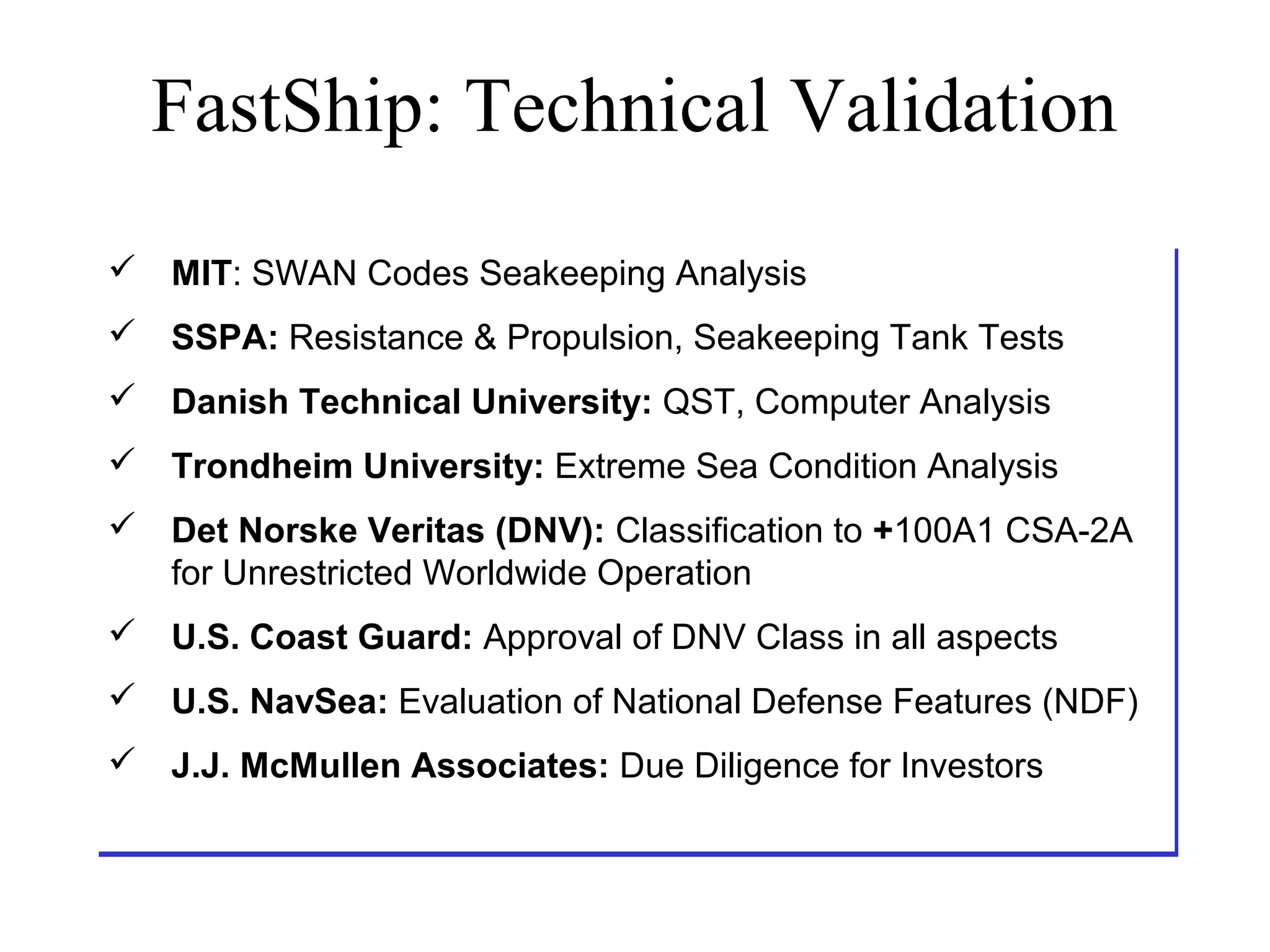
- Technical validation is anchored by MIT SWAN codes and DNV classification for unrestricted worldwide operation (Slide 1).
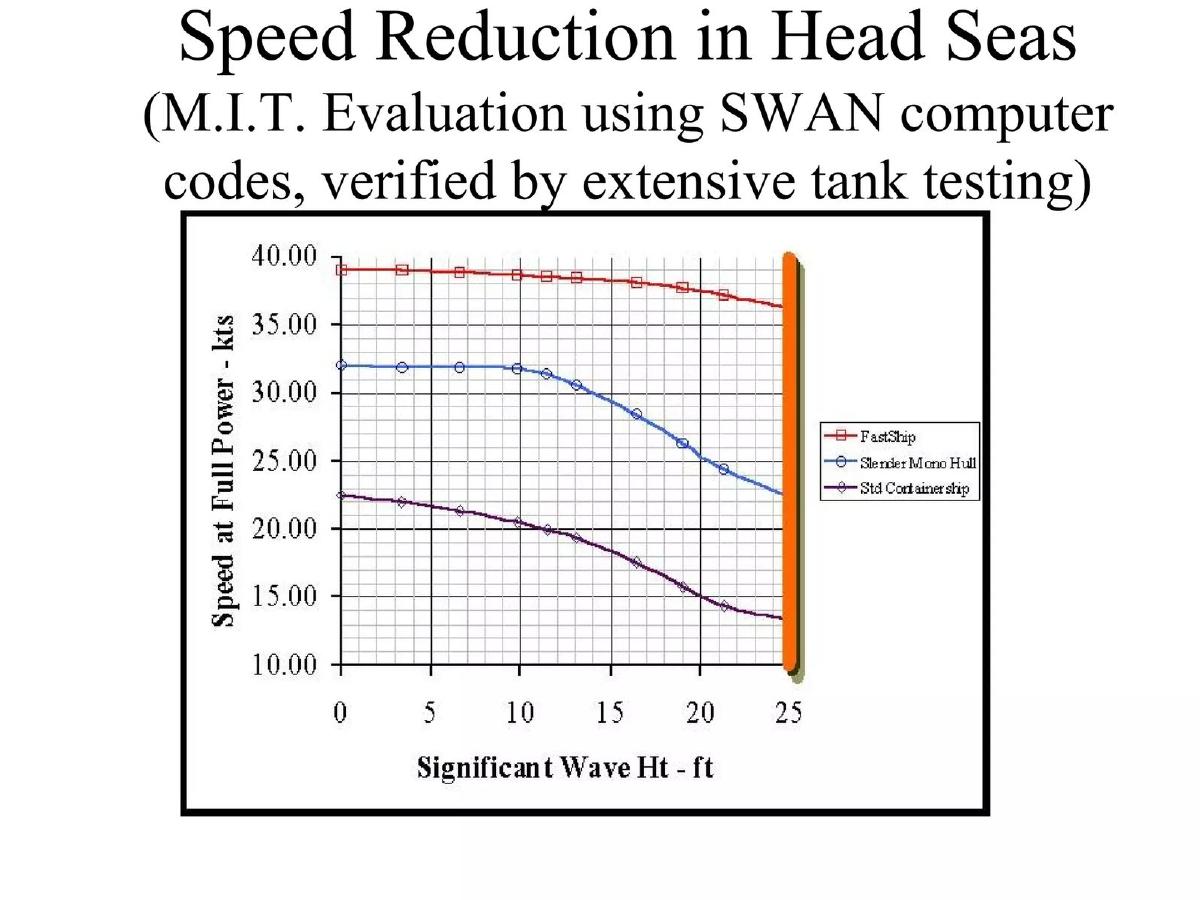
- The vessel maintains near-maximum speed (approx. 37-40 knots) even in significant wave heights of 25 feet, significantly outperforming standard container ships (Slide 2).
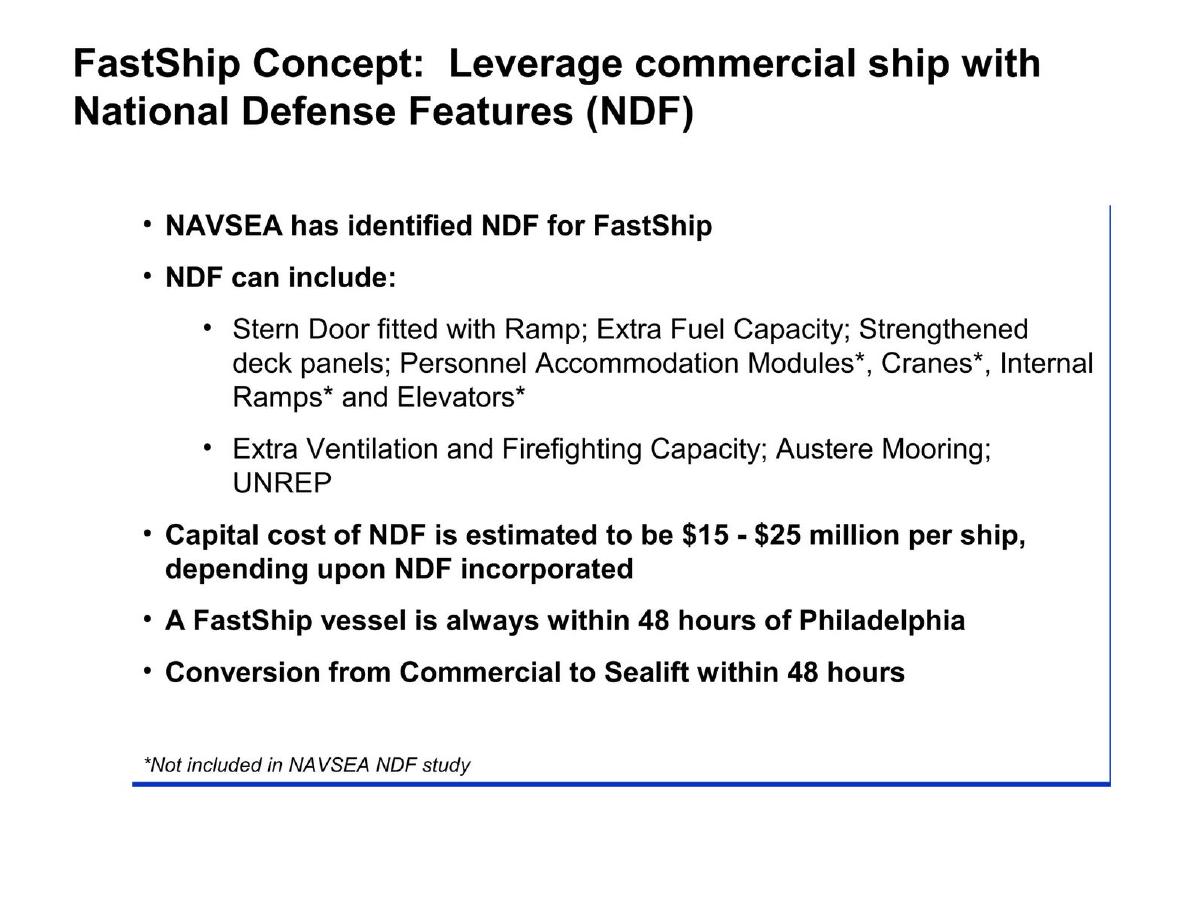
- National Defense Features (NDF) add an estimated $15 - $25 million to the capital cost per ship (Slide 3).
- Military conversion from commercial to sealift status is claimed to be achievable within 48 hours (Slide 3).
- Payload capacity is capped at a nominal limit of 12,000 tons, with range varying based on speed and weight (Slide 4).
- The 'Sea-Base' design includes internal ramps, elevators, and the ability to conduct in-stream transfers in sea state 3 (Slides 5-7).
- FastShip claims a 22.5-day round trip time, which is 72% faster than the LMSR class (Slide 8).
- Strategic resilience is highlighted by the claim that sailing around Africa only adds 2.7 days to the Kuwait route if the Suez Canal is blocked (Slide 9).
FastShip: Technical Validation and Defense Logistics Analysis
The FastShip deck is a dense, engineering-focused presentation that prioritizes technical feasibility over market narrative. It targets a very specific audience: maritime regulators, defense contractors, and institutional investors comfortable with heavy infrastructure and long-cycle industrial technology. The deck is characterized by its reliance on third-party validation and comparative performance data.
Slide 1: Technical Validation
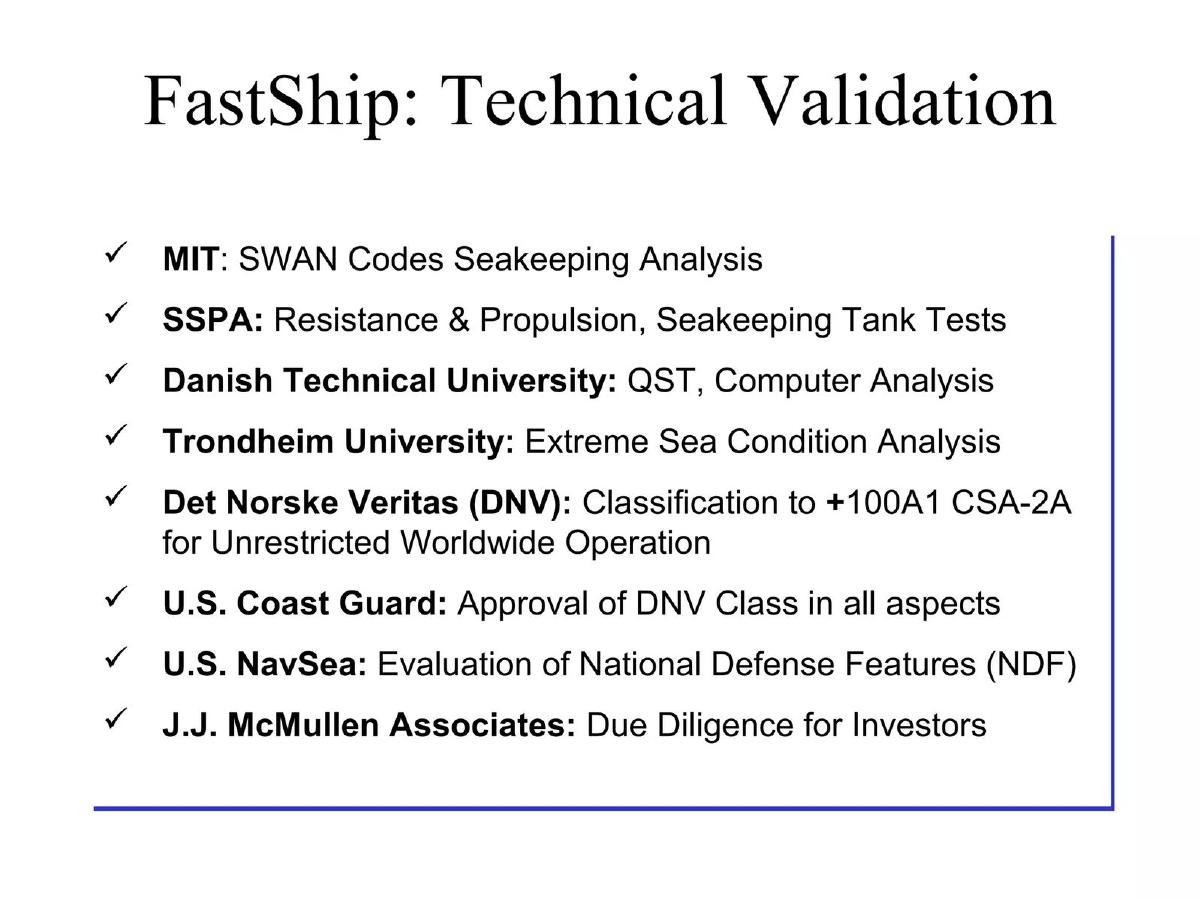
The presentation opens with a list of 'Technical Validation' milestones. This is a credibility-building slide designed to mitigate the perceived risk of a new hull design. It cites MIT for SWAN Codes Seakeeping Analysis and SSPA for tank tests. Crucially, it mentions Det Norske Veritas (DNV) classification to +100A1 CSA-2A, which is a standard requirement for unrestricted worldwide operation. The inclusion of the U.S. Coast Guard and NAVSEA suggests the company has already engaged with high-level regulatory and military stakeholders. The final bullet point mentions J.J. McMullen Associates for investor due diligence, indicating that the company has undergone external professional scrutiny.
Slide 2: Speed Reduction in Head Seas
This slide provides the core physical evidence for the company's competitive advantage. A line graph compares FastShip to a 'Slender Mono Hull' and a 'Std Container ship.' The Y-axis measures speed at full power in knots, while the X-axis measures significant wave height in feet. The data, attributed to MIT and tank testing, shows FastShip maintaining a speed of approximately 37-40 knots even as wave heights reach 25 feet. In contrast, the standard container ship drops below 15 knots in the same conditions. This illustrates that FastShip’s value isn't just 'speed' in a vacuum, but 'reliability' in adverse weather.
Slide 3: National Defense Features (NDF)
Slide 3 shifts the focus to the dual-use nature of the vessel. It defines the 'FastShip Concept' as leveraging commercial ships with National Defense Features. The deck lists specific NDF components: stern doors with ramps, extra fuel capacity, strengthened deck panels, and personnel accommodation modules. The slide provides a specific cost estimate of $15 - $25 million per ship for these features. Two operational claims are made: a vessel is always within 48 hours of Philadelphia, and conversion from commercial to sealift status takes less than 48 hours. This slide is clearly intended to appeal to the U.S. Department of Defense as a cost-effective alternative to dedicated military-only vessels.
Slide 4: Military Speed/Payload/Range
This is a complex multi-variable chart plotting Payload (in tons) against Range (in nautical miles) at 95% power. It shows that at a nominal payload limit of 12,000 tons, the ship can maintain 36 knots. As the payload decreases, the speed increases, reaching 41 knots at lower weights. The chart also overlays specific military loads, such as '2 Armored Battalions (10,069 tons)' and '4 Air Cavalry Squadrons (1,573 tons).' This translates abstract engineering data into concrete military utility, showing exactly what the ship can carry and how fast it can get there.
Slide 5: FastShip Sea-Base Rendering
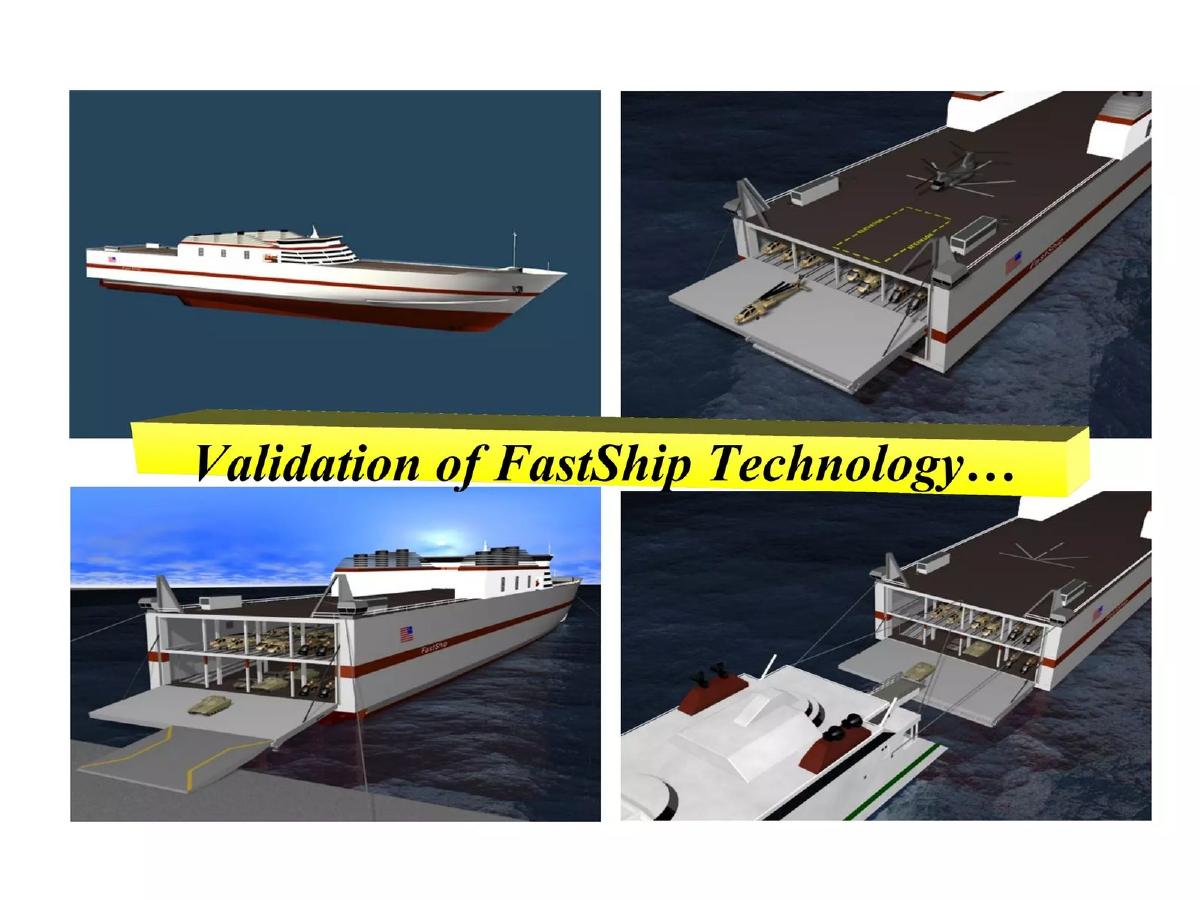
Moving from data to visualization, Slide 5 shows a 3D rendering of the 'Sea-Base' concept. The image depicts a large vessel with an open top deck carrying helicopters (Chinooks and Black Hawks), trucks, and Humvees. It shows a rear ramp deploying a vehicle onto a smaller landing craft. This slide serves to communicate the 'Roll-on/Roll-off' (Ro-Ro) capability and the versatility of the deck space for multi-modal military operations.
Slide 6: Unloading Containers by Crane or Translifter
This slide continues the visualization of cargo operations. It shows two views: one of a crane lifting a container from the side and another of a 'Translifter' truck moving a large container through the internal decks. The presence of multiple internal decks with helicopters parked in the background emphasizes the high volume of usable space within the hull. It reinforces the message that the ship is designed for rapid loading and unloading, which is critical for reducing port turnaround time.
Slide 7: In-Stream Transfer in Sea State 3
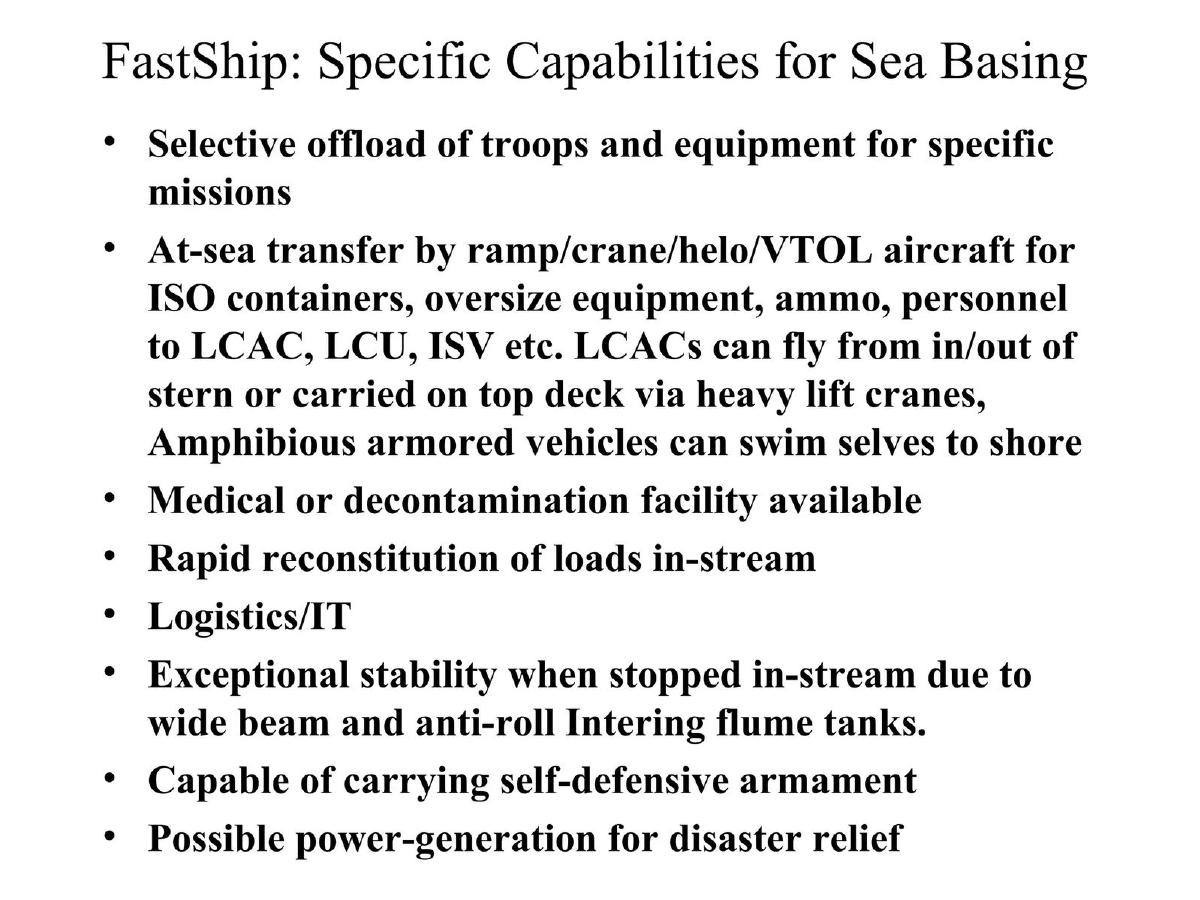
Slide 7 addresses a specific maritime challenge: transferring cargo between ships while at sea. It claims the ability to perform 'In-Stream transfer in sea state 3 (4FT Significant wave height).' The slide lists 'Unique Advantages' such as high initial stability against rolling, an integral static anti-roll flume system, and a ballast system that allows the ship to level with an Intra Theater Support Vessel (ISV). The wide stern is noted for providing an 'effective lee' (a sheltered area) for the smaller vessel. This is a highly technical selling point for expeditionary warfare where port access may be denied or unavailable.
Slide 8: Speed Comparison Table
This slide provides a direct competitive analysis of transit times. It compares FastShip to three other vessel classes: FSS, LMSR, and Standard Container/Ro-Ro (SCRC). The table breaks down load time, voyage out, unload time, voyage back, and total round trip time. FastShip is shown to have a round trip time of 22.5 days, compared to 40.5 days for the LMSR and 46 days for a standard container ship. The headline claim is that FastShip is '72% Faster than LMSR.' This is the most compelling 'business' slide in the deck, as it quantifies the efficiency gain in a single metric.
Slide 9: Suez Canal Contingency
The final slide in the set addresses a strategic geopolitical risk: the blockage of the Suez Canal. A bar chart compares transit times 'Via Suez' versus 'Round Africa' to Kuwait. It shows that while all ships take longer to go around Africa, FastShip’s high speed minimizes the penalty. The slide claims FastShip only needs 2.7 days longer to sail around Africa, whereas the other vessel types see much larger increases in transit time. This positions FastShip as a 'resilient' logistics solution that can maintain schedules even when primary global shipping lanes are disrupted.
What FastShip Does Well
The deck is exceptionally strong on technical validation. By citing MIT, DNV, and the U.S. Coast Guard, the founders anticipate and answer the 'will it work?' question that plagues new hull designs. The use of comparative data (Slides 2, 8, and 9) is effective because it doesn't just say FastShip is fast; it shows exactly how much faster it is than the current industry standards under specific, difficult conditions like 25-foot waves or a Suez Canal closure. The 3D renderings are functional rather than just aesthetic, clearly demonstrating the ship's internal layout and cargo-handling capabilities.
What is Missing from the Deck
While the technical case is robust, the investment case is almost entirely absent from these nine slides. There is no Team Slide , which is a significant omission for a project of this scale; investors need to know if the leadership has experience in shipyard management or defense procurement. There is no Financial Projections slide or Unit Economics —we know the NDF costs $15-$25 million, but we don't know the cost of the ship itself or the projected day rates. Most importantly, there is no Ask . The deck explains what the ship can do, but not what the company needs from an investor to reach the next milestone. Finally, there is no mention of the Commercial Market ; the deck focuses exclusively on military utility, ignoring the potential for high-value commercial cargo (like perishables or electronics) that would likely form the bulk of the ship's peacetime operations.
What a Founder Should Copy
Founders in 'Hard Tech' or infrastructure should copy the way FastShip uses third-party validation to build a 'moat of credibility.' Instead of making bold claims themselves, they point to MIT and DNV. The 'Speed Reduction in Head Seas' chart (Slide 2) is a masterclass in showing a competitive advantage through environmental stress-testing. Founders should also emulate the 'Strategic Resilience' angle shown in Slide 9; by showing how their product performs in a 'worst-case scenario' (like a canal blockage), they demonstrate a deeper understanding of their customers' pain points than a simple 'best-case' performance chart would allow. The use of specific military loadouts (Slide 4) is also a great way to make abstract capacity numbers feel real and urgent to a target customer.
Frequently asked questions
- What is the primary value proposition of FastShip?
- FastShip proposes a high-speed maritime transport solution that bridges the gap between slow conventional shipping and expensive air freight. By utilizing a unique hull design validated by MIT, the ship maintains high speeds in rough seas, allowing for a 72% faster delivery cycle than current military Large, Medium-Speed Roll-on/Roll-off (LMSR) vessels.
- How does the company address military utility?
- The deck introduces the concept of National Defense Features (NDF). These are modular additions like stern doors, extra fuel capacity, and personnel modules that allow a commercial vessel to be converted for military use within 48 hours. This dual-use strategy is intended to make the fleet a strategic asset for the U.S. Navy and NAVSEA.
- What technical proof does the deck provide for its performance claims?
- The deck cites 'Technical Validation' from several prestigious bodies, including MIT for seakeeping analysis, SSPA for tank tests, and Det Norske Veritas (DNV) for classification. Slide 2 specifically uses a graph to show that while standard ships slow down significantly in high waves, FastShip maintains nearly 40 knots in 25-foot waves.
- What are the estimated costs for the military features?
- According to Slide 3, the capital cost of incorporating National Defense Features is estimated to be between $15 million and $25 million per ship. This cost covers enhancements like strengthened deck panels, extra ventilation, firefighting capacity, and austere mooring capabilities.
- Is there a clear business model or financial exit strategy in the deck?
- No. The provided slides are strictly technical and operational. There is no mention of revenue models, customer contracts, total addressable market (TAM), or an exit strategy. The deck appears to be a technical annex or a specialized pitch for defense procurement rather than a general investor deck.