Fatfish Internet Group (ASX:FFG) presented this deck in April 2018 to position itself as a premier 'venture builder' for the internet and blockchain sectors. Operating across Australia, Singapore, Malaysia, the UK, and Sweden, the company utilizes a three-stage investment approach: acting as a corporate founder, driving growth through management talent, and pursuing exits via capital markets. The deck is notable for its transparency regarding its public listing status, including a market cap of A$18.5m and a cash position of A$3.3m as of December 2017. A significant portion of the presentatio…
Key takeaways
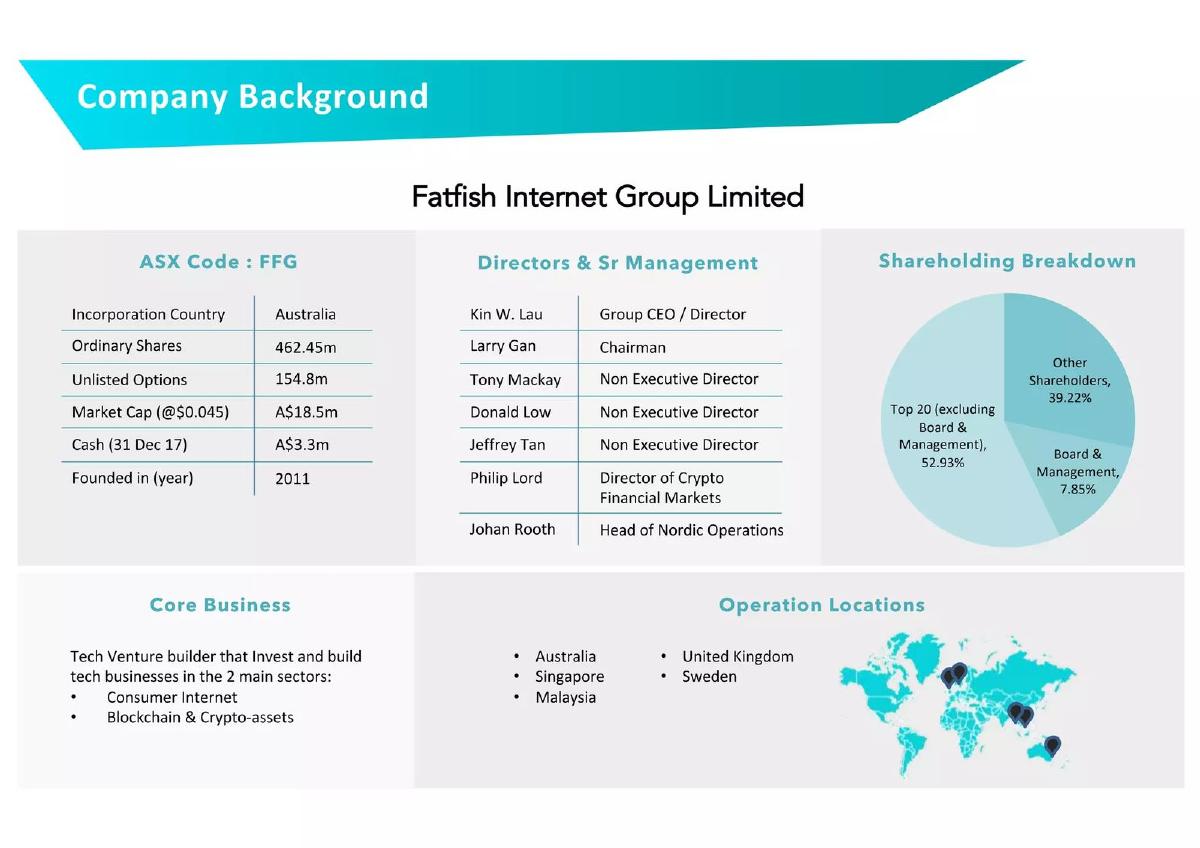
- The company operates as a tech venture builder focusing on Consumer Internet and Blockchain/Crypto-assets (Slide 2).
- Fatfish is a publicly traded entity on the ASX with a market cap of A$18.5m at a share price of $0.045 (Slide 2).
- The investment strategy emphasizes investing at the 'lowest valuation possible' during Seed and Pre-Series A stages (Slide 3).
- The Board of Directors features significant institutional experience, including a former Managing Partner at Accenture and the founding CEO of Chi-X Global (Slide 4).
- Cloudaron is highlighted as a primary success story, having completed an IPO in Malaysia in November 2017 with a market cap of A$90m (Slide 7).
- The company aggressively entered the crypto mining space via APAC Mining, investing US$1m for a 51% stake (Slide 8).
- A Deloitte valuation report estimates the fair value of the consumer internet portfolio assets at over A$16.7m (Slide 9).
- The blockchain ecosystem strategy includes mining, regulated fund management, crypto exchanges, and ICO advisory (Slide 10).
Executive Summary: The Venture Builder Pivot
Fatfish Internet Group (ASX:FFG) occupies a unique space in the investment landscape. This 2018 investor presentation serves as a bridge between their established history as a consumer internet venture builder and their aggressive pivot into the then-booming blockchain economy. By combining traditional corporate governance with high-risk, high-reward tech sectors, the deck attempts to justify a valuation based on both realized IPO successes and future crypto-mining potential.
Slide 1: Title and Global Footprint
The cover slide establishes the company's dual focus: "Building Ventures for the Internet & Blockchain Economy." It lists five key jurisdictions—Australia, Singapore, Malaysia, UK, and Sweden—immediately signaling that this is a cross-border play. The inclusion of the ASX ticker (FFG) on the logo reminds investors that this is a liquid, regulated investment vehicle.
Slide 2: Company Background and Capital Structure
This slide functions as a fact sheet. It provides essential data for a publicly traded company: 462.45m ordinary shares, a market cap of A$18.5m, and a cash position of A$3.3m as of December 2017. The shareholding breakdown shows that the Top 20 shareholders (excluding board and management) hold 52.93% of the company, suggesting a relatively concentrated but institutional-friendly registry. The core business is defined clearly as a "Tech Venture builder" across two sectors: Consumer Internet and Blockchain.
Slide 3: The Three-Stage Investment Approach
Fatfish outlines its value-add process in three distinct phases: Corporate Founder / Strategic Investor , Growth Hacking , and IPO / Exit Route . They explicitly state a preference for investing at the "lowest valuation possible" during Seed and Pre-Series A stages. The middle column is particularly important for a venture builder, highlighting that they provide "management talents to accelerate" rather than just passive capital.
Slide 4: Board of Directors
For a micro-cap company, the board is exceptionally high-profile. The slide highlights Larry Gan's tenure at Accenture and Tony Mackay's role as the founding CEO of Chi-X Global. CEO Kin W. Lau is presented as a serial entrepreneur with six tech IPOs under his belt. This slide is designed to build trust; the message is that while the underlying ventures may be risky startups, the people overseeing the capital are seasoned corporate veterans.
Slide 5: Educational Context for Blockchain
In 2018, blockchain was still a nascent concept for many retail and institutional investors. Slide 5 provides a basic primer on how a transaction is broadcasted, verified, and added to a ledger. The sidebar explains "Why is cryptocurrency disrupting?" focusing on globalized, decentralized, and secured networks. This is a common tactic in emerging tech decks: educate the investor to make the subsequent pitch feel like a logical conclusion.
Slide 6: The Venture Builder Portfolio
This slide displays the breadth of the Fatfish portfolio, categorized into four buckets: Software / SaaS (Cloudaron, News Deeply), Interactive Media (Lunch Actually, iCandy, VDancer), E-commerce (ifashion group, ClosetStyles, Beam, iSecrets), and Fintech (Kredito, Smartfunding.sg, RajaPremi, Fatberry). The sheer number of logos (13 in total) demonstrates the company's diversification strategy.
Slide 7: Case Study - Cloudaron
To prove the model works, Fatfish highlights Cloudaron. It notes that Cloudaron is publicly traded on Bursa Malaysia with a market cap of A$90m. Key metrics provided include revenue of over USD 14m in the previous financial year and a client list featuring Bank of Singapore and Yale NUS College. Crucially, it shows Fatfish's involvement "Since Seed Stage" leading to an IPO in November 2017, validating the "Seed to Exit" claim from Slide 3.
Slide 8: APAC Mining Operations
This slide details the company's direct entry into crypto infrastructure. Fatfish invested US$1m for a 51% stake in APAC Mining. The slide includes photos of server racks and a facility in Malaysia. The strategic hook is the "low-energy cost of hydropower excess capacity." The financial target is bold: scaling to USD 1.5m in monthly revenue by the end of 2018 through the production of BTC, ETH, and LTC.
Slide 9: Third-Party Valuation (Deloitte)
One of the strongest slides in the deck, this presents a summarized valuation report from Deloitte. It lists the fair value of various assets, totaling over A$16.7m. By using an independent big-four accounting firm to value their private holdings, Fatfish provides a floor for their valuation. It shows that the fair value of their consumer internet assets alone nearly covers their A$18.5m market cap, essentially giving investors the blockchain upside for free.
Slide 10: The Blockchain Ecosystem Map
The final slide in this set visualizes the "Blockchain Ecosystem Play." It connects various subsidiaries and investments—iCandy (gaming), APAC Mining (hardware), Altairian (fund management), Fatfish (Swedish subsidiary to IPO), CryptoFoundry (ICO advisory), and Kryptos (exchange). This wheel diagram is intended to show synergy; each piece of the blockchain puzzle supports the others, creating a comprehensive macro play.
What Fatfish Does Well
The deck excels at providing institutional-grade transparency. For a company involved in the often-opaque world of cryptocurrency in 2018, providing a Deloitte valuation report and a clear board of directors biography is a significant trust-builder. They also do a good job of balancing "proven" successes (Cloudaron IPO) with "future" growth drivers (APAC Mining). The geographic diversification is also a strength, showing they aren't reliant on a single regulatory environment.
What is Missing from the Deck
While the deck provides a fair value of assets, it lacks a consolidated profit and loss (P&L) statement for the parent company. There is no mention of the burn rate or how long the A$3.3m in cash will last given the capital-intensive nature of crypto mining. Furthermore, while the APAC Mining slide mentions a revenue target of USD 1.5m/month, it does not provide the projected margins or the cost of the hardware depreciation, which is a critical factor in mining profitability.
Founder's Guide: What to Copy
Third-Party Validation: If you are a holding company or an incubator, including a valuation report from a reputable firm like Deloitte (Slide 9) is the gold standard for proving your "paper" wealth to investors. · The Ecosystem Wheel: Slide 10 is an excellent way to show how disparate investments actually fit into a single strategic vision. It turns a list of logos into a cohesive story. · Clear Exit Evidence: Don't just say you can exit companies; show the timeline and the final market cap of a successful exit (Slide 7). · Fact Sheet Summary: Slide 2 is a perfect example of how to present a company's vitals (cash, market cap, shares) in a single, easy-to-read table.
Frequently asked questions
- What is Fatfish Internet Group's core business model?
- Fatfish operates as a 'Venture Builder.' Unlike a traditional VC, they act as a corporate founder, putting together founding teams and providing management talent to accelerate growth. They focus on two main sectors: Consumer Internet and Blockchain/Crypto-assets, with a geographic footprint spanning Australia, Southeast Asia, and Europe.
- How does the deck handle the transition into blockchain?
- The deck uses a 'Best-in-Class Exposure' model to show a diversified blockchain ecosystem. This includes hardware (APAC Mining), infrastructure (Kryptos exchange), services (ICO advisory), and regulated finance (Altairian fund management). It positions blockchain not just as a trend, but as a comprehensive expansion of their existing venture building expertise.
- What financial evidence is provided to support their portfolio value?
- Fatfish includes a detailed table from a Deloitte valuation report. It lists 14 specific portfolio companies, their investment instruments (mostly straight equity or RCPS), the cost basis, and the fair value. This transparency is intended to show that the underlying asset value (A$16.7m) is close to the total market cap of the parent company.
- Who are the key people behind the company?
- The leadership is led by CEO Kin W. Lau, who took his first company to IPO at age 28. The board is heavily weighted toward capital markets and corporate governance, featuring Larry Gan (ex-Accenture), Tony Mackay (ex-Chi-X), and Donald Low (former Hong Kong securities regulator), signaling a focus on public market exits.
- What are the specific goals for their crypto mining operations?
- Through APAC Mining, Fatfish invested US$1m for a 51% stake. The operations were initially based in Malaysia with plans to expand to Mongolia to utilize low-cost hydropower. Their stated goal in the deck was to scale the mining of BTC, ETH, and LTC to reach US$1.5m in monthly revenue by the end of 2018.