Fashinza’s 13-slide deck serves as a masterclass in demonstrating market traction and operational scale for a B2B marketplace. The company positions itself as a 'one-stop online platform' for fashion sourcing, boasting over 250 brand customers and 150 digitalized manufacturers. The deck centers on three core value propositions: a digital catalog with 45-day turnaround times, AI-driven supplier matching, and 100% supply chain visibility. By showcasing high-profile clients like Forever 21 and Walmart, alongside a $100 million Series B led by Prosus and Westbridge, Fashinza builds immediate cred…
Key takeaways
- Fashinza reports a $150 million annualised GMV run rate and 10x growth over a 12-month period (Slide 12).
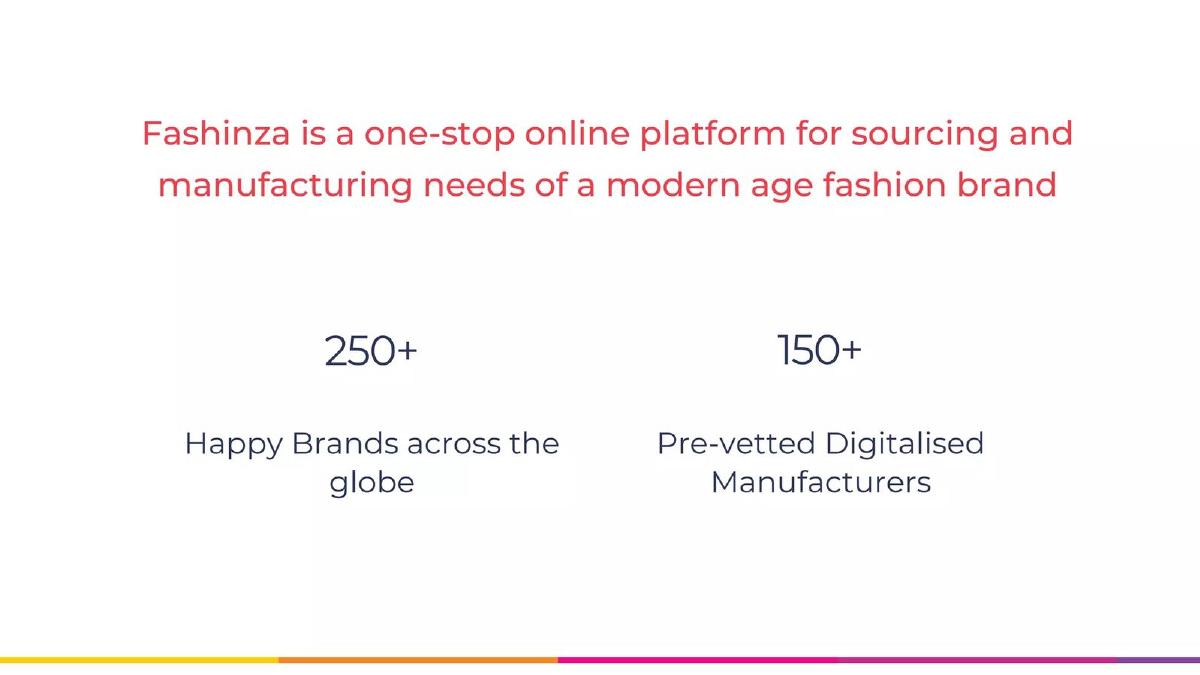
- The platform has successfully onboarded 250+ global brands and 150+ pre-vetted digitalized manufacturers (Slide 2).
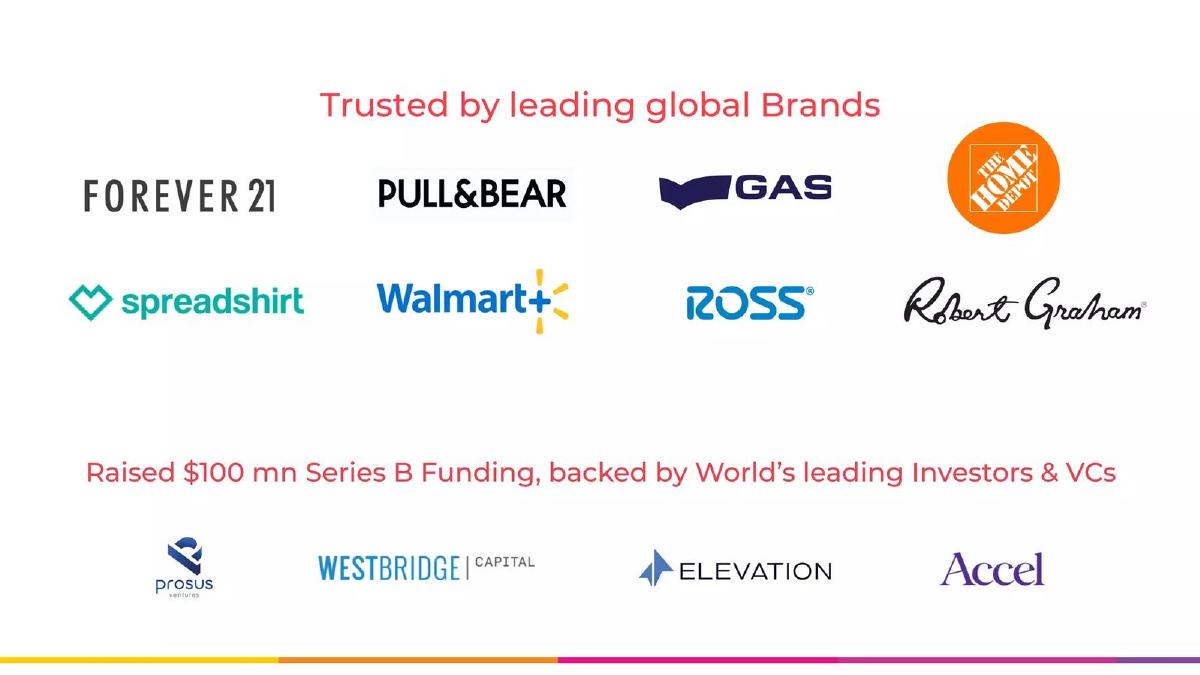
- The company secured a $100 million Series B funding round backed by Prosus Ventures, Westbridge Capital, Accel, and Elevation (Slide 3).
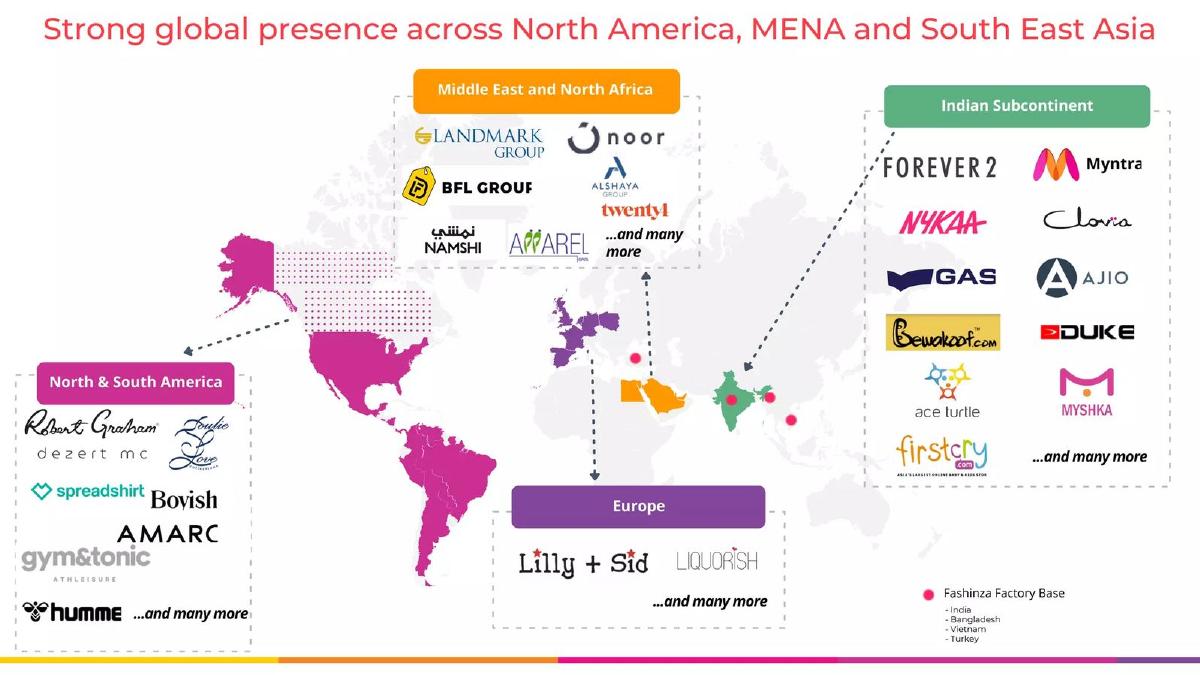
- Fashinza maintains a global factory base across India, Bangladesh, Vietnam, and Turkey (Slide 4).
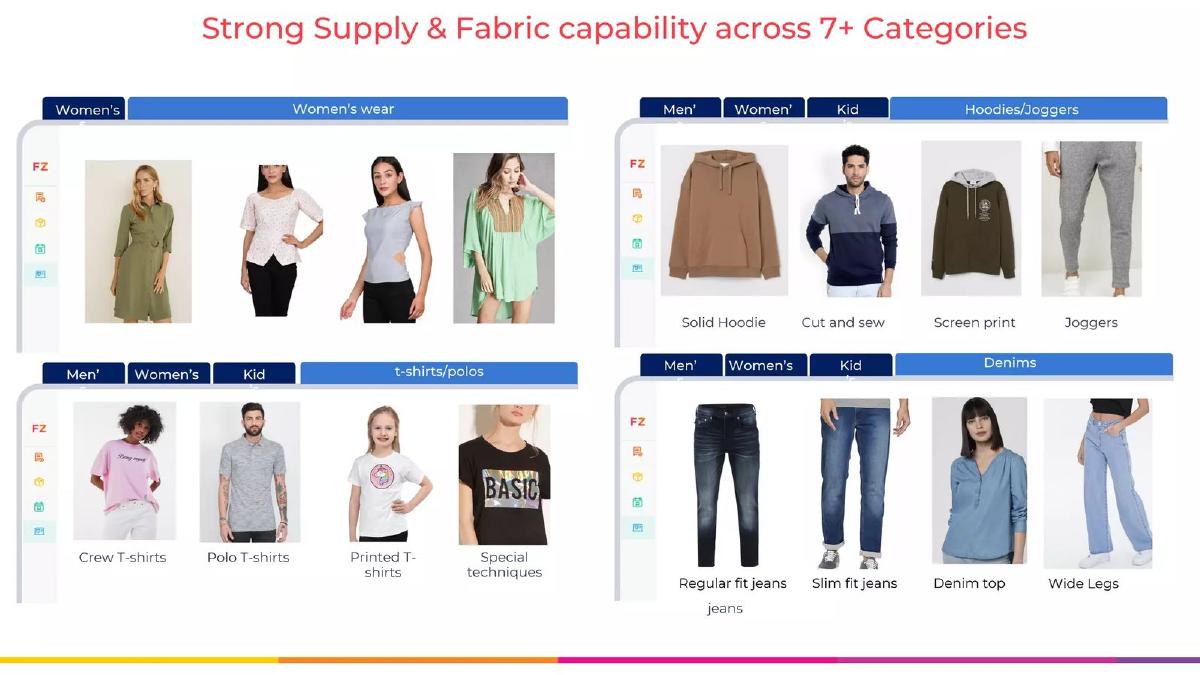
- Product capability spans 7+ categories including women's wear, denims, nightwear, and home decor (Slides 6-7).
- The platform offers a 45-day turnaround time (TAT) and low minimum order quantities (MOQs) as low as 50 units (Slides 5, 12).
- Sustainability is a core pillar, with claims of impacting 3000 artisans and achieving a 12% drop in fabric wastage (Slide 11).
- The deck omits a dedicated team slide, though founders appear in a press photo on Slide 12.
Fashinza Pitch Deck Teardown: Manufacturing the Future of Fashion
Fashinza’s pitch deck is a high-signal document that prioritizes traction, social proof, and operational capability over abstract problem-solving. By the time a company reaches a $100 million Series B, the 'problem' is usually well-understood by the market; the deck's job is to prove that the company has the infrastructure to dominate the solution. Fashinza does this by showcasing a sophisticated digital platform that bridges the gap between fragmented manufacturing and global retail demand.
Slide 1: Title and Positioning
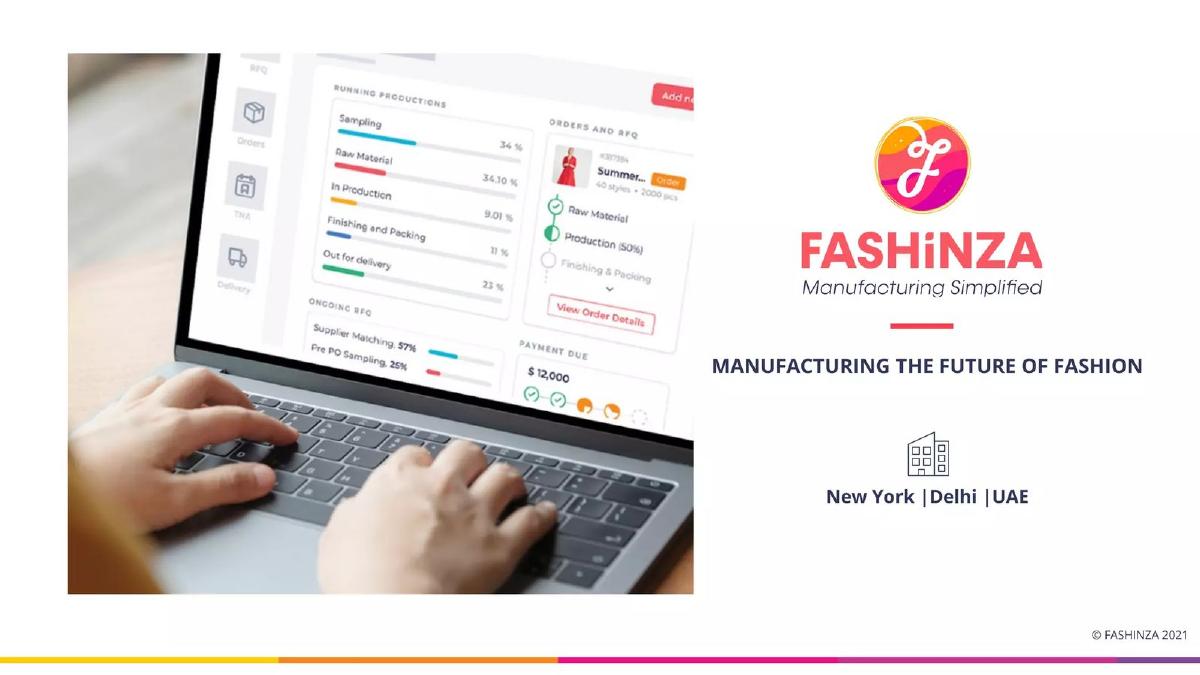
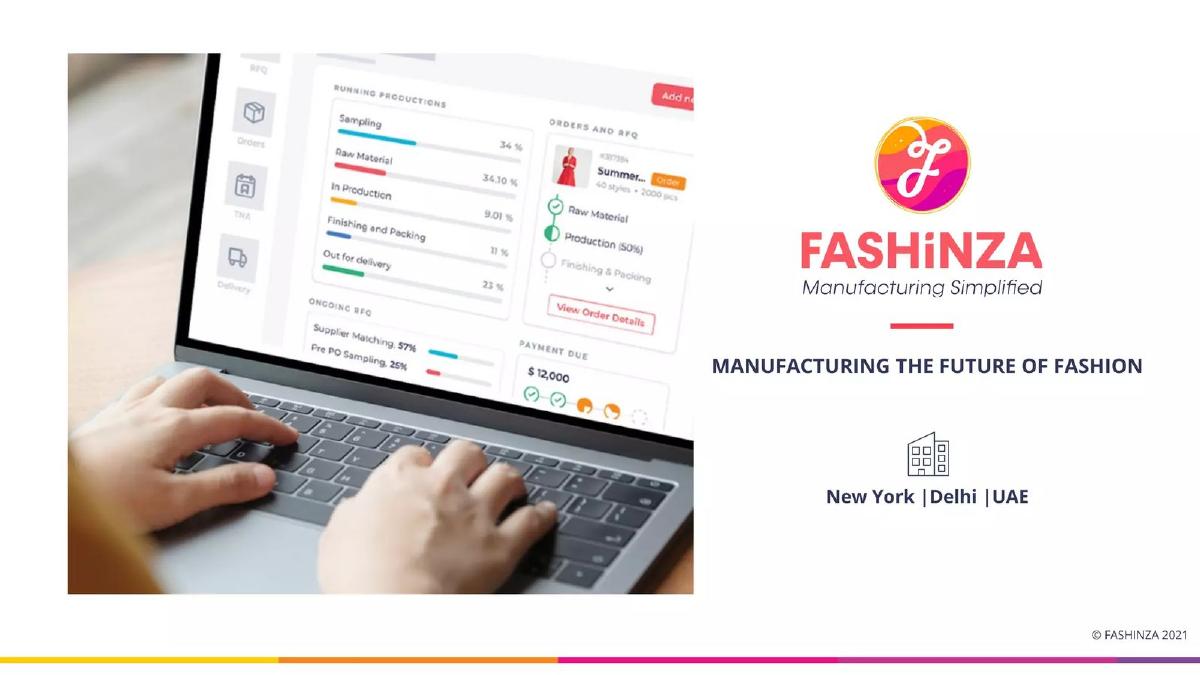
The cover slide introduces the company with the tagline "Manufacturing Simplified" and the ambitious vision "Manufacturing the Future of Fashion." It immediately establishes a global presence by listing New York, Delhi, and UAE as key hubs. The visual of a user interacting with a production dashboard on a laptop sets the tone for a tech-first approach to a traditionally manual industry.
Slide 2: The Value Proposition and Scale
Slide 2 defines Fashinza as a "one-stop online platform for sourcing and manufacturing needs of a modern age fashion brand." It leads with two massive numbers: 250+ "Happy Brands" and 150+ "Pre-vetted Digitalised Manufacturers." This establishes the marketplace's liquidity immediately, showing that they have successfully solved the chicken-and-egg problem inherent in B2B platforms.
Slide 3: Trust and Capital
This is a pure credibility slide. The top half features logos of global retail giants including Forever 21, Walmart, Pull&Bear, and The Home Depot. The bottom half highlights the $100 million Series B funding round, prominently featuring top-tier VC logos: Prosus Ventures, Westbridge Capital, Elevation, and Accel. For a prospective partner or investor, this slide signals that Fashinza is already a validated, well-capitalized player.
Slide 4: Global Footprint
Fashinza uses a world map to visualize its supply and demand network. They categorize their presence into North & South America, Europe, MENA, and the Indian Subcontinent. Crucially, they identify their "Factory Base" locations: India, Bangladesh, Vietnam, and Turkey. This geographic diversity is a key selling point for brands looking to de-risk their supply chains from over-reliance on a single region.
Slide 5: Platform Features
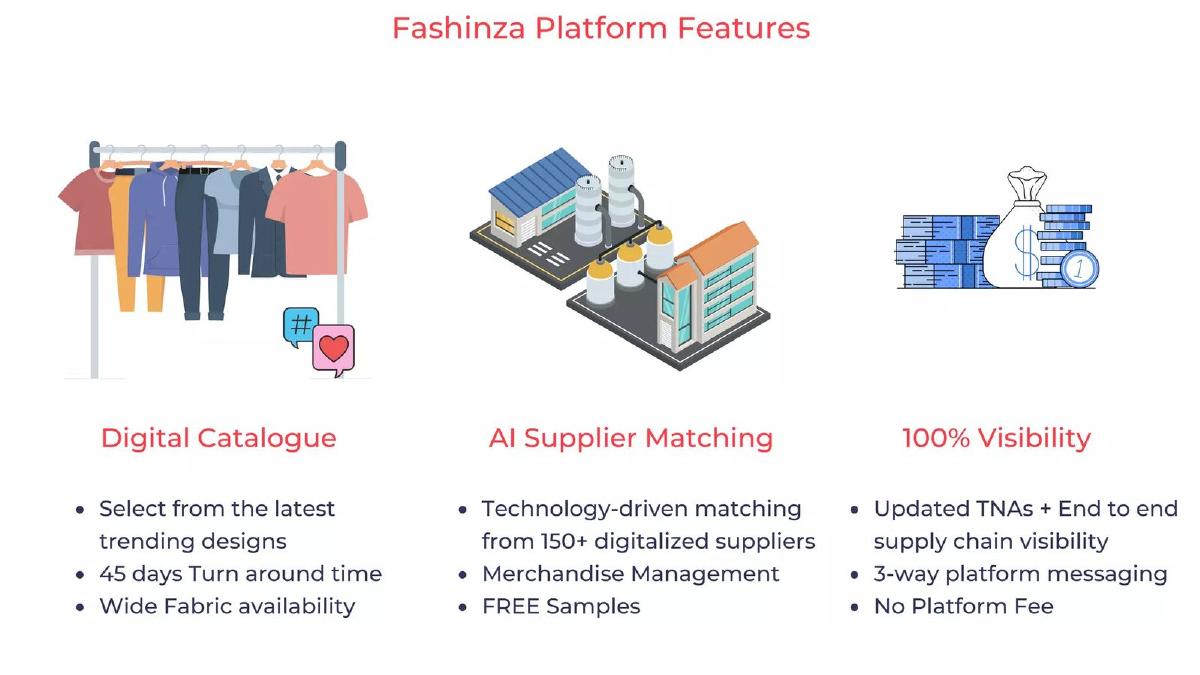
Digital Catalogue: Trending designs with a 45-day turnaround time. · AI Supplier Matching: Matching brands to 150+ digitalized suppliers with free samples. · 100% Visibility: End-to-end supply chain tracking with no platform fee.
The mention of "No Platform Fee" suggests a take-rate model based on transaction volume or manufacturing margins rather than a SaaS subscription.
Slides 6 & 7: Product Capability
These two slides serve as a lookbook, proving that Fashinza can handle complex manufacturing across diverse categories. They showcase everything from basic T-shirts and hoodies to technical denims, dungarees, and even home decor items like mirrors and platters. This breadth demonstrates that their platform is not a niche tool but a comprehensive sourcing solution for large retailers with diverse inventories.
Slide 8: Seamless Online Ordering
Slide 8 provides a UI walkthrough of the RFQ (Request for Quote) process. It highlights how brands can add product details, upload tech packs, and receive AI-driven supplier suggestions based on "capability, live capacity & supplier performance." The slide claims a reduction in order closure TAT (Turnaround Time) through this data-driven matching.
Slides 9 & 10: Order Tracking and Visibility
These slides focus on the post-order experience. Slide 9 shows a dashboard for tracking costing and sampling, while Slide 10 focuses on production, QC (Quality Control) checks, and delivery. The mobile-first UI shown in these slides emphasizes that brand managers can track their entire production line from their phones, a significant upgrade from traditional email-and-spreadsheet sourcing.
Slide 11: Sustainability and Impact
Fashinza dedicates a full slide to ESG (Environmental, Social, and Governance) metrics. They claim to follow SDG-aligned practices and provide specific impact numbers: 3000 artisans impacted, 12% drop in fabric wastage, and 100% of artisans receiving on-time payments. They also display certifications like ISO 9001, BCI (Better Cotton Initiative), and Fair Trade, which are increasingly mandatory for global brands.
Slide 12: Press and Growth Metrics
The penultimate slide is a collage of press clippings from The Economic Times, Forbes, and TechCrunch. It contains the most significant financial data in the deck: "In the past 12 months... Fashinza grew its business 10x, crossing $150 million in annualised GMV run rate." It also notes that they reduced MOQs to as low as 50 units, a critical feature for agile fashion brands.
Slide 13: Contact and Closing
The final slide provides contact information and photos of a factory floor, reinforcing the connection between their digital platform and the physical reality of manufacturing.
What Fashinza Does Well
Fashinza excels at Social Proof . By placing logos like Walmart and Accel on the third slide, they remove any doubt about their legitimacy. They also do an excellent job of Visualizing the Product . Instead of just saying they have a dashboard, they show high-fidelity screenshots of the RFQ process and production tracking, which makes the "AI-driven" claims feel tangible. Finally, their Category Breadth (Slides 6-7) effectively counters the objection that a single platform can't handle diverse manufacturing needs.
What Is Missing from the Deck
The most notable omission is a Dedicated Team Slide . While the founders appear in a small photo on Slide 12, there is no breakdown of their backgrounds or the expertise of the broader leadership team. Additionally, the deck lacks Unit Economics . While they mention a $150M GMV run rate, they do not disclose their take rate, margins, or customer acquisition costs. There is also no Competitive Landscape analysis, which is surprising given the crowded nature of the B2B sourcing space.
What Other Founders Should Copy
Founders should emulate Fashinza’s Traction-First Layout . If you have impressive numbers and big-name clients, don't bury them at the end of the deck. Fashinza puts their best foot forward by Slide 3. Another takeaway is the Clarity of Value Pillars on Slide 5. By grouping their features into three distinct benefits (Speed, Matching, Visibility), they make a complex technical platform easy to understand for a non-technical buyer or investor.
Frequently asked questions
- What is Fashinza's core business model?
- Fashinza operates as an AI-driven B2B marketplace that connects fashion brands with manufacturers. According to Slide 5, they offer a digital catalog for design selection, AI-driven supplier matching based on live capacity, and an end-to-end tracking dashboard. They monetize by managing the production process, notably offering 'No Platform Fee' to brands while providing 100% visibility into the supply chain.
- How much funding has Fashinza raised?
- Slide 3 and Slide 12 confirm that Fashinza raised a $100 million Series B funding round. The round was led by Prosus Ventures and Westbridge Capital, with participation from Accel, Elevation, DisruptAD, and angel investors like Naval Ravikant and Jeff Fagnan. The source listing suggests total funding has since reached $120 million.
- What are the key performance metrics mentioned in the deck?
- The deck highlights several high-growth metrics: a $150 million annualised GMV run rate, 10x business growth within 12 months, and a 50% reduction in design-to-delivery turnaround times. Additionally, Slide 2 notes a network of 250+ brands and 150+ digitalized manufacturers, while Slide 12 mentions reducing MOQs to as low as 50 units.
- Which geographic markets does Fashinza operate in?
- Fashinza has a broad global footprint. Slide 4 illustrates presence in North & South America, Europe, MENA (Middle East and North Africa), and the Indian Subcontinent. Their factory bases are specifically located in India, Bangladesh, Vietnam, and Turkey, while corporate offices are listed in New York, Delhi, and the UAE.
- What specific product categories does Fashinza support?
- The platform supports over 7 categories. Slides 6 and 7 detail these as Women’s wear (dresses, tops), Men’s wear (hoodies, joggers, polos), Kids' wear, Denims, Dungarees, Nightwear, Bedding/Towels, Silk products, and Home Decor (mirrors, wall decor, baskets).