Fayceoff's pitch deck, dated February 14, 2012, presents a 'social trading network' designed to solve the monetization gap in social gaming, where only 1% to 3% of users spend money (Slide 2). The platform enables gamers to trade virtual goods using Fayceoff Credit, with a generous 95% revenue share offered to game developers (Slide 3). The deck highlights a sales pipeline of over 250 game companies and a partnership with iQU reaching 100 million unique users (Slide 4). Having already raised $300k in note/equity and closed a $500k seed round, the company outlines a path toward a $2M to $4M Se…
Key takeaways
- The core market problem identified is that only 1% to 3% of social gamers currently spend money, despite 60,000 virtual goods being used every second (Slide 2).
- Fayceoff proposes a secondary market where gamers can bid, buy, and transfer virtual goods that were previously locked within specific games (Slide 2, 3).
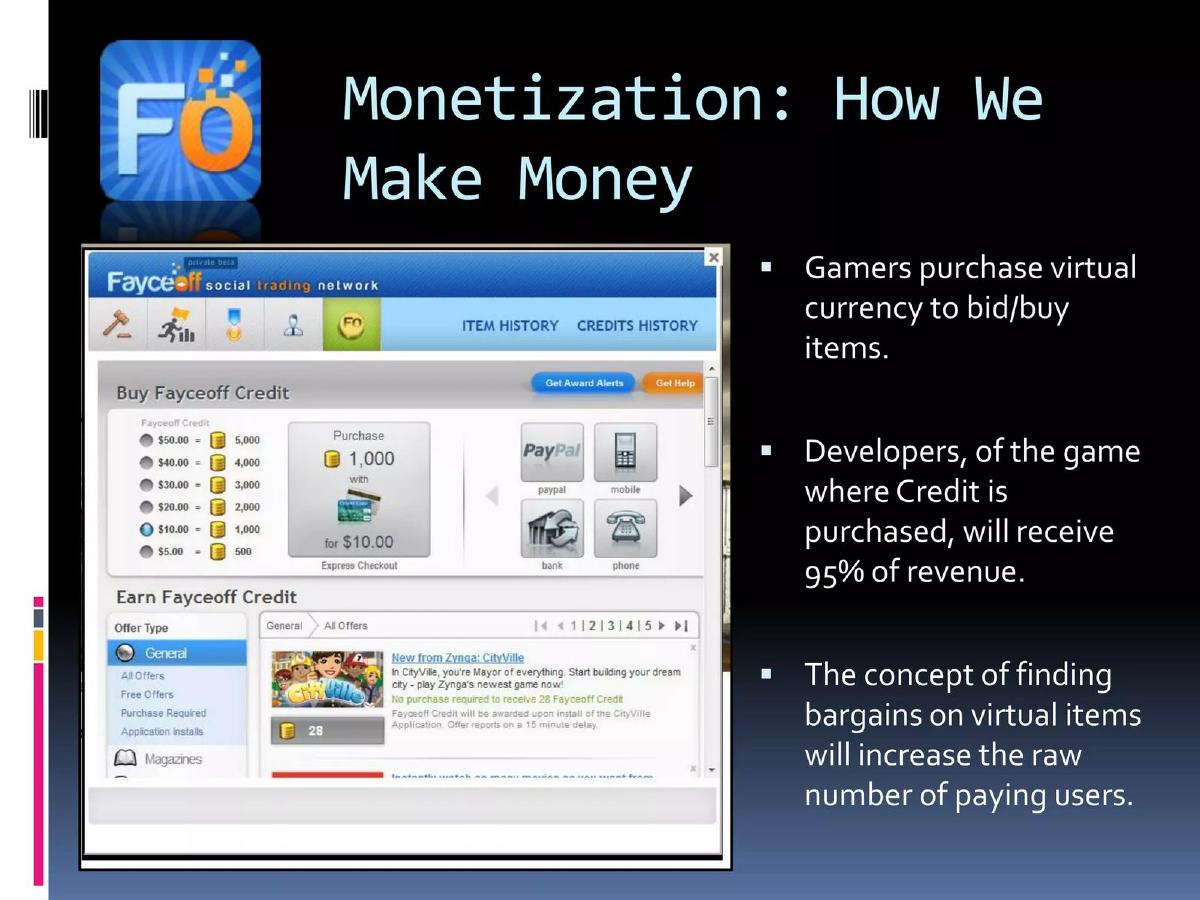
- The monetization strategy involves a 95% revenue kickback to the original game developers for credits spent on their items (Slide 3).
- The company claims a significant sales pipeline including 250 game companies and partnerships with iQU, Atari, and Digital River (Slide 4).
- The organization chart shows a structured team led by Mark Sendo, including roles for platform design, mobile development, and external sales (Slide 5).
- Historical funding includes a $300k initial raise and a $500k closed seed round (Slide 6).
- Future milestones include scaling to mobile and developing a 'Social Trading Game Engine' before seeking a Series A of $2M to $4M (Slide 6).
- The deck explicitly lists potential exit partners, including GREE, Atari, VISA, Digital River, and Facebook (Slide 6).
Introduction: The 2012 Social Gaming Secondary Market
The Fayceoff investor deck, dated February 14, 2012, captures a specific moment in the evolution of the 'social gaming' era. During this period, companies like Zynga were dominant, but monetization remained a significant hurdle. Fayceoff's pitch centers on the idea that virtual goods—items used in games like FarmVille—represent a massive untapped market if they can be traded between players. The deck positions Fayceoff as a 'social trading network' that facilitates this peer-to-peer exchange.
Slide 1: Title and Branding
The cover slide introduces the brand 'Fayceoff' with the tagline 'social trading network.' It prominently features a 'private beta' badge, signaling that the product is live but not yet fully public. The contact information for Mark Sendo is provided, along with the date of February 14, 2012. The visual style, featuring glossy reflections and a dark background, is characteristic of early 2010s tech aesthetics.
Slide 2: The Market Problem
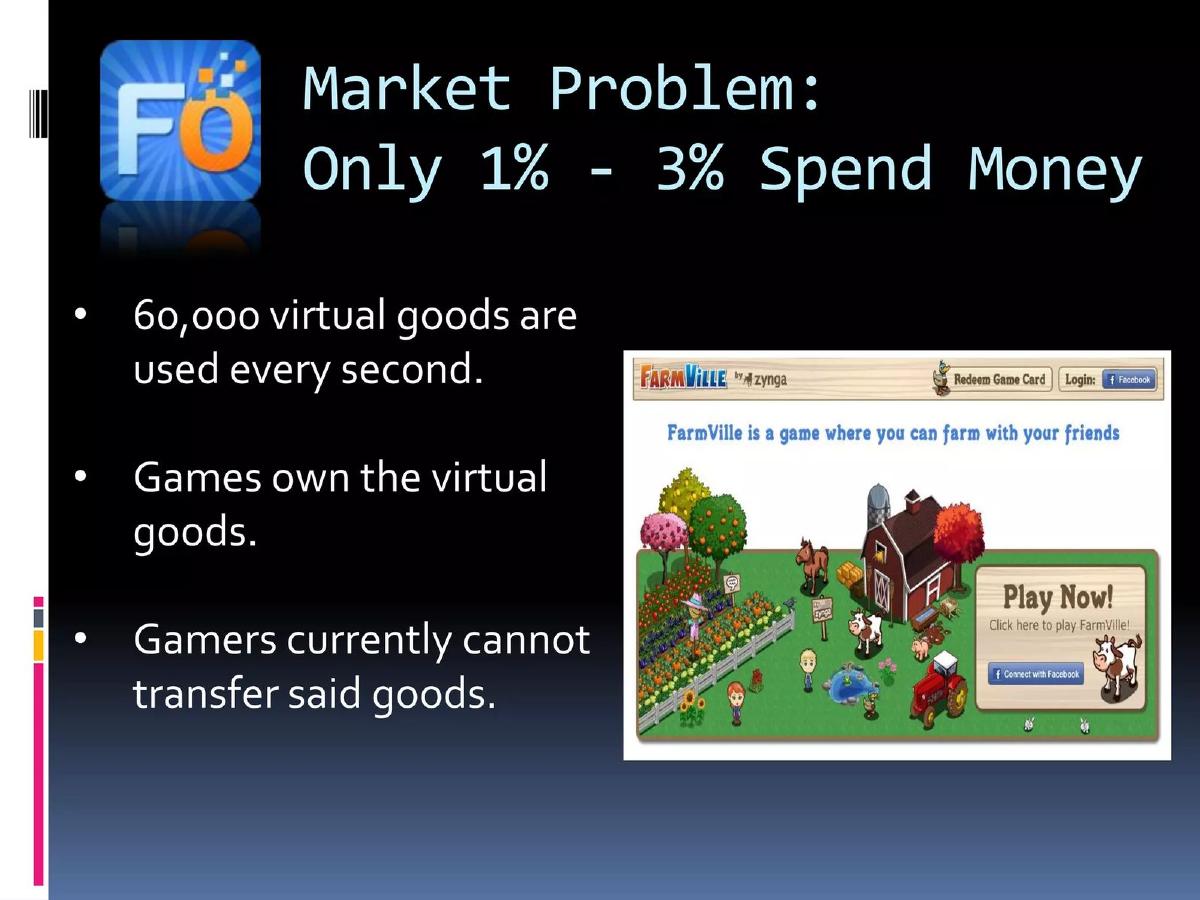
Fayceoff identifies a stark disparity in the social gaming market. While '60,000 virtual goods are used every second,' only '1% - 3% [of users] Spend Money.' The slide uses a screenshot of FarmVille by Zynga to illustrate the current landscape. The core friction points identified are that 'Games own the virtual goods' and 'Gamers currently cannot transfer said goods.' This sets the stage for a solution that unlocks the liquidity of these digital assets.
Slide 3: Monetization and Revenue Share
This slide explains the mechanics of the platform. Gamers purchase 'Fayceoff Credit' to bid on or buy items. A screenshot of the interface shows various credit packages ranging from $5.00 (500 credits) to $50.00 (5,000 credits), with payment options including PayPal, mobile, bank, and phone. A critical business model detail is revealed here: 'Developers, of the game where Credit is purchased, will receive 95% of revenue.' This high payout is likely intended to overcome developer resistance to third-party trading. The slide claims that finding bargains on virtual items will 'increase the raw number of paying users.'
Slide 4: Market Share and Partnerships
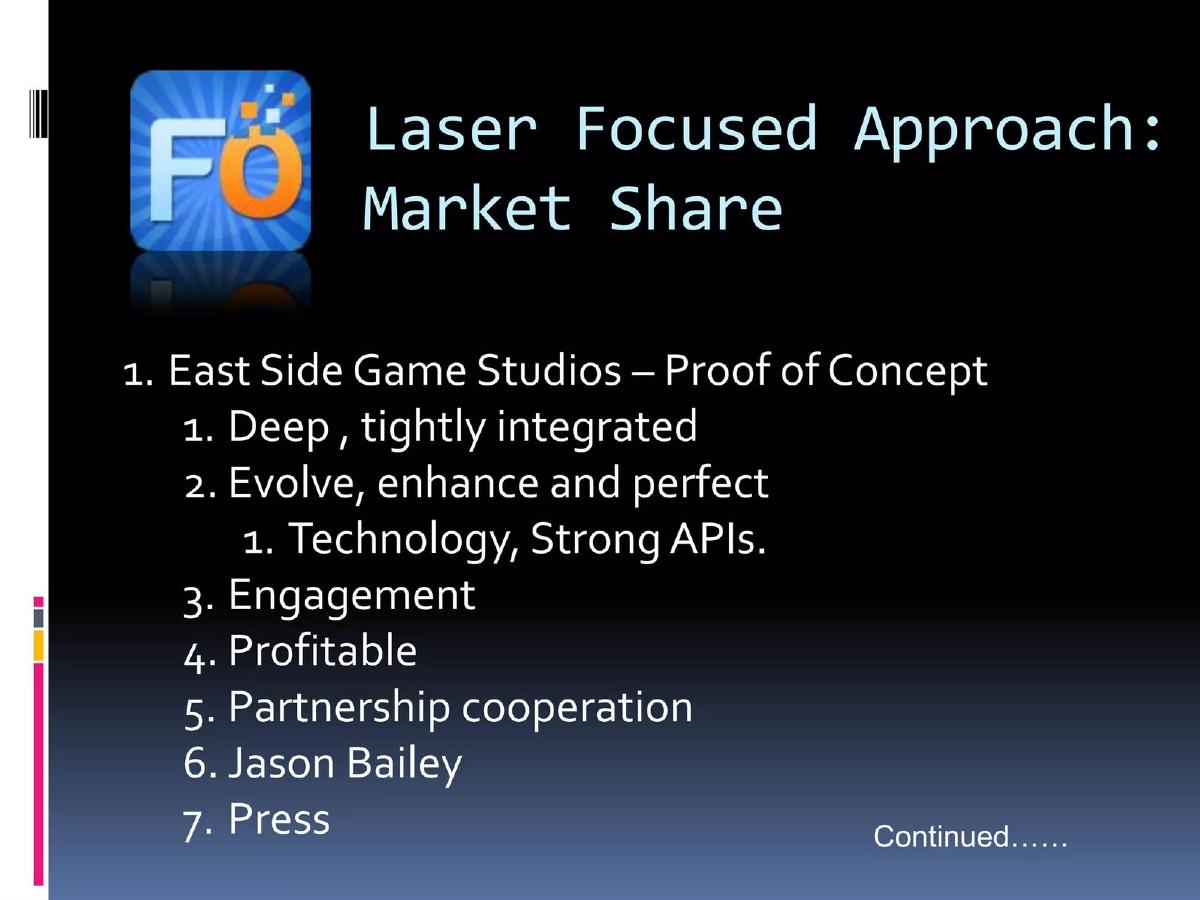
Fayceoff outlines its go-to-market strategy through five channels. The most significant claims include a 'Sales Pipeline of over 250 game companies' and a partnership with 'iQU' which supposedly grants access to '100 million unique users.' Other mentioned partners include Atari, Digital River, and 'theg (OF).' The strategy also involves placing sales representatives in San Francisco, Los Angeles, Europe, and Asia to establish local awareness and sign third-party publishers.
Slide 5: Organization Chart
The team slide is presented as a formal hierarchy. Mark Sendo is the CEO, flanked by two 'XXX' placeholders for future Board Seats. The leadership team includes Shashi (Engineering), Jonathan (Mobile), Chris Mack (Platform Design), Mani (Lead Developer), and Leyya (CFO/COO). The chart also lists specialized technical roles such as an 'HTMLIZer' and a 'Flash Engineer Consultant,' reflecting the technology stack of the era. An 'Advisers' box is included but does not list specific names, only 'Industry & Business Experts.'
Slide 6: Trivia (Milestones and Exit Strategy)
The final slide, titled 'Trivia,' serves as a roadmap and summary of achievements. It confirms that 'Phase 1' is launched and $300k has been raised in note/equity. It also states that a '$500,000 Seed Round' has closed. The roadmap includes scaling to mobile and developing a 'Social Trading Game Engine.' Looking forward, the company targets a 'Series A - $2 to $4 million.' The slide concludes with a list of potential exit partners: GREE, Atari, VISA, Digital River, and Facebook.
What Fayceoff Does Well
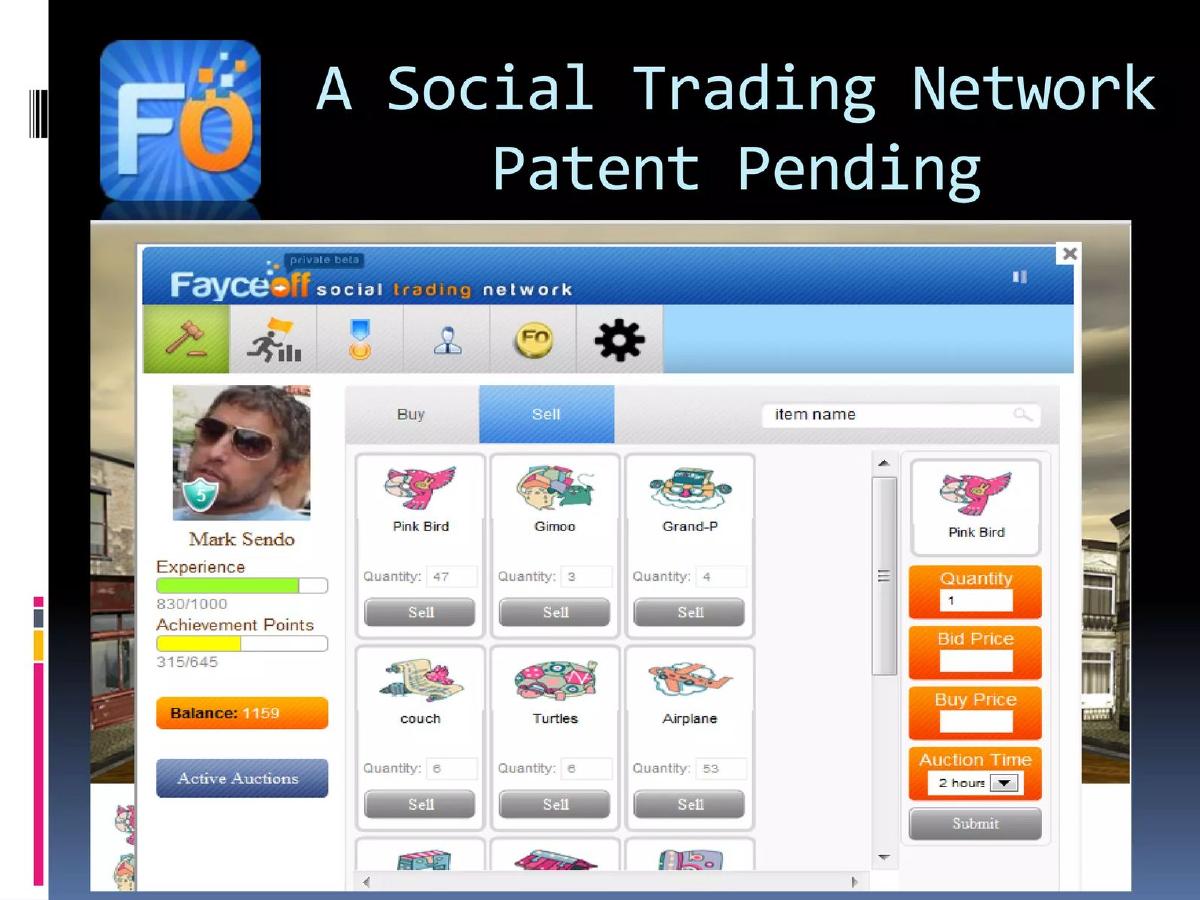
The deck is highly specific about its monetization model. By stating the exact revenue share (95%) for developers on Slide 3, Fayceoff addresses the most obvious objection: why would a game developer let a third party handle their item sales? The inclusion of a functional UI screenshot for credit purchases also suggests that the 'private beta' is more than just a landing page; there is a working transaction layer.
Furthermore, the deck does a good job of quantifying its reach through partnerships. Mentioning a pipeline of 250 companies and a 100-million-user partnership provides a sense of scale that offsets the early stage of the product itself.
What is Missing from the Fayceoff Deck
The most glaring omission is the lack of specific names for the Board of Directors and the Advisers. Slide 5 uses 'XXX' placeholders for board seats and generic labels for advisors. For a seed-stage company, the quality of the board and advisors is often a key trust signal for investors.
Additionally, while the deck mentions a '95% revenue share' to developers, it does not explicitly state Fayceoff's own take rate or how they cover operational costs if they are passing nearly all revenue to the developer. It is unclear if Fayceoff takes the remaining 5% or if there are other fees involved. There is also no mention of the legal or terms-of-service hurdles involved in trading goods from games owned by companies like Zynga, who historically guarded their ecosystems closely.
Founder Takeaways: Secondary Market Pitches
For founders building in the secondary market or 'trading' space, Fayceoff offers a few lessons. First, the '95% revenue share' is a bold way to frame a partnership—it positions the startup as a service provider to the incumbent rather than a competitor. Second, the use of a 'Trivia' slide to combine history, current status, and future goals is an efficient way to close a deck, though 'Roadmap' or 'Milestones' might be a more professional heading.
Finally, the deck shows the importance of defining the 'Problem' in terms of lost revenue. By framing the issue as 'only 1-3% spend money,' Fayceoff makes their solution a tool for market expansion rather than just a utility for existing spenders. This is a powerful narrative for any B2B2C platform.
Frequently asked questions
- What is the primary value proposition for game developers in the Fayceoff model?
- According to Slide 3, Fayceoff offers developers 95% of the revenue generated when credits are purchased to buy or bid on items from their specific games. This is intended to incentivize developers to allow their virtual goods to be traded on a third-party platform, potentially increasing the total number of paying users by finding 'bargains' on items.
- How does Fayceoff plan to acquire users and game inventory?
- Slide 4 outlines a multi-pronged strategy: internal sales targeting a pipeline of 250 game companies, external sales reps in major global hubs (SF, L.A., Europe, Asia), and strategic partnerships. A key partnership mentioned is with iQU, which purportedly provides access to 100 million unique users.
- What is the current development status of the Fayceoff platform?
- As of the deck's date in February 2012, the company was in 'private beta' (Slide 1). Slide 6 further clarifies that 'Phase 1' had launched, the platform was built, and they had secured their first customer and filed intellectual property.
- What does the team structure look like according to the deck?
- Slide 5 provides an organization chart showing Mark Sendo as CEO, supported by directors for Engineering, Mobile, and Platform Design. The chart also includes a CFO/COO, a Lead Developer, and several specialized roles like 'HTMLIZer' and 'Flash Engineer Consultant,' indicating a heavy focus on the technical execution of the web and mobile platforms.
- What are the financial milestones and future funding goals mentioned?
- Slide 6 ('Trivia') notes that the company had already raised $300k in note/equity and closed a $500k seed round. The next financial target listed is a Series A round ranging from $2 million to $4 million, following a push to scale the mobile platform and the social trading game engine.