Feel Therapeutics addresses the lack of objective monitoring in mental health by utilizing wearable devices and proprietary algorithms to track digital biomarkers. Their pitch deck emphasizes a rigorous scientific foundation, citing 23 research and clinical studies involving 2,727 patients across nine countries. The company positions itself as a 'Digital Precision Medicine' platform, moving beyond subjective self-reporting to continuous, passive monitoring. With a core team of 31 members and a significant intellectual property portfolio—including one granted patent and four pending—Feel Thera…
Key takeaways
- The company frames mental illness as a $6 trillion economic problem that will be the leading cause of disability by 2030 (Slide 2).
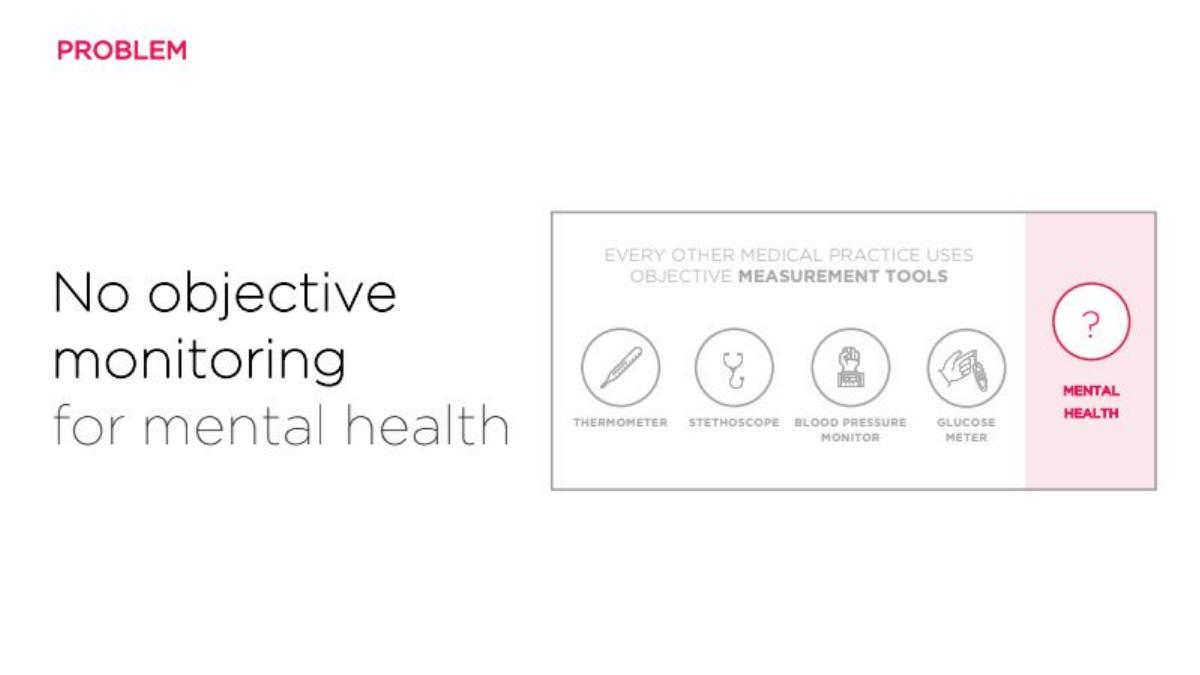
- Feel identifies a critical gap in psychiatry: unlike other medical fields, mental health lacks objective measurement tools like thermometers or glucose meters (Slide 3).
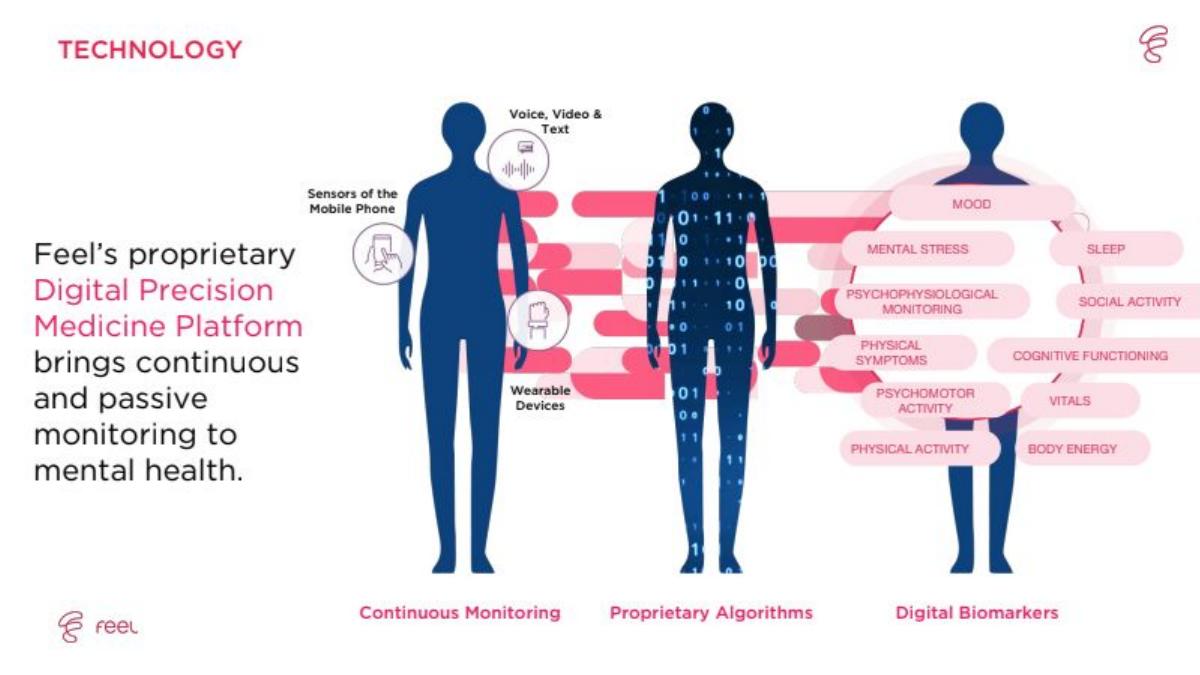
- The platform uses mobile sensors and wearables to monitor mood, sleep, and psychomotor activity through proprietary algorithms (Slide 4).
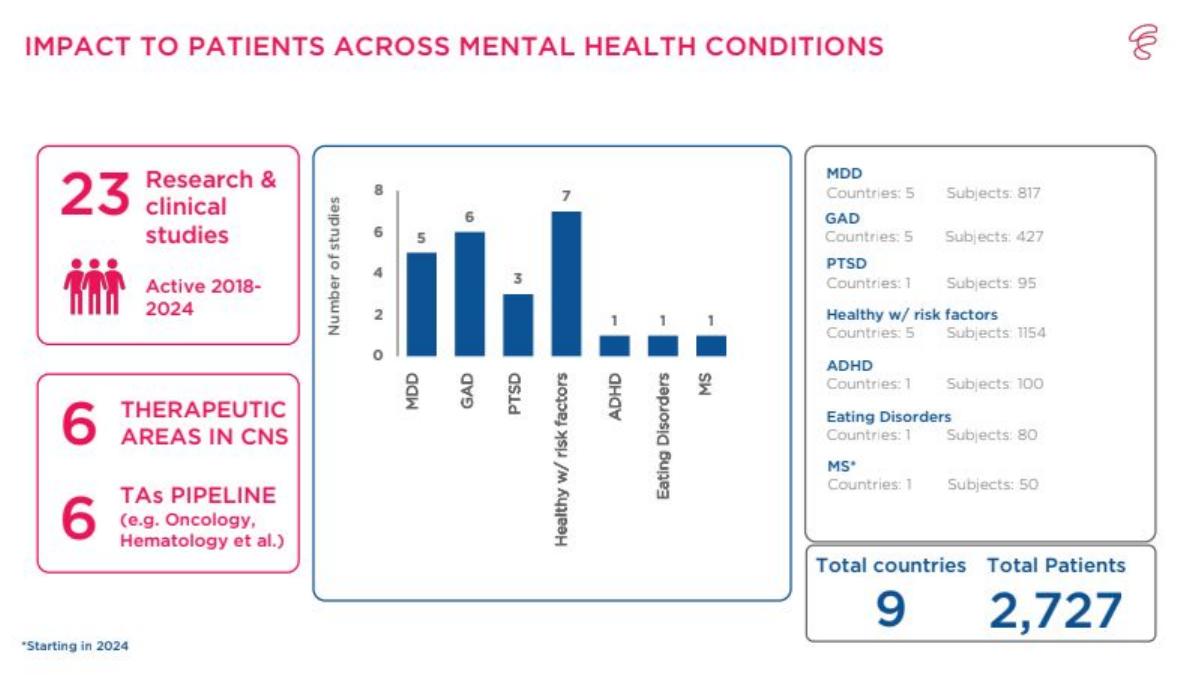
- Clinical validation is a core pillar, with 23 studies conducted between 2018 and 2024 across conditions like MDD, GAD, and PTSD (Slide 6).
- The deck highlights an 87% precision rate in detecting mood state changes in psychiatric patients (Slide 7).
- Intellectual property is explicitly detailed, listing one granted patent (US114106828) and four pending applications for ADHD, insomnia, and depression relapse (Slide 8).
- The team slide includes a rare level of financial transparency for a seed deck, disclosing a $180k core gross monthly burn rate (Slide 9).
- The fundraising ask is specific: $1M remaining in a $3.5M round, structured as a convertible note with a $30M cap and 20% discount (Slide 10).
Decoding Mental Health: The Feel Therapeutics Pitch Deck Analysis
Feel Therapeutics enters the crowded mental health tech space with a distinct angle: Digital Precision Medicine. While many startups focus on teletherapy or meditation apps, Feel focuses on the underlying data. Their 12-slide deck is a masterclass in using clinical evidence and intellectual property to justify a hardware-plus-software business model in a Seed round. By the time this deck was circulated in 2024, the company had already secured $2.5M of a $3.5M round, using the remaining $1M as a bridge to specific regulatory and clinical inflection points.
Slide 1: Title Slide
The deck opens with the tagline Decoding Mental Health and defines the category as Digital Precision Medicine for Mental Health . The visual design is clean, utilizing a geometric pattern in shades of pink and red, establishing a brand identity that feels medical yet modern.
Slide 2: The Macro Problem
Feel establishes the urgency of their mission using three heavy-hitting statistics. First, they cite the WHO, stating that mental illness will be the leading cause of disability by 2030 , carrying a global cost of $6 Trillion . Second, they note that 1 out of 4 people will experience a mental disorder. Finally, they highlight the intersection of physical and mental health, noting that >45% of patients with chronic conditions struggle with behavioral health . This slide successfully moves the conversation from a niche wellness concern to a massive economic and healthcare burden.
Slide 3: The Specific Gap
This is the 'Aha!' moment of the deck. Slide 3 contrasts mental health with every other medical practice. It shows icons for a thermometer, stethoscope, blood pressure monitor, and glucose meter, noting that these are objective measurement tools used elsewhere. Under the 'Mental Health' column, there is only a question mark. The text No objective monitoring for mental health identifies the specific technical void Feel intends to fill.
Slide 4: The Technology Platform
Slide 4 explains how the 'Digital Precision Medicine Platform' works. It visualizes three stages: Continuous Monitoring (via mobile sensors and wearables), Proprietary Algorithms , and Digital Biomarkers . The biomarkers listed include mood, mental stress, sleep, social activity, vitals, and psychomotor activity. This slide is crucial because it explains that the 'product' isn't just a wearable; it is the data processing layer that turns raw sensor input into clinical insights.
Slide 5: The Integrated Solution
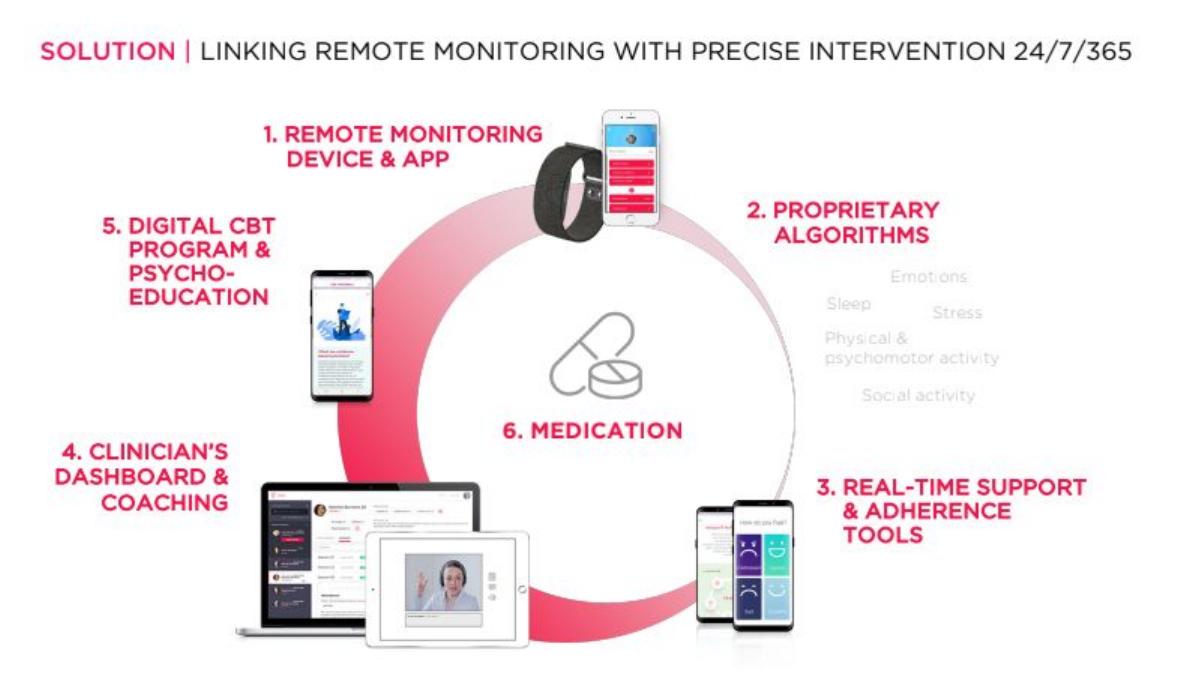
Feel describes their solution as a closed-loop system linking remote monitoring with precise intervention 24/7/365 . The slide features a circular diagram with six components: 1. Remote monitoring device & app, 2. Proprietary algorithms, 3. Real-time support & adherence tools, 4. Clinician's dashboard & coaching, 5. Digital CBT program, and 6. Medication. This positioning suggests that Feel is not trying to replace doctors or drugs, but rather to provide the data infrastructure that makes those interventions more effective.
Slide 6: Clinical Impact and Traction
This slide is the 'meat' of the deck for a healthcare investor. It lists 23 research & clinical studies active between 2018 and 2024. The data is impressive: 2,727 total patients across 9 countries . A bar chart breaks down the number of studies by condition, showing a heavy focus on Major Depressive Disorder (MDD), Generalized Anxiety Disorder (GAD), and PTSD. They also mention a pipeline for therapeutic areas like Oncology and Hematology starting in 2024. This level of clinical volume is rare for a Seed-stage company and serves as a significant barrier to entry for competitors.
Slide 7: Scientific Publications
To further bolster their credibility, Slide 7 lists specific publications and findings. Key highlights include 87% precision in detecting mood state changes and evidence that their psychophysiological index strongly correlates with changes in Cortisol levels and the Endocannabinoid System . By linking their digital biomarkers to established biological markers like cortisol, they validate the 'Precision Medicine' claim made on Slide 1.
Slide 8: Intellectual Property
Feel lists their patent portfolio, which is a critical asset for hardware/biotech companies. They cite one granted patent ( US114106828 ) for emotion detection based on physiological and digital data. They also list four pending patents covering emotion detection (continuation), ADHD digital biomarkers, insomnia digital biomarkers, and depression relapse detection. This slide tells investors that the company's 'moat' is legally protected.
Slide 9: The Team
The team slide is exceptionally dense. It features the leadership team (CEO George Eleftheriou and CTO Haris Tsirbas, PhD), industry experts (including the former CEO of Biogen), and psychiatry experts (professors from Harvard, UC Davis, and UCSF). Most notably, the right-hand sidebar includes Core Team metrics: 31 members, 9 post-docs, and 4 professors. It also includes a rare disclosure: a $180k core gross monthly burn rate . This transparency suggests a management team that is highly disciplined and confident in their capital efficiency.
Slide 10: The Ask and Milestones
The fundraising slide is clear and direct. They are raising a $3.5M Pre-Series A round , with $1M left to close. The terms are disclosed as a Convertible Note with a $30M Cap and 20% Discount . The slide also lists two major upcoming milestones: FDA approval as a 510k Class II medical device and a Launch as a Drug+ in the market. They use Empatica and Click Therapeutics as 'comparables' to show that similar regulatory clearances led to successful Series B rounds for other companies.
Slide 11: Contact Information
A standard closing slide with the CEO's contact details and the company's San Francisco address.
What Works in the Feel Therapeutics Deck
Clinical Overwhelming: By Slide 6, an investor is no longer questioning if the technology works. The sheer volume of patients (2,727) and studies (23) provides a level of de-risking that most Seed startups cannot match. · The 'Why Now' Logic: Slide 3 creates a logical vacuum (the lack of objective measurement in psychiatry) that the rest of the deck perfectly fills. It makes the product feel like an inevitability rather than a luxury. · Financial Transparency: Disclosing the burn rate and the exact terms of the convertible note (Slide 9 and 10) saves time in due diligence and signals that the founders are sophisticated operators. · Regulatory Roadmap: By explicitly mentioning the 510k Class II pathway and the 'Drug+' strategy, the company shows it understands the complex landscape of healthcare reimbursement and clinical adoption.
What is Missing from the Feel Therapeutics Deck
Unit Economics: While the burn rate is mentioned, there is no information on the cost to manufacture the wearable or the subscription price for the software/dashboard. For a B2C/Hardware model, these figures are vital. · Go-to-Market Strategy: The deck mentions 'Drug+' and 'Clinician's Dashboard,' but it doesn't explain how they actually acquire patients. Is it through direct-to-consumer marketing, partnerships with pharmaceutical companies, or insurance provider networks? · Competitive Landscape: While they mention Empatica as a milestone comparable, they do not provide a traditional 'competitor matrix.' Investors would want to know how Feel differs from other mental health wearables like Whoop or Oura, or other DTx companies.
Founder Takeaways: What to Copy
The 'Gap' Slide: If you are building in a space that lacks data, use Slide 3's format. Show the 'standard' tools for other industries and the 'missing' tool for yours. It is the most effective way to define a problem. · Quantify Your Team's Brainpower: Don't just list names. Feel's use of '9 post-docs' and '800+ team member publications' (Slide 9) quantifies the intellectual depth of the organization in a way that headshots alone cannot. · Specific Milestones: Don't just say 'we will grow.' Feel lists specific regulatory hurdles (FDA 510k) and specific market entries (Drug+). This gives investors a clear yardstick to measure future success. · IP as a Slide: If you have a patent, don't hide it in the appendix. Feel's Slide 8 treats their IP as a product roadmap, showing that their future value is already being legally fenced in.
Frequently asked questions
- What is the primary technology behind Feel Therapeutics?
- Feel Therapeutics utilizes a Digital Precision Medicine Platform that combines wearable devices and mobile phone sensors with proprietary algorithms. This system continuously and passively monitors 'digital biomarkers' such as psychomotor activity, sleep patterns, social activity, and vitals to objectively detect changes in a user's emotional state and mental health.
- How does Feel Therapeutics validate its mental health claims?
- The company relies heavily on clinical evidence, citing 23 research and clinical studies active between 2018 and 2024. These studies involved 2,727 patients across nine countries, covering therapeutic areas such as Major Depressive Disorder (MDD), Generalized Anxiety Disorder (GAD), and ADHD. They also highlight peer-reviewed publications showing 87% precision in mood detection.
- What is the company's regulatory strategy?
- Feel Therapeutics is pursuing FDA approval for its wearable as a 510k Class II medical device. The deck also outlines plans to launch as a 'Drug+' product, where the Feel DTx (Digital Therapeutics) program serves as an adjunct to traditional medication, specifically for the treatment of Major Depressive Disorder.
- Who are the key investors in Feel Therapeutics?
- According to the deck and catalogue facts, the round was led by Satori Neuro (Satori Capital). Other participating investors include Felicis Ventures, SOSV, Anthemis Group, Genesis Ventures, Gaingels, PaceZero Capital Partners, Sapiens Ventures, and individual angels like Bill Lucia and Philippos Kourkoulos-Latsis.
- What are the specific terms of the fundraising round mentioned in the deck?
- Slide 10 specifies that the company was seeking to close the final $1M of a $3.5M round. The investment was structured as a Convertible Note featuring a $30M valuation cap and a 20% discount for investors. This slide also notes that $2.5M of the round had already been closed.