Feesheh is an e-commerce platform dedicated to musical instruments in Jordan and the wider Middle East. Their 12-slide seed deck, used to raise $310,000, centers on the 'accessibility gap' created by global retailers like Guitar Center and Thomann, who struggle with MENA-specific hurdles such as low credit card penetration and high shipping costs. The deck effectively uses traction metrics, specifically a 35% recurring customer rate, to prove product-market fit. While it lacks a formal 'Ask' slide or detailed financial projections, it leans heavily on the founders' identity as musicians servi…
Key takeaways
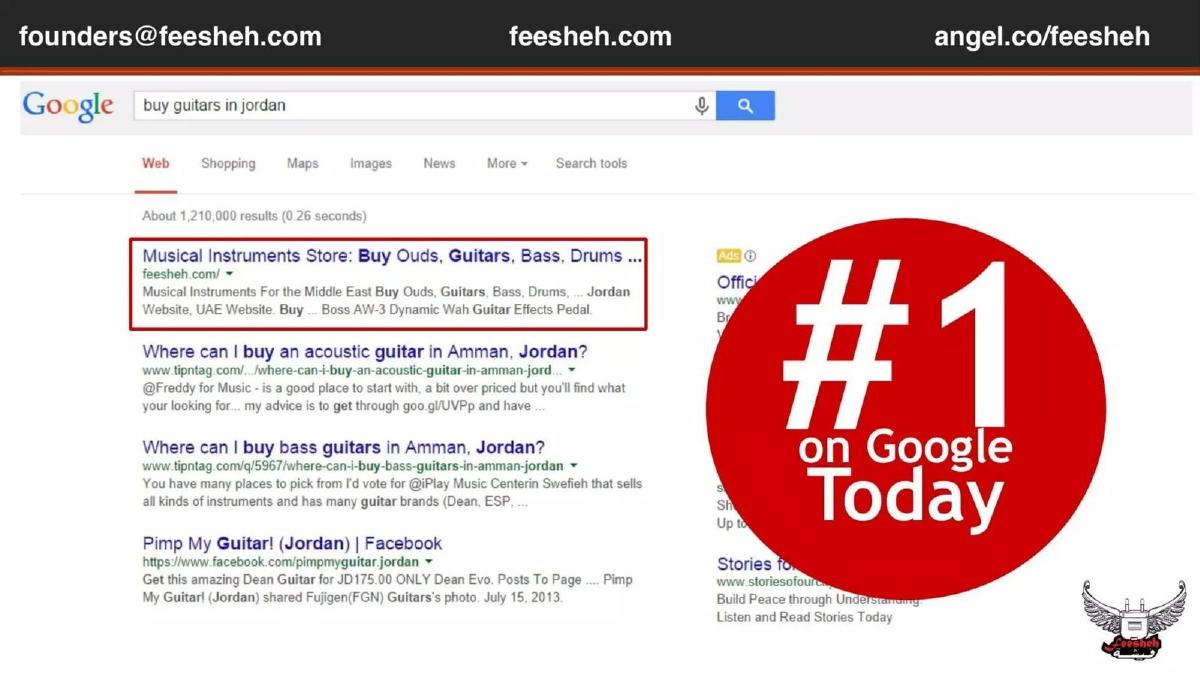
- The company claims the #1 spot on Google for 'buy guitars in Jordan' as a primary proof of search dominance on slide 2.
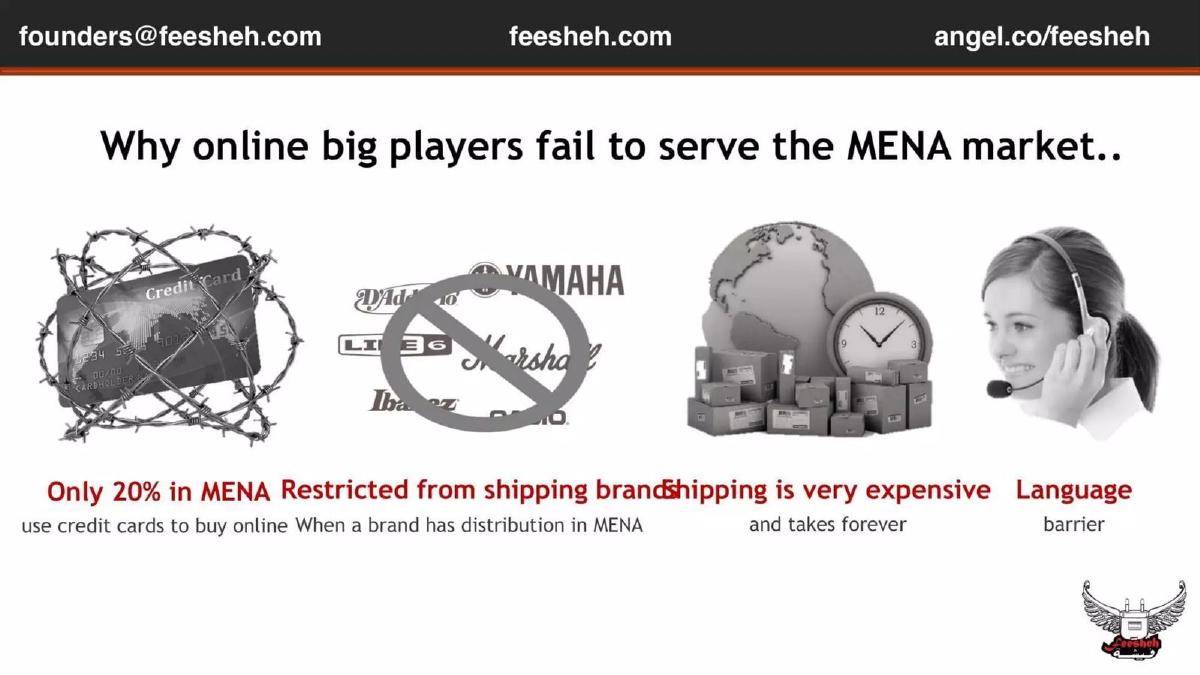
- Only 20% of the MENA population uses credit cards to buy online, creating a massive barrier for Western competitors as noted on slide 5.
- Feesheh offers Cash on Delivery (COD) and 2-3 day delivery to bypass regional payment and shipping friction on slide 7.
- Customer retention is high, with 35% of customers returning to upgrade or buy accessories according to slide 8.
- The target market consists of over 300 million people, with 50% under the age of 25 as stated on slide 9.
- The supply chain utilizes a mix of local sourcing and drop shipping to maintain scalability on slide 10.
- The team slide (11) emphasizes founder-market fit by showing all five team members holding or playing musical instruments.
- The deck omits a specific funding request, valuation, or use-of-funds breakdown within the 12 slides provided.
Feesheh Pitch Deck Teardown
Feesheh entered the market as a specialized e-commerce player targeting a niche but passionate demographic: musicians in the Middle East and North Africa (MENA). At the time of this deck in 2010, e-commerce in the region was still grappling with fundamental infrastructure challenges. This teardown examines how Feesheh positioned itself as the bridge between global brands and a local audience that was largely ignored by Western retailers.
The Hook and Search Dominance (Slides 1-2)
Slide 1: Title Slide The deck opens with the brand name and the tagline: "The Online Destination for Arab Musicians." The logo features a winged electrical plug, which is a play on the word "Feesheh" (meaning 'plug' or 'socket' in Arabic), symbolizing the connection between the musician and their gear.
Slide 2: Traction via SEO Instead of starting with a problem statement, Feesheh leads with a win. They show a Google search for "buy guitars in jordan" with Feesheh appearing as the #1 organic result. A large red circle reinforces this with the text "#1 on Google Today." This is a low-cost way to demonstrate market relevance and organic reach without showing a marketing budget.
Defining the Accessibility Gap (Slides 3-5)
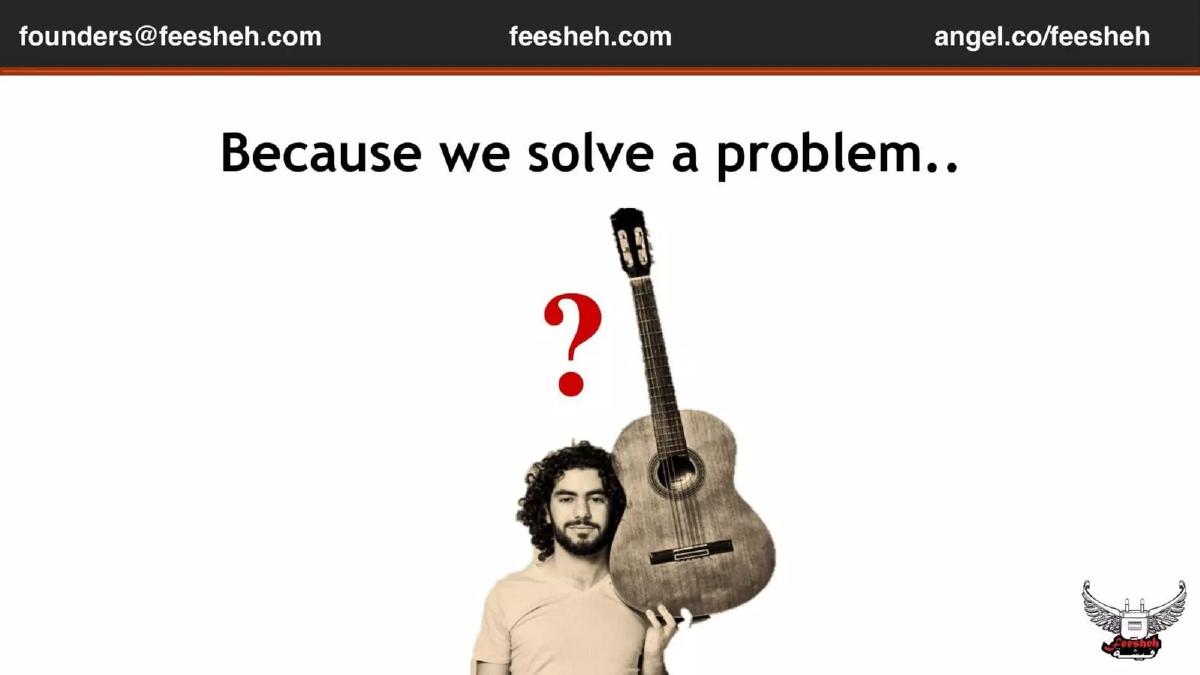
Slide 3: The Problem Intro A simple transition slide featuring a musician looking confused next to a guitar. It sets the stage for the specific pain points of the MENA music market.
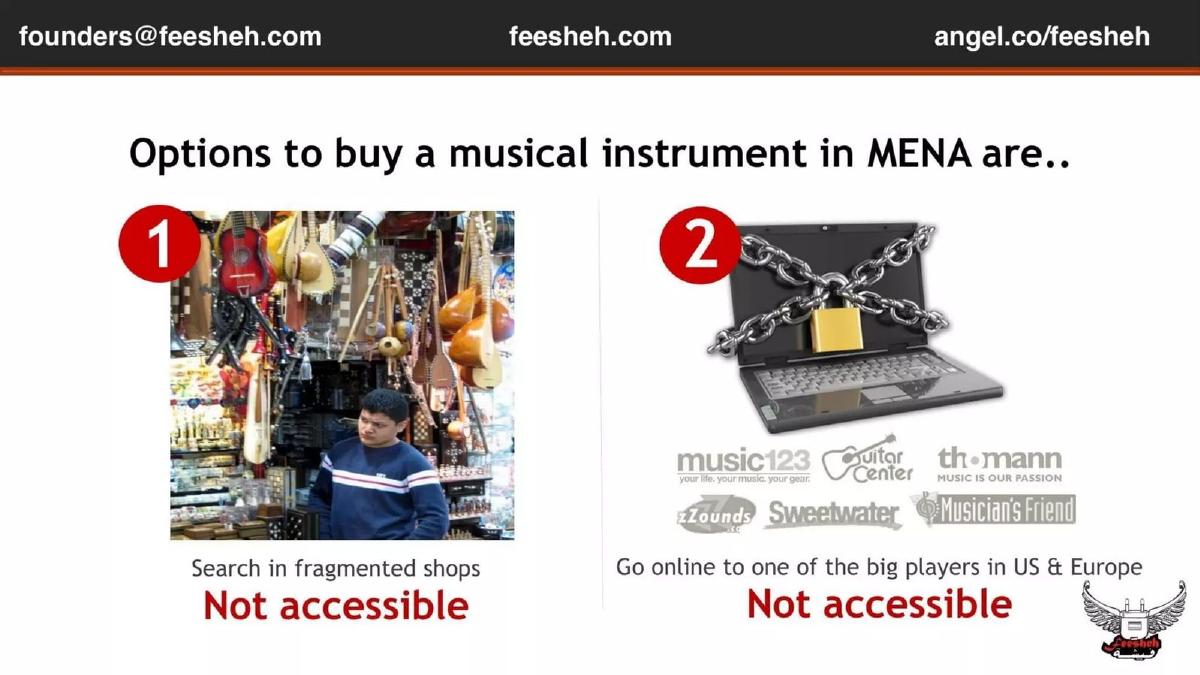
Slide 4: The Current Options The deck identifies two existing options for musicians, both labeled "Not accessible." Option 1 is searching in "fragmented shops," illustrated by a photo of a cluttered, traditional souq-style music store. Option 2 is going online to US and European "big players" like Guitar Center, Thomann, and Sweetwater. A graphic of a laptop wrapped in chains and a padlock visually represents the barriers to these platforms.
Slide 5: Why Global Players Fail This is the most critical slide in the deck for establishing the business case. It lists four specific barriers:
Credit Cards: Only 20% in MENA use credit cards to buy online. · Brand Restrictions: Shipping is often restricted when a brand already has a local distributor. · Logistics: Shipping is "very expensive and takes forever." · Language: A clear "Language barrier" exists for customer support.
The Feesheh Solution (Slides 6-7)
Slide 6: Transition A simple "This is where we come in" slide featuring the company logo.
Slide 7: The Value Proposition Feesheh presents its platform as "Tailored to Arab musicians." The slide shows a screenshot of the Arabic-language website alongside four icons representing their core advantages:
Inventory: Both Arab and Western instruments (e.g., Ouds alongside guitars). · Payment: The "Option to pay Cash on Delivery," which directly addresses the 20% credit card penetration mentioned earlier. · Speed: "Fast delivery 2-3 days." · Support: "Supported by Arab musicians," emphasizing cultural and technical alignment.
Market Size and Retention (Slides 8-10)
Slide 8: Customer Retention The deck highlights a "35% Recurring Customers" rate. It explains the customer lifecycle: they return to upgrade, buy a different instrument, or purchase accessories like strings and headphones. This metric is intended to prove that the business isn't just a series of one-off transactions but a long-term relationship with the user base.
Slide 9: Market Demographics Feesheh points to a "300+ million population" in the region, with a crucial demographic kicker: "Over 50% of which under the age of 25." This suggests a large, growing, and tech-savvy audience that is more likely to adopt e-commerce than older generations.
Slide 10: Scalability The company notes it is "Now in 2 markets" (Jordan and UAE, based on the red pins on the map). They describe a "Scalable Supply Chain" utilizing locally sourced items and drop shipping. This indicates a capital-light model where the company doesn't necessarily need to hold massive amounts of inventory for every SKU, which is vital for a seed-stage startup.
Team and Vision (Slides 11-12)
Slide 11: Team On A Mission The team slide features Nur Alfayez (CEO), Fahed Farraj (COO), and managers for distribution, content, and logistics. Every person is pictured with a musical instrument. This is a deliberate choice to show founder-market fit. Below the team, they display logos for Oasis500, Silicon Oasis Founders, and 500 Startups, signaling institutional backing and credibility.
Slide 12: Closing The final slide shows the logo over a globe surrounded by various instruments (Ouds, drums, tambourines), reiterating the contact email: founders@feesheh.com.
What Works in the Feesheh Deck
Specific Regional Insight: The deck does an excellent job of explaining why a global giant like Amazon or Guitar Center can't easily crush them. By citing the 20% credit card usage and the specific logistical hurdles of the MENA region, they turn their local presence into a competitive moat.
Founder-Market Fit: The team slide is highly effective. In a niche market like musical instruments, buyers want to know they are talking to experts. Seeing the CEO with an Oud and the COO with an electric guitar immediately builds trust that the team understands the product quality and the needs of the customer.
Traction First: Leading with the #1 Google ranking is a strong move. It proves that there is active demand for the product and that the company has already figured out how to capture that demand without expensive customer acquisition costs.
What is Missing from the Feesheh Deck
The Ask: There is no slide stating how much money the company is looking to raise. While the catalogue facts state they raised $310,000, a potential investor viewing this deck in isolation would not know the target amount or the terms of the round.
Financials and Unit Economics: The deck mentions a 35% retention rate, but it omits Average Order Value (AOV), Customer Acquisition Cost (CAC), and gross margins. For an e-commerce business, these numbers are essential to prove that the business can eventually become profitable.
Competitive Landscape: While they mention Western "big players," they do not address local competition or how they protect their market share if a larger regional e-commerce player (like Souq.com, which was active at the time) decided to expand into the music category.
What a Founder Should Copy
Visual Problem Mapping: Use icons and simple graphics to explain complex market barriers. The way Feesheh used the "laptop in chains" and the "barbed wire credit card" makes the problem visceral and easy to understand in seconds.
Highlighting Local Nuance: If you are building in an emerging market, don't just say the market is big. Explain the specific local frictions (like Cash on Delivery) that you have solved, which larger international competitors have not.
Authenticity in Team Photos: If your startup is in a hobbyist or passion-driven industry (music, sports, gaming), your team photos should reflect that passion. It proves you are building for yourselves as much as for the market.
Frequently asked questions
- What is the primary problem Feesheh aims to solve?
- Feesheh targets the lack of accessibility for musical instruments in the MENA region. Western giants like Sweetwater or Thomann are hindered by expensive shipping, language barriers, and a reliance on credit cards in a region where only 20% of people use them for online purchases. Feesheh solves this by offering local language support, Cash on Delivery, and faster regional shipping.
- How does Feesheh prove its market traction?
- The deck uses two main data points for traction: SEO dominance and customer retention. Slide 2 shows them at the top of Google search results for their primary keywords, and slide 8 highlights that 35% of their customers are recurring, indicating that musicians return to the platform for upgrades and accessories.
- What is Feesheh's supply chain strategy?
- According to slide 10, the company employs a 'Scalable Supply Chain' that combines local sourcing with drop shipping. This allows them to minimize inventory risk while maintaining 'Logistics Control' and 'Automation' to serve their two initial markets efficiently.
- Who are the founders and what is their background?
- The team is led by Nur Alfayez (CEO) and Fahed Farraj (COO). The deck emphasizes their personal connection to the industry; the team slide features photos of the founders and managers with instruments like the Oud and electric guitars, positioning them as a 'Team On A Mission' who understand their customers' needs.
- What key information is missing from this pitch deck?
- The deck is missing several standard investor components, including a specific 'Ask' (how much money they are raising), a 'Use of Funds' slide, detailed financial projections (revenue/margins), and a competitive landscape matrix beyond just mentioning Western retailers.