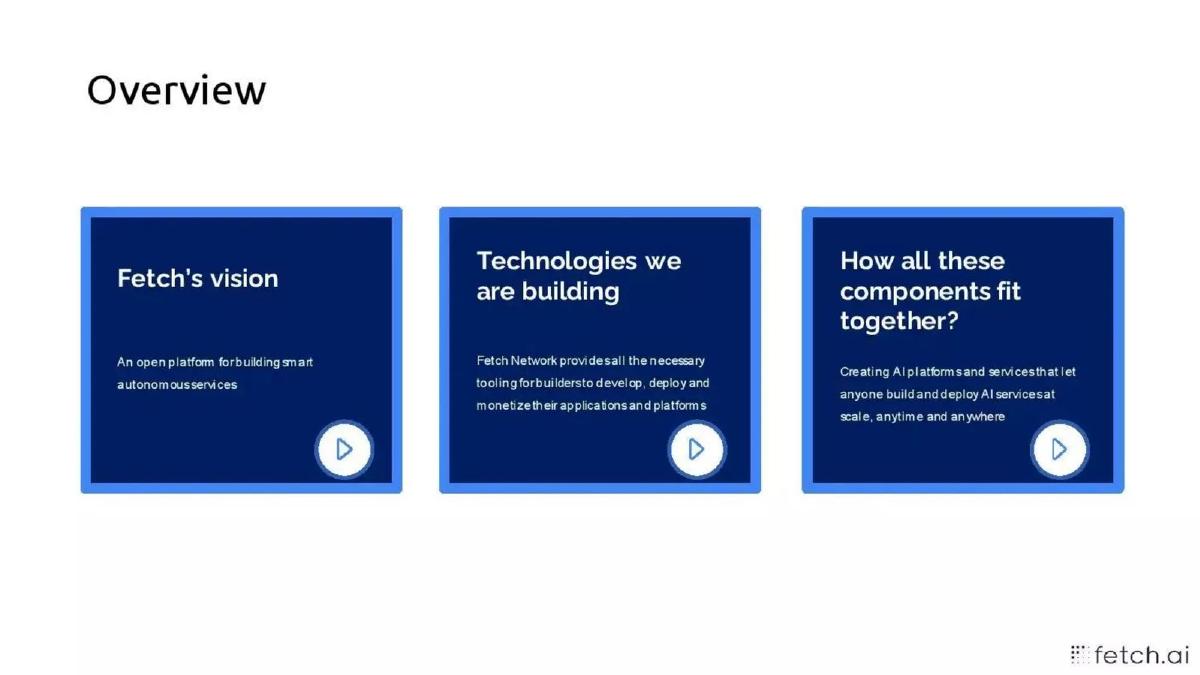
Fetch AI’s deck focuses on the transition from simple AI chat interfaces to autonomous execution. By combining Large Language Models (LLMs) with a proprietary execution layer, the company aims to create peer-to-peer marketplaces that bypass traditional aggregators. The presentation leans heavily into technical infrastructure, detailing the interplay between uAgents, the Fetch Network, and AI/ML models. While it provides a clear roadmap for the 'Why Now'—citing the explosion of ChatGPT—it lacks traditional venture metrics like current revenue, user growth, or a specific capital ask in the prov…
Key takeaways
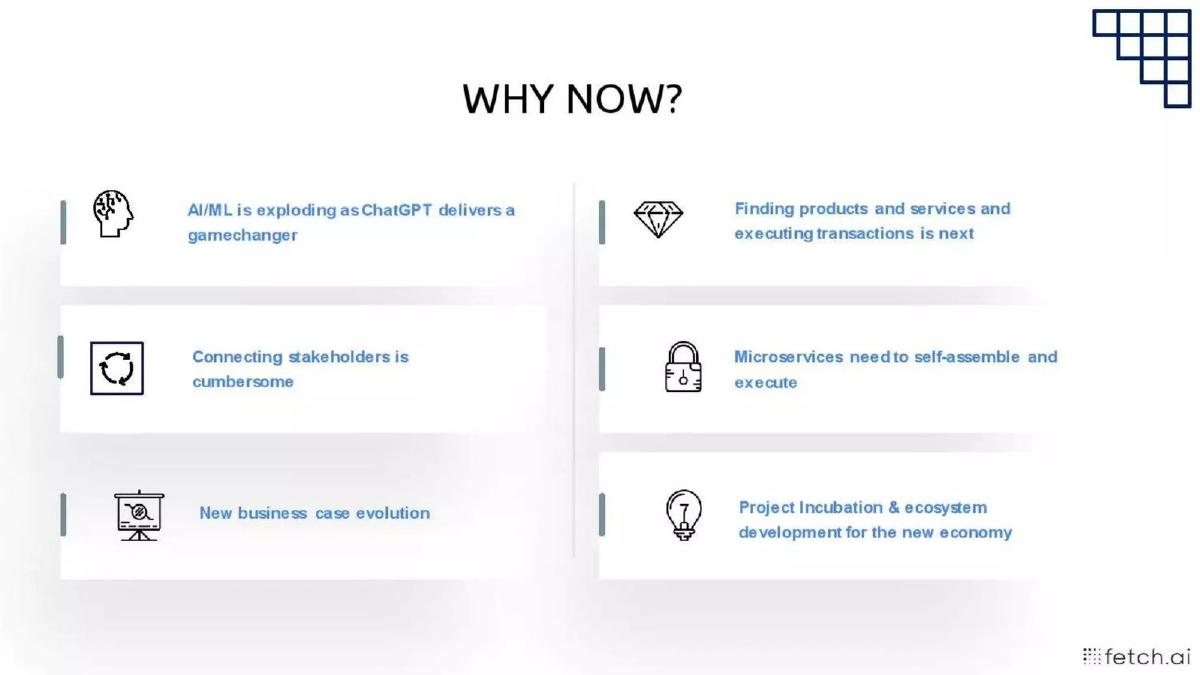
- The deck positions ChatGPT as the catalyst for an explosion in AI/ML that makes autonomous execution the logical next step (Slide 2).
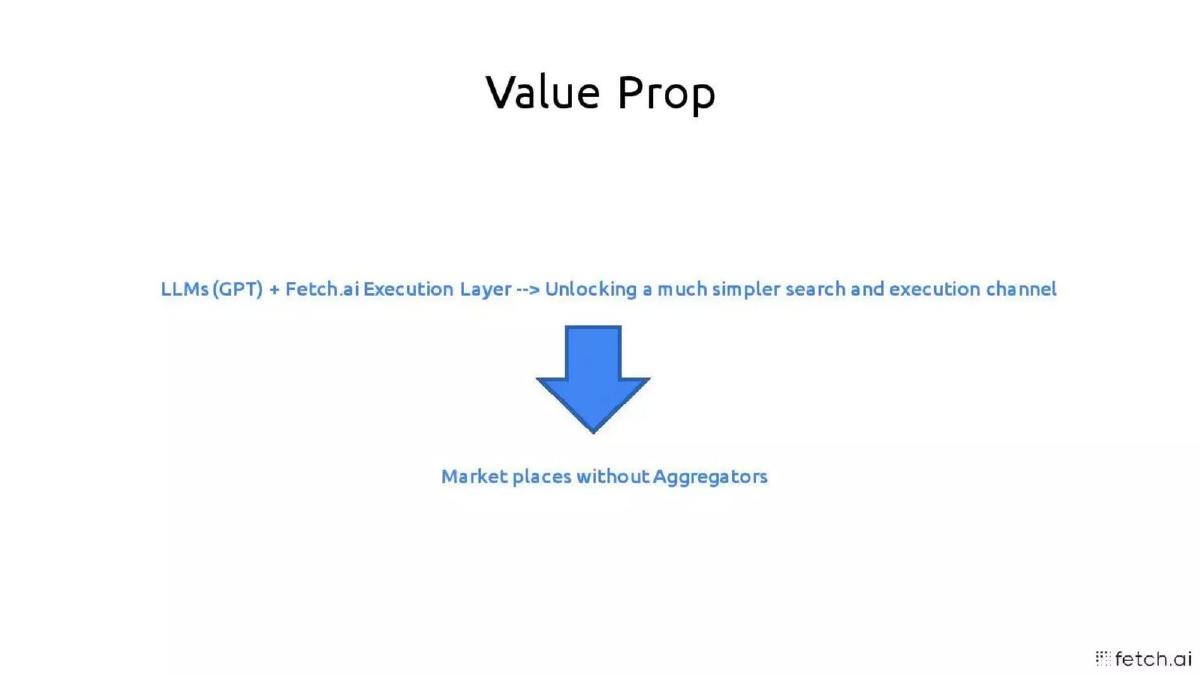
- Fetch AI aims to eliminate market aggregators by combining LLMs with their own execution layer (Slide 3).
- The company targets the P2P gig services market, projected to grow from $455.2B in 2023 to $1.1T by 2030 (Slide 4).
- Infrastructure is divided into four pillars: Agents, Network, AI/ML, and Tooling, all centering on 'Power Autonomous Business Models' (Slide 5).
- A detailed technical schematic illustrates the Fetch Network's interaction with human actors, IoT sensors, and external data sources (Slide 6).
- The primary use case presented is a complex EV charging scenario involving automated negotiation, booking, and meal ordering (Slide 7).
- The deck highlights 'uAgents' as a faster, federated alternative to the monolithic AEA Framework (Slide 8).
- The presentation omits a team slide, financial projections, and a specific funding ask in the 10 slides provided.
Introduction and Vision
The Fetch AI deck begins with a clear focus on the evolution of artificial intelligence from simple conversation to autonomous action. The title slide, featuring the name Humayun Sheikh, sets a professional tone with the subtitle 'Autonomous Execution.' This immediately signals to the investor that the company is not just another wrapper for existing AI models, but an infrastructure play designed to handle the 'doing' phase of the AI revolution.
Slide 1: Title Slide
The opening slide is minimalist, featuring the Fetch.ai logo and the name of the presenter, Humayun Sheikh. The central theme is 'Autonomous Execution.' This is a strategic choice; in a market saturated with 'Generative AI' startups, Fetch AI differentiates itself by focusing on the execution layer—the ability for AI to perform tasks rather than just generate text or images.
Slide 2: Why Now?
Slide 2 addresses the 'Why Now?' question by leveraging the current AI hype cycle. It explicitly mentions that 'AI/ML is exploding as ChatGPT delivers a gamechanger.' The slide lists several market drivers: the cumbersome nature of connecting stakeholders, the need for microservices to self-assemble, and the evolution of new business cases. By positioning 'finding products and services and executing transactions' as the next logical step after LLMs, Fetch AI creates a sense of inevitability for their product.
Slide 3: Value Proposition
The value proposition on Slide 3 is presented as a simple equation: LLMs (GPT) + Fetch.ai Execution Layer = Unlocking a much simpler search and execution channel. The ultimate goal stated here is 'Market places without Aggregators.' This is a bold claim, suggesting that Fetch AI intends to disrupt platform giants like Uber, Airbnb, or Amazon by allowing agents to transact directly with one another without a central intermediary taking a cut.
Slide 4: Market Size
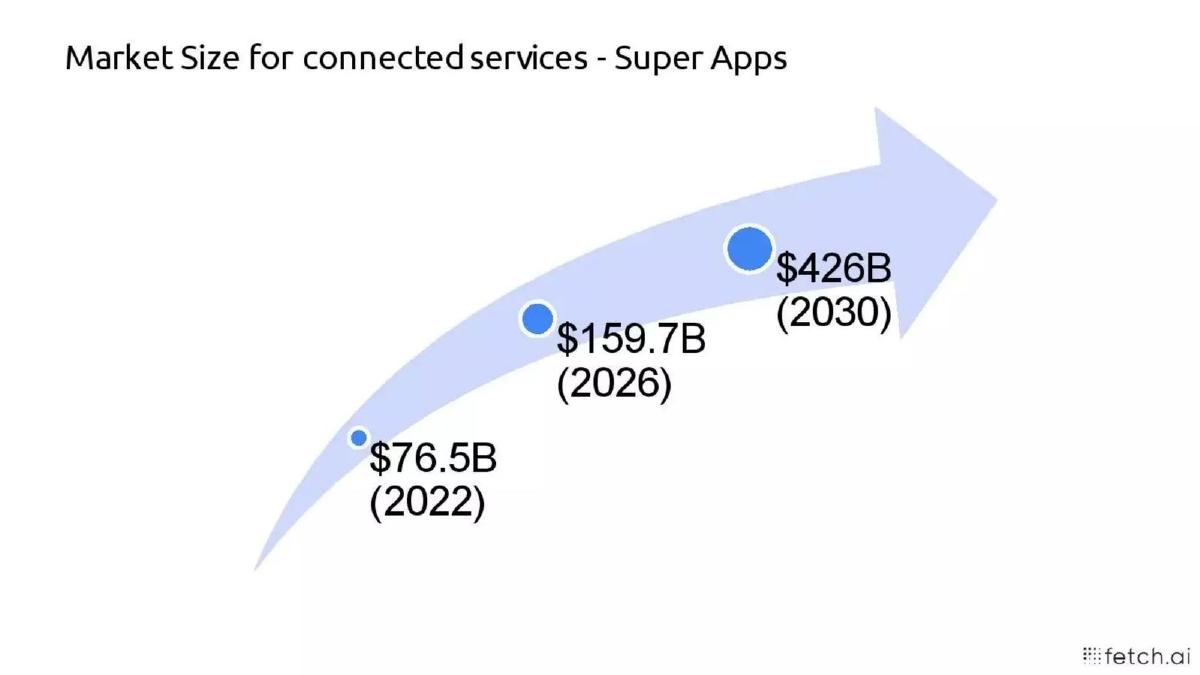
Slide 4 provides the quantitative justification for the project. It focuses on the 'Market Size for P2P Gig services.' The figures cited are $455.2B in 2023 , $663.9B in 2026 , and $1.1T in 2030 . The use of a large, upward-curving arrow emphasizes growth. However, the deck does not explain exactly how 'autonomous execution' captures this specific market, leaving a gap between the broad gig economy and Fetch's specific technical solution.
Slide 5: Infrastructure Overview
This slide introduces the 'Fetch.ai Infrastructure' via a four-quadrant circular diagram. The quadrants are: Agents (P2P Microservices), Network (Coordination & Settlement), AI/ML (Inferences & Insights), and Tooling (Development). This slide is crucial for technical investors as it shows that Fetch is building a full-stack ecosystem rather than a single application. The central hub of this diagram is 'Power Autonomous Business Models,' reinforcing the company's focus on economic utility.
Slide 6: Technical Building Blocks
Slide 6 is a high-level technical schematic. It illustrates how 'Human Actors' and 'Machines / Devices' interact with 'Agents' hosted on the 'Agent Hosting' layer. It shows connections to 'Centralized Recommender Services,' the 'Axim Colearn Platform,' and the 'Fetch Network.' This slide is dense and serves to prove the complexity and readiness of the underlying architecture. It specifically highlights 'Revenue Opportunities' with dollar signs attached to various nodes in the network, though it doesn't quantify them.
Slide 7: Use Case - Agent Based Economy
To ground the technical jargon, Slide 7 presents a sequence diagram for an EV charging use case. It tracks a car agent as it searches for a charger, negotiates a price, pays for the charge, and even interacts with a cafe agent to order a meal. This is a classic 'day in the life' slide that helps investors visualize how the technology works in the real world. It successfully demonstrates the 'Autonomous Execution' promised on the title slide.
Slide 8: Feature Comparison (uAgents vs. AEA)
This slide is highly technical, comparing 'uAgents' to the 'AEA Framework.' It highlights that uAgents are Federated / Microservices based, whereas AEA is Monolithic . It also notes that uAgents support multiple languages (Python, Dart, Javascript) and offer faster implementation speeds. This slide is likely intended to show product evolution and a commitment to developer-friendly tools, which is essential for ecosystem growth.
Slide 9: Feature Comparison (Capabilities)
Continuing the comparison, Slide 9 uses icons to highlight three pillars: uAgents (micro-agents) , AI enabled from the start , and Blockchain ready . It mentions integration with the 'Gym library for reinforcement learning' and the ability to interface with other decentralized networks like Ocean. This reinforces the 'Blockchain' aspect of the project, which was less prominent in the earlier 'Why Now' slides.
Slide 10: Closing Visual
The final slide in the provided set is a dark, high-tech graphic featuring the Fetch.ai logo inside a circular, HUD-style interface. While it contains no new data, it maintains the 'futuristic infrastructure' aesthetic of the rest of the deck.
What Works in This Deck
The deck excels at positioning . By framing Fetch AI as the 'execution layer' for the LLM revolution, the founders successfully ride the coattails of ChatGPT's success while offering something distinct. The technical depth is also a strength; the schematics on Slides 6 and 7 provide enough detail to satisfy a technical due diligence team without being completely impenetrable to a generalist partner. The use case on Slide 7 is particularly effective because it takes a complex multi-agent interaction and makes it easy to follow, proving the utility of the network.
What Is Missing
The most glaring omissions in these 10 slides are traction and financials . There is no mention of current revenue, number of active agents, developer sign-ups, or partnerships. While the market size is mentioned, the company's specific progress within that market is absent. Furthermore, there is no team slide in this selection, which is a critical component for any $40M raise. Investors need to know who is building this complex infrastructure. Finally, there is no 'Ask' slide , meaning we don't know the valuation or how the $40M will be allocated across R&D, marketing, and operations.
What a Founder Should Copy
Founders building complex infrastructure should copy the 'Value Prop Equation' from Slide 3. It takes a complicated technical concept and reduces it to a simple A + B = C formula that anyone can understand. Additionally, the 'Why Now' slide is a masterclass in timing; it doesn't just say 'AI is big,' it explains exactly why the current state of AI (LLMs) creates a specific gap that the company is uniquely positioned to fill. The use of sequence diagrams for use cases is also highly recommended for any product that involves automated or background processes that aren't immediately visible to a user.
Frequently asked questions
- What is the core value proposition of Fetch AI according to the deck?
- The core value proposition, as stated on Slide 3, is the combination of Large Language Models (LLMs) like GPT with the Fetch.ai Execution Layer. This synergy is intended to unlock a simpler search and execution channel, ultimately creating marketplaces that function without the need for traditional third-party aggregators.
- How does Fetch AI define its market opportunity?
- Fetch AI focuses on the 'P2P Gig services' market. According to Slide 4, this market was valued at $455.2 billion in 2023 and is forecasted to grow to $663.9 billion by 2026, reaching $1.1 trillion by 2030. This suggests they view their autonomous agents as the primary labor force for future digital and physical gig tasks.
- What technical components make up the Fetch AI infrastructure?
- Slide 5 outlines four main components: Agents (P2P microservices for automation), Network (for coordination and economic settlement), AI/ML (for inferences and insights), and Tooling (for development of P2P apps). These components surround a central goal of powering autonomous business models.
- What is a 'uAgent' and how does it differ from previous frameworks?
- As shown on Slide 8, uAgents are micro-agents designed for implementation speed and language portability (Python, Dart, Javascript). Unlike the older AEA Framework, which is described as 'Monolithic' and mainly Python-based, uAgents use a 'Federated / Microservices' software pattern and native package management (PyPI, NPM).
- Is there a specific use case described in the deck?
- Yes, Slide 7 details a 'New Agent Based Economy' use case involving an Electric Vehicle (EV). The flow shows a car agent searching for an EV charger, negotiating prices, booking the charge, and even coordinating with a recommender service to order a meal at a nearby cafe while the car charges.