The June 2013 deck for Ferrum Americas is a classic mining exploration and development presentation. It focuses almost exclusively on the Cerro Rojo project in Bolivia, emphasizing a 'start small, scale up' strategy. The company highlights its 43-101 compliant resource estimates, which include 32.1 million tonnes of indicated resources at a 51.5% Fe grade. A significant portion of the pitch is dedicated to logistical advantages, specifically the project's proximity to rail lines and the Hidrovia river system. While the deck provides strong technical and geographical data, it lacks a formal te…
Key takeaways
- The company's primary mission is to build a major iron ore mining company in Latin America, starting with the Cerro Rojo project in Eastern Bolivia (Slide 4).
- Ferrum Americas completed its first phase of drilling in late 2012, intersecting high grades across 2,800 meters of strike (Slide 7).
- Technical validation is provided via 43-101 Open Pit Resources, showing 111.0 million tonnes of indicated resources at a 15% Fe cut-off (Slide 10).
- At a higher 50% Fe cut-off, the project holds 32.1 million tonnes of indicated resources and 63.0 million tonnes of inferred resources (Slide 10).
- Logistics are a core value proposition, with the project located 8 km from a rail line and 55 km from a port (Slide 13).
- The deck highlights proximity to the Hidrovia river system, described as 'Latin America's Mississippi River,' for bulk commodity shipping (Slide 22).
- The 2013 roadmap included completing a Preliminary Economic Assessment (PEA) by the third quarter (Slide 16).
- The strategy emphasizes 'low capex' and scalability, aiming to avoid the high upfront costs associated with more remote mining projects (Slide 22).
Executive Summary: The Technical Case for Bolivian Iron
The Ferrum Americas deck from June 2013 is a highly specialized document tailored for the mining and natural resources sector. Unlike software-as-a-service (SaaS) decks that focus on user acquisition and churn, this presentation lives and dies by geological data, regulatory compliance (43-101 standards), and logistical feasibility. The company presents the Cerro Rojo project in Bolivia not just as a mineral deposit, but as a strategically located asset that overcomes the traditional 'remote location' curse of mining through proximity to rail and river infrastructure.
Slide 1: Title and Visual Context
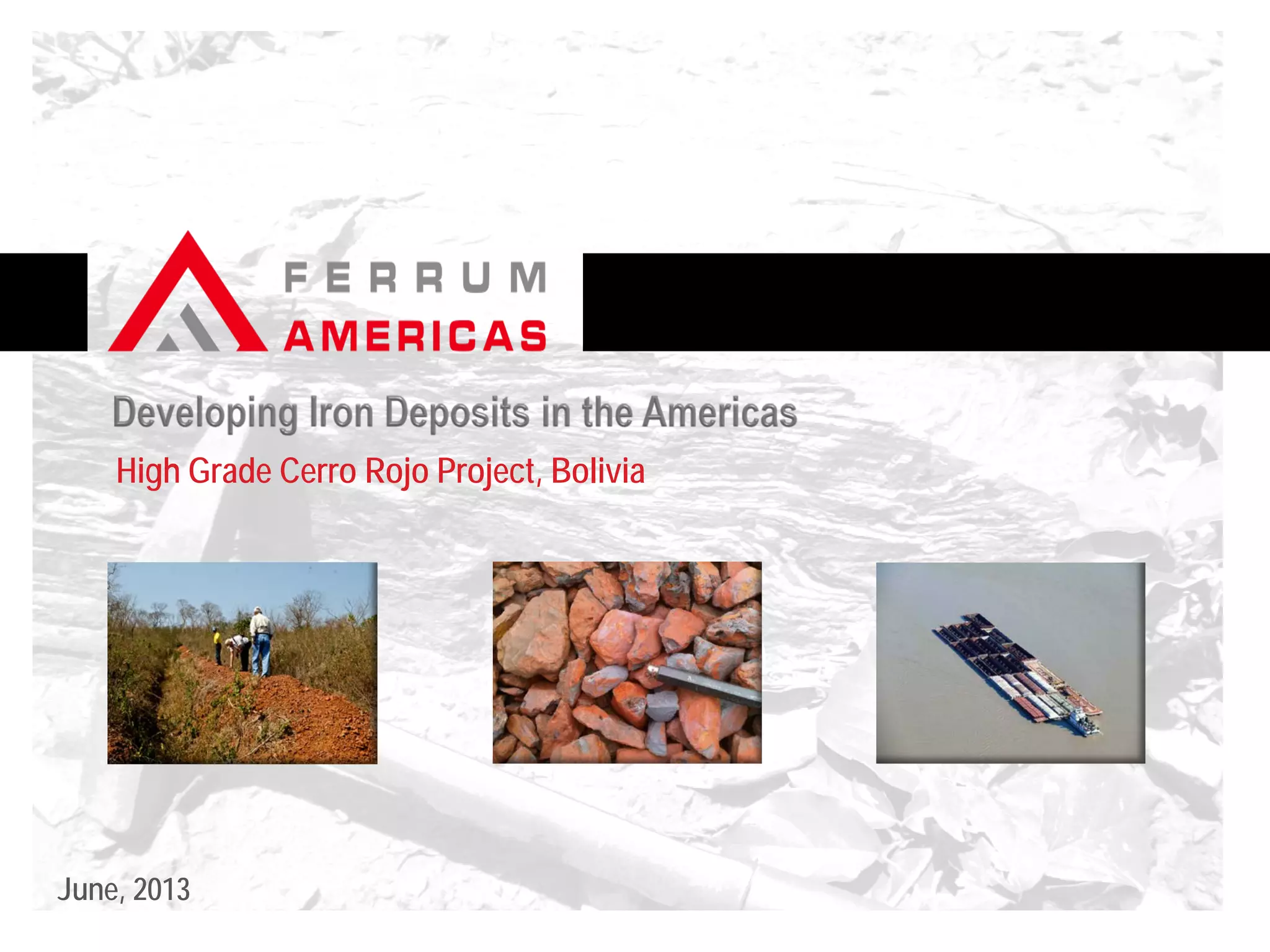
The cover slide establishes the company's focus: 'Developing Iron Deposits in the Americas,' specifically the 'High Grade Cerro Rojo Project, Bolivia.' The imagery is functional, showing field workers, raw ore samples, and a barge, signaling the three stages of the business: exploration, extraction, and logistics. The date, June 2013, places this in a period where iron ore prices were experiencing significant volatility following the post-2008 commodities boom.
Slide 4: The Vision and Strategy
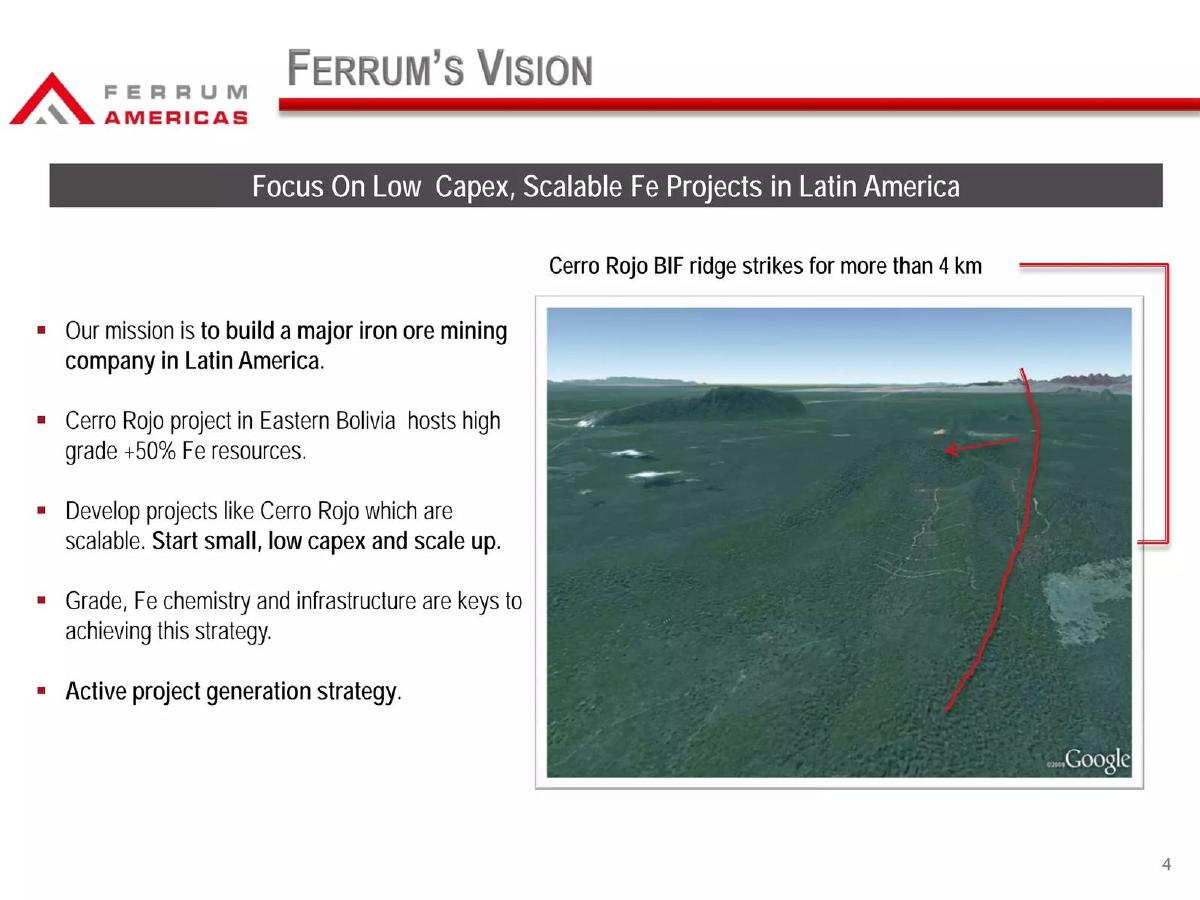
Ferrum Americas defines its mission as building a 'major iron ore mining company in Latin America.' The core of their strategy, as stated on Slide 4, is to 'Start small, low capex and scale up.' This is a direct response to the massive, multi-billion dollar capital requirements of Tier-1 mining projects. By focusing on a BIF (Banded Iron Formation) ridge that 'strikes for more than 4 km,' they argue for a scalable approach where the project can grow alongside cash flow. The use of a Google Earth overlay provides a sense of scale for the ridge.
Slide 7: Exploration Progress
Slide 7 focuses on 'First Phase Drilling Completed.' The company notes that a program testing near-surface mineralization was finished in late 2012. Key data points include the fact that drilling 'intersected consistently high grades across 2,800 m of strike.' The photos of drill rigs and core samples serve as proof of work, moving the project from a theoretical prospect to a verified deposit.
Slide 10: 43-101 Open Pit Resources
This is the most critical slide for a mining investor. It provides the National Instrument 43-101 compliant resource estimates, prepared by P&E Mining Consultants Inc. in January 2013. The data is split into two categories:
15% Fe cut-off: 111.0M tonnes Indicated (48.1% Fe) and 175.9M tonnes Inferred (48.8% Fe). · 50% Fe cut-off: 32.1M tonnes Indicated (51.5% Fe) and 63.0M tonnes Inferred (52.0% Fe).
The distinction is important because the 50% cut-off represents the higher-quality 'starter pit' material that would likely drive early economics.
Slide 13: Logistics and Infrastructure
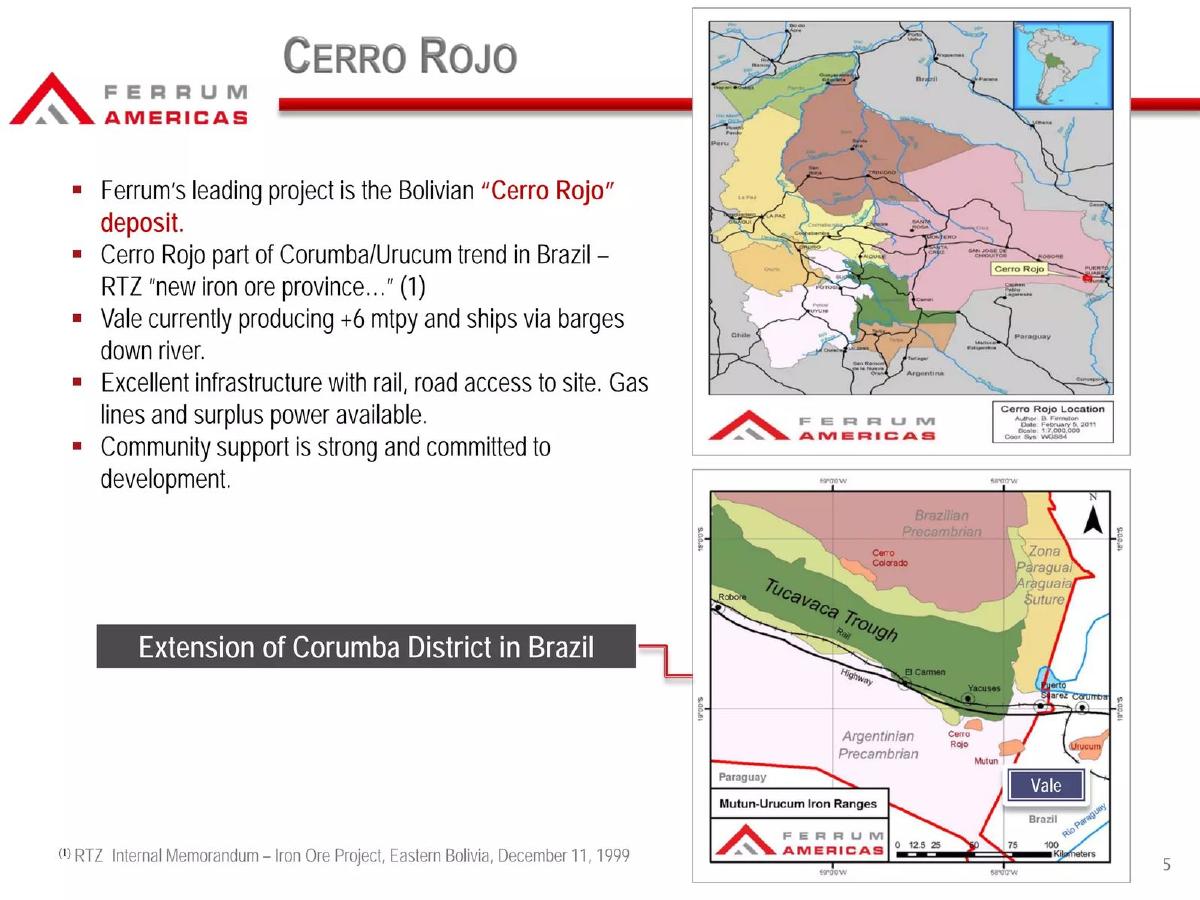
Mining projects often fail not because of a lack of ore, but because of the cost of moving it. Slide 13 argues that Ferrum has an 'Infrastructure Advantage.' The project is located near Puerto Suarez, Bolivia, just 8 km from a rail line. It notes that a new $180 million Votorantim cement plant nearby is helping drive infrastructure initiatives. The map illustrates the project's proximity to the Rio Paraguay, which provides access to the Hidrovia river system for international export.
Slide 16: 2013 Roadmap
This slide outlines the 'Advancing Cerro Rojo in 2013' plan. The milestones are clear:
Preliminary logistics and transportation cost study. · Complete beneficiation work by Q2. · Prospect Cerro Rojo Norte. · Complete Preliminary Economic Assessment (PEA) by Q3.
These are standard de-risking milestones for a junior mining company.
Slide 19: Geological Evidence
Titled 'Enriched Fe in Colluvium,' this slide provides visual evidence of the ore quality on the surface. Colluvium refers to loose, unconsolidated sediments at the base of hillslopes. The photos show large chunks of high-grade ore and workers sampling the soil, reinforcing the 'near-surface' nature of the deposit which typically leads to lower mining costs compared to deep underground mines.
Slide 22: Summary and Value Proposition
The final slide in the provided set summarizes the 'High Option Value.' It reiterates the low capex, high grade (+50% Fe), and infrastructure advantages. It specifically mentions the Hidrovia as 'Latin America's Mississippi River.' The slide also notes that 'Small capitalization provides significant option value,' suggesting that the company's market valuation at the time was low relative to the potential of the resource, a common pitch for junior miners seeking to attract speculative investment.
What Works in This Deck
Technical Transparency: By including the 43-101 resource tables and the name of the consulting firm (P&E Mining Consultants), the company provides the necessary 'hard data' that institutional mining investors require. They don't hide behind vague adjectives; they provide tonnages and percentages.
Logistical Focus: The deck correctly identifies that in the iron ore business, you are essentially a logistics company that happens to own a hole in the ground. The detailed map on Slide 13 and the specific distances to rail and port are the strongest selling points for the project's economic viability.
Strategic Clarity: The 'start small, scale up' mantra is a pragmatic approach for a junior miner. It signals to investors that the management team is conscious of capital dilution and the risks of over-leveraging for a massive build-out before the economics are fully proven.
What Is Missing from This Deck
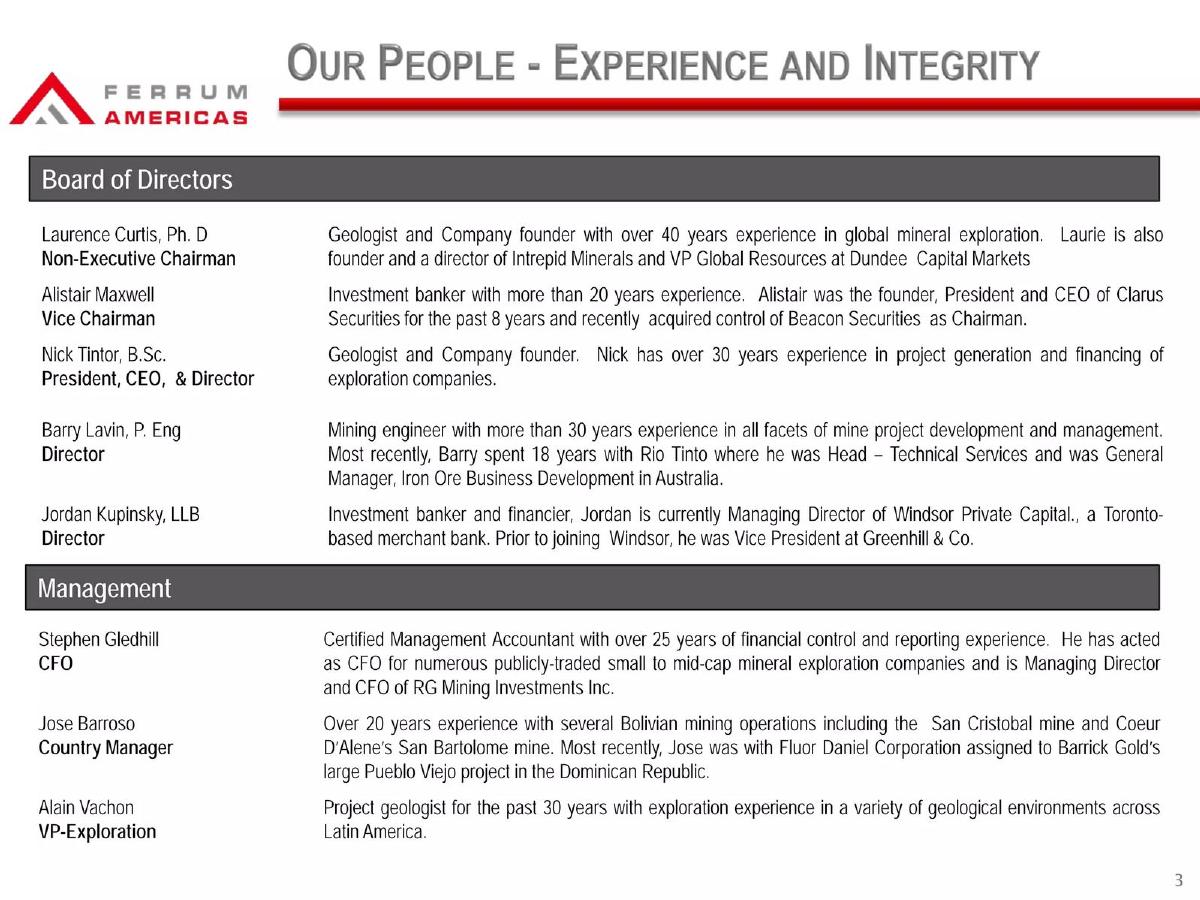
Team Slide: In the mining industry, the track record of the geologists and the executive team (specifically their experience in Latin American jurisdictions) is paramount. The provided slides do not list the management team or board of directors.
Financial Ask: There is no slide detailing how much capital the company is looking to raise, the terms of the offering, or a specific 'Use of Proceeds' breakdown. Without this, the deck functions more as a corporate update than a fundraising tool.
Competitor Analysis: While the deck mentions the project's advantages over 'remote projects in the world,' it does not name specific competitors or other projects in the region (such as the massive Mutun deposit nearby) to provide a relative valuation framework.
Environmental and Social Governance (ESG): Even in 2013, mining in Bolivia required significant focus on community relations and environmental permitting. The deck is silent on the status of environmental licenses or agreements with local indigenous groups, which are often the primary 'deal-killers' in South American mining.
Founder's Lessons
Lead with the 'Unfair Advantage': Ferrum Americas knows their advantage isn't just the iron; it's the rail line 8 km away. Founders in any industry should identify the one external factor (infrastructure, a specific regulation, a unique partnership) that makes their project more viable than a competitor's and highlight it early.
Use Industry Standards: If your industry has a 'Gold Standard' for reporting (like 43-101 in mining or SOC2 in security), use it. It builds immediate credibility and shows you are playing by the rules of the institutional players you are trying to attract.
Visual Proof of Work: For physical businesses, photos of the site, the product, and the team in the field are more effective than stock photography. The raw photos of core samples and drill rigs in this deck, while not 'pretty,' are highly effective at proving the project is real and active.
Frequently asked questions
- What is the primary project discussed in the Ferrum Americas deck?
- The primary focus is the Cerro Rojo project located in Eastern Bolivia, near the border with Brazil. The deck describes it as a high-grade iron deposit with a BIF (Banded Iron Formation) ridge that strikes for more than 4 kilometers. The project is positioned as the first step in a broader strategy to develop scalable, low-capex iron ore assets across Latin America.
- What are the specific resource estimates provided?
- According to Slide 10, the project has 43-101 compliant resources. At a 15% Fe cut-off, there are 111.0 million tonnes (Indicated) and 175.9 million tonnes (Inferred). At a more selective 50% Fe cut-off, the resource stands at 32.1 million tonnes (Indicated) at 51.5% Fe and 63.0 million tonnes (Inferred) at 52.0% Fe.
- How does the company plan to transport the iron ore?
- Ferrum Americas emphasizes an 'infrastructure advantage' on Slide 13. The site is 8 km from an existing rail line and 55 km from a port. It also mentions the Hidrovia river system for barging, noting that a new port development at P. Busch could save 7 days of barging time for bulk commodity exports.
- What were the company's immediate goals for 2013?
- As of the June 2013 date on the deck, the company aimed to complete additional beneficiation work to determine the final product by the second quarter and finish a Preliminary Economic Assessment (PEA) by the third quarter. They also planned to prospect a new target area called Cerro Rojo Norte (Slide 16).
- Is there an investment ask or valuation mentioned?
- No. The provided slides do not include a specific funding request, valuation, or breakdown of how capital would be spent. The deck concludes with a summary of 'High Option Value,' suggesting it may have been used for investor relations or general corporate marketing rather than a specific capital raise round.