Fetch is a mobile-first platform designed to bridge the gap between local restaurants and value-seeking consumers. Unlike transaction-heavy competitors like Groupon, Fetch utilizes a low-cost subscription model, charging users $1.49 per month for access to exclusive, instant deals. The deck outlines a lean path to profitability, projecting a break-even point within twelve months and an average monthly revenue of $150,000 by the end of the third year. Seeking a modest $20,000 through crowdfunding or loans, the company focuses on high-frequency restaurant interactions and direct customer-to-mer…
Key takeaways
- The business model relies on a $1.49 monthly member fee to unlock exclusive restaurant discounts (Slide 6).
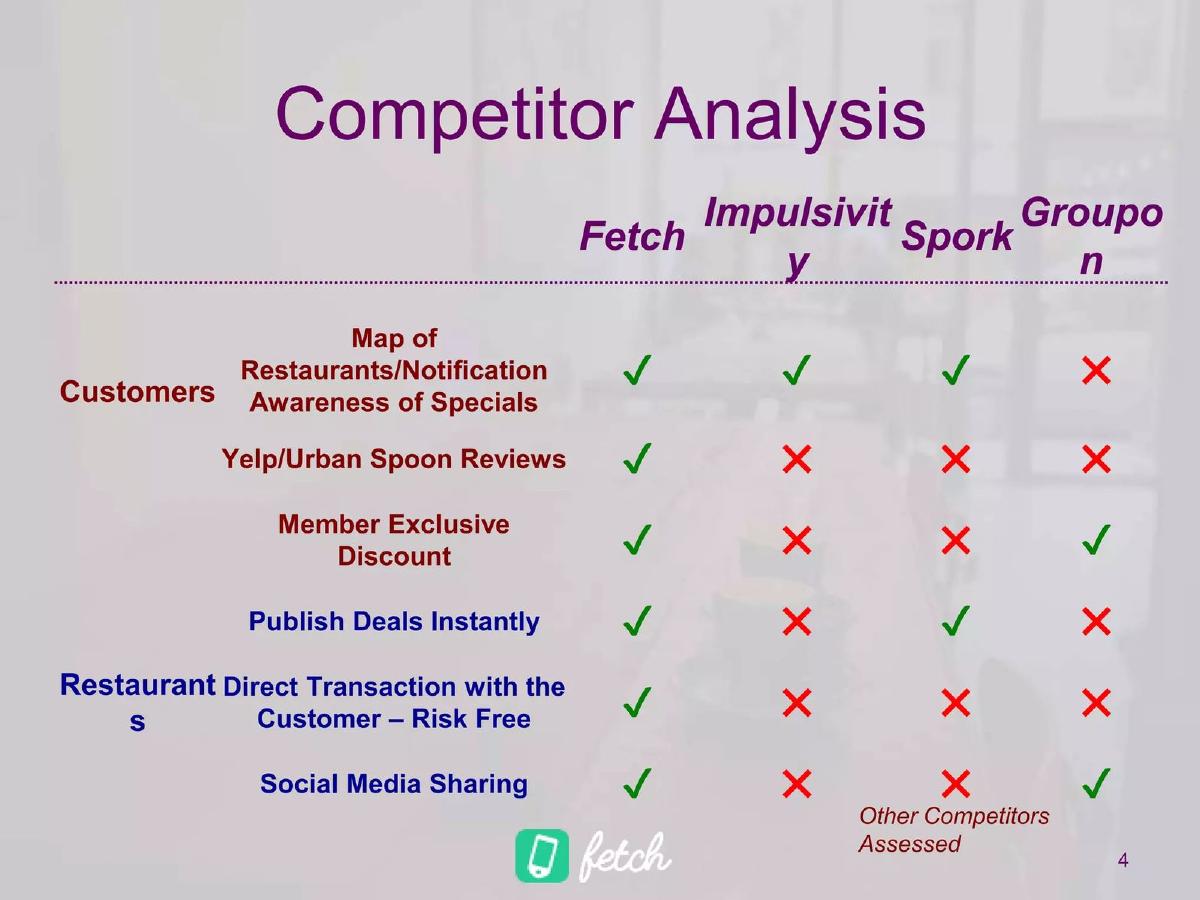
- Fetch identifies Groupon, Spork, and Impulsivity as primary competitors, distinguishing itself through instant deal publishing and review integration (Slide 4).
- The company projects reaching break-even at approximately the 10-month mark (Slide 8).
- By the end of year three, Fetch forecasts an average net cash flow of $30,000 per month (Slide 8).
- The funding ask is exceptionally low at $20,000, intended to be sourced from crowdfunding or loans rather than traditional VC (Slide 8).
- Customer Acquisition Cost (CAC) is projected to drop from $5.40 in month zero to $1.40 by month ten (Slide 17).
- The team consists of five core members across development, finance, sales, and marketing, supported by a mentor and a 'connector' (Slide 14).
- Merchant benefits are framed as 'Risk Free' due to direct transactions between the restaurant and the customer (Slide 4).
Fetch Pitch Deck Analysis
The Fetch pitch deck represents an early-stage mobile application targeting the local restaurant and dining sector. The presentation focuses heavily on a low-friction subscription model for consumers and a risk-free marketing channel for merchants. With a total of 17 slides (9 provided for this analysis), the deck moves quickly from the consumer value proposition to the underlying unit economics and financial projections.
Slide 1: Title Slide
The cover slide features the Fetch logo—a stylized, cursive wordmark—over a blurred background of a coffee shop or cafe. The URL www.fetchzone.com is displayed in the bottom left corner. The aesthetic is minimalist, focusing on the brand identity rather than a specific tagline or mission statement.
Slide 2: Fetch for Consumers
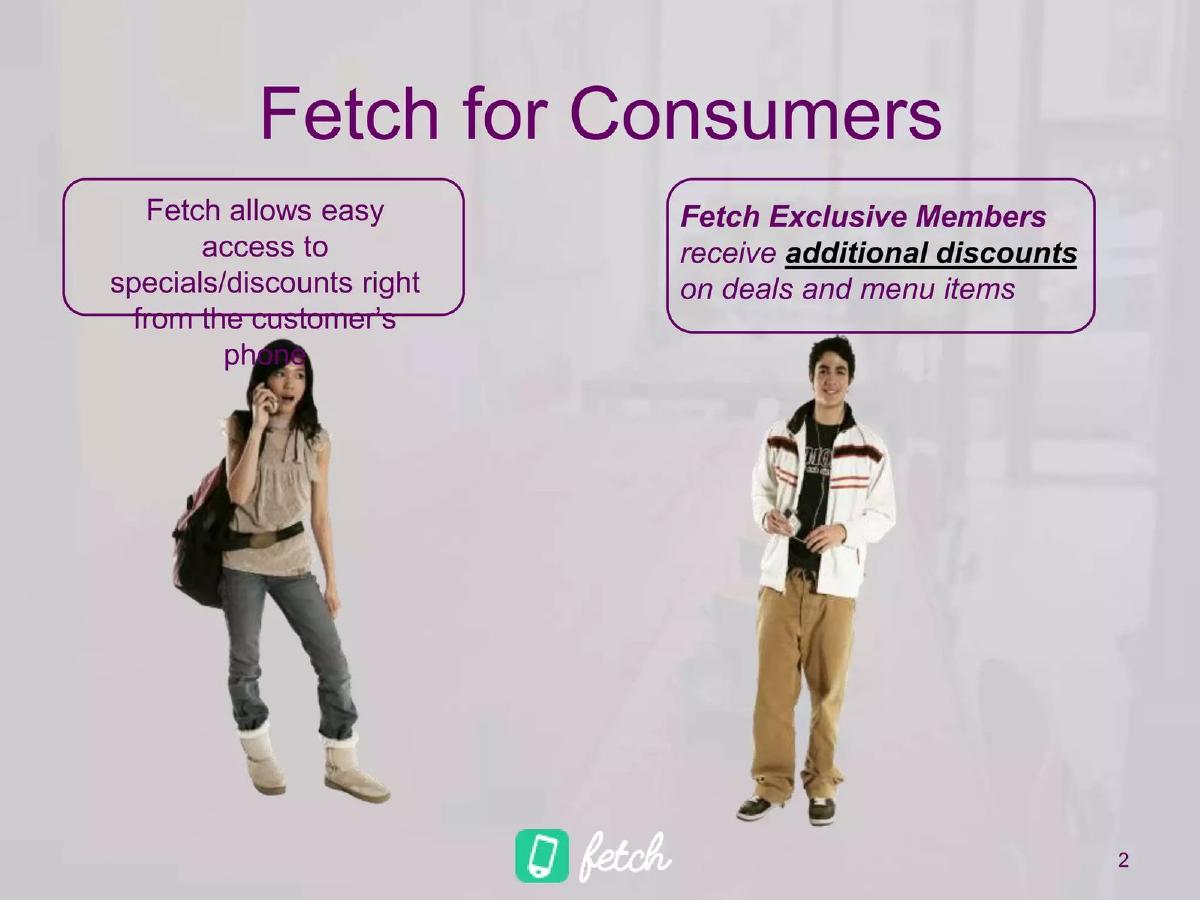
This slide introduces the two-sided value proposition for the end user. On the left, it states that Fetch allows "easy access to specials/discounts right from the customer's phone." On the right, it highlights that "Fetch Exclusive Members receive additional discounts on deals and menu items." The use of stock photography of young adults suggests a target demographic of students or young professionals looking for dining value.
Slide 4: Competitor Analysis
Fetch positions itself against three specific competitors: Impulsivity, Spork, and Groupon. The matrix uses six criteria to differentiate the product. Fetch claims to be the only platform that offers all six features, including Yelp/Urban Spoon reviews and "Restaurant Direct Transaction with the Customer – Risk Free." Notably, Groupon is marked with an 'X' for instant deal publishing and direct transactions, highlighting Fetch's focus on real-time, local engagement rather than the pre-purchased voucher model popularized by larger incumbents.
Slide 6: Business Model
The business model slide uses a flow chart to explain the ecosystem. Fetch provides "Free Marketing & Increase in Clients" to local restaurants. In return, restaurants provide "Additional Discounts on Deals & Menu Items" to the customers. The revenue comes directly from the customers via a "$1.49/Month Member Fee." The slide emphasizes that these deals are "Honest and significantly better" than competitors and that the discounts "quickly offset the monthly fee," providing a clear ROI for the subscriber.
Slide 8: Revenue Projection
This slide contains the core financial ask and projections. A line graph shows total revenue and total expense over a 12-month period. The "Break-even" point is indicated by an arrow at approximately month 10. Key figures include:
End of 3rd Year Avg. Revenue/Month: $150,000 · End of 3rd Year Avg. Net Cash/Month: $30,000 · Required Funding: $20,000 (Mixture of Crowd-funding/Loans)
The slide notes that revenue is currently "Subscription Only" and that expenses are primarily marketing, payroll, and taxes.
Slide 12: Product Visualization
This slide shows the Fetch logo on a mobile device (an older iPhone model). There is no UI/UX demonstration or screenshot of the actual app interface on this slide, serving primarily as a placeholder for the mobile-first nature of the service.
Slide 14: Team Fetch
The team slide introduces five operational members and two advisors. The roles are clearly defined: Product Development (Ghulam and Syeda), Business & Finance (Rangwala), Business & Sales (Lam), and Marketing (Feng). The inclusion of a "Mentor" (John Phyper) and a "Connector" (Prerna Kaul) suggests the team is leveraging an external network to gain traction in the local business community.
Slide 16: Reference Slides
A transition slide titled "Reference Slides" indicates the beginning of the appendix or data-heavy section of the deck. It maintains the consistent purple and white color scheme used throughout the presentation.
Slide 17: Customer Acquisition Cost (CAC)
This appendix slide provides a month-by-month breakdown of growth and efficiency. It tracks "Total Customers," "Cumulative Expense," and "Cost Per Customers." The data shows a scaling effect:
Month 0: 269 customers at $5.40 CAC · Month 5: 2,004 customers at $2.00 CAC · Month 10: 4,675 customers at $1.40 CAC
This table is critical as it demonstrates the team's assumption that marketing efficiency will improve significantly as the brand gains local density.
What Fetch Does Well
The Fetch deck excels at defining a very specific, niche business model. By choosing a $1.49 subscription over a transaction fee, they avoid the friction of handling payments for the restaurants, which they correctly identify as a "Risk Free" proposition for the merchant. This is a strong selling point for small business owners who are often wary of high commission rates from platforms like Groupon or UberEats.
The inclusion of a detailed CAC table (Slide 17) is a professional touch rarely seen in decks asking for such a small amount of capital ($20,000). It shows that the founders are thinking about unit economics and the relationship between marketing spend and user growth. The competitive matrix is also well-constructed, focusing on functional gaps in the market—like real-time deal publishing—rather than just broad industry trends.
What is Missing from the Fetch Deck
The most significant omission is a clear "Problem" slide. While the solution is described, the deck doesn't explicitly state the pain point it is solving for consumers or restaurants beyond a general desire for discounts. Are restaurants struggling with empty tables during off-peak hours? Are consumers overwhelmed by the voucher process of competitors? Defining the 'why' would make the 'what' more compelling.
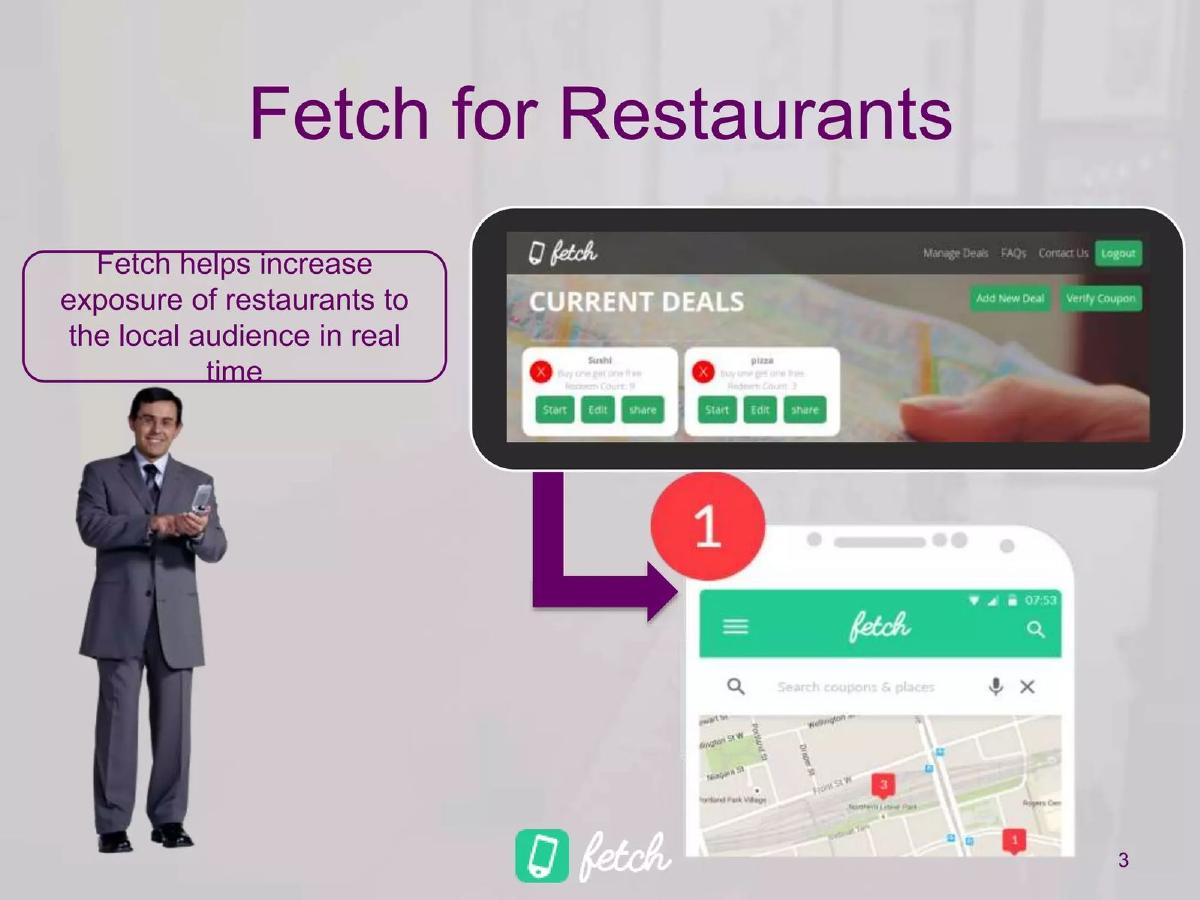
Furthermore, the deck lacks actual product screenshots. Slide 12 shows a logo on a phone, but there is no evidence of the user interface, the map functionality mentioned in the competitor analysis, or the deal publishing flow for merchants. For a mobile-first startup, showing the product is essential to prove technical feasibility. Finally, the team slide lacks credentials; there are no mentions of previous successful exits, specific industry experience, or educational backgrounds that would give an investor confidence in their ability to execute.
Founder Takeaways: What to Copy
Specific Pricing: Don't be afraid to name your price. Fetch clearly states the $1.49/month fee on the business model slide. This allows investors to immediately run their own back-of-the-envelope calculations on market size and revenue potential.
Merchant-Centric Value: Framing the product as "Risk Free" for the B2B side of a two-sided marketplace is a smart psychological move. If you are building a platform that requires merchant adoption, emphasize how you minimize their financial risk.
The 'Connector' Role: Including a "Connector" on the team slide is an interesting tactic for local-growth startups. It signals to investors that you have someone dedicated specifically to networking and business development, which is the lifeblood of a hyper-local app.
Data Transparency: Providing a month-by-month CAC projection shows a level of operational discipline. Even if the numbers are estimates, it demonstrates that the founders understand the levers that will drive their business forward.
Frequently asked questions
- What is the primary revenue stream for Fetch?
- Fetch operates on a 'Subscription Only' model as stated on slide 8. Consumers pay a $1.49 monthly member fee to access additional discounts on deals and menu items. The deck notes that other potential revenue streams, such as advertisements and add-ons, will be accounted for at a later date, keeping the initial focus on recurring user fees.
- How does Fetch differentiate itself from Groupon?
- According to the competitor analysis on slide 4, Fetch differentiates itself by allowing restaurants to publish deals instantly and facilitating direct transactions with customers, which they label as 'Risk Free.' Unlike Groupon, Fetch also integrates Yelp and Urban Spoon reviews and provides a map for notification awareness of specials.
- What are the projected financials for the first year?
- Slide 8 shows a revenue projection graph where total expenses start higher than revenue. The company expects to cross the break-even point around month 10. By month 12, the graph indicates total revenue exceeding $50,000, while total expenses remain below $50,000, suggesting the start of profitable operations.
- What is the team structure and experience level?
- Slide 14 lists a seven-person team. Umar Ghulam and Zaara Syeda handle Product Development; Abbas Rangwala covers Business & Finance; Andrew Lam manages Business & Sales; and Jesse Feng leads Marketing. They are supported by John Phyper (Mentor) and Prerna Kaul (Connector). The deck does not list specific past company experience or degrees.
- How much capital is Fetch seeking and for what purpose?
- Fetch is seeking $20,000, which is a very small amount for a tech startup. Slide 8 specifies this should be a 'Mixture of Crowd-funding/Loans.' The funds are likely intended to cover the initial marketing and payroll expenses shown in the revenue projection, supporting the growth to 4,675 customers by month 10.