The Truth Social (TMTG) investor presentation, dated November 2021, serves as the primary document for its merger with Digital World Acquisition Corp (DWAC). The deck positions TMTG not just as a social media platform, but as a comprehensive media and technology conglomerate intended to rival Disney, Netflix, and Twitter. The financial structure is complex, featuring an initial $875M purchase price and a $1B PIPE, with an enterprise value potentially reaching $12.28B assuming full earnouts and a $10 share price. Strategically, the deck leans heavily on the 'censorship' narrative, citing the b…
Key takeaways
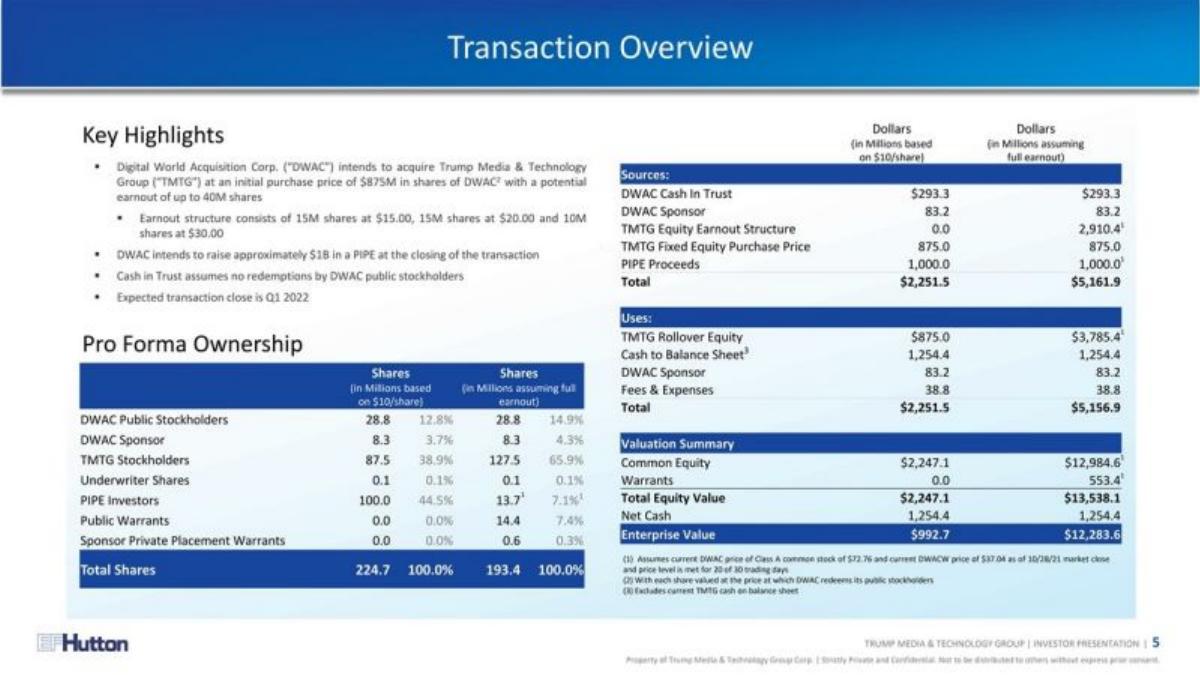
- The transaction includes an initial purchase price of $875M in shares of DWAC with a potential earnout of up to 40M shares (Slide 5).
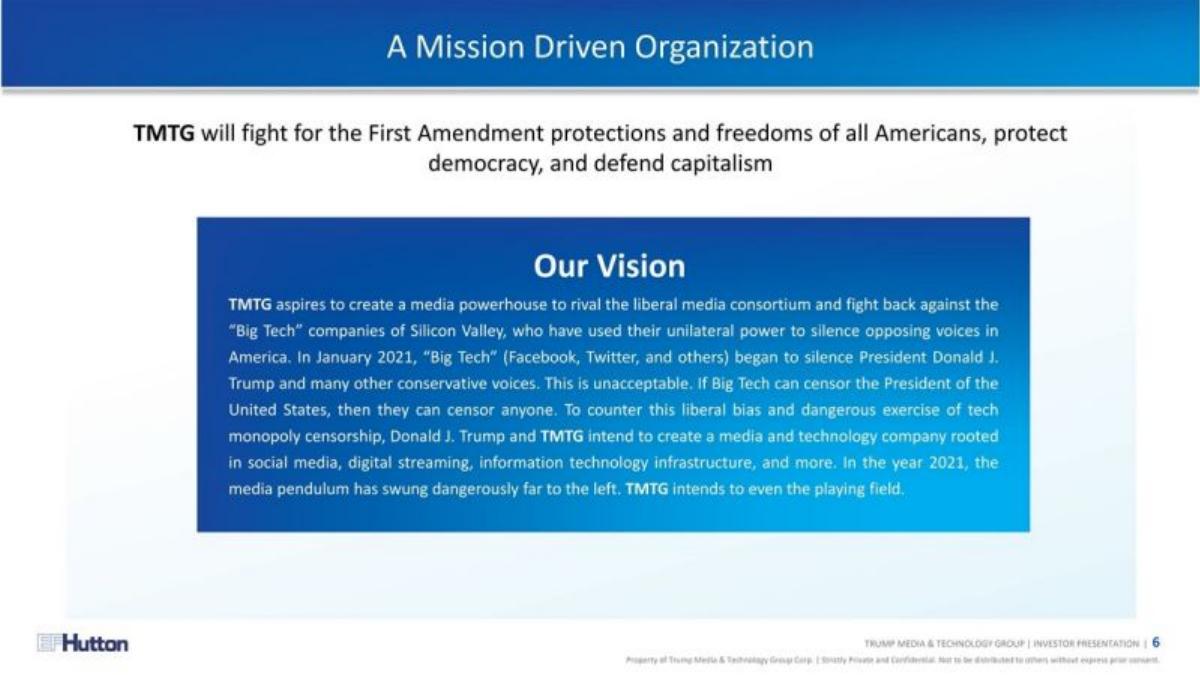
- TMTG identifies its primary market opportunity as a reaction to 'Tech Monopoly Censorship,' specifically citing the banning of the U.S. President from Twitter (Slide 7).
- The company projects reaching 81M total users for Truth Social and 40M subscribers for TMTG+ by 2026 (Slide 37).
- Management targets an Average Revenue Per User (ARPU) of $13.50 for Truth Social by 2026, which they note is a 43% discount to Twitter's 2021 ARPU (Slide 37).
- The 'Technology Team' slide lists 30+ individuals by first name and last initial, highlighting prior experience at companies like Apple, Google, and Stripe (Slide 21).
- The infrastructure plan emphasizes a 'resilient ecosystem' with multiple redundancies to prevent being 'cancelled' by vendors (Slide 11 and 23).
- TMTG+ is positioned as a 'non-woke' entertainment service competing directly with Disney+ and Hulu (Slide 31).
- The deck uses Twitter's $41B valuation and 6.6x revenue multiple as a benchmark for the potential value creation of Truth Social (Slide 29).
The Macro Narrative: Fighting Big Tech Monopolies
Slides 1-4: The Formalities
The presentation opens with a standard corporate cover identifying the partnership between Trump Media & Technology Group (TMTG) and Digital World Acquisition Corp (DWAC) . The presence of the EF Hutton logo establishes the institutional backing of the SPAC. Slide 3 is a dense 'Disclaimer and Risk Factors' page, which is standard for SEC-regulated filings but particularly critical here given the speculative nature of the projections. It explicitly states that 'investments in private placements are speculative and involve a high degree of risk.'
Slide 5: Transaction Overview and Valuation
This is the most data-heavy slide in the deck. It outlines that DWAC intends to acquire TMTG at an initial purchase price of $875M in shares. There is a significant earnout structure: 15M shares at $15.00, 15M shares at $20.00, and 10M shares at $30.00. The slide also notes a $1B PIPE (Private Investment in Public Equity) intended to close with the transaction. Under the 'Pro Forma Ownership' table, TMTG stockholders are shown to hold 38.9% of the company initially, potentially rising to 65.9% assuming a full earnout. The 'Enterprise Value' is calculated at $992.7M in the base case, scaling to $12.283B in the 'full earnout' scenario.
Slides 7-10: The Problem Statement
Slide 7, titled 'Tech Monopoly Censorship Threatens Free Speech,' serves as the 'Problem' slide. It uses a collage of newspaper clippings to highlight actions taken by Amazon, Facebook, Stripe, Apple, and Twitter against President Trump and the Parler platform. A specific comparison is made between Twitter 'banning' the U.S. President while 'maintaining' a Taliban account. This sets the stage for TMTG to be positioned not just as a business, but as a political and social alternative to existing platforms.
The Solution: A Multi-Vertical Media Empire
Slides 11-13: Investment Highlights and Market Segmentation
Slide 11 introduces the core value proposition: a 'Resilient ecosystem' with 'multiple redundancies.' The business model is described as 'Ad-based recurring subscription revenue' with the potential to reach 15M monetizable social users and 10M digital streaming subscribers , leading to over $1B in revenue . Slide 13 provides a historical timeline of media segmentation, suggesting that just as radio (1920s) and TV (1950s) disrupted previous eras, TMTG will be the 'fountainhead' for a new shift in 2021 against 'Big Tech.'
Slide 15: The 'Big Tent' Strategy
This slide attempts to broaden the target demographic. It visualizes a 'Big Tent' where 'All Are Welcome,' specifically labeling 'Liberal | Independent | Conservative.' It benchmarks the opportunity against Netflix (214M subscribers) and Twitter (211M mDAU) . Crucially, it lists 'Trump's Historic Following' as the primary acquisition funnel: 89M on Twitter, 33M on Facebook, and 24M on Instagram. This is the deck's strongest argument for low customer acquisition costs (CAC).
Slide 17: The 'Non-Cancellable' Global Community
Slide 17 is a purely aspirational graphic of the Earth with the text 'Building a "Non-Cancellable" Global Community.' This reinforces the technical theme of the deck: that the platform is being built to withstand de-platforming from service providers, a direct reference to the Parler/AWS situation mentioned earlier.
The Execution: Team and Infrastructure
Slides 19-21: Advisors and Technology Team
Slide 19 lists professional services firms including Loeb & Loeb and Marcum . Slide 21 is the 'Technology Team' slide. Instead of full names, it lists first names and last initials (e.g., 'Josh A. - CTO'). It compensates for the lack of full names by displaying a cloud of logos from 'Prior Experience,' including Apple, Google, Netflix, Stripe, and Rumble . This suggests a team recruited from top-tier tech firms, though the anonymity is unusual for a public investor presentation.
Slides 23-27: Technical Architecture
Slide 23 provides a 7-layer infrastructure diagram, from Users down to Database Servers. It emphasizes geographic distribution (DC-US-EAST, CENTRAL, WEST). Slide 27, 'TRUTH Social Infrastructure,' is surprisingly transparent about the software stack. It lists NGINX, PostgreSQL, Redis , and explicitly names 'Backend v1 (Mastodon)' . This confirms that the initial version of the platform was a fork of the open-source Mastodon project. It also lists threats such as 'Nation states' and 'Targeted activist / political attacks.'
The Product: Truth Social and TMTG+
Slides 28-31: Monetization and Content
Slide 29 compares Truth Social to Twitter, noting that the market values Twitter at 6.6x enterprise value to sales . It leaves a '?' for Truth Social's valuation, inviting investors to apply that multiple to TMTG's projections. Slide 31 introduces TMTG+ , a streaming service for 'non-woke' entertainment, documentaries, and sports. It positions itself as a competitor to Disney+ and Hulu .
Slides 33-35: The Trump Brand Equity
Slide 33 highlights the 'History of President Trump's Entertainment Success,' citing The Apprentice and Miss Universe with Variety and LA Times headlines. Slide 35 projects that TMTG+ could achieve an Average Monthly Revenue Per User closer to Netflix ($11.73) than Disney+ ($4.16) due to a 'highly enthused base.'
Slide 37: Financial Projections
The deck concludes its data section with specific 2026 targets. For Truth Social, it projects 81M total users and an ARPU of $13.50 . For TMTG+, it projects 40M total subscribers with a $9.00 monthly fee . These figures are the basis for the $1B+ revenue claim made earlier in the deck.
What Truth Social Does Well
1. Clear Market Positioning: The deck does not shy away from its political catalyst. It identifies a specific segment of the population that feels underserved or 'cancelled' by mainstream tech and positions TMTG as the only viable alternative.
2. Infrastructure Focus: Unlike many social media pitches that focus purely on UI/UX, this deck spends significant time on 'resiliency.' By listing the specific tech stack (Mastodon, PostgreSQL) and the threat model, it addresses the 'de-platforming' risk that is central to its business case.
3. Leveraging Existing Audience: The use of Slide 15 to show the 100M+ aggregate followers across other platforms provides a plausible (if unproven) path to rapid user growth without massive marketing spend.
What is Missing from the Deck
1. Current Metrics: As a pre-launch or early-launch SPAC deck, there are zero 'hard' metrics regarding current user engagement, retention, or churn. Everything is based on 'projections' and 'historic following.'
2. Full Team Transparency: The use of first names and initials on the team slide is a red flag in traditional venture capital, though perhaps explained here by the polarized nature of the project. Investors generally want to perform background checks on the C-suite of a billion-dollar entity.
3. Content Acquisition Strategy: While TMTG+ is positioned to rival Netflix and Disney, the deck lacks any detail on how they will fund or produce the 'non-woke' content. Streaming is a capital-intensive business, and the $1.25B cash-to-balance-sheet (Slide 5) would be exhausted quickly in a content war with major studios.
Founder's Teardown: Lessons to Carry Forward
The 'Multiple' Play: Founders should note how Slide 29 uses a 'comparable company' multiple (6.6x sales) to anchor the valuation. Even if your revenue is currently zero, anchoring your potential to a known market leader's multiple is a standard way to justify a high valuation during a SPAC or late-stage round.
The 'Problem' as a Movement: TMTG doesn't just pitch a feature; it pitches a solution to a perceived societal grievance. If your startup taps into a significant cultural or systemic shift, your 'Problem' slide should be as visceral as Slide 7. It creates a sense of urgency that a simple 'efficiency' play lacks.
Infrastructure as a Feature: If your industry has high 'platform risk' (e.g., you rely on a single API or a single cloud provider), follow TMTG's lead in Slide 23 and 27. Show the investors exactly how you have built redundancies to ensure your business cannot be turned off overnight by a third party.
Frequently asked questions
- What is the total valuation of the TMTG deal according to the deck?
- According to Slide 5, the valuation is tiered. Based on a $10/share price, the initial Total Equity Value is $2.247B. However, assuming a full earnout and the same $10 share price, the Total Equity Value is projected at $13.538B, with an Enterprise Value of $12.283B.
- How does Truth Social plan to monetize its user base?
- Slide 11 and 37 outline a dual revenue model: ad-based revenue for the social media platform and recurring subscription revenue for the TMTG+ streaming service. They project Truth Social ARPU to reach $13.50 and TMTG+ monthly fees to reach $9.00 by 2026.
- What is the 'Big Tent' approach mentioned in the presentation?
- Slide 15 defines the 'Big Tent' approach as an inclusive environment for Liberals, Independents, and Conservatives. It contrasts TMTG's potential reach against the 'historic following' of Donald Trump across Twitter (89M), Facebook (33M), and Instagram (24M).
- What specific technology is Truth Social built on?
- Slide 27 lists the application stack, which includes NGINX, PostgreSQL, Redis, and specifically identifies 'Backend v1 (Mastodon).' The infrastructure is designed to be self-reliant to mitigate threats from 'Nation states' and 'Vendors.'
- Who are the key advisors and underwriters for this SPAC deal?
- Slide 19 and the cover slide identify EF Hutton as the primary advisor. Other listed firms include Nelson Mullins, Loeb & Loeb LLP, Ellenoff Grossman & Schole LLP (EGS), Marcum, MZ Investor Relations, and Withum.