Trym’s 15-slide deck is a focused pitch for a vertical SaaS solution in the legal cannabis industry. Seeking a $1.5M Series Seed round, the company highlights a significant market opportunity: a projected $31B US legal cannabis market by 2024 (Slide 2). The deck effectively uses a competitive matrix (Slide 10) to show how Trym occupies a unique intersection of regulatory compliance and environmental management. With 2.3 million square feet of cultivation facilities already under management across 15 states (Slide 7), the traction is tangible. However, the deck relies heavily on blurred charts…
Key takeaways
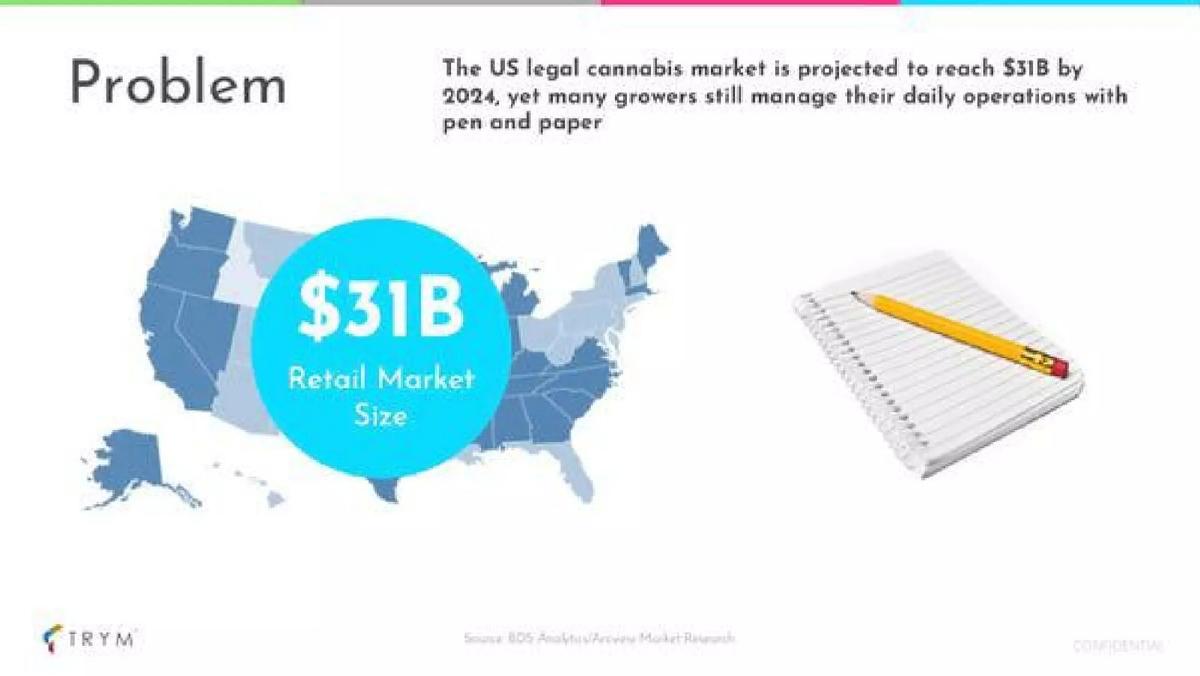
- The US legal cannabis market was projected to reach $31B by 2024, yet many growers still used pen and paper (Slide 2).
- Trym manages 2.3 million square feet of cultivation facilities across 15 different states (Slide 7).
- The 2024 Total Addressable Market (TAM) for cannabis farm management was estimated at over $1B (Slide 9).
- Trym positions itself at the intersection of 'Cannabis Regulatory Compliance' and 'Controls / Management Systems' (Slide 10).
- The software integrates with industry standards like Metrc, Argus, TrolMaster, and Slack (Slide 11).
- The company sought a $1.5M Series Seed Preferred Round with existing backing from 7thirty Capital and WelCan Capital (Slide 13).
- Trym manages $1B in annualized crop value, drawing a direct comparison to AgTech giant Granular (Slide 14).
- The team includes 12 members with backgrounds from Amazon, HBO, and SunPower (Slide 6).
Executive Summary: A Vertical SaaS Play for the Green Rush
Trym’s pitch deck is a clinical example of how to pitch vertical SaaS in a high-growth, high-regulation industry. Founded in 2015, the company identified a massive gap in the cannabis cultivation market: the lack of integrated software that combines environmental data with regulatory compliance. The deck focuses heavily on the 'professionalization' of the industry, moving growers away from manual tracking toward data-driven operations.
The Problem and Solution (Slides 1-4)
Slide 1: Title Slide The deck opens with a clean, professional aesthetic. It clearly defines the product: "Cannabis Farm Management Software." The imagery includes a mobile interface showing plant counts and environmental conditions, immediately signaling a mobile-first, data-heavy solution. Matt Mayberry is listed as CEO and Co-founder.
Slide 2: Problem The problem is framed through a market inefficiency. While the US legal cannabis market is projected to reach $31B by 2024, the slide notes that "many growers still manage their daily operations with pen and paper." This is a classic SaaS pitch: high-value industry, low-tech current state.
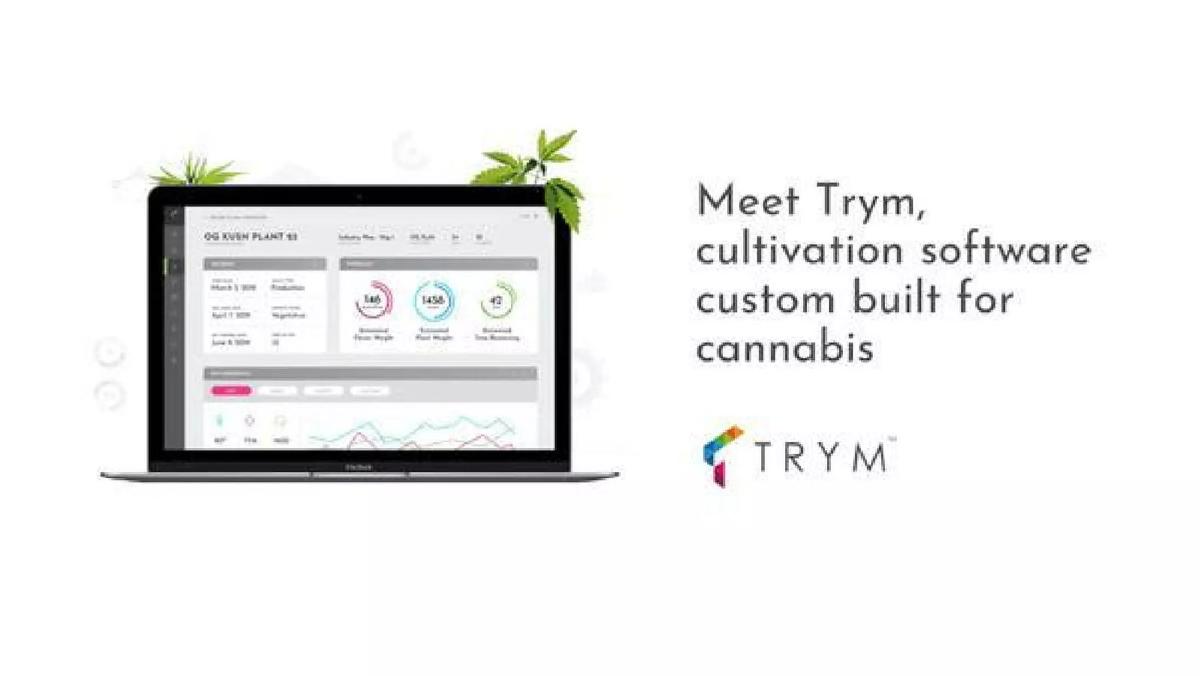
Slide 3: Meet Trym The solution slide is minimalist, showing a dashboard on a laptop with the tagline "cultivation software custom built for cannabis." It emphasizes that the software is not a generic AgTech tool but is tailored to the specific needs of cannabis growers.
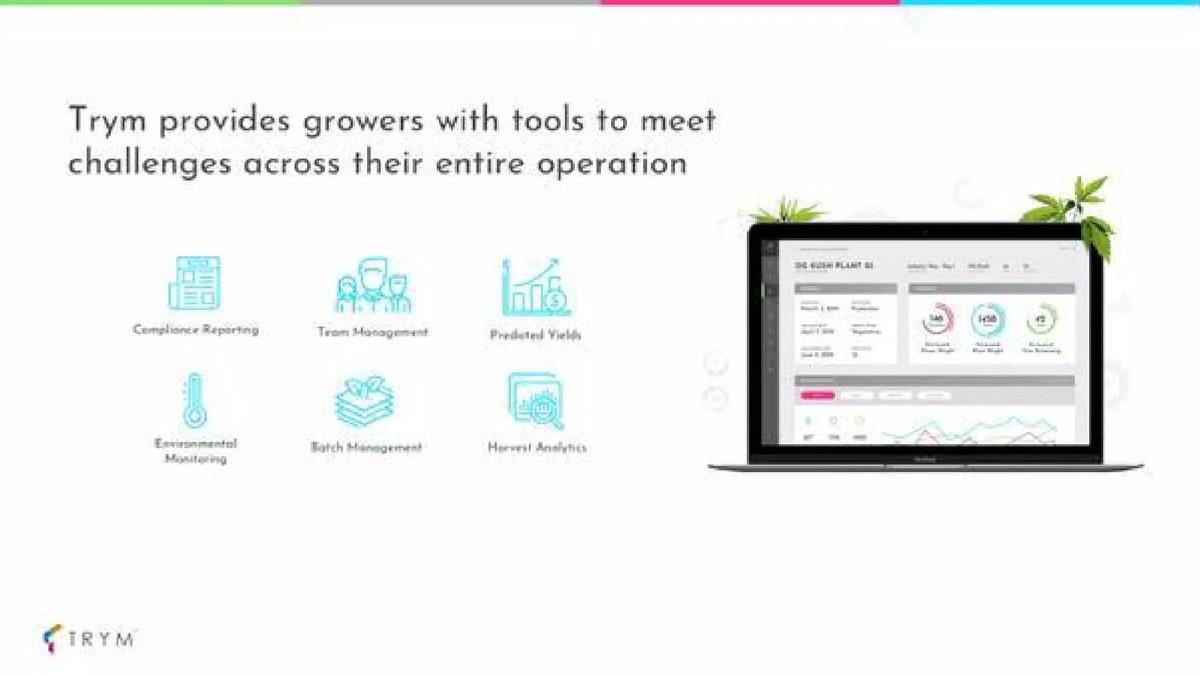
Slide 4: Feature Overview Trym breaks down its utility into six core pillars: Compliance Reporting, Team Management, Predicted Yields, Environmental Monitoring, Batch Management, and Harvest Analytics. This slide demonstrates the breadth of the platform, positioning it as an all-in-one operating system for a farm.
Product Depth and Team (Slides 5-6)
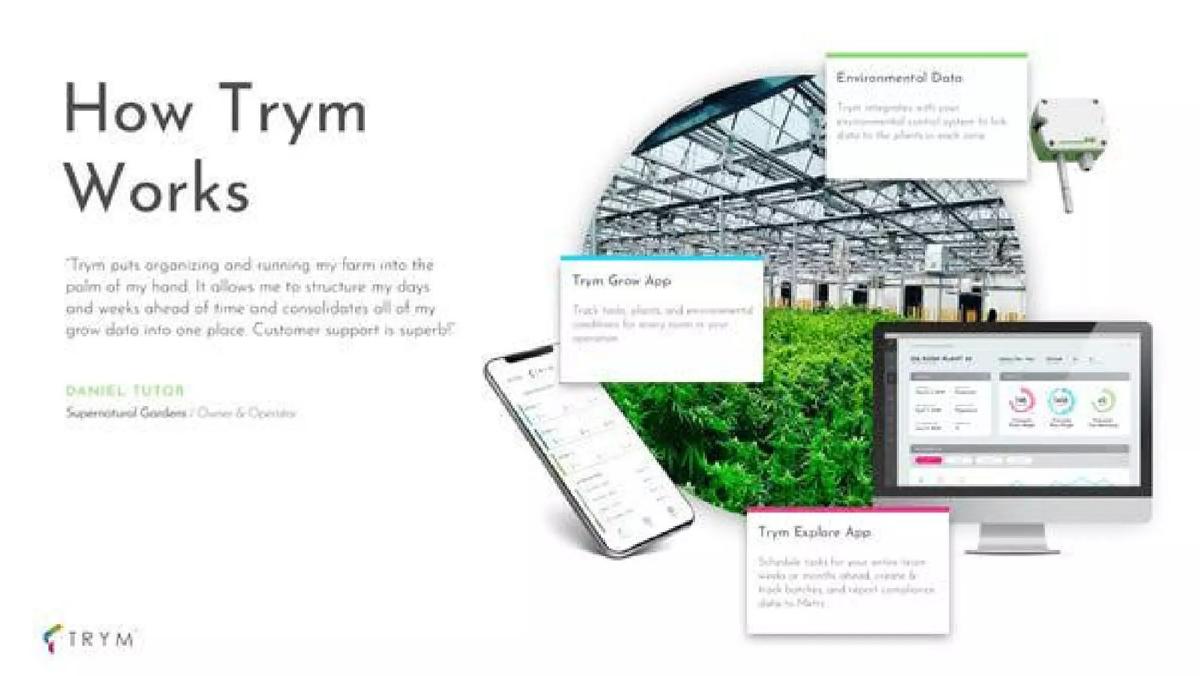
Slide 5: How Trym Works This slide uses a customer testimonial from Daniel Tutor of Supernatural Gardens to validate the product. It highlights three components: the Trym Grow App (tracking tasks and plants), Environmental Data (integrating with control systems), and the Trym Explore App (scheduling and compliance). The testimonial emphasizes that the software "puts organizing and running my farm into the palm of my hand."
Slide 6: Team The team slide is impressive for a seed-stage company, featuring 12 members. It highlights backgrounds from major tech and industry players like Amazon, SunPower, HBO, Trellis, Baker, and Green Bits. This mix of high-scale tech experience and industry-specific knowledge is a strong trust signal for investors.
Market Traction and TAM (Slides 7-9)
Slide 7: Geographic Reach Trym demonstrates significant scale here, stating they work with "leading cultivators across 15 states" with "2.3 Million Sq. Ft. of Cultivation Facilities Managed." Although the logos of the cultivators are blurred, the sheer volume of managed space provides a strong metric for product-market fit.
Slide 8: Strong Early Traction This slide is unfortunately heavily blurred in the public version of the deck. It shows a line graph trending upward and three key metrics at the top, including what appears to be a customer count and an ARPU (Average Revenue Per User) figure of $425. The visual intent is to show consistent month-over-month growth.
Slide 9: US Cannabis Farm Management TAM The deck calculates the Total Addressable Market (TAM) by looking at the number of cultivators. In 2020, there were 39,015 cultivators; by 2024, this was projected to grow to 71,145. The slide concludes that the 2024 TAM for cannabis farm management is >$1B, noting that there are 4x more cultivation licenses than any other license type (manufacturers, dispensaries, retailers).
Competitive Landscape and Integrations (Slides 10-11)
Slide 10: Competitive Landscape This is one of the most effective slides in the deck. It uses a 2x2 matrix with "Cannabis Regulatory Compliance" on the Y-axis and "Controls / Management Systems" on the X-axis. Trym places itself alone in the top-right quadrant. It categorizes competitors like Metrc and Canix as compliance-heavy, and others like Argus and Growlink as control-heavy. Trym’s claim is that they are the only ones doing both at a high level.
Slide 11: Software Integrations To support its position as a central hub, Trym lists its integrations. These include Metrc (essential for California and Oregon compliance), Argus, TrolMaster, and Slack. This shows the product is designed to fit into an existing ecosystem rather than forcing a total rip-and-replace of hardware.
The Ask and Exit Strategy (Slides 12-15)
Slide 12: Revenue and Customer Growth Projections Like the traction slide, this is blurred. It shows a bar chart projecting revenue growth over four years. While the specific numbers are hidden, the trajectory is aggressively exponential, typical for a venture-backed SaaS pitch.
Slide 13: Investment Opportunity The ask is clear: "Raising $1.5M Series Seed Preferred Round." The pre-money valuation is blurred. It lists existing major investors: 7thirty Capital, WelCan Capital, and Delta Emerald Ventures. The slide also includes placeholders for key goals regarding paying accounts and ARR (Annual Recurring Revenue).
Slide 14: Precedence for Exit This slide provides a valuation anchor. It compares Trym to Granular, which was acquired by DuPont for $300M. The logic is compelling: Granular managed 2 million acres of row crops with $1.3B in crop value. Trym manages only 2 million square feet, but because cannabis is so high-value, that small footprint represents $1B in annualized crop value. This suggests that Trym can reach a massive valuation with a much smaller physical footprint than traditional AgTech.
Slide 15: Thank You The deck concludes with contact information and social handles, set against a background of a high-tech indoor cultivation facility.
What Works in This Deck
1. The Value-Density Argument: The comparison to Granular on Slide 14 is brilliant. It preempts the investor concern that "cannabis is a niche market" by showing that the dollar value of the crops managed is equivalent to traditional agriculture at a fraction of the scale.
2. Clear Differentiation: The competitive matrix on Slide 10 clearly articulates why Trym needs to exist. By identifying the split between compliance and controls, they carve out a "blue ocean" for their integrated platform.
3. Ecosystem Thinking: Slide 11 (Integrations) shows that the founders understand the technical reality of their customers. They aren't just building a silo; they are building a connector for the hardware and regulatory tools growers already use.
What is Missing
1. Specific Unit Economics: While the ARPU is hinted at on Slide 8 ($425), the deck lacks a clear breakdown of Customer Acquisition Cost (CAC) or Lifetime Value (LTV). For a SaaS play, these are critical metrics for a Seed round.
2. Sales Strategy: The deck shows great traction (15 states), but it doesn't explain how they are getting these customers. Is it a direct sales force, partnerships with hardware providers, or digital marketing? The "Go-to-Market" slide is a notable omission.
3. Use of Funds: Slide 13 mentions the $1.5M raise but doesn't specify how the capital will be allocated. Investors want to know if the money is going toward engineering, sales, or regulatory expansion.
What a Founder Should Copy
1. The 'Professionalization' Narrative: If you are pitching a vertical SaaS tool for an industry that is currently "un-tech," use the "pen and paper" vs. "digital dashboard" contrast. It is a simple, effective way to communicate value (Slide 2).
2. Industry-Specific TAM: Trym didn't just use a generic "cannabis is a $31B market" stat. They broke it down by license type (Slide 9) to show exactly how many potential customers exist in their specific sub-sector (cultivators). This level of granularity builds credibility.
3. Strategic Blurring (for Public Decks): While frustrating for analysts, the use of blurred charts for sensitive financial data allows a founder to share their deck more widely while protecting proprietary growth rates. If you are uploading your deck to a public platform, follow this lead.
4. Credible Team Bench: Even if your team is small, highlighting the logos of prestigious former employers (Slide 6) helps bridge the "trust gap" with investors who may not know your specific industry well.
Frequently asked questions
- What is Trym's core product offering?
- Trym offers cannabis farm management software designed to streamline daily operations. According to Slide 4, the platform includes compliance reporting, team management, predicted yields, environmental monitoring, batch management, and harvest analytics. It aims to replace manual 'pen and paper' processes with a digital dashboard that integrates environmental data with task management.
- How does Trym differentiate itself from competitors?
- Trym uses a competitive landscape matrix on Slide 10 to show its unique positioning. While most competitors focus strictly on either regulatory compliance (like Metrc or Canix) or environmental controls (like Argus or Growlink), Trym claims to occupy the upper-right quadrant, providing a unified solution that handles both aspects of cultivation management.
- What level of traction did Trym have at the time of this deck?
- At the time of the presentation, Trym was working with leading cultivators across 15 states, managing a total of 2.3 million square feet of cultivation facilities (Slide 7). Slide 14 further notes that this represents approximately $1B in annualized crop value under management, positioning them as a significant player in the niche AgTech space.
- Who were the investors involved in Trym's Seed round?
- Slide 13 lists 7thirty Capital, WelCan Capital, and Delta Emerald Ventures as major investors. The deck was used to raise a $1.5M Series Seed Preferred Round. Catalogue facts indicate the company eventually raised $125,000 in 2015, though this deck appears to be for a subsequent, larger seed-stage effort.
- What is the 'Precedence for Exit' mentioned in the deck?
- On Slide 14, Trym compares itself to Granular, a farm management software for row crops that was acquired by DuPont for $300M. Trym highlights that while Granular managed 2 million acres, Trym's 2 million square feet of cannabis manages a comparable annualized crop value ($1B vs $1.3B) due to the high value of cannabis compared to conventional crops.