TrustCloud's 13-slide deck, used to raise $600,000 in 2009, targets the friction inherent in the early sharing economy. The core thesis is that trust is siloed within individual platforms like eBay or Airbnb, creating 'crossover risk' for users and providers. TrustCloud proposes a portable 'TrustScore' and 'TrustCard' that aggregates data from four layers: verification, background, behavior, and transactions. The deck leans heavily on analogies, comparing their value proposition to Best Buy's warranty revenue and the FICO credit score. While the deck lacks a formal 'Ask' slide or detailed fin…
Key takeaways
- The deck identifies 'crossover risk' as the primary friction point in a sharing economy growing at triple digits (Slide 3).
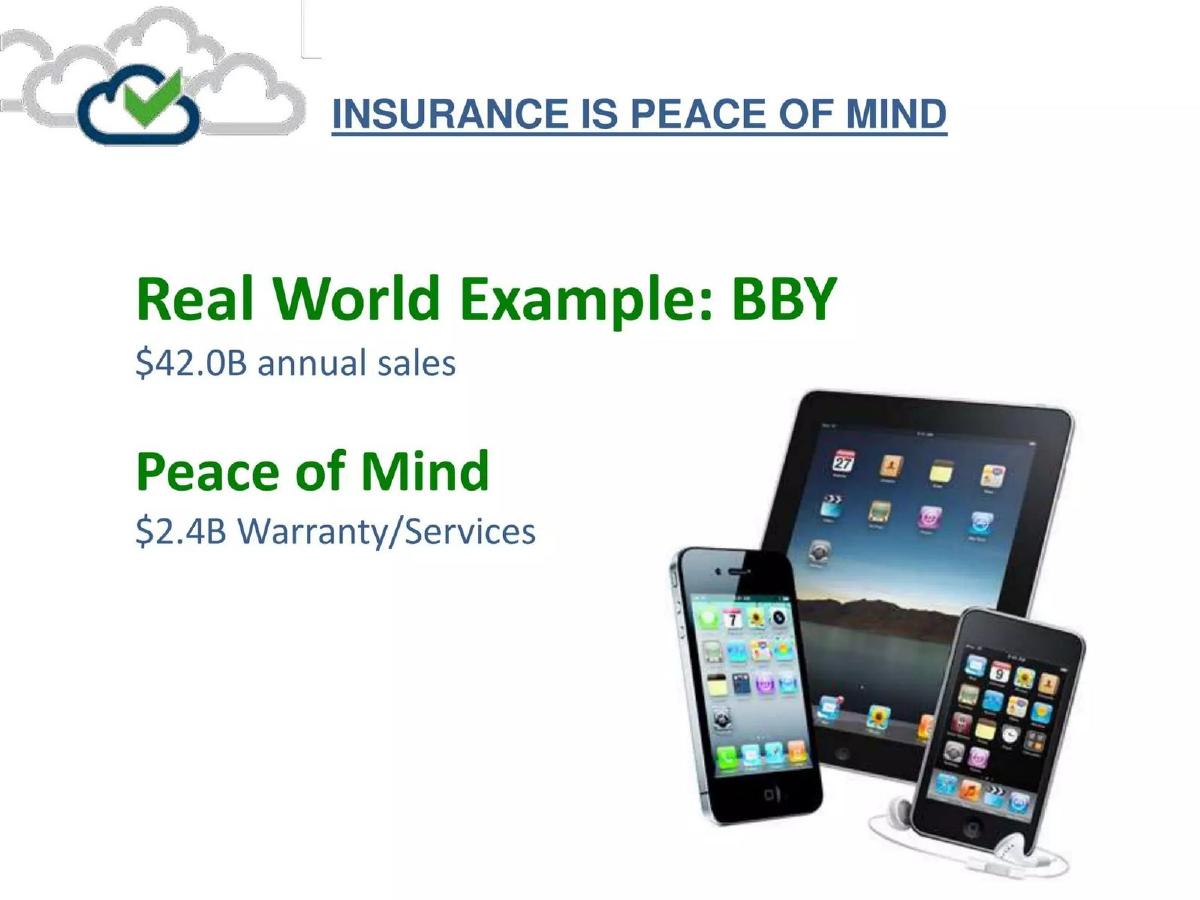
- TrustCloud positions insurance as the ultimate 'Peace of Mind' monetization strategy, citing Best Buy's $2.4B warranty business (Slide 4).
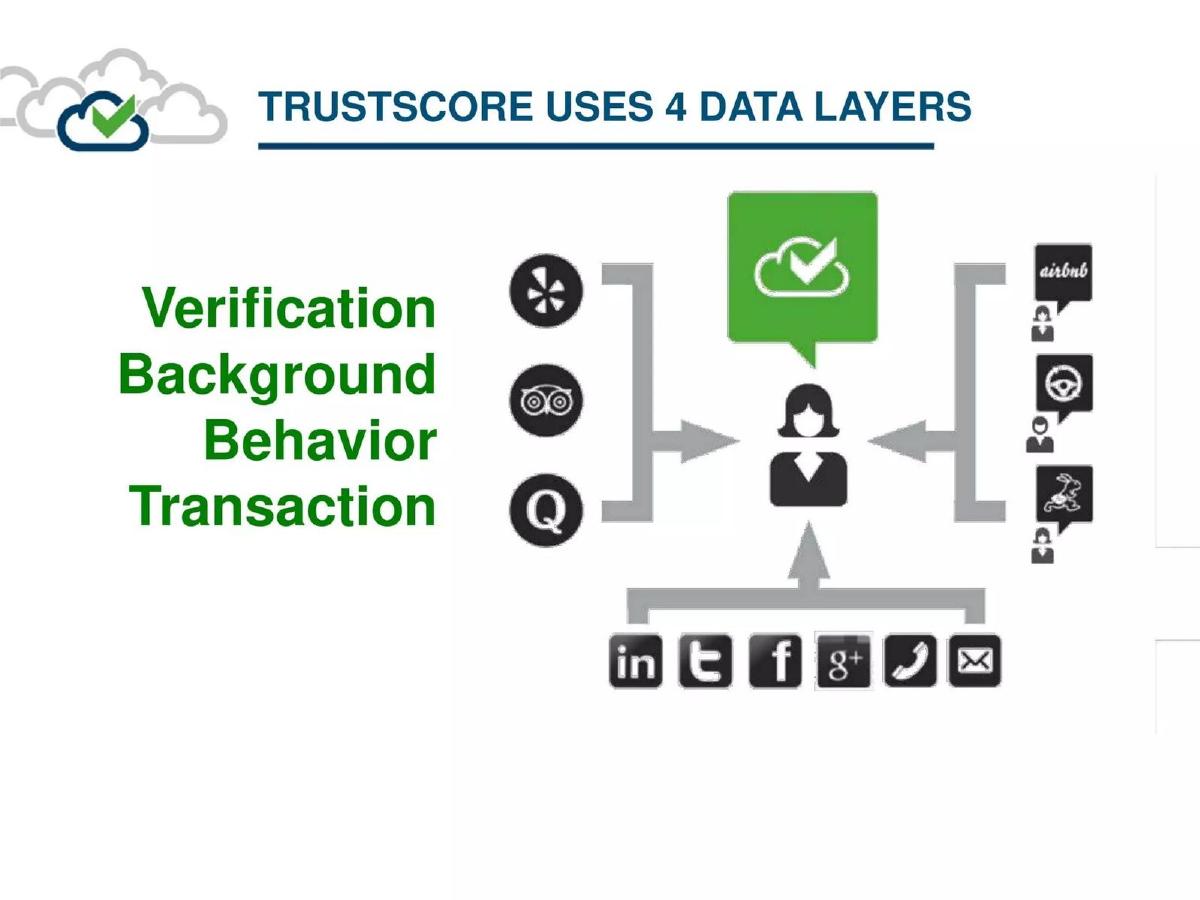
- The product architecture relies on four data layers: Verification, Background, Behavior, and Transaction (Slide 6).
- The TrustScore is designed to be portable across platforms, featuring a numerical score and contextual 'Trust Badges' (Slide 7).
- Early traction includes partnerships with platforms like Rover.com, Doorman, and LendSquare (Slide 8).
- The business model targets $2.0M ARR per 'Tier One' platform, with 15,000 qualified jobs per week as a benchmark (Slide 9).
- The vision is to become the 'FICO for sharing platforms,' acting as a gatekeeper between marketplaces and insurance carriers (Slide 10, 12).
- The founding team highlights 25+ years of experience in warranty, platforms, and data (Slide 11).
Introduction: The Trust Infrastructure of 2009
TrustCloud’s 2009 seed deck arrived at the dawn of the sharing economy. With platforms like Airbnb and TaskRabbit just beginning to scale, the founders identified a critical bottleneck: trust was not portable. If you were a five-star seller on eBay, that reputation didn't help you rent a room or hire a dog walker. This 13-slide deck outlines a plan to build the underlying data layer for interpersonal trust, effectively aiming to become the credit score for the gig economy.
The Problem and Market Context
Slide 1: Title The deck opens with a simple logo and the tagline "Ensuring Trust, Safety & Quality." It includes the contact information for Miles Spencer. The branding is corporate and safe, leaning into the 'cloud' and 'check-mark' imagery to signal reliability.
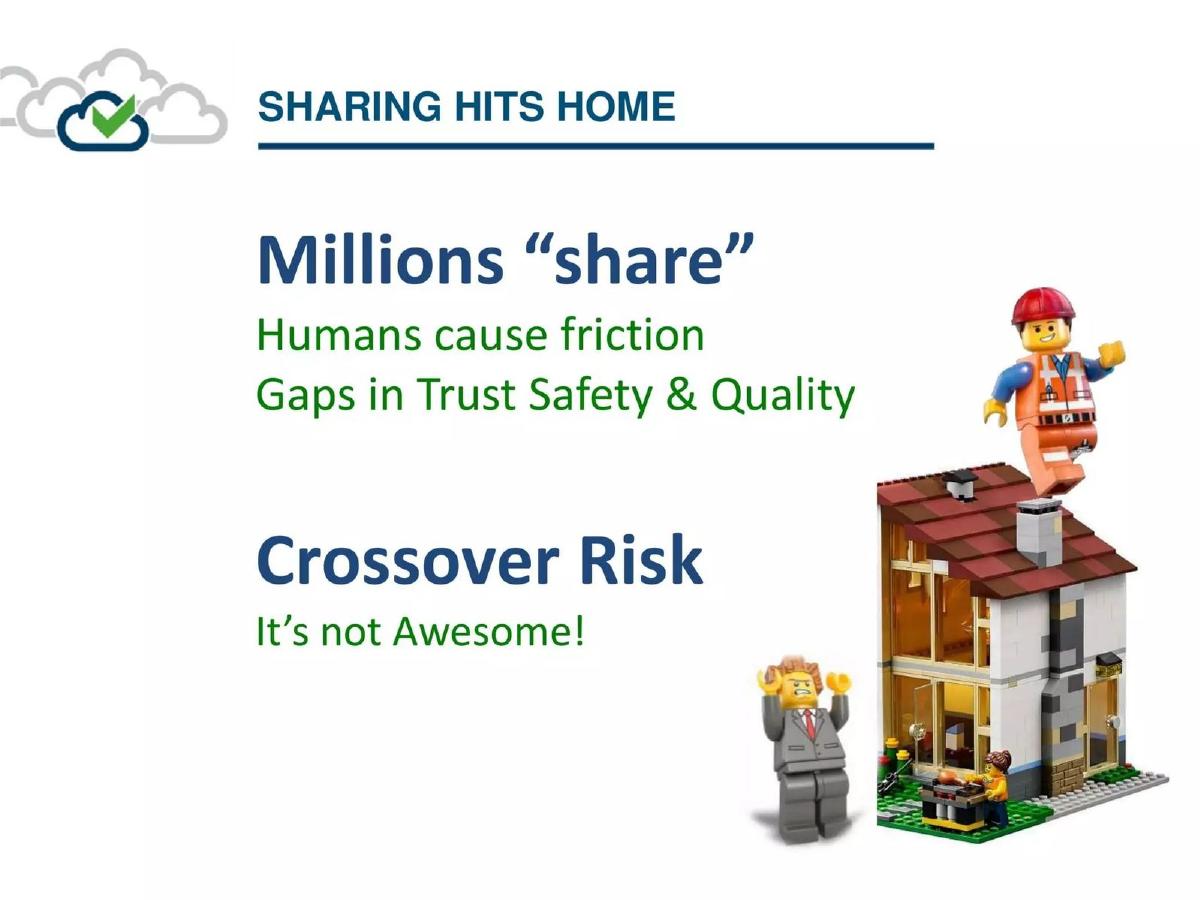
Slide 2: Sharing Hits Home This slide uses Lego imagery to illustrate the friction in the sharing economy. It identifies "Millions 'share'" but notes that "Humans cause friction" and there are "Gaps in Trust Safety & Quality." The term "Crossover Risk" is introduced here, though not fully defined until later. The slide is light on text, relying on the presenter to explain the 'not awesome' nature of current risks.
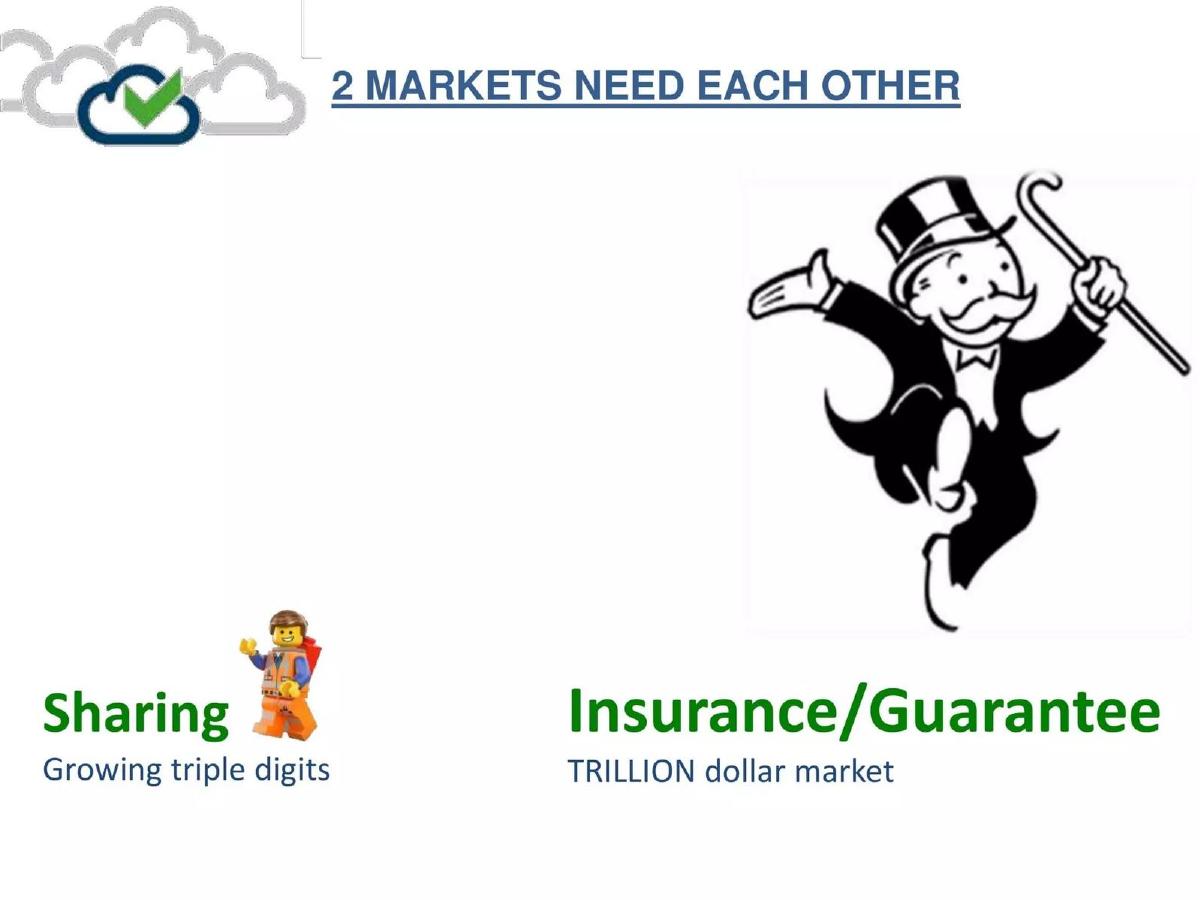
Slide 3: 2 Markets Need Each Other TrustCloud identifies two converging forces: the "Sharing" economy, which they claim is growing at triple digits, and the "Insurance/Guarantee" market, described as a "TRILLION dollar market." The use of the Monopoly Man represents the traditional insurance industry, suggesting a need for a bridge between new-age sharing and old-world financial protection.
The Value Proposition and Product
Slide 4: Insurance is Peace of Mind To justify the business model, the deck uses a "Real World Example" of Best Buy (BBY). It notes $42.0B in annual sales vs. $2.4B in Warranty/Services. The takeaway is that 'Peace of Mind' is a multi-billion dollar sub-sector. By positioning TrustCloud as a provider of this peace of mind, they are framing their service as a high-margin necessity rather than a luxury.
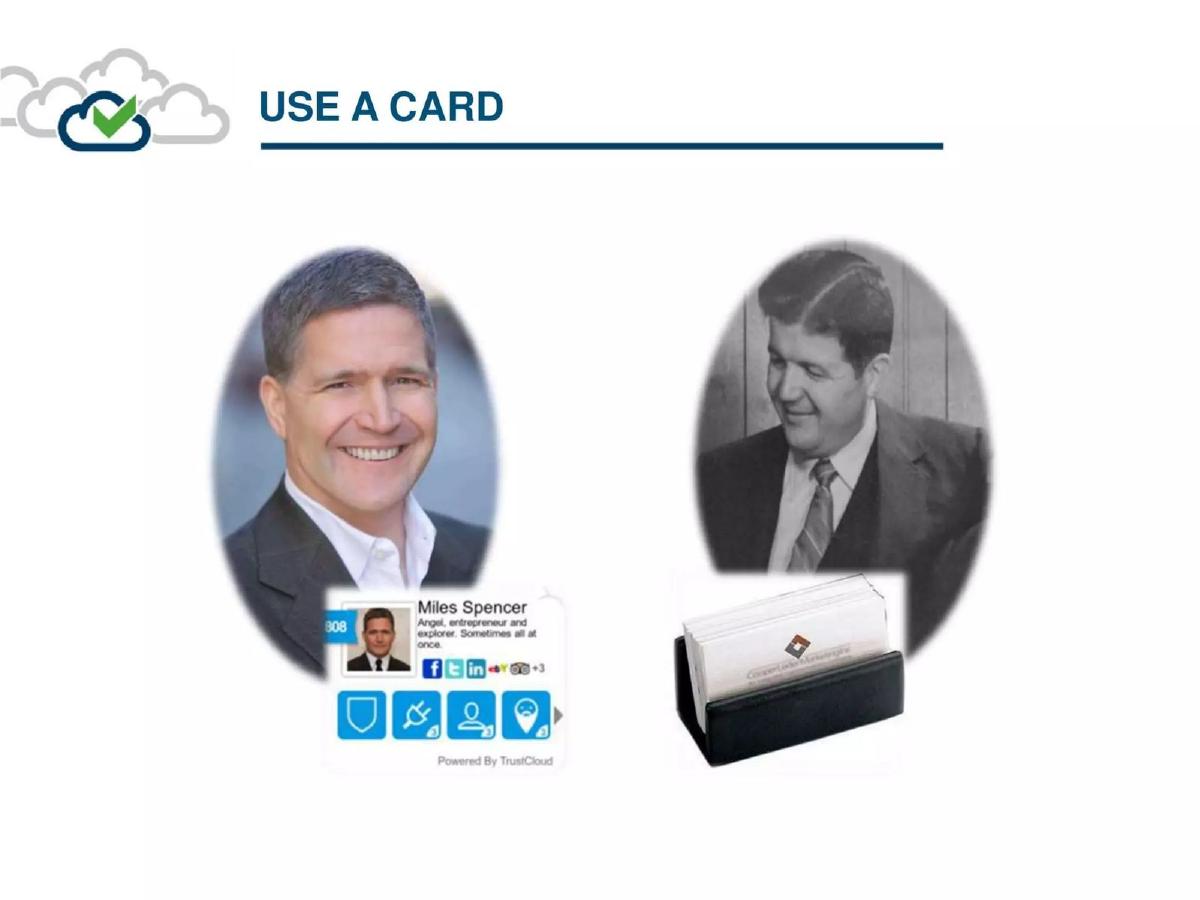
Slide 5: Use a Card This slide contrasts the old way of building trust (physical business cards) with the new way (a digital TrustCard). It shows a profile of Miles Spencer with a numerical score (808) and various social icons. The visual metaphor is clear: the business card is dead; the portable digital profile is the future.
Slide 6: TrustScore Uses 4 Data Layers This is the core technical slide. It outlines the four pillars of their algorithm: Verification , Background , Behavior , and Transaction . It shows data flowing from social networks (LinkedIn, Facebook, Google+), review platforms (Yelp, TripAdvisor), and sharing platforms (Airbnb, eBay) into a central user profile. This establishes the 'portable' nature of their data set.
Slide 7: TrustCard on a Profile This slide provides a UI mockup of the TrustCard. It highlights the "TrustScore" (Universal Virtues), "Verified Sources" (Weighted), and "Trust Badges" (Context). The badges are intended to give "color to baseline score," suggesting that a score alone isn't enough—users need to know why someone is trustworthy in a specific context.
Traction and Business Model
Slide 8: 0-90 Days: Winning Platforms TrustCloud displays logos of early partners, including Rover.com, Doorman, LendSquare, and CareLuLu. They claim to have the "Largest Portable, Independent Dataset" that "Solves crossover risk." This slide is crucial for a seed deck as it proves that platform operators are willing to integrate their technology.
Slide 9: Example: Tier One Platform The deck gets specific about revenue potential here. For a "First Tier One" platform (with an LOI in legal), they project 15,000 qualified jobs per week and $2.0M ARR per platform. This gives investors a unit of value to multiply across the entire market.
Slide 10: Gatekeepers Between Giants This slide visualizes TrustCloud's position in the ecosystem. They sit between marketplaces (Airbnb, Match.com, Angie's List, Home Depot) and the insurance industry (the Monopoly Man). They argue that insurance currently "Eats half the margin" because of data silos. TrustCloud claims their score "Drives partnership with A+ Carrier" and "Unlocks markets."
Team and Vision
Slide 11: Team: Veteran Entrepreneurs The team slide features a photo of three founders in TrustCloud t-shirts. They highlight "25+ years experience" in "Warranty, Platforms & Data." While it lacks specific names of previous successful exits or companies, the 'veteran' label is used to de-risk the investment.
Slide 12: Vision The vision is summarized in one line: "Fico For sharing platforms." By comparing themselves to FICO, they are claiming the most valuable position in a financial ecosystem—the standard by which all participants are measured. The slide repeats the mantra of "Insuring Trust, Safety & Quality."
Slide 13: Closing A repeat of the title slide with contact information.
What Works in the TrustCloud Deck
The deck excels at analogical positioning . By comparing their product to the FICO score and Best Buy’s warranty business, they bypass the need for complex technical explanations and immediately communicate the scale of the opportunity. Investors understand that FICO is a monopoly-like toll booth, and they understand that warranties are high-margin. Mapping TrustCloud onto these existing mental models is a highly effective shortcut.
The data layer visualization on Slide 6 is also a strength. It clearly explains how they solve the 'cold start' problem of trust by aggregating existing social and transactional data. It makes the 'portability' argument visual and easy to grasp.
What is Missing from the TrustCloud Deck
The most glaring omission is the Ask . There is no slide stating how much money the company is looking for, what the valuation expectations are, or how the funds will be allocated. This is a fundamental requirement for a fundraising deck. Without it, the deck feels more like a partnership pitch than an investment opportunity.
Furthermore, the Competitive Landscape is entirely absent. In 2009, other companies were exploring social credit and online reputation (such as Klout or PeerIndex). TrustCloud doesn't explain why their specific 'four-layer' approach is superior to competitors or how they will defend their position once a platform like Airbnb decides to build its own internal reputation system.
Finally, there is a lack of Financial Depth . While Slide 9 mentions $2.0M ARR per platform, there are no projections for total market penetration, burn rate, or path to profitability. The deck relies almost entirely on the 'vision' and 'traction' slides to carry the weight of the investment thesis.
What a Founder Should Copy
Founders should emulate the clarity of the 'Gatekeeper' slide (Slide 10) . It perfectly illustrates where the company sits in the value chain. If you are building a B2B2C or infrastructure product, showing exactly who you sit between—and whose pain you are solving (in this case, the insurance carriers' lack of data and the platforms' margin loss)—is essential.
The use of 'Trust Badges' to provide context (Slide 7) is also a smart product lesson. It shows an understanding that a single number isn't a complete solution for human trust. Acknowledging the nuance of the problem you are solving builds credibility with investors who might otherwise view a 'trust score' as overly simplistic.
Fact Check: The catalogue listing states TrustCloud raised $600,000 in 2009. The deck itself does not mention this figure, nor does it mention the specific 'Seed' stage, though the content is consistent with a seed-stage vision.
Frequently asked questions
- What is the core problem TrustCloud aims to solve?
- TrustCloud addresses 'crossover risk' and friction in the sharing economy. In 2009, trust was siloed; a user's good reputation on eBay didn't help them on Airbnb. TrustCloud aimed to aggregate this data into a single, portable score to ensure safety and quality across all peer-to-peer transactions.
- How does TrustCloud plan to make money?
- The deck suggests a dual approach: platform fees and insurance integration. Slide 9 mentions a target of $2.0M ARR per platform. Slide 10 explains that they act as a gatekeeper for insurance carriers, helping to unlock markets by reducing the risk that typically 'eats half the margin' due to data silos.
- What data sources does the TrustScore use?
- According to Slide 6, the score is built on four layers. It pulls from social and professional networks (LinkedIn, Twitter, Facebook, Google+), review sites (Yelp, TripAdvisor, Quora), and transactional platforms (Airbnb, eBay, TaskRabbit) to create a comprehensive view of a user's virtuous online behavior.
- What is the significance of the Best Buy example in the deck?
- Slide 4 uses Best Buy (BBY) to illustrate the high-margin potential of 'Peace of Mind' services. By showing that Best Buy generates $2.4B in warranty revenue against $42B in sales, TrustCloud argues that trust and guarantees are essential, highly profitable components of large-scale commerce.
- Is there a clear exit strategy or 'Ask' in this deck?
- No. The deck is notably missing a slide detailing how much capital they are raising, the valuation, or the specific milestones they intend to hit with the funds. It also lacks a slide regarding competition or a formal exit strategy, focusing instead on the long-term vision of becoming a 'FICO' equivalent.