Trulieve’s 2022 investor deck presents a mature, vertically integrated cannabis powerhouse transitioning from a regional leader to a national player. With 159 dispensaries and operations across 11 states as of early 2022, the company emphasizes its operational efficiency and financial discipline, boasting 15 consecutive quarters of profitability. The presentation leans heavily on the successful acquisition of Harvest Health & Recreation, which bolstered its presence in the 'cornerstone' market of Arizona. Unlike early-stage startups, Trulieve focuses on debt management—highlighting a $350 mil…
Key takeaways
- The company achieved 15 consecutive quarters of profitability through September 30, 2021, as stated on slide 2.
- Trulieve operates a massive footprint with over 3.5 million square feet of cultivation and processing capacity as of January 4, 2022 (slide 2).
- Arizona is identified as a cornerstone market with 17 retail dispensaries and 320,000 square feet of cultivation (slide 13).
- The acquisition of Harvest Health & Recreation closed on October 1, 2021, significantly expanding the retail footprint (slide 22).
- Financial discipline is demonstrated by the retirement of $270.1 million of high-cost Harvest debt following the acquisition (slide 22).
- The company raised $350 million in senior secured notes at an 8% interest rate due in 2026 (slide 22).
- Product innovation includes specialized forms like TruTonic powdered drink mix and live resin 'Sauz' carts (slide 16).
- The board of directors includes heavyweights from Coca-Cola, Marriott, and Kimberly-Clark, signaling a focus on consumer packaged goods expertise (slide 19).
Executive Summary: A Profitable Titan in a Volatile Industry
The Trulieve January 2022 investor presentation is not a typical startup deck. It is the roadmap of a public company (CSE: TRUL, OTCQX: TCNNF) that has successfully navigated the transition from a Florida-centric medical provider to a national multi-state operator (MSO). The primary narrative of this deck is scale and stability. While many cannabis companies struggled with cash flow during this period, Trulieve used its 15 consecutive quarters of profitability to anchor its expansion story.
Slide 1: Title and Public Listing
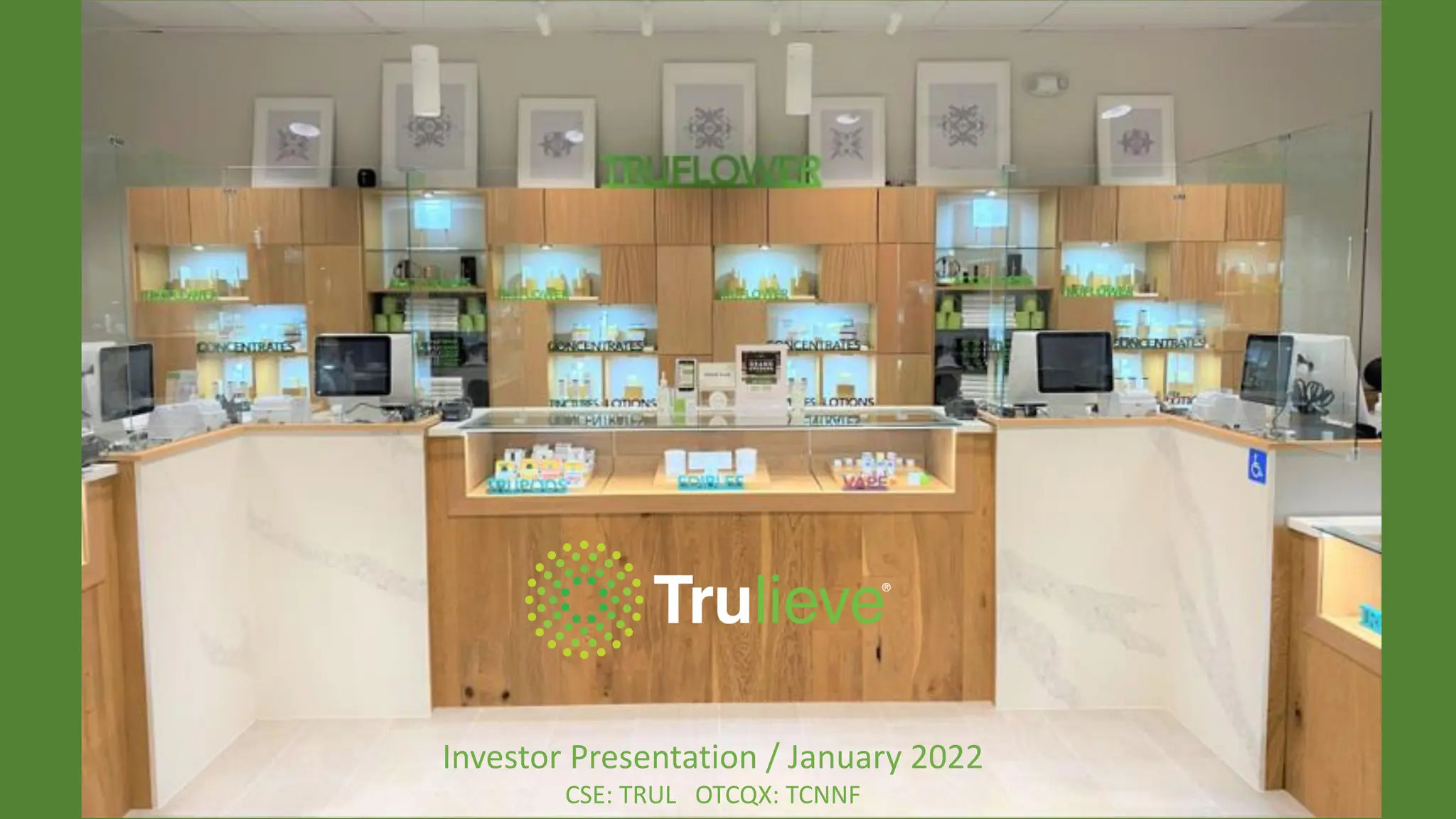
The cover slide establishes the brand's visual identity—clean, professional, and retail-focused. It prominently displays the company's tickers on the CSE and OTCQX, immediately signaling to the reader that this is a public entity subject to rigorous reporting standards. The background image of a modern, high-end dispensary counter reinforces the 'Apple Store of Weed' aesthetic that many successful MSOs strive for.
Slide 2: The Momentum Snapshot
This is the 'hook' slide. It uses a grid layout to present four massive metrics: 159 dispensaries, 11 states, over 3.5 million square feet of cultivation, and the most impressive stat—15 consecutive quarters of profitability. By leading with these figures, Trulieve preemptively answers the most common investor concern in the cannabis space: 'Can you actually make money?' The inclusion of the GA Notice of Intent to Award a Class 1 Production License shows active, ongoing expansion even as the deck was being finalized.
Slide 3: Growth Initiatives
Slide 3 serves as a transition, pairing a retail interior with a cultivation facility. It sets the stage for the 'Growth Initiatives' section. The imagery emphasizes the vertical integration—showing the product where it grows and where it is sold. This visual duality is a recurring theme, reminding investors that Trulieve owns the entire value chain.
Slide 10: The Cornerstone Market Strategy
Trulieve identifies Florida, Pennsylvania, and Arizona as its 'Cornerstone Markets.' The slide outlines why: limited license markets. In the cannabis industry, a limited license market is a moat. It prevents the price compression seen in 'open' markets like Oregon or Colorado. The slide notes 'Future catalysts with adult use expansion,' which is industry shorthand for the massive revenue jump that occurs when a state moves from medical-only to recreational sales.
Slide 13: Deep Dive into Arizona
Following the Harvest acquisition, Arizona became a focal point. This slide details the infrastructure: 17 retail dispensaries and 320,000 square feet of cultivation. It also touches on the regulatory environment, mentioning 13 rural/underserved county licenses and 26 future social equity licenses. This level of detail is intended to show investors that Trulieve doesn't just have a presence; they have a sophisticated understanding of the local regulatory landscape.
Slide 16: Product Innovation and R&D
Cannabis is rapidly moving from a commodity (flower) to a consumer packaged good (CPG). Slide 16 highlights this shift. By listing products like 'TruTonic powdered drink mix,' 'Live Sauz carts,' and 'Diamonds,' Trulieve is demonstrating its ability to capture the high-margin 'concentrates and edibles' segment. They also mention being the 'First to sell clones in MA,' showing a willingness to experiment with different revenue streams like home-grow supplies.
Slide 19: Board of Directors and Governance
The team slide is replaced here by a 'Board of Directors' slide, which is common for mature companies. The pedigree is significant. CEO Kim Rivers is flanked by directors with experience at Coca-Cola, Procter & Gamble, Marriott, and Brown-Forman. This isn't a group of 'cannabis enthusiasts'; it is a group of corporate heavyweights. This slide is designed to build institutional investor confidence in the company's governance and long-term strategic planning.
Slide 22: Recent Developments and M&A
This slide acts as a progress report. The headline is the closing of the Harvest Health & Recreation acquisition on October 1, 2021. More importantly, it highlights financial maneuvers: raising $350 million at 8% (a very competitive rate for cannabis at the time) and retiring $270.1 million of high-cost Harvest debt. This shows the 'Trulieve Effect'—using their superior balance sheet to clean up the financials of acquired companies.
Slide 25: Financial Highlights and Share Structure
The final slide in this selection provides the raw data. It shows cash growing from $147 million in Q4 2020 to $214 million in Q3 2021. It also provides a transparent look at the share count, which is vital for public investors calculating dilution. The 'Pro Forma Estimated Shares' of 134.3 million (as of Sept 30) vs the 180.4 million (as of Nov 8) clearly shows the impact of the Harvest acquisition on the equity structure.
What Trulieve Does Exceptionally Well
Trulieve excels at presenting a 'boring' business in an exciting industry. While other cannabis decks focus on the 'culture' or the 'plant,' Trulieve focuses on the 'process' and the 'profit.' Their emphasis on limited-license markets (Slide 10) is a brilliant strategic signal to investors that they are building a business with high barriers to entry. Furthermore, their ability to articulate the financial benefits of M&A—specifically the debt retirement mentioned on Slide 22—demonstrates a level of financial sophistication that was rare in the 2022 cannabis market.
What is Missing from the Deck
While the deck is comprehensive for a public company, there are notable omissions for a general investor. First, there is very little mention of the competitive landscape. While they mention 'leading market presence,' they do not name specific competitors or provide market share percentages in their cornerstone states. Second, while they mention 'ESG' (Environmental, Social, and Governance) on Slide 22, the deck lacks specific data or goals regarding their environmental impact, which is a major concern in high-intensity indoor cultivation. Finally, the deck does not provide a clear 'Ask' or 'Use of Proceeds' for the $350 million raised, though it is implied to be for debt restructuring and expansion.
Founder's Playbook: What to Copy
Lead with Profitability: If you have it, flaunt it. Slide 2 puts the '15 quarters of profitability' front and center. In a 'growth at all costs' era, this was a massive differentiator. · Visual Verticality: Use imagery to show both the 'factory' and the 'store.' Slides 3 and 13 do this perfectly, reinforcing the idea of supply chain control. · Regulatory Expertise: Don't just say you are in a state; explain the license structure (Slide 13). It shows you understand the 'moat' provided by the government. · CPG Branding: Even if you are a tech company, show your 'product' in a way that looks like a high-end consumer brand. Slide 16 moves away from the plant and toward the packaging. · Debt as a Tool: Don't be afraid to talk about debt. Slide 22 shows how Trulieve used a new, cheaper debt raise to kill off old, expensive debt. This is a sign of a mature management team.
Frequently asked questions
- What is Trulieve's primary market strategy?
- Trulieve focuses on 'limited license' markets, specifically Florida, Pennsylvania, and Arizona. As noted on slide 10, these markets offer leading retail presence and favorable returns on capital. By operating in states where licenses are capped, the company protects its margins and market share from unlimited competition, allowing for more predictable growth and optimization of its vertical operations.
- How does Trulieve handle its cultivation and processing?
- The company is heavily vertically integrated. Slide 2 mentions over 3.5 million square feet of cultivation and processing. In Arizona specifically (slide 13), they utilize a mix of indoor, greenhouse, and outdoor facilities totaling 320,000 square feet. This verticality allows them to control the supply chain from seed to sale, which is critical for maintaining the profitability mentioned on slide 2.
- What was the significance of the Harvest Health & Recreation acquisition?
- The acquisition, which closed in October 2021 (slide 22), was a transformative event. It allowed Trulieve to retire $270.1 million of high-cost debt and expand rapidly into Arizona. It also contributed to the jump in share count from 129.5 million in September to 180.4 million in November 2021, as shown in the financial highlights on slide 25.
- What kind of products does Trulieve manufacture?
- Beyond standard flower, slide 16 highlights 'Innovation Across Product and Consumer Categories.' This includes high-margin derivatives like live resin, live budder, 'diamonds,' and mini pre-rolls. They also focus on minor cannabinoids like CBG and CBN, and branded edibles like TruTonic and Bhang, aiming to capture diverse consumer segments in the cannabis market.
- Who leads Trulieve's corporate governance?
- The company is led by Founder and CEO Kim Rivers, who has a background in law and real estate (slide 19). The board is notably diverse in professional background, featuring directors with executive experience at global brands like Coca-Cola (Giannella Alvarez), Marriott International (Susan Thronson), and Cabela's (Thomas Millner), suggesting a transition toward a CPG-style management approach.