TruckTrack raised $394,600 in 2013 with a remarkably lean 9-slide deck. The presentation avoids the typical clutter of early-stage pitches, opting instead for high-impact visuals and singular data points. The core argument rests on the disparity between a $600 billion annual revenue market and the 'best tools' currently used by operators: Excel and paper. While the deck lacks a formal 'Ask' slide or detailed financial projections, it successfully leverages early traction—88 companies in trial—to validate the product-market fit. The team slide highlights deep domain expertise, specifically not…
Key takeaways
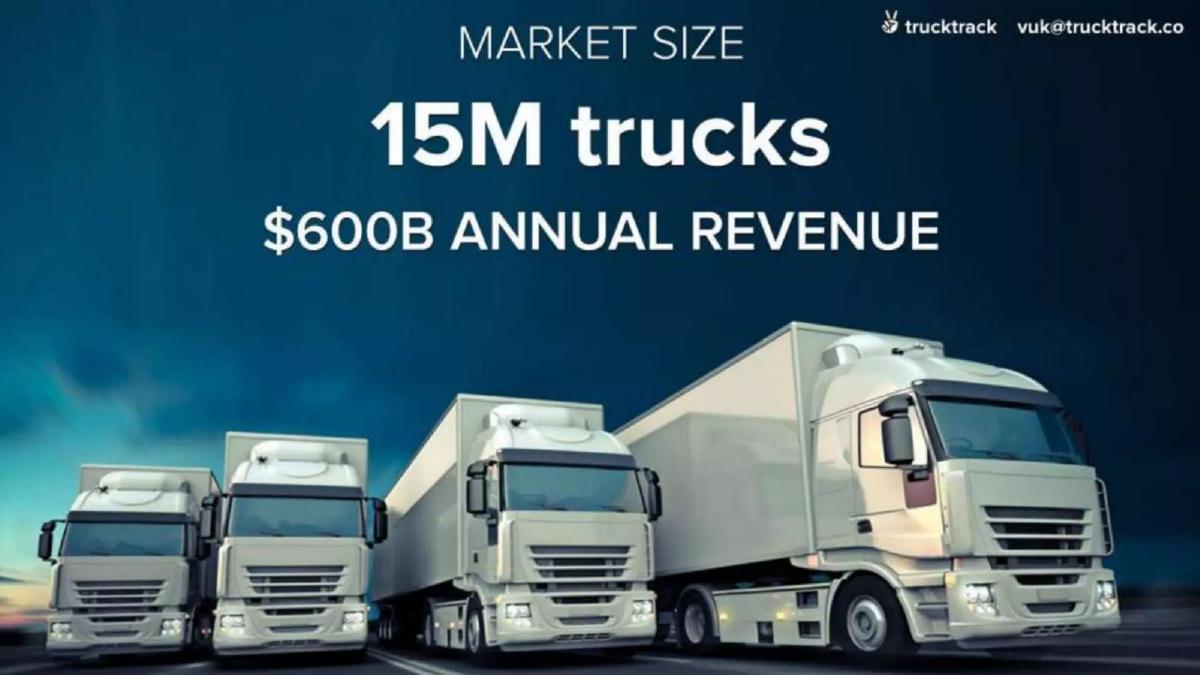
- The deck identifies a massive market opportunity of 15 million trucks and $600 billion in annual revenue on slide 2.
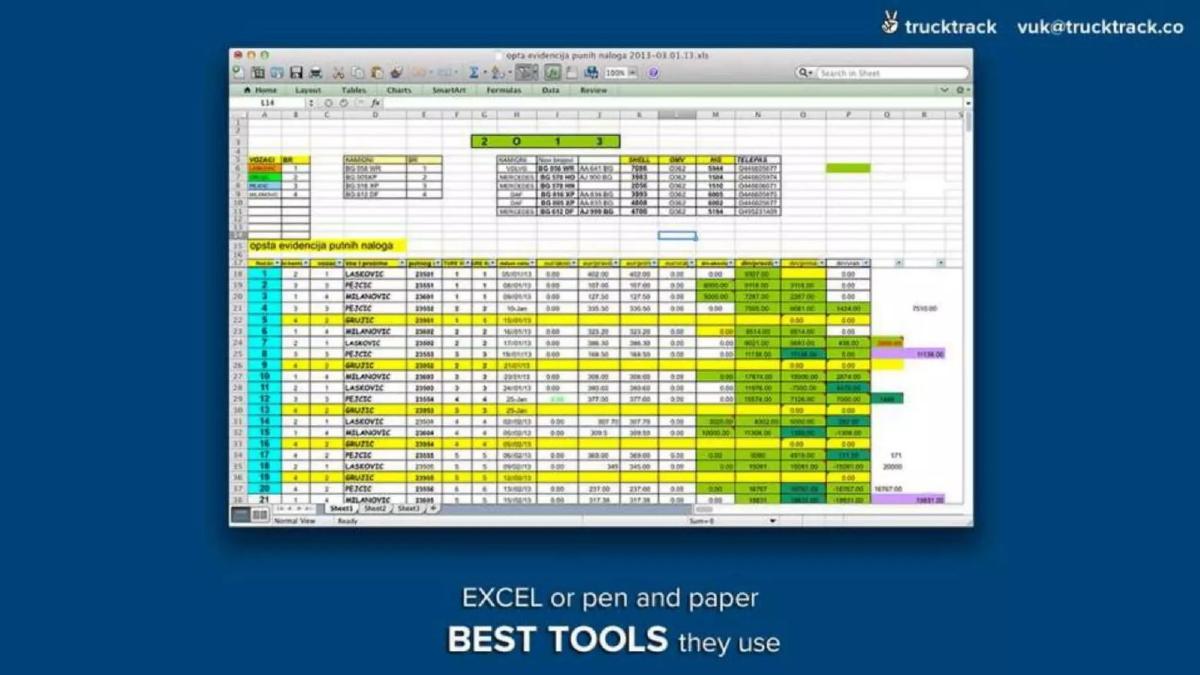
- It highlights the inefficiency of the status quo by showing a complex, manual Excel spreadsheet as the 'best tool' currently in use on slide 3.
- The solution is presented as a dual-platform SaaS: a management dashboard for companies and a mobile app for drivers on slides 5 and 6.
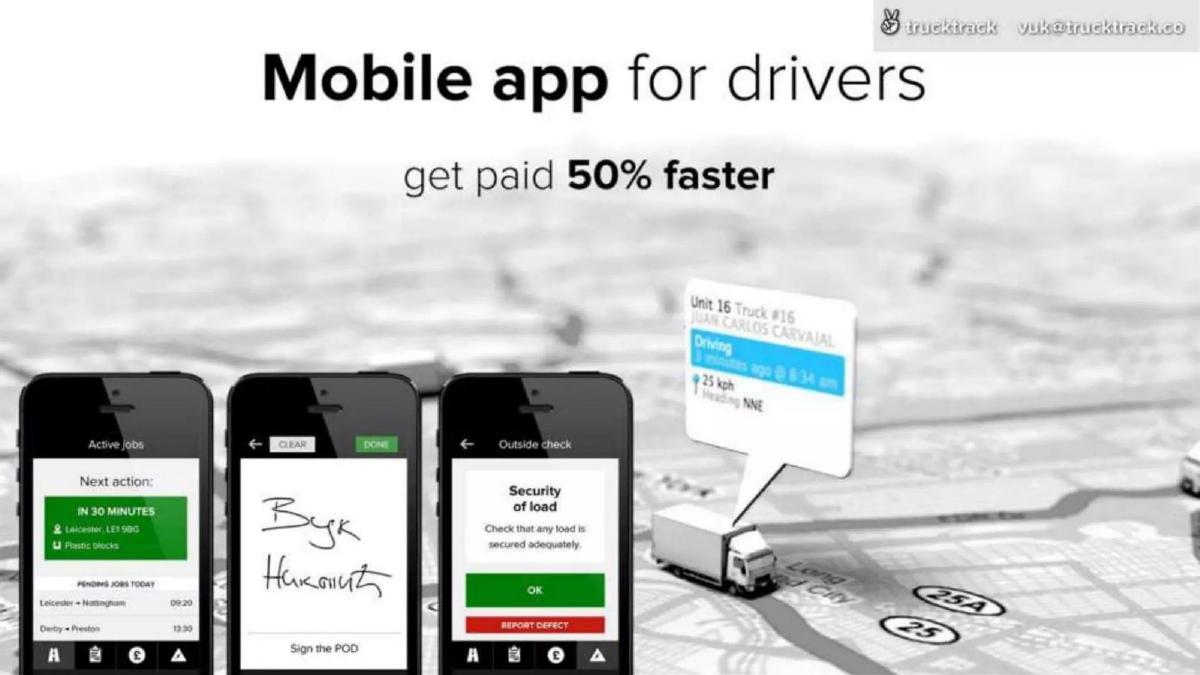
- A specific value proposition is claimed on slide 6: helping drivers get paid 50% faster through the mobile app.
- Traction is quantified as 88 companies and 600 trucks currently in trial on slide 7.
- The team slide (slide 8) emphasizes specialized experience, including a CEO with a trucking background and a developer with 7 years of truck software experience.
- The deck completely omits a business model slide, failing to explain how the SaaS is priced or monetized.
- There is no 'Ask' slide, meaning the specific funding amount and use of proceeds are not disclosed within the presentation itself.
Introduction: The 9-Slide Seed Strategy
TruckTrack’s 2013 pitch deck is an exercise in extreme minimalism. In an era where seed-stage decks often bloat to 20 or 30 slides filled with complex charts, TruckTrack managed to raise $394,600 using just nine slides. The deck follows a classic narrative arc: market size, problem, solution, traction, and team. It avoids the trap of over-explaining technical features, focusing instead on the visceral reality of the industry—trucks, paper logs, and the people behind the wheel.
Slides 1-2: The Hook and the Scale
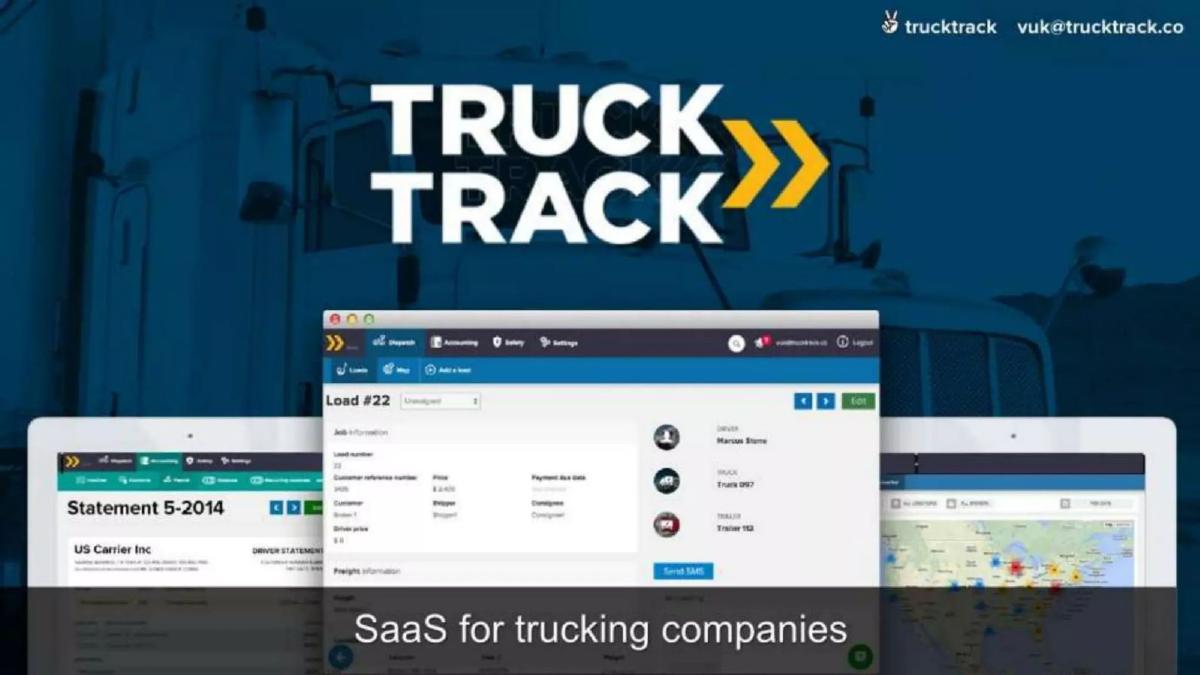
Slide 1 is a simple title slide featuring the TruckTrack logo. The branding is clean, using a dark blue and yellow color palette that evokes industrial reliability. There are no taglines or introductory paragraphs here; the logo does the work.
Slide 2 immediately pivots to the Market Size. It presents two staggering figures: 15M trucks and $600B annual revenue . By placing these numbers over an image of a fleet of white trucks, the founders establish the 'why now' and the 'why care' instantly. They aren't just building an app; they are targeting a massive, high-revenue infrastructure sector. The slide is uncluttered, ensuring the investor focuses entirely on the scale of the opportunity.
Slides 3-4: The Pain Point and the Human Element
Slide 3 is perhaps the most effective in the deck. It shows a screenshot of a chaotic, color-coded Excel spreadsheet titled 'opta evidencija punih naloga 2013.' The caption reads: EXCEL or pen and paper BEST TOOLS they use . This slide identifies the competitor not as another startup, but as the status quo. It highlights the fragility and inefficiency of current operations without needing a single bullet point of text.
Slide 4 provides a human face to the problem. It shows a photo of what appears to be a truck driver or fleet operator in front of a vehicle. This reinforces that this is a real-world industry with real people who are currently underserved by technology. It grounds the digital solution in physical reality, a crucial step for a SaaS product targeting a blue-collar industry.
Slides 5-6: The Product Solution
Slide 5 introduces the product as SaaS for trucking companies . It shows a multi-device mockup (desktop and tablet) featuring the software interface. The UI looks modern for 2013, showing load management, maps, and driver statements. This slide answers the 'what'—a centralized management hub for fleet owners.
Slide 6 focuses on the other side of the equation: the Mobile app for drivers . It makes a bold, quantifiable claim: get paid 50% faster . This is a powerful value proposition. In logistics, cash flow is king. By promising to cut payment times in half through digital proof-of-delivery (shown on the phone screen as 'Sign the POD'), TruckTrack identifies a specific, high-value pain point they can solve.
Slides 7-8: Validation and Execution
Slide 7 covers Traction. It lists 88 companies and 600 trucks as being 'in trial.' While 'in trial' is a weaker metric than 'paid customers,' the volume (88 companies) suggests significant interest and a successful top-of-funnel sales process. The slide also mentions partnerships with trucking associations and driver schools, indicating a multi-channel go-to-market strategy.
Slide 8 introduces The Team. The deck highlights specific credentials that matter for this niche. Vuk (CEO) has a trucking background and has been coding since 6 . Marko (CTO) has 2 startups before and was a lead in big tech . Most importantly, Milos (Fullstack Dev) is listed with 7Y of truck software exp . This specific detail—having a developer who has already spent seven years in this exact niche—is a massive de-risking factor for investors.
Slide 9: The Closing
Slide 9 is the contact slide, featuring the slogan: If you bought it a truck brought it. It provides the CEO's email address. Notably, there is no 'Ask' here. The deck ends on a thematic high note rather than a request for capital, which suggests this version of the deck may have been used for a demo day or a first-look email rather than a final closing meeting.
What Works in This Deck
The primary strength of this deck is its clarity of purpose . It does not try to be everything to everyone. It identifies a specific industry (trucking), a specific problem (manual processes/Excel), and a specific benefit (50% faster payments). The use of high-quality, full-bleed imagery makes the deck feel professional and modern, contrasting sharply with the 'Excel' slide that represents the competition.
The traction slide is also well-executed for a seed round. Even though the users are in trial, the raw number of companies (88) demonstrates that the founders have the 'hustle' required to get their product into the hands of a notoriously difficult-to-reach demographic. Finally, the team slide is excellent because it maps specific past experiences to the current problem. They aren't just 'experienced developers'; they are 'experienced trucking software developers.'
What Is Missing
The most glaring omission is the Business Model . There is no mention of how TruckTrack makes money. Is it per truck, per month? Is there a transaction fee on the faster payments? Investors need to know if this is a $10/month utility or a $1,000/month enterprise platform. Without this, the $600B market size feels disconnected from the actual revenue potential of the startup.
Additionally, there is no Competitive Landscape slide. While they identify Excel as the primary competitor, the logistics tech space was already becoming crowded in 2013. Failing to acknowledge other software players can make a team look naive about the market. Finally, the lack of a Financial Projections or Use of Funds slide leaves the investor wondering what the $394,600 will actually be used for—hiring more devs, sales, or marketing?
What a Founder Should Copy
The 'Status Quo' Slide: Showing a screenshot of the messy Excel sheet your customers currently use is far more effective than a list of bullet points describing 'inefficiency.' · Specific Value Props: Don't just say 'we make things better.' Say 'get paid 50% faster.' Quantifiable benefits stick in an investor's mind. · Niche Experience: If a team member has years of experience in the specific vertical you are attacking, highlight the number of years prominently. It proves you won't spend the first six months of funding just learning the industry jargon. · Visual Brevity: Keep text to a minimum. Use one large headline and one or two key figures per slide. If you can't explain the slide in 10 seconds, it's too complex.
Frequently asked questions
- How much did TruckTrack raise with this deck?
- According to catalogue data from pitchdeckhunt.com, TruckTrack raised $394,600 in a Seed round in 2013. The deck itself does not state the amount raised or the terms of the investment, which is a common omission in decks intended for public presentation or broad distribution.
- What is the primary problem TruckTrack aims to solve?
- The deck argues that the trucking industry is massive but technologically stagnant. Slide 3 shows that the 'best tools' currently used are Excel or pen and paper. This manual process leads to inefficiencies in management and slow payment cycles for drivers, which the software intends to automate.
- What specific metrics does the deck use to show traction?
- On slide 7, the company reports having 88 companies and 600 trucks 'in trial.' It also lists partnerships with trucking associations, driver schools, and freight brokers. However, it does not disclose how many of these trials converted to paid users or what the current Monthly Recurring Revenue (MRR) was at the time.
- Who are the key members of the TruckTrack team?
- The team is led by Vuk (CEO), who has a trucking background and has been coding since age 6, and Marko (CTO), who previously led teams in big tech. Crucially, Milos (Fullstack Dev) is credited with 7 years of truck software experience, providing the domain-specific technical depth needed for this niche.
- What is missing from the TruckTrack pitch deck?
- The deck is missing several standard components: a business model/pricing slide, a competitor analysis, a financial forecast, and a specific 'Ask' slide. It relies heavily on the 'problem/solution' narrative and early trial numbers to carry the pitch without getting into the granular unit economics.