Tromzo’s 17-slide Seed deck from 2021 is a masterclass in narrative-driven fundraising for technical products. By focusing on the inherent conflict between rapid development cycles and slow, manual security processes, the founders established a clear 'why now' for their platform. The deck relies heavily on the founders' deep domain expertise—Harshit Chitalia and Harshil Parikh—and validates the product through high-quality testimonials from CISOs and security leads. While the deck lacks traditional financial metrics, market sizing, or a specific use-of-funds slide, it successfully secured $3M…
Key takeaways
- The deck identifies a specific bottleneck: developers push code in hours, but manual security processes take weeks or months (Slides 5 and 7).
- Tromzo positions itself as a 'Developer 1st' platform, emphasizing self-service security rather than a top-down enforcement model (Slide 3).
- The product architecture slide shows deep integration with 15+ industry-standard tools including Snyk, GitHub, and AWS (Slide 9).
- Founder pedigree is a central pillar, highlighting leadership roles at Medallia and Juniper Networks (Slide 13).
- Social proof is provided by four detailed testimonials from leaders at NextRoll, Druva, and Acoustic (Slide 15).
- The deck contains zero financial data, revenue figures, or growth metrics, suggesting a pre-revenue or very early-stage raise.
- There is no competition slide, leaving the investor to infer how Tromzo differs from the security tools it integrates with.
- The 'Ask' is entirely omitted from the slides, though catalogue data confirms a $3M raise.
The Narrative: Bridging the Gap Between Speed and Security
Tromzo’s 2021 Seed deck is built around a single, powerful tension: the speed of modern software development versus the sluggishness of legacy security. In the cybersecurity world, this is a well-known pain point, and the founders use the first half of the deck to illustrate this 'friction' before introducing their solution. The deck is visually clean, using a consistent color palette of deep purple, red, and yellow, which helps maintain a professional, high-tech aesthetic throughout the 17 slides.
Slides 1-3: The Mission and Vision
Slide 1 is a standard title card, identifying Tromzo as a 'Dev 1st AppSec Management Platform' in 2021. The use of 'Dev 1st' is a strategic choice, signaling that the product is designed for the people writing the code, not just the people auditing it.
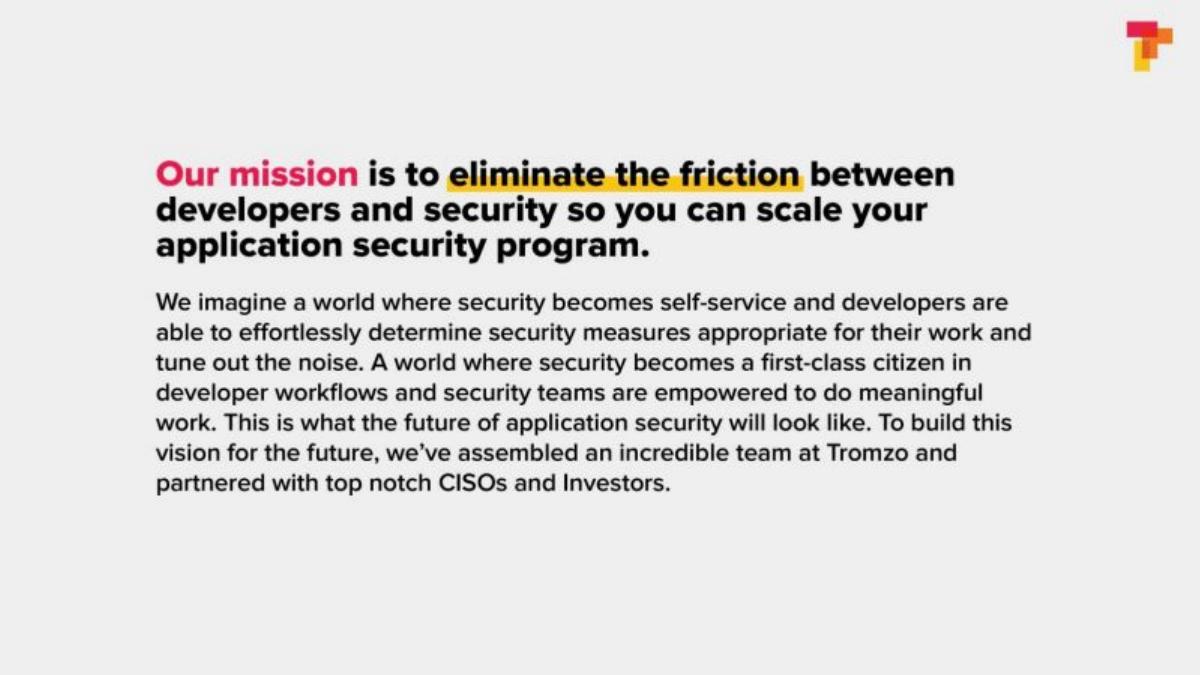
Slide 2 is a transition slide simply titled 'Our mission.' This leads into Slide 3 , which explicitly states: 'Our mission is to eliminate the friction between developers and security so you can scale your application security program.' The text on this slide paints a picture of a 'self-service' future where security is a 'first-class citizen' in developer workflows. This is a high-level vision slide meant to align the investor with the founders' worldview before getting into the technical weeds.
Slides 4-7: Defining the Problem Space
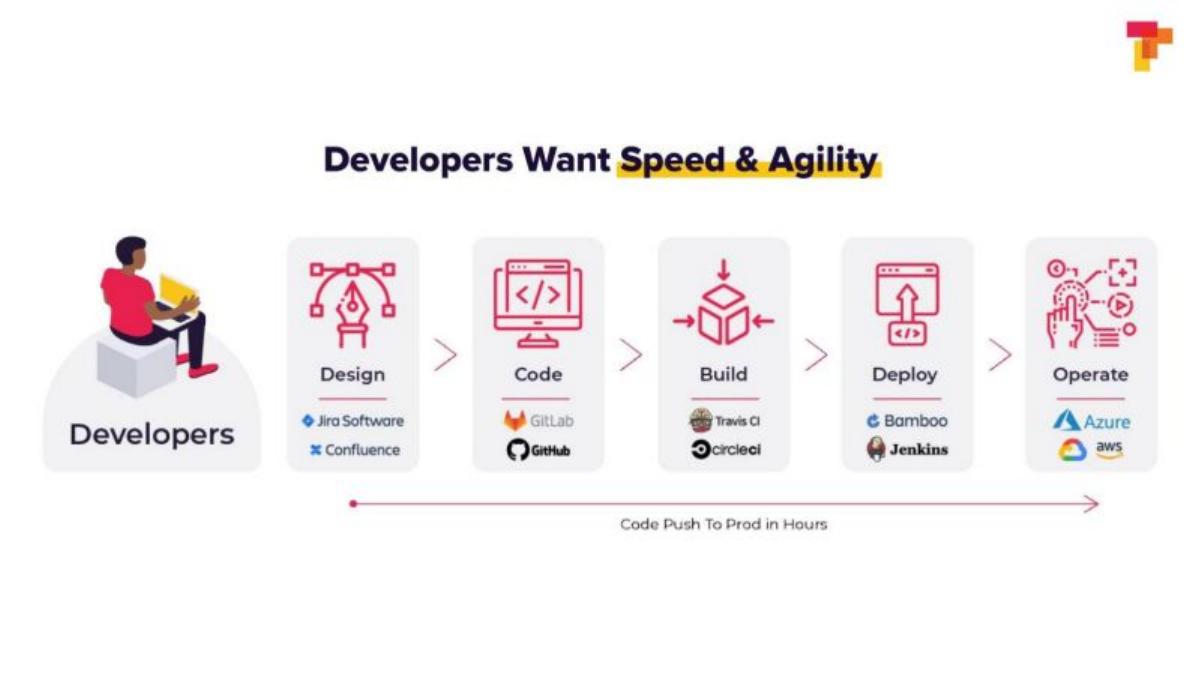
Slide 4 introduces the 'Modern Software Pipeline.' This is followed by Slide 5 , which uses a linear graphic to show the developer workflow: Design, Code, Build, Deploy, and Operate. A red arrow at the bottom notes that 'Code Push To Prod' happens in 'Hours.' This establishes the baseline for modern development speed.
Slide 6 transitions to 'Legacy Application Security,' and Slide 7 provides the counter-narrative to Slide 5. It shows the security process: Design Reviews, Scan & Test, Prioritize, Remediation Decisions, and Action. Crucially, the red arrow at the bottom of this slide states that 'Manual Security Processes' take 'Weeks / Months.' By placing these two timelines in direct opposition, the founders clearly define the 'bottleneck' they intend to solve. They label this state as 'Too Late, Too Much Noise,' noting that developers cannot remediate under these conditions.
Slides 8-11: The Tromzo Solution
Slide 8 transitions to the product reveal. Slide 9 is the most technical slide in the deck, showing the 'Developer 1st Application Security Management Platform' architecture. It illustrates how Tromzo sits in the middle of three ecosystems: Security Tools (Snyk, Aqua, Tenable, etc.), DevOps Tools (GitHub, GitLab, Jenkins), and Cloud Platforms (AWS, GCP, Azure). The internal components of Tromzo are listed as an Analytics Engine, No Code Automation, Prioritization Engine, and Notification Engine. The output of this system is 'Comprehensive Visibility,' 'Automated Remediation Campaigns,' 'Actionable Alerts,' and 'Dashboards/KPIs.'
Slide 10 is a transition slide for 'Scaling AppSec With Tromzo.' Slide 11 breaks down the value proposition into three pillars: Total Visibility, Continuous Security, and Workflow Automation. It also segments the benefits by persona: Security (automating testing), Compliance (real-time audits), and Developer (fixing bugs before production). This slide is effective because it shows that the platform provides value to multiple stakeholders within an enterprise, increasing the likelihood of a successful 'land and expand' sales strategy.
Slides 12-15: Team and Validation
Slide 12 transitions to 'Who we are.' Slide 13 introduces the founders, Harshit Chitalia and Harshil Parikh. The text highlights their specific 'earned secret': Harshil led security at Medallia, and Harshit led engineering at Juniper Networks. This slide is critical for a Seed round; it proves the founders have lived the problem they are solving. The text notes they joined forces in 'early 2021,' making this a very fresh venture at the time of the deck's creation.
Slide 14 transitions to 'What Our Customers Say.' Slide 15 is a heavy-hitting social proof slide. It features four testimonials from high-ranking security professionals. Nico Valcarcel (Product Security Lead, NextRoll) and Ralph Pyne (VP of Security, NextRoll) provide a strong endorsement from a single organization, while Allan Swanepoel (Druva) and Steve Dotson (Acoustic) provide broader market validation. The quotes are specific, mentioning 'automated triaging' and 'single source of truth,' which reinforces the product claims made earlier in the deck.
Slides 16-17: Closing
Slide 16 is a simple closing slide with the Tromzo logo. Slide 17 is an external promotional slide for the source of the deck and is not part of the company's original presentation.
What Tromzo Does Well
Clear Conflict: The comparison between the 'Hours' of development (Slide 5) and the 'Months' of security (Slide 7) is a perfect way to visualize a complex enterprise problem. · Founder-Market Fit: The team slide (Slide 13) doesn't just list titles; it explains the specific frustrations the founders faced in their previous roles, which led to the creation of Tromzo. · Integrations as a Feature: By showing logos of established tools like Snyk and AWS on Slide 9, Tromzo positions itself as a 'force multiplier' that works with an existing stack rather than a 'rip and replace' solution that would face higher sales resistance. · Persona-Based Value: Slide 11 correctly identifies that a security tool needs to win over developers and compliance officers, not just the CISO.
What is Missing from the Tromzo Deck
The Ask: There is no slide indicating how much money is being raised, the valuation, or the milestones the founders intend to hit with the capital. While we know from catalogue data they raised $3M, this information is absent from the deck. · Market Size: There is no mention of the Total Addressable Market (TAM). Investors usually want to see that the problem being solved is part of a multi-billion dollar opportunity. · Competition: The deck ignores the competitive landscape. In 2021, the AppSec Orchestration and Correlation (ASOC) market was becoming crowded, and failing to mention how Tromzo differs from competitors is a notable omission. · Business Model: There is no information on how Tromzo makes money. Is it per-developer, per-repository, or a flat enterprise fee? · GTM Strategy: The deck explains what the product is but not how they will sell it. There is no mention of a sales pipeline, partnership strategy, or marketing plan.
What Other Founders Should Copy
The 'Why Now' Visual: Use the linear timeline comparison found on Slides 5 and 7. It is the most effective way to show that a legacy process is broken in the context of modern speeds. · High-Quality Testimonials: If you are in a technical B2B space, generic 'this is great' quotes are useless. Copy Tromzo’s approach on Slide 15: use quotes that mention specific features (triaging, visibility, friction reduction) and include the full name, title, and company of the person giving the quote. · The Hub-and-Spoke Architecture: Slide 9 is a great template for any 'middleware' or 'orchestration' startup. Showing exactly where you sit in the existing ecosystem helps investors understand your technical moat and your integration requirements.
Frequently asked questions
- What is the primary problem Tromzo aims to solve?
- Tromzo addresses the friction between developers and security teams. According to slides 5 and 7, modern developers push code to production in hours, while legacy application security processes are manual and take weeks or months. This creates a bottleneck where security is seen as a 'noise' generator that developers cannot easily remediate.
- How does Tromzo describe its product functionality?
- The platform is described as an 'AppSec Management Platform' that provides total visibility, continuous security, and workflow automation. Slide 9 details a technical architecture including an Analytics Engine, No Code Automation, and a Prioritization Engine. It acts as a central hub that ingests data from security tools, DevOps tools, and cloud platforms to produce actionable alerts and automated remediation campaigns.
- Who are the founders and what is their background?
- The company was founded by Harshit Chitalia and Harshil Parikh in early 2021. Harshil previously led security for Medallia, and Harshit led engineering at Juniper Networks. Their combined experience in scaling security programs and managing engineering teams is presented as the core reason they are equipped to solve the developer-security gap (Slide 13).
- What evidence of market validation is included in the deck?
- Validation is provided through qualitative testimonials rather than quantitative metrics. Slide 15 features quotes from four industry professionals: Nico Valcarcel (NextRoll), Allan Swanepoel (Druva), Steve Dotson (Acoustic), and Ralph Pyne (NextRoll). These testimonials emphasize the platform's ability to provide visibility, automate triaging, and reduce friction between teams.
- What key fundraising elements are missing from this deck?
- The deck is missing several standard slides: there is no market size (TAM/SAM/SOM) analysis, no competitive landscape or 'magic quadrant' comparison, no business model or pricing information, and no financial projections. Most notably, there is no 'The Ask' slide detailing how much capital is being raised or how it will be spent.