FleetDM’s 2022 pitch deck is a masterclass in positioning a startup within an established category by leveraging open-source momentum. By building on Osquery, FleetDM avoids the 'yet another agent' problem and instead offers a 'standard way of talking to any device with SQL.' The deck focuses heavily on the technical evolution of the product—moving from a management server to a comprehensive compliance and vulnerability scanner. While the deck is light on traditional financial metrics, it uses social proof from engineers at Square and Uber to validate its 'legendary user experience.' The narr…
Key takeaways
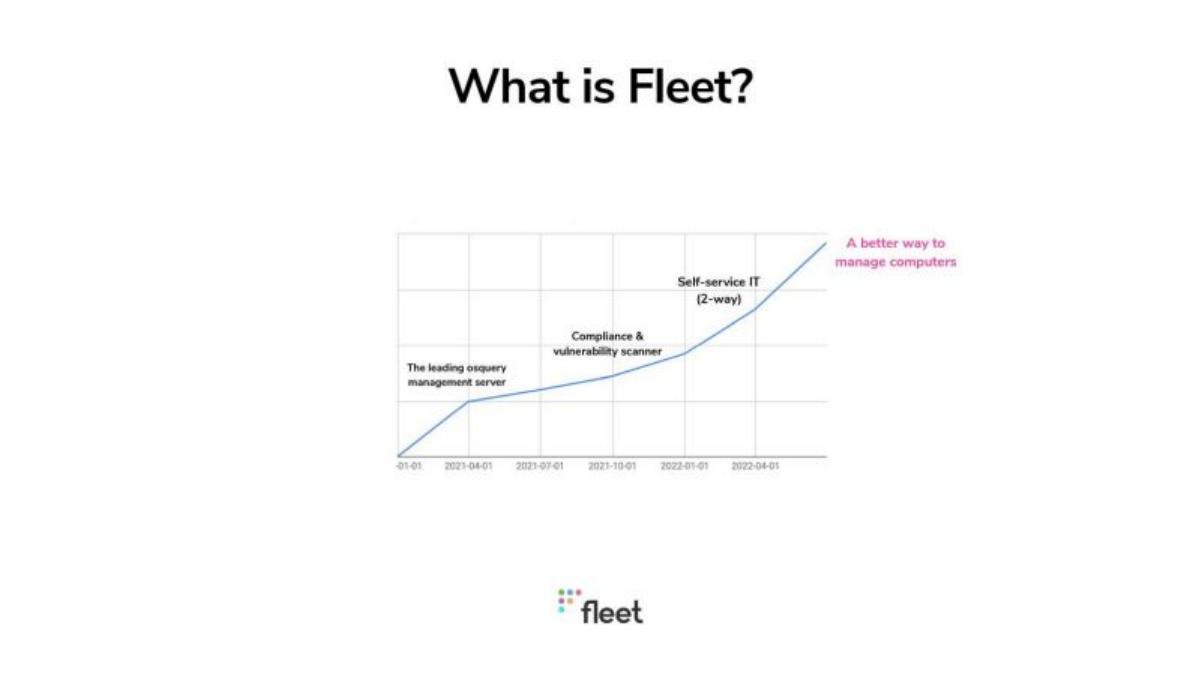
- The company positions itself as the 'leading osquery management server' as of early 2021 on slide 2.
- FleetDM defines the future of device management as 'Open, Programmable, Cross-platform, and Universal' on slide 4.
- The product roadmap on slide 6 emphasizes 'Self-service, 2-way IT' and '80% of the most common policies' in a standard library.
- The deck outlines a clear valuation trajectory, targeting a $1B valuation by 2024 on slide 8.
- Social proof is a core pillar, featuring testimonials from Staff Software Engineers at Uber and Square on slide 11.
- The 'More than MDM' thesis on slide 5 argues for an 'ultimate source of truth' that goes beyond traditional Apple and Windows management.
- The deck explicitly mentions integration with AWS, GCP, and Azure to simplify deployment for non-SREs on slide 6.
- FleetDM utilizes a 'Seed' to 'Series B' growth visualization using plant emojis to signal stage progression on slide 8.
The Narrative: From Management Server to Programmable Infrastructure
FleetDM’s pitch deck is built around the transition of a technical tool into an enterprise platform. The narrative begins by anchoring the company in the open-source ecosystem, specifically Osquery, and then expands the scope to encompass the entire security and IT operations stack. It is a 'bottom-up' story where technical excellence and developer love (the 'legendary user experience') serve as the foundation for a billion-dollar enterprise vision.
Slide 1: The Vision and the Standard
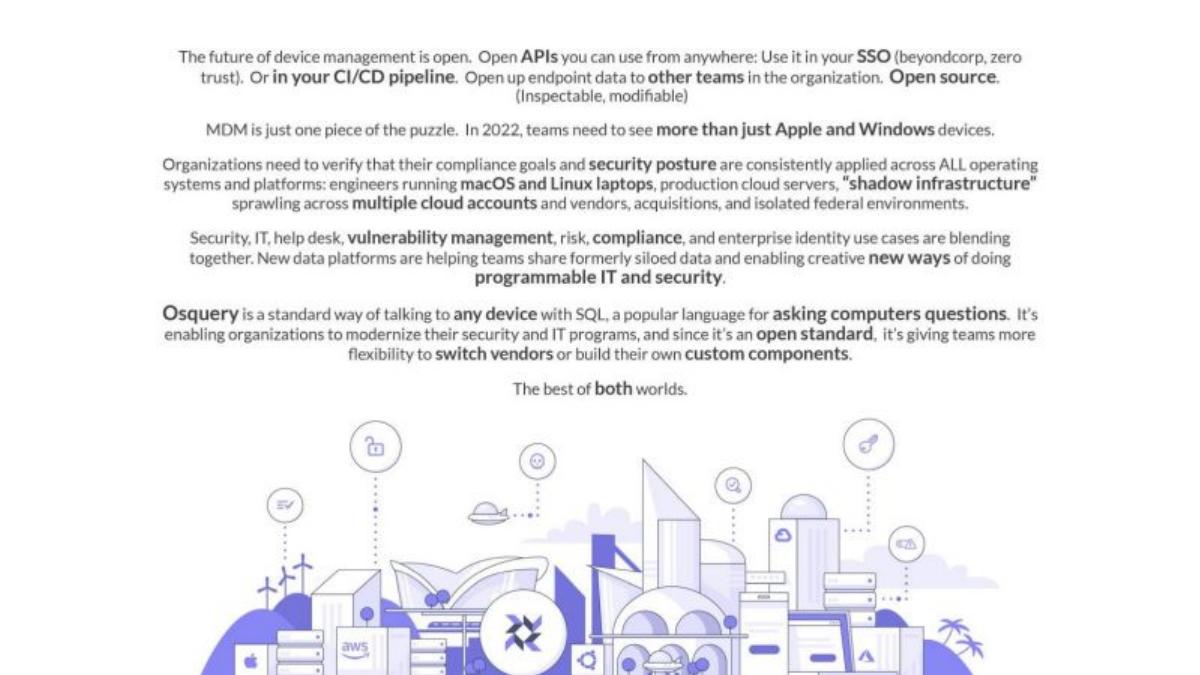
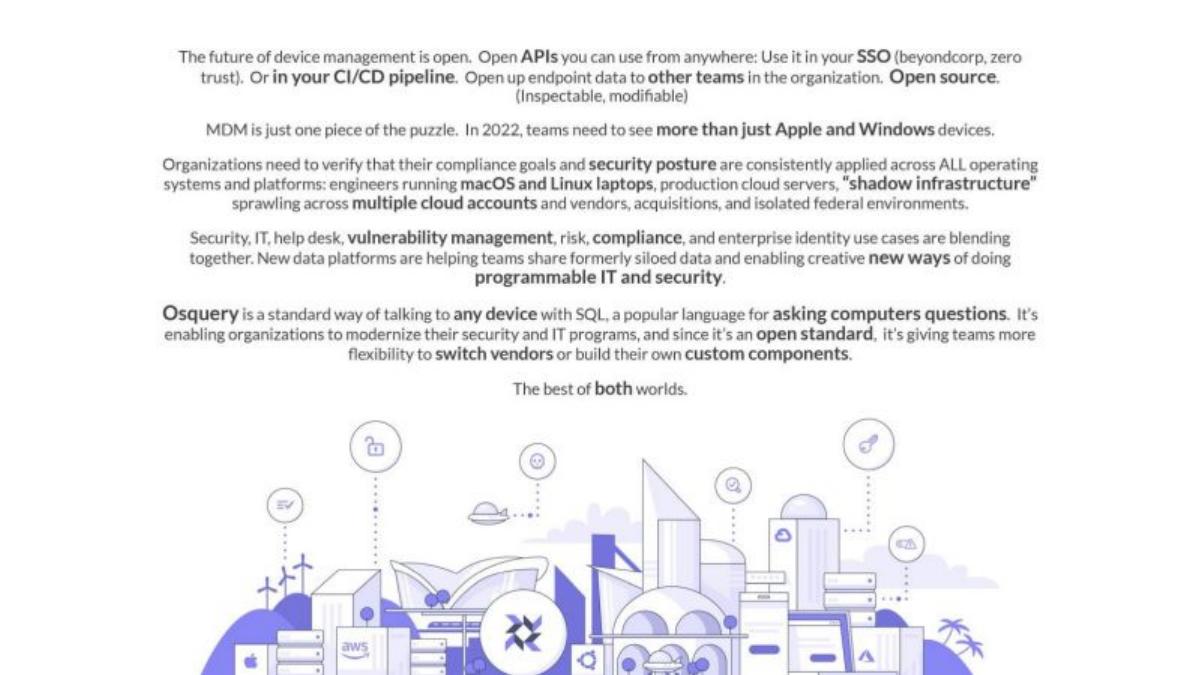
The opening slide sets a dense but clear stage. It defines the 'future of device management' as open. Key technical pillars are established immediately: Open APIs , CI/CD pipeline integration , and Open source . The slide introduces Osquery as the 'standard way of talking to any device with SQL.' This is a strategic move; by aligning with an open standard, FleetDM positions itself as a facilitator of a movement rather than just a vendor of a proprietary tool. It mentions the need to see 'more than just Apple and Windows devices,' specifically calling out macOS and Linux laptops alongside production cloud servers and 'shadow infrastructure.'
Slide 2: What is Fleet?
Slide 2 uses a growth chart to define the company’s evolution. It shows a timeline starting in early 2021 where Fleet is 'The leading osquery management server.' By late 2021, it evolves into a 'Compliance & vulnerability scanner.' By early 2022, it reaches 'Self-service IT (2-way).' The terminal point of the graph is labeled 'A better way to manage computers.' This slide is critical because it shows the investors that FleetDM is not a static product but a rapidly expanding platform that is moving up the value chain from a simple server to a comprehensive IT solution.
Slide 3 & 4: The 'Bigger than MDM' Thesis
These slides serve as the 'Why Now' and 'Market Shift' components of the deck. Slide 3 contains a single bold statement: 'The future of device management is bigger than MDM .' Slide 4 expands on this with four keywords: Open, Programmable, Cross platform, and Universal . This is a direct challenge to incumbent Mobile Device Management (MDM) players who are often perceived as closed, platform-specific (e.g., Jamf for Apple), and difficult to automate. FleetDM is positioning itself as the modern, developer-centric alternative.
Slide 5 & 6: Defining the Modern Standard
Slide 5 outlines what 'More than MDM' means today: cross-platform universality, ease of use as the 'ultimate source of truth,' and a 'who's watching the watchers' security philosophy. Slide 6 gets into the tactical details for Q1 2022. It lists 'Self-service, 2-way IT' via Fleet Desktop and 'Scope transparency.' It also makes a strong claim about ease of use, stating they provide '80% of the most common policies that any org needs' in a standard library. Notably, it mentions 'Boring solutions to deploy to AWS, GCP, Azure,' signaling that they are prioritizing reliability and ease of deployment for teams without dedicated Site Reliability Engineers (SREs).
Slide 7 & 8: The Roadmap to a Billion Dollars
Slide 7 uses a simple emoji-based progress bar to show 'you are here,' positioned at the 'potted plant' stage. Slide 8 translates these emojis into a financial and fundraising roadmap. It lists 2020 as 'Sid' (likely referring to a pre-seed or founder-led stage), 2021 as 'Seed,' 2022 as 'Series A,' 2023 as 'Series B,' and 2024 as the '$1B valuation, and beyond' milestone. This provides a clear, aggressive timeline for investors, showing exactly where the company expects to be in the next three years.
Slide 9: The Revenue Question
Slide 9 is a transition slide featuring a redacted ARR figure. It asks the question 'How?' beneath the revenue number. This indicates that the following slides are intended to explain the drivers behind their financial growth. Even with the number redacted in public versions, the presence of this slide shows that the company is focused on ARR as its primary metric for success.
Slide 10 & 11: Legendary User Experience
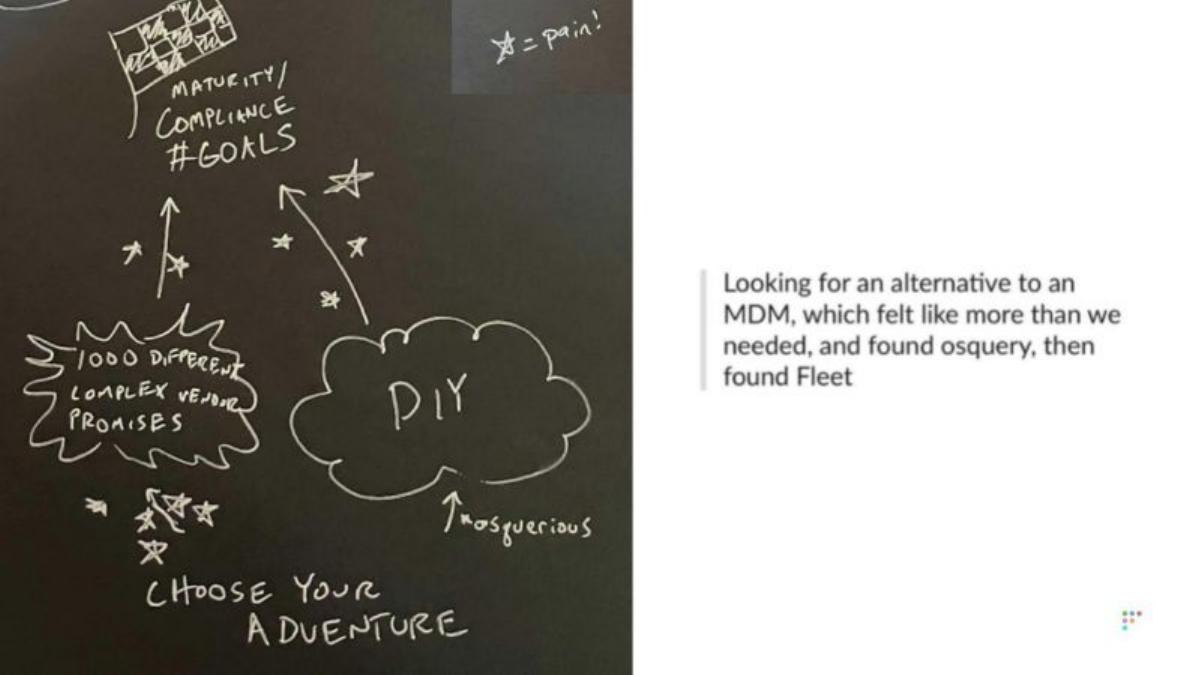
To answer the 'How?' from the previous slide, FleetDM points to its users. Slide 10 shows a Slack-style message from a user praising the 'fleetctl preview' as 'smooth, simple and quite frankly, sexy.' Slide 11 provides high-signal social proof with testimonials from Wesley Whetstone (CPE @Square) and Erik Gomez (Staff Software Engineer @Uber) . Whetstone notes the ease of making a deploy package, while Gomez highlights the team's responsiveness to feedback. For a Seed-stage company, having named endorsements from engineers at Square and Uber is a powerful indicator of product-market fit within sophisticated tech organizations.
Slide 12: Core Use Cases
The final content slide summarizes the functional value of the platform using emojis and concise bullet points: Maintain secure laptops and servers , Keep an accurate inventory , Respond to incidents quickly , Automate security workflows , Meet compliance goals , and Self-service IT . This acts as a summary of the 'Jobs to be Done' that FleetDM addresses for its customers.
What Works in the FleetDM Deck
1. Strong Category Positioning: The deck does an excellent job of taking an existing, somewhat 'unsexy' category (MDM) and reframing it as a modern, programmable infrastructure problem. By saying the future is 'bigger than MDM,' they aren't just competing; they are evolving the category.
2. High-Quality Social Proof: Testimonials from engineers at Square and Uber are worth more than a dozen generic 'customer logos.' It demonstrates that the people actually using the tool—the engineers—love it, which is the hallmark of a successful bottom-up SaaS motion.
3. Clarity of Product Evolution: Slide 2 is a very effective way to show how a product grows. It moves from a specific technical utility (Osquery management) to a broad business value (Better way to manage computers), giving investors a roadmap for how the TAM (Total Addressable Market) expands over time.
What Is Missing from the FleetDM Deck
1. Team Slide: In the 13 slides provided, there is no dedicated team slide. While the testimonials mention 'Mike & Zach,' the deck does not explicitly detail the founders' backgrounds, previous successes, or technical expertise. For a Seed round, the team is usually the most important factor.
2. Detailed Financials/Unit Economics: Aside from the redacted ARR slide, there is no mention of churn, CAC (Customer Acquisition Cost), LTV (Lifetime Value), or sales cycles. While common in early Seed decks, a company targeting a $1B valuation by 2024 should ideally show the underlying efficiency of its growth.
3. Competitive Landscape: The deck mentions MDM generally but does not name specific competitors like Jamf, Kandji, or Tanium. A slide showing how FleetDM specifically wins against these incumbents on features or price would strengthen the case for displacement.
4. The 'Ask': There is no slide detailing how much money is being raised in this specific round or how those funds will be allocated (e.g., hiring, R&D, sales expansion). The catalogue facts state they raised $5M, but the deck itself omits the specific request.
What a Founder Should Copy
1. The 'Standard' Play: If your startup is built on an open-source standard (like Osquery, Kubernetes, or Terraform), use FleetDM’s approach of positioning yourself as the 'leading management layer' for that standard. It borrows the credibility of the standard while highlighting your unique value-add.
2. The Emoji Roadmap: Slide 8 is a simple, visually engaging way to show a multi-year valuation and fundraising plan. It’s much more memorable than a standard table of dates and numbers.
3. Qualitative Traction: If you don't have massive revenue yet, use 'Legendary User Experience' slides. Show screenshots of real users (with permission) praising the product in Slack or on Twitter. It proves that you have built something people actually want, which is the primary goal of a Seed-stage company.
Final Thoughts
FleetDM’s deck is a highly technical, developer-centric presentation that successfully translates 'nerdy' features into high-level business value. It relies on the strength of the Osquery community and the undeniable trend toward programmable, cross-platform security. While it lacks some of the traditional 'business' slides, the strength of its social proof and the clarity of its vision for the future of IT management make it a compelling case for a $5M Seed round in the cybersecurity space.
Frequently asked questions
- What is FleetDM's core value proposition?
- FleetDM provides an open-source platform for device management and security built on Osquery. It allows organizations to query their entire fleet of devices (macOS, Linux, Windows, and cloud servers) using SQL. This approach aims to replace siloed, proprietary MDM tools with a programmable, cross-platform 'source of truth' for security and IT teams.
- How does FleetDM differentiate itself from traditional MDM?
- According to slide 3 and 5, FleetDM believes the future is 'bigger than MDM.' While traditional MDM often focuses on basic device enrollment and policy enforcement for specific OSs, FleetDM emphasizes programmability, open APIs, and the ability to verify security posture across 'shadow infrastructure' and multiple cloud accounts using open standards.
- What evidence of market traction does the deck provide?
- The deck relies heavily on qualitative traction and user sentiment. Slide 10 and 11 showcase 'legendary user experience' through direct quotes from engineers at Square and Uber. Slide 9 mentions an ARR figure, though the specific number is redacted in this version, indicating they are tracking and reporting revenue growth to investors.
- What is the company's long-term financial goal?
- Slide 8 explicitly states an 'Inflection points' timeline that targets a $1B valuation by 2024. This follows a structured path from Seed in 2021 to Series A in 2022 and Series B in 2023, showing a clear intent to scale rapidly within the cybersecurity and IT management sectors.
- Who is the target user for FleetDM based on the deck?
- The deck targets a broad range of internal stakeholders. Slide 1 mentions Security, IT, help desk, vulnerability management, risk, and compliance teams. It specifically highlights use cases for engineers running macOS and Linux laptops, as well as production cloud servers, suggesting a focus on tech-forward enterprise environments.