Fivetran’s Series B pitch deck is remarkably lean, utilizing just 13 slides to secure a $44 million investment. The deck avoids dense financial tables and instead prioritizes the 'why now' of the modern data stack. It effectively contrasts the 'brittle' nature of traditional ETL (Extract, Transform, Load) with its own automated, idempotent architecture. By highlighting 750+ customers and deep integrations with Snowflake and Google Cloud, Fivetran positions itself as the inevitable infrastructure layer for data-driven companies. While it lacks a traditional team slide with founder bios or a sp…
Key takeaways
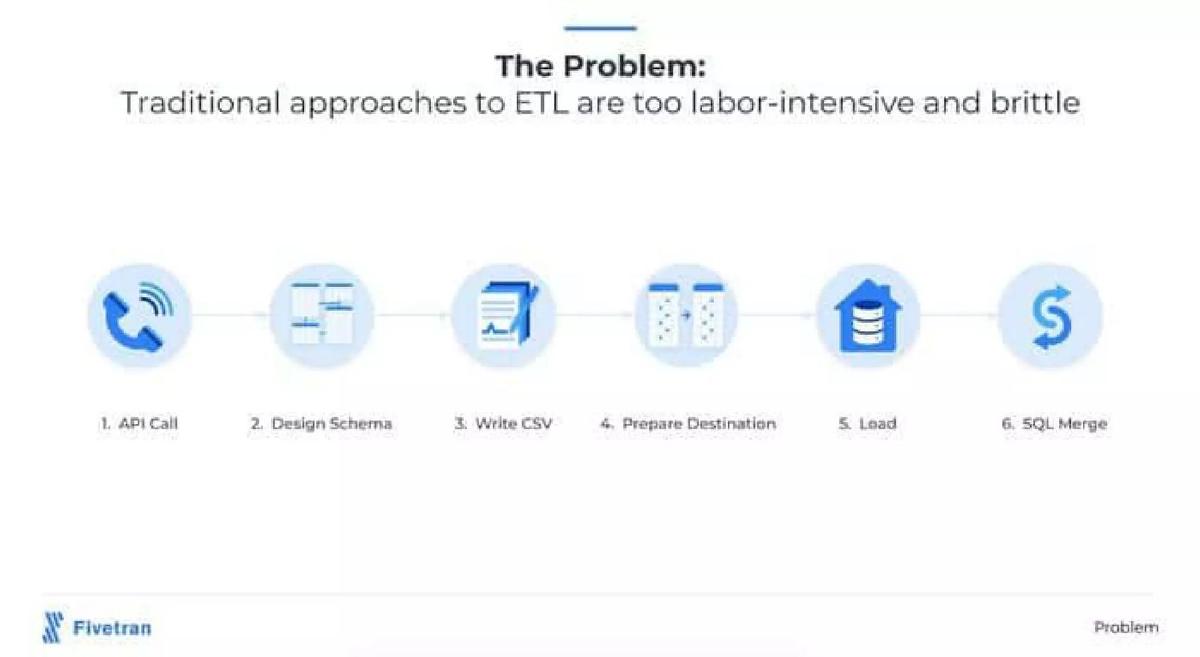
- The deck identifies the core problem as 'traditional approaches to ETL are too labor-intensive and brittle' on slide 3.
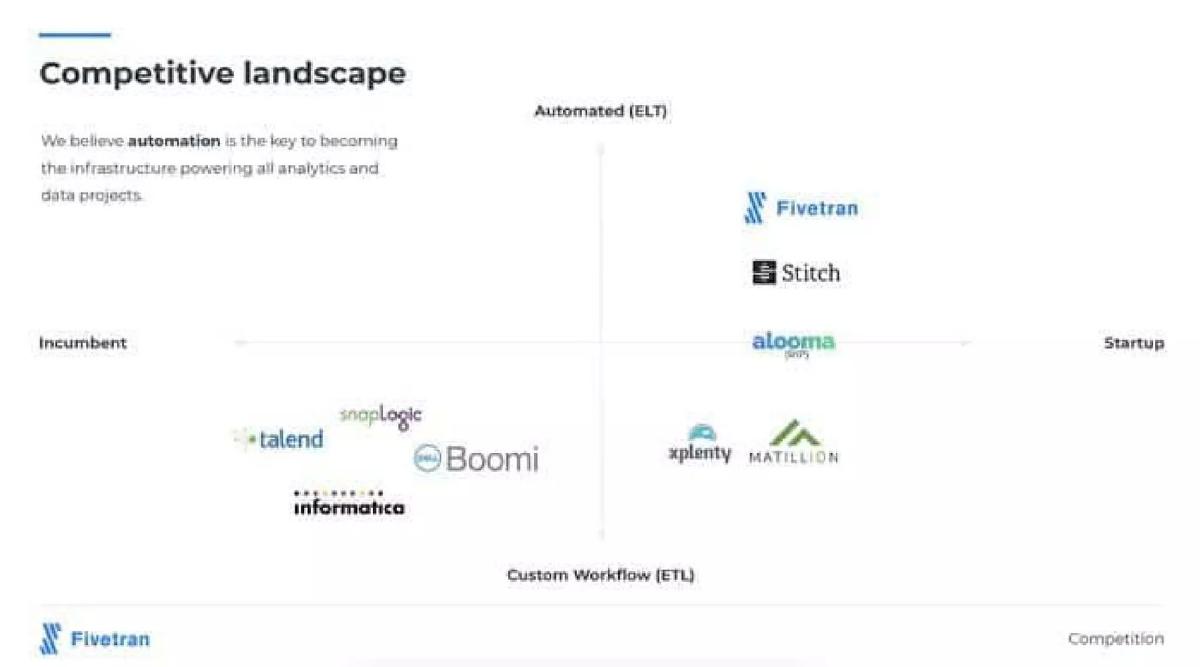
- Fivetran positions itself as a leader in the 'Automated (ELT)' quadrant, distinguishing itself from 'Custom Workflow (ETL)' incumbents like Informatica and Talend on slide 6.
- The company demonstrates significant market traction by listing '750+ Customers' including major brands like Square, Monzo, and WeWork on slide 11.
- Validation is shown through direct UI integration with major partners Snowflake and Google Cloud on slide 8.
- The 'Why now?' slide (slide 7) attributes market timing to the proliferation of SaaS tools and the rise of cloud-based, serverless data warehouses.
- Fivetran highlights its scale with '160 Total Employees' across five global offices including Oakland, Dublin, and Bengaluru on slide 12.
- The deck emphasizes a '5.0 Glassdoor Rating' based on 30 reviews to signal strong internal culture and execution on slide 12.
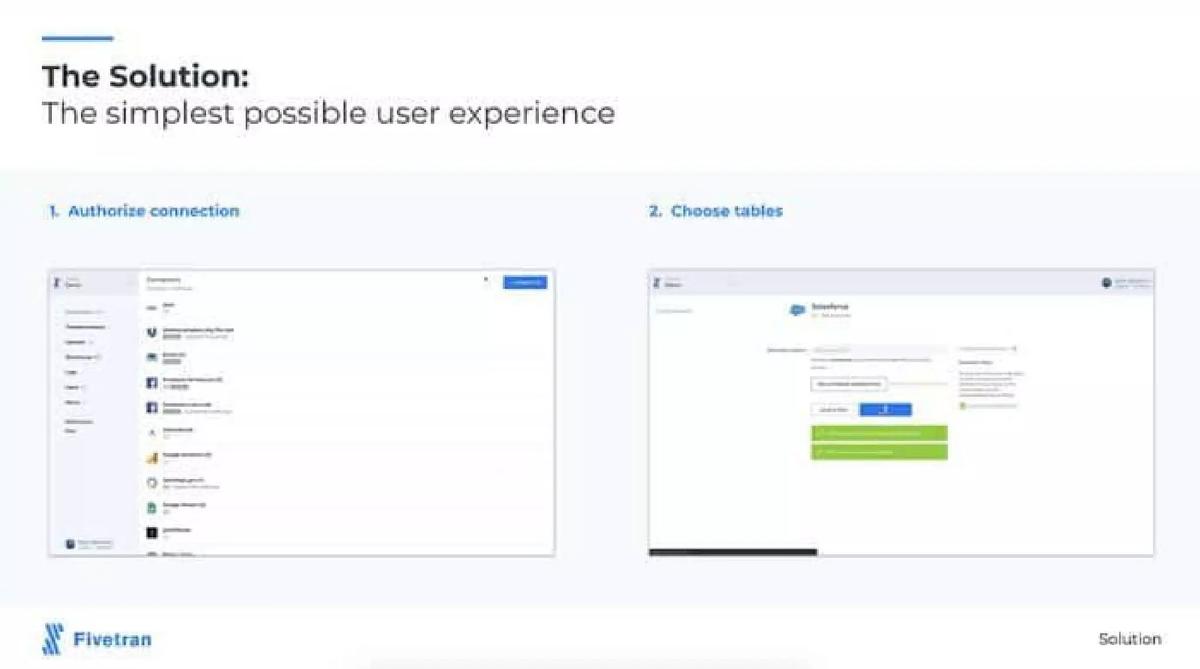
- The solution is framed as 'The simplest possible user experience,' requiring only two steps: authorizing a connection and choosing tables on slide 5.
The Narrative of Automation: Fivetran's Series B Strategy
Fivetran’s 13-slide deck is a masterclass in the 'Modern Data Stack' narrative. At the time of this Series B, the company was positioning itself not just as a tool, but as the essential plumbing for the cloud data revolution. The deck relies heavily on visual storytelling to contrast the 'old way' of manual data engineering with the 'new way' of automated pipelines.
The Problem and Solution (Slides 1-5)
Slide 1: Title. The deck opens with the logo and the tagline 'All your data in one place.' It is simple and focuses on the end result rather than the technical process.
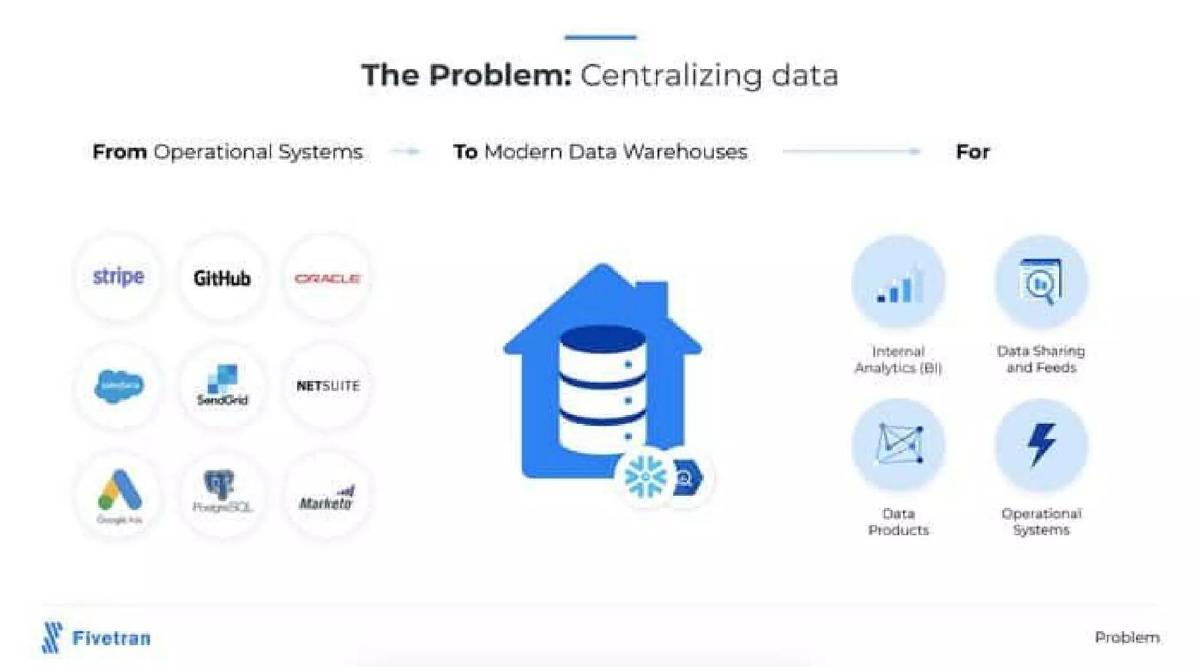
Slide 2: The Problem: Centralizing data. This slide establishes the context. It shows data moving 'From Operational Systems' (like Stripe, Salesforce, and GitHub) 'To Modern Data Warehouses' (Snowflake and BigQuery) 'For' various use cases like BI and Data Products. It sets the stage for the complexity of the ecosystem.
Slide 3: The Problem: Traditional approaches to ETL. This is the 'villain' of the story. Fivetran identifies the traditional ETL process as a six-step manual slog: API Call, Design Schema, Write CSV, Prepare Destination, Load, and SQL Merge. They explicitly label this as 'too labor-intensive and brittle,' a key pain point for data engineers.
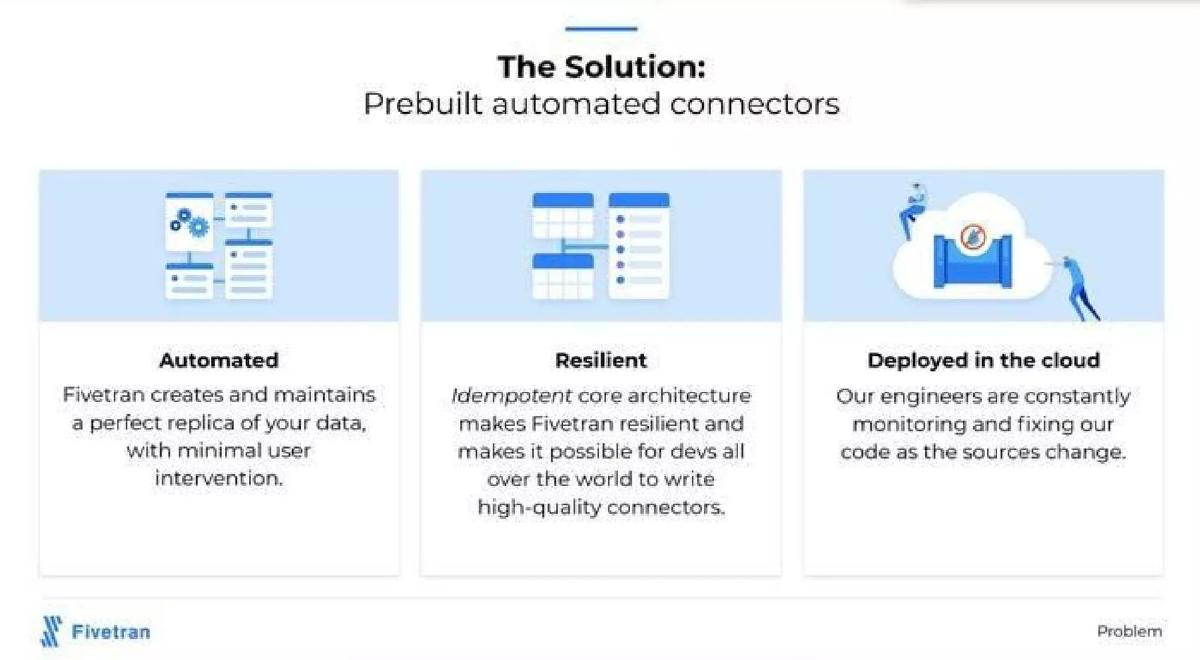
Slide 4: The Solution: Prebuilt automated connectors. Fivetran introduces its three pillars: Automated, Resilient, and Deployed in the cloud. They mention an 'Idempotent core architecture,' which is a technical term used to signal reliability to sophisticated investors—it means the system can handle retries without duplicating data.
Slide 5: The Solution: The simplest possible user experience. This slide uses product screenshots to show a two-step process: '1. Authorize connection' and '2. Choose tables.' This directly contrasts the six-step manual process shown on slide 3, emphasizing the reduction in complexity.
Market Positioning and Timing (Slides 6-7)
Slide 6: Competitive landscape. Fivetran uses a standard 2x2 matrix but chooses its axes carefully: 'Automated (ELT)' vs. 'Custom Workflow (ETL)' and 'Incumbent' vs. 'Startup.' By placing itself at the top-right, it claims the high ground of automation. It lists competitors like Stitch, Alooma, and Matillion, but positions itself as the most automated among the startups.
Slide 7: Why now? This slide explains the tailwinds driving Fivetran's growth. It cites the 'Proliferation and Adoption of SAAS Tools,' the 'New Generation of Cloud-based, Serverless Data Warehouses,' and the fact that 'Leveraging Data is a Requirement to be Competitive.' It connects the product's necessity to broader market shifts.
Validation and Traction (Slides 8-11)
Slide 8: Validation: Direct integration within partner's UI. This is a high-signal slide. It shows Fivetran embedded directly into the interfaces of Snowflake (Partner Connect) and Google Cloud (Marketplace). This demonstrates that the biggest players in the industry are effectively acting as a distribution channel for Fivetran.
Slide 9: The Past: Fragmented approaches. This slide visualizes a world where different tools (Workflow tools, Custom Code, CSV files) are used for different destinations. It looks messy and inefficient.
Slide 10: The Future: Single stable foundation. This slide shows Fivetran as the central hub connecting all sources to all destinations. It uses the phrase 'Fully managed, automated, zero maintenance connectors' to hammer home the value proposition.
Slide 11: 750+ Customers. A massive logo wall provides the ultimate social proof. Names like Square, Monzo, WeWork, and Kickstarter show that Fivetran is being used by both high-growth tech companies and established enterprises.
The Team and Summary (Slides 12-13)
Slide 12: Team. Instead of individual bios, Fivetran shows a large group photo. They highlight '160 Total Employees' and a '5.0 Glassdoor Rating.' This suggests a scalable, high-performing culture rather than just a few 'rockstar' founders. It also lists global office locations, indicating a mature corporate structure.
Slide 13: Summary. The final slide reiterates that Fivetran is the 'stable foundation for data driven applications.' It summarizes the market, the product, and the competitive advantage (automation and partnerships) over a simple illustration of a data pipeline.
What Works in the Fivetran Deck
Visual Contrast: The deck does an excellent job of contrasting the 'brittle' six-step manual ETL process with Fivetran’s two-step automated process. This makes the value proposition immediately obvious even to a non-technical investor. · Ecosystem Validation: Showing the product inside the Snowflake and Google Cloud UI is more powerful than any testimonial. It proves that Fivetran is a 'first-class citizen' in the modern data stack. · Scale over Pedigree: By Series B, investors care more about the machine than the inventors. Focusing on 160 employees and a 5.0 Glassdoor rating signals that the company has successfully transitioned from a founder-led startup to a professional organization. · Clarity of Category: The competitive matrix clearly defines the 'ELT' category as distinct from the 'ETL' category, helping investors understand exactly where Fivetran fits in the market.
What is Missing from the Fivetran Deck
The Financial Ask: There is no slide stating how much money is being raised, the valuation target, or the specific use of funds. · Revenue and Growth Metrics: While '750+ Customers' is a great metric, the deck omits ARR (Annual Recurring Revenue), Net Revenue Retention (NRR), or month-over-month growth rates. · Unit Economics: There is no mention of Customer Acquisition Cost (CAC) or Lifetime Value (LTV), which are usually critical for Series B investors. · Founder Bios: While the team photo is nice, the lack of background on the leadership team is unusual, though perhaps mitigated by the company's clear traction.
What a Founder Should Copy
The 'Why Now' Logic: Use slide 7 as a template. Connect your product to three undeniable market trends to show that your success is inevitable due to external forces. · The Problem Visualization: Don't just describe the problem; map out the steps of the 'old way' (as seen on slide 3) to show exactly where the friction lies. · Partner Integration: If you have deep integrations with major platforms, show them inside the platform's UI. It is the strongest form of partnership validation. · Simplified Summary: End with a slide that distills your entire pitch into three bullet points and one clear graphic.
Frequently asked questions
- What is the primary value proposition of Fivetran according to this deck?
- Fivetran’s primary value proposition is the automation of data centralization. As stated on slide 4, the company provides 'prebuilt automated connectors' that are resilient and deployed in the cloud. They contrast this with the six-step manual process of traditional ETL—API calls, schema design, writing CSVs, etc.—which they label as 'labor-intensive and brittle' on slide 3. The goal is to provide a 'zero maintenance' foundation for data applications.
- How does Fivetran differentiate itself from competitors in the pitch?
- On slide 6, Fivetran uses a 2x2 matrix to position itself in the top-right quadrant: 'Automated (ELT)' and 'Startup.' It places incumbents like Informatica, Talend, and Boomi in the 'Custom Workflow (ETL)' and 'Incumbent' categories. By doing this, Fivetran argues that while older tools require manual coding, their solution is part of a new generation of automated infrastructure that is inherently more scalable.
- What evidence of market validation does the deck provide?
- Validation is presented in two ways: partnerships and customer count. Slide 8 shows 'Direct integration within partner's UI,' specifically featuring screenshots of Fivetran inside Snowflake's 'Partner Connect' and Google Cloud's 'Marketplace.' Furthermore, slide 11 displays a logo wall representing '750+ Customers,' which includes high-profile companies like Kickstarter, Optimizely, and Urban Outfitters, proving the product's broad market appeal.
- Is there a detailed team slide in the Fivetran Series B deck?
- No, the deck does not include a traditional team slide featuring founder biographies, headshots, or past experience. Instead, slide 12 features a group photo of the entire staff. It focuses on the scale of the organization—'160 Total Employees'—and its global footprint across offices in the US, Europe, and India. It also highlights a '5.0 Glassdoor Rating' to emphasize organizational health rather than individual pedigree.
- What key fundraising elements are missing from this deck?
- The deck is missing several standard components: a specific 'Ask' slide detailing how much capital is being raised and its intended use, a detailed 'Financials' slide showing ARR or growth rates, and a 'Unit Economics' slide. Because this is a Series B deck for a company with 750+ customers, these details were likely shared in a separate data room, with the deck serving primarily as a narrative guide.