Five App presents a 13-slide deck (7 available for review) centered on a mobile application that enables deaf users to communicate via sign language animations. The narrative is heavily product-centric, showcasing specific features like facial expression selection and integration with Facebook Messenger. The deck highlights a diverse team that includes sign language specialists and an existing investor, signaling early-stage validation. While the deck succeeds in demonstrating the 'how' of the product and its international press traction—citing outlets like Business Insider and Forbes—it lack…
Key takeaways
- The company claims to be the 'world's first sign language messenger' on slide 1.
- Product functionality allows users to choose from six facial expression options to modify the meaning of signed sentences, as shown on slide 3.
- The app features a direct integration with Facebook Messenger, allowing animations to be sent within seconds (slide 4).
- The team includes three dedicated 'Sign Language Specialists' and a 'Chief Brand Ambassador,' emphasizing community-led development (slide 5).
- The deck identifies Dawid Wesołowski as an existing investor on the team slide (slide 5).
- International press validation is a core pillar of their credibility, featuring logos from Business Insider, Forbes, and Voice of America (slide 6).
- The company is registered as Five Technologies sp. z o.o. based in Poznań, Poland (slide 7).
- The deck completely omits financial projections, unit economics, and a specific capital requirement or 'ask' slide.
Slide-by-Slide Analysis
Slide 1: Title and Value Proposition
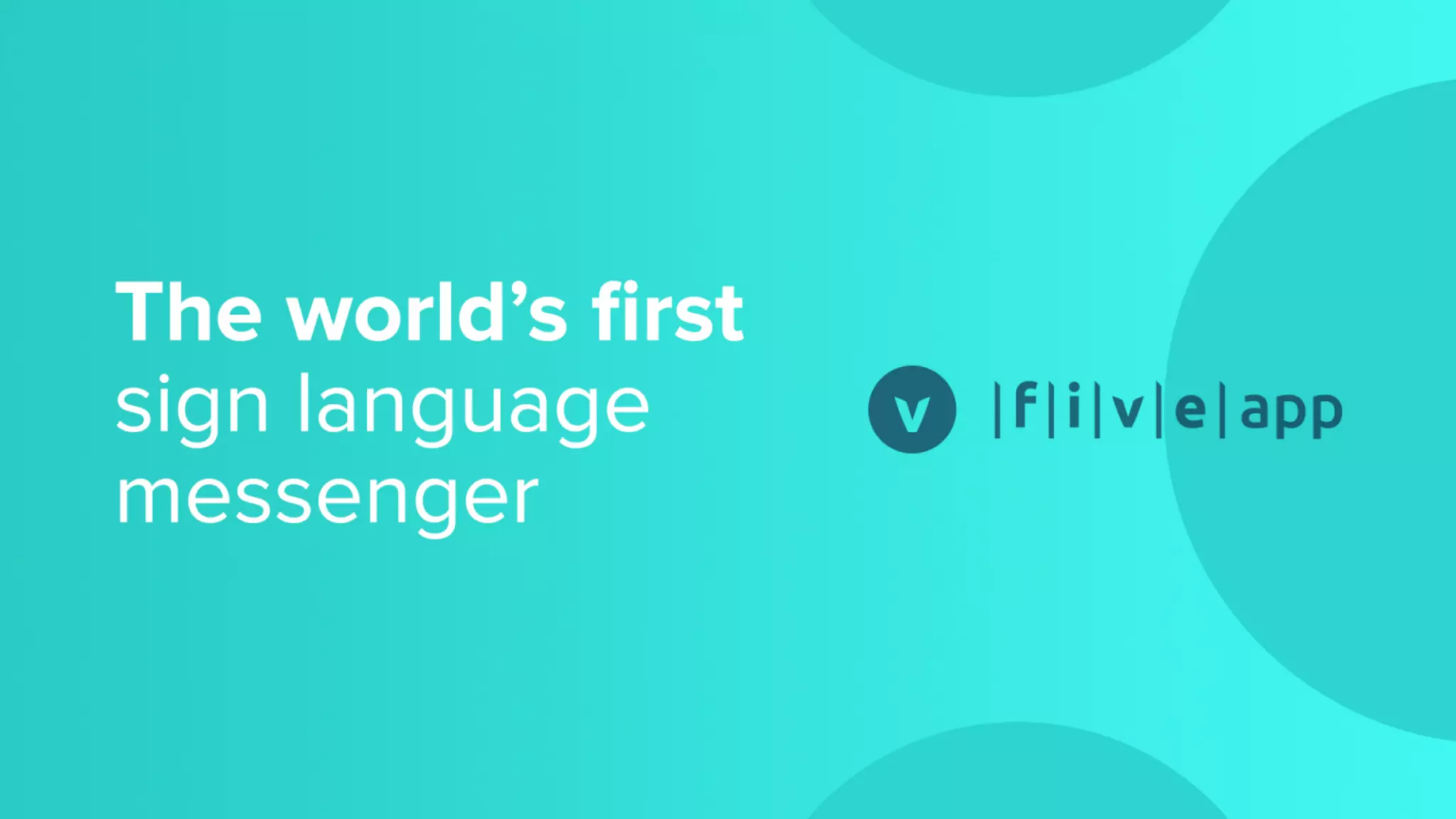
The deck opens with a high-contrast teal background featuring the company logo and a bold claim: "The world's first sign language messenger." This is a strong, category-defining opening. It immediately identifies the niche (accessibility/communication) and the product type (messenger). The branding is clean, though the logo for "Five App" uses vertical bars between letters, which may be a stylistic choice related to sign language or simply a design preference.
Slide 2: The Mission Statement
Slide 2 uses a darkened background image of a man signing, with white text overlay: "Five App finally allows deaf people to send short and simple messages to their friends. Let's take a look!" This slide serves as the transition from the 'what' to the 'how.' It defines the target user (deaf people) and the use case (short, simple social messaging). The phrase "finally allows" suggests a long-standing pain point in the community that has previously gone unaddressed by mainstream tech.
Slide 3: Product Feature - Facial Expressions
This slide dives into the technical nuances of sign language. It notes that "facial expression can change the meaning of a sentence." To solve this, the app allows users to "select one of six available options" for facial expressions by tapping and holding an animation preview. The inclusion of this slide demonstrates that the founders understand the linguistic complexity of their target market, moving beyond simple hand gestures to a more holistic communication tool.
Slide 4: Platform Integration
Slide 4 highlights a critical strategic move: "Send signs via Facebook Messenger." By showing an iPhone running a Facebook Messenger chat with a Five App animation embedded, the company demonstrates interoperability. The text explains that animations are "generated automatically in the app and sent to Messenger within seconds." This reduces friction for adoption, as users do not need to convince all their hearing friends to download a new app to receive messages.
Slide 5: The Team
The team slide is well-populated, featuring ten individuals. It is divided between core leadership (CEO, COO, CMO, CTO), specialists, and external support. The inclusion of three Sign Language Specialists is a significant credibility marker for an accessibility startup. Furthermore, the slide identifies Dawid Wesołowski as an "Investor," which tells new prospects that the company has already passed some level of professional due diligence. However, the slide lacks professional bios or past company logos, which would help establish the 'why us' more firmly.
Slide 6: Press and Traction
Titled "We have gained international attention," this slide acts as the social proof layer. It features clippings from Business Insider, Forbes, Upworthy, and Voice of America. One headline highlights the founder's age: "This 18-year-old CEO in Poland is making the first sign language messaging app for deaf people." While press is not a substitute for user growth metrics, for a pre-seed or seed-stage company, this level of global coverage suggests a high degree of public interest and potential for viral growth.
Slide 7: Contact and Legal Entity
The final slide provides the "Thank you!" and contact details. It lists the legal entity as Five Technologies sp. z o.o. and provides a physical address in Poznań, Poland. It also includes the REGON and NIP numbers (Polish tax and business identifiers). This adds a layer of formal legitimacy to the presentation, though it is a standard closing slide.
What Works in This Deck
Specific Problem Solving: The deck does an excellent job of explaining why a sign language messenger needs specific features like facial expressions. This educates the investor on the nuances of the problem space without becoming overly academic.
Ecosystem Awareness: The integration with Facebook Messenger is a highlight. Many social startups fail because they try to build a "walled garden." Five App acknowledges that the value is in the communication, not necessarily the platform ownership, making the tool more utilitarian.
Community Involvement: Listing sign language specialists as core team members suggests the product is being built with the community, not just for them. This is often a key factor in the success of assistive technologies.
What Is Missing from This Deck
Market Size (TAM/SAM/SOM): There is no mention of how many people use sign language globally or the economic profile of this demographic. Investors need to know if this is a niche hobby project or a scalable business.
Business Model: The deck is entirely silent on how the company intends to make money. Is it a subscription model? Is it B2B for organizations? Is it ad-supported? Without a revenue strategy, it looks like a non-profit venture.
User Metrics: While the press coverage is impressive, there are no figures regarding downloads, active users, or retention rates. Even early beta testing data would have strengthened the case.
The Ask: The most significant omission is the lack of a funding request. A pitch deck's primary purpose is to secure a meeting for an investment. Without stating how much capital is needed and what it will be used for (e.g., hiring more developers, marketing in new regions), the deck feels incomplete.
What a Founder Should Copy
Visual Simplicity: The deck uses a consistent color palette and clean layouts. The use of strong, centered headlines makes the slides easy to digest during a quick flip-through.
Feature-Benefit Pairing: Slide 3 is a perfect example of how to present a feature. It states the problem (facial expressions change meaning) and then shows the solution (a simple UI to select expressions). Founders should always explain the 'why' behind their 'what.'
Leveraging Press: If you have high-tier press, dedicate a full slide to it. Five App uses the actual screenshots of the articles rather than just logos, which makes the traction feel more tangible and less like a collection of icons.
Final Thoughts
The Five App deck is a strong product showcase that successfully communicates a unique value proposition in the accessibility space. It benefits from a clear mission and early external validation. However, to move from a 'cool project' to a 'venture-backable business,' the founders would need to supplement these slides with a rigorous look at the market opportunity, the competitive landscape, and the financial roadmap. As it stands, it is an excellent 'teaser' deck but lacks the depth required for a full investment round.
Frequently asked questions
- What is the primary problem Five App is trying to solve?
- Based on slide 2, the app aims to allow deaf people to send 'short and simple messages to their friends.' The deck implies that existing text-based messaging may not fully capture the nuances of sign language, particularly the role of facial expressions in conveying meaning, which the app addresses through customizable animations.
- How does the technology integrate with existing social platforms?
- Slide 4 explicitly details an integration with Facebook Messenger. The app automatically generates an animation of the sign language message which can then be sent directly to contacts on the Facebook platform, suggesting a strategy of meeting users where they already communicate rather than forcing a total platform migration.
- Who are the key members of the leadership team?
- The leadership consists of Mateusz Mach (CEO), Piotr Polański (COO), Blake Wind (CMO), and Jacek Knaflewski (CTO). Notably, the team is supported by three sign language specialists—Olgierd Kosiba, Ola Włodarczak, and Paweł Rosik—and an advisor, Piotr Bucki, as listed on slide 5.
- What kind of market validation does the deck provide?
- The deck relies on earned media as its primary form of validation. Slide 6 displays headlines from Business Insider, Forbes, Upworthy, and VOA. One headline specifically mentions the CEO's age (18 years old), suggesting the company gained significant early attention due to the founder's profile and the app's social utility.
- Is there a clear investment opportunity presented in these slides?
- No. The provided slides do not include a 'The Ask' slide, a roadmap, or any financial data. While slide 5 mentions an existing investor, there is no information regarding the current round's size, valuation, or intended use of funds. This deck serves better as a high-level product overview than a final investment memorandum.