GradGears, presenting its flagship product GradGuru, addresses a stark educational crisis: the fact that 75% of community college students drop out. The deck positions the startup as a 'counselor in your pocket,' utilizing mobile technology to deliver deadlines, behavioral nudges, and peer-to-peer support. Uniquely, the company identifies as a nonprofit in its competitive matrix, yet its financial projections include diverse revenue streams such as messaging subscriptions, data analytics fees, and console licensing. The deck is data-heavy, particularly in its five-year financial and impact pr…
Key takeaways
- The problem is framed by a significant statistic: 3/4 of students who enter community college drop out, according to NCES 2012 (Slide 2).
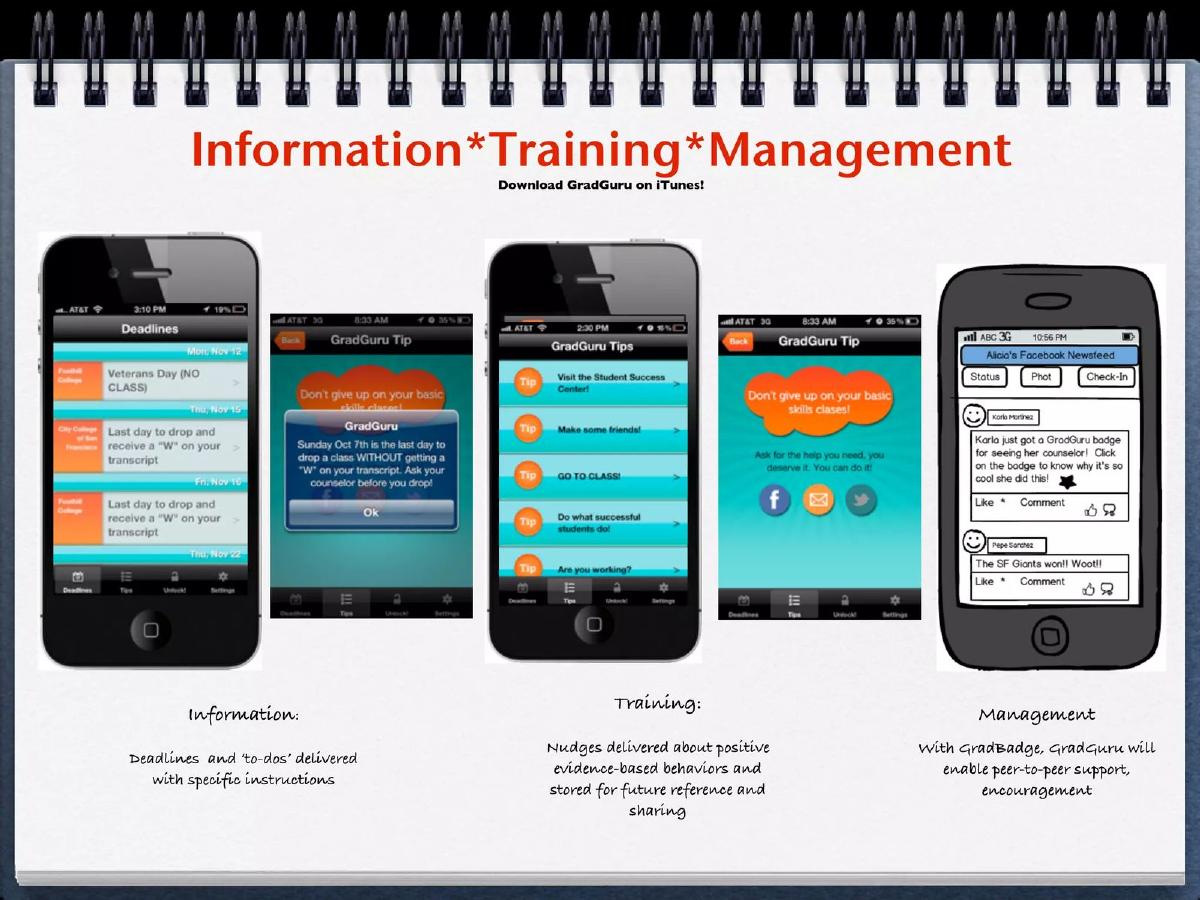
- The product, GradGuru, is defined by three functional pillars: Information (deadlines), Training (behavioral nudges), and Management (peer support) (Slide 4).
- GradGears identifies as a nonprofit entity, distinguishing itself from for-profit competitors like PersistencePlus and Myedu (Slide 8).
- The business model relies on a mix of grant contributions and earned revenue from campus subscriptions and data analytics (Slide 9).
- User acquisition strategies include a 'Regional Approach' and direct sales to Deans, Vice Presidents of Student Services, and Chancellors (Slide 7).
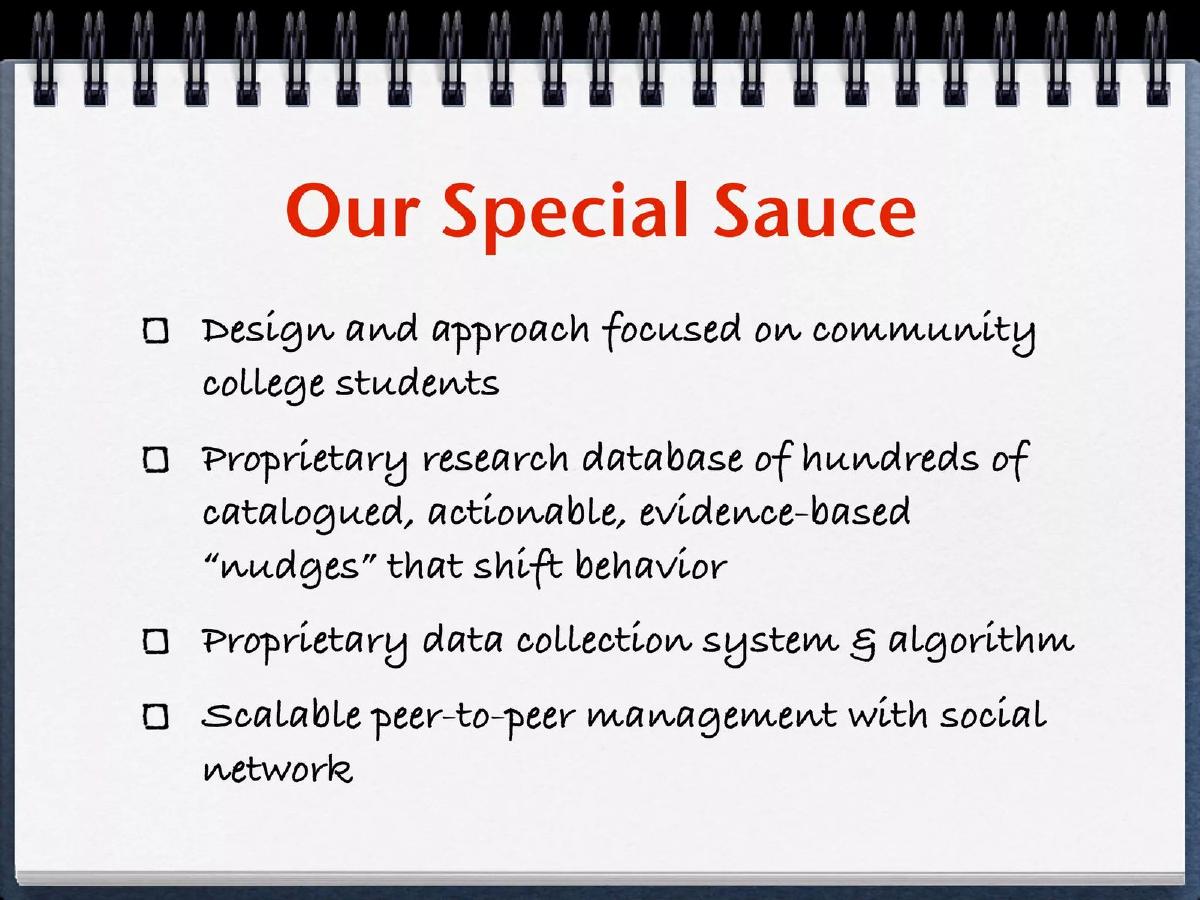
- The 'Special Sauce' includes a proprietary research database of hundreds of evidence-based 'nudges' designed to shift student behavior (Slide 6).
- Financial projections show a transition from $40,000 in grant-only inflows in 2012 to nearly $2 million in earned revenue by 2016 (Slide 9).
- The deck includes a specific impact metric, projecting that 28,134 students will complete school one year faster by 2021 due to the platform (Slide 9).
Executive Summary: The Community College Retention Crisis
GradGears, through its mobile platform GradGuru, addresses one of the most significant leaks in the American educational pipeline: the community college dropout rate. The deck is structured as a classic social enterprise pitch, balancing a clear mission-driven problem with a structured business model that aims for self-sustainability through institutional partnerships. By focusing on 'nudges'—small, timely interventions delivered via mobile—the company seeks to provide the support that under-resourced campus counseling offices cannot scale.
Slide 1: Title and Mission
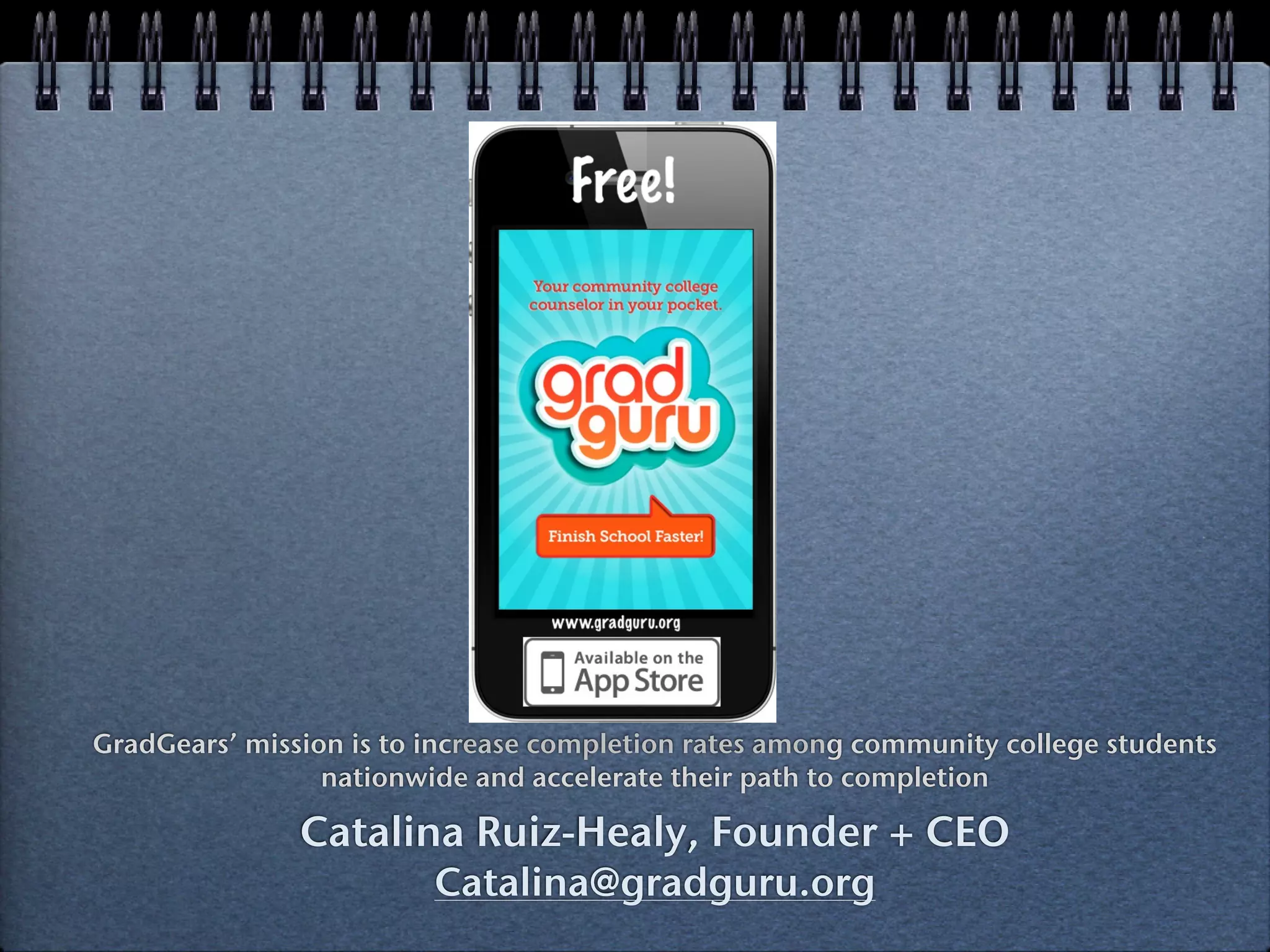
The opening slide introduces GradGuru as "Your community college counselor in your pocket." It explicitly states the mission: to increase completion rates among community college students nationwide and accelerate their path to completion. The slide includes a mockup of the app on an iPhone, emphasizing its availability on the App Store. Catalina Ruiz-Healy is identified as the Founder and CEO.
Slide 2: The Problem
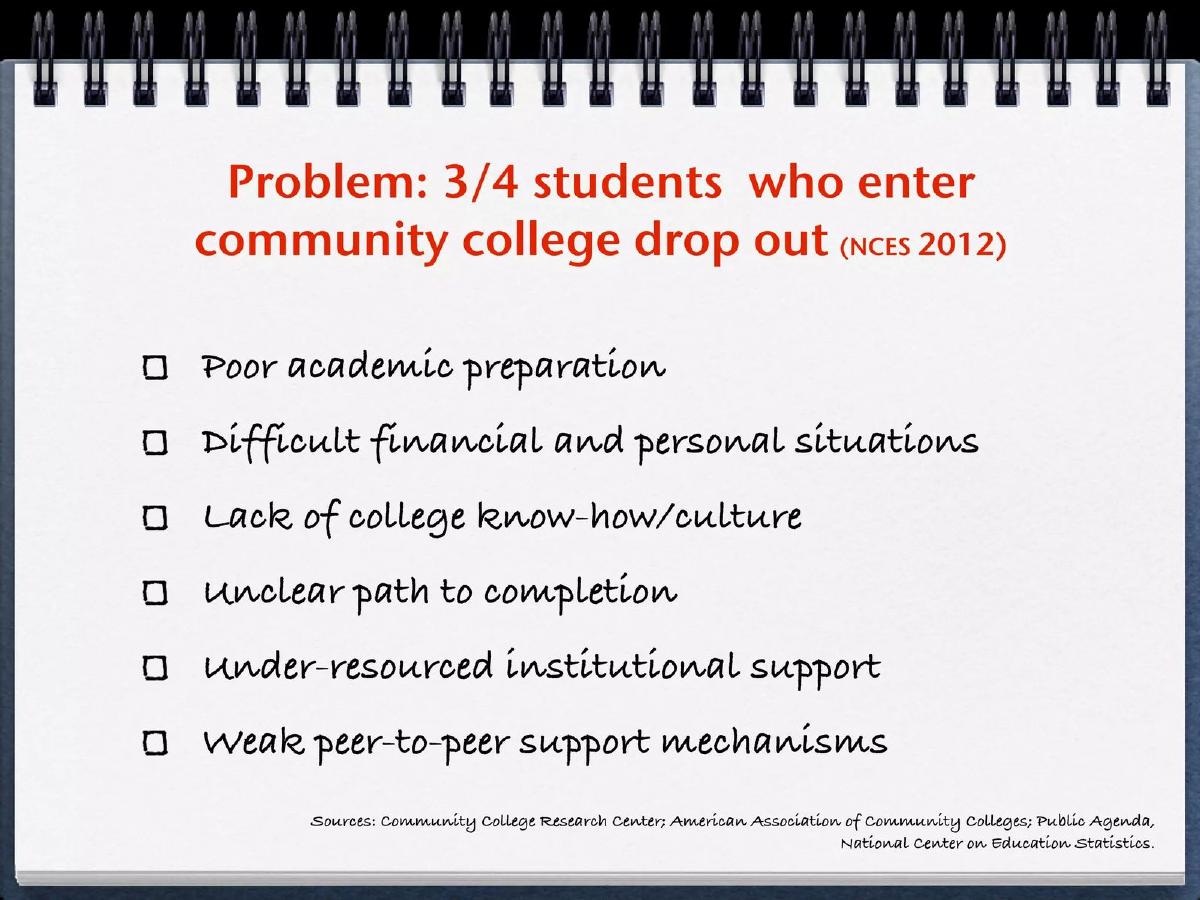
GradGears utilizes a stark data point to establish urgency: "3/4 students who enter community college drop out," citing NCES 2012. The slide lists six contributing factors: poor academic preparation, difficult financial/personal situations, lack of college know-how, unclear paths to completion, under-resourced institutional support, and weak peer-to-peer support mechanisms. This slide successfully frames the problem as both systemic and personal.
Slide 3: The Solution
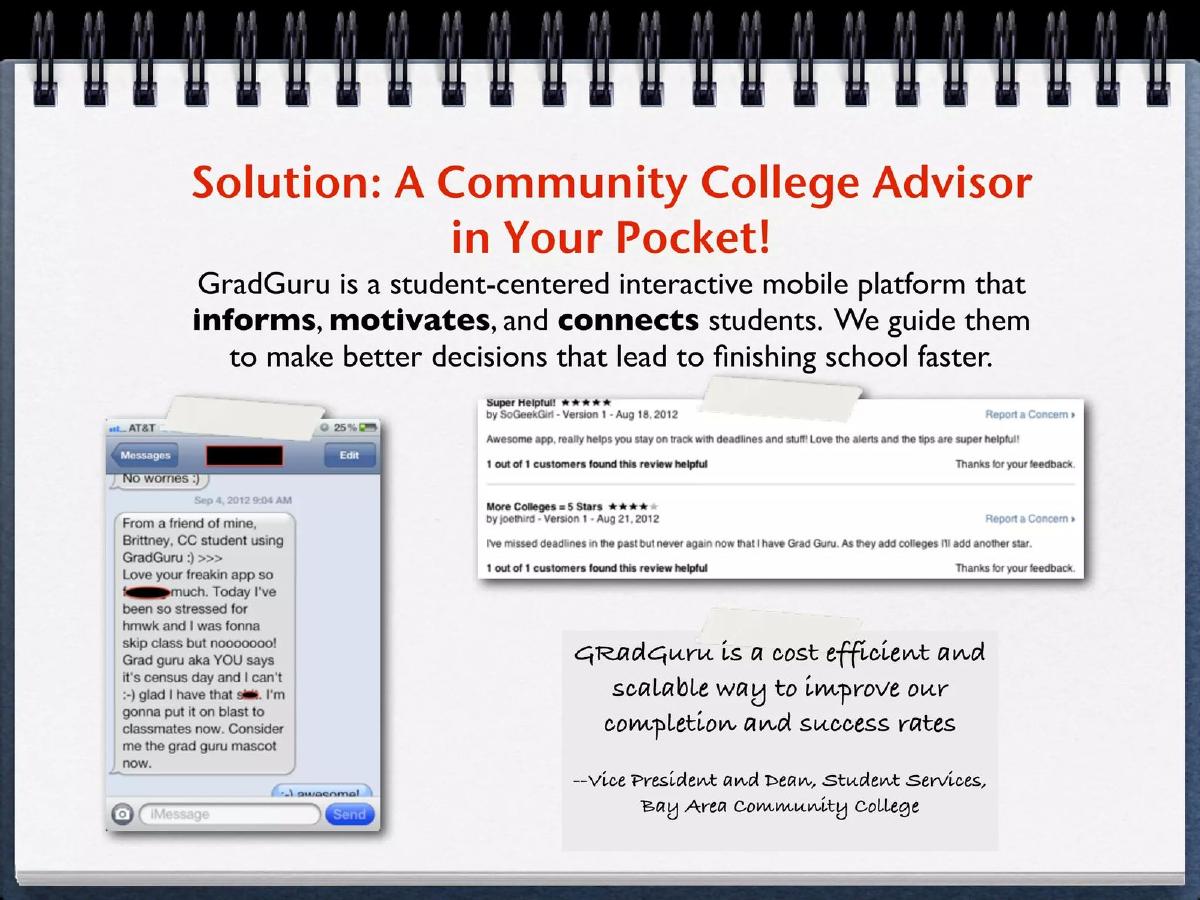
The solution is framed as a "student-centered interactive mobile platform that informs, motivates, and connects students." To validate the concept, the slide includes screenshots of user testimonials and a text message from a student. Notably, it features a quote from a Vice President and Dean of Student Services at a Bay Area Community College, calling GradGuru a "cost efficient and scalable way to improve our completion and success rates." This provides early institutional validation.
Slide 4: Product Functionality
This slide breaks the app down into three categories: Information (deadlines and to-dos), Training (nudges about positive evidence-based behaviors), and Management (peer-to-peer support via GradBadge). The visual aids show the UI for deadlines, tips, and a Facebook newsfeed integration where students can see their peers' achievements. This clarifies that the app is not just a calendar, but a behavioral intervention tool.
Slide 5: The Business Model Canvas
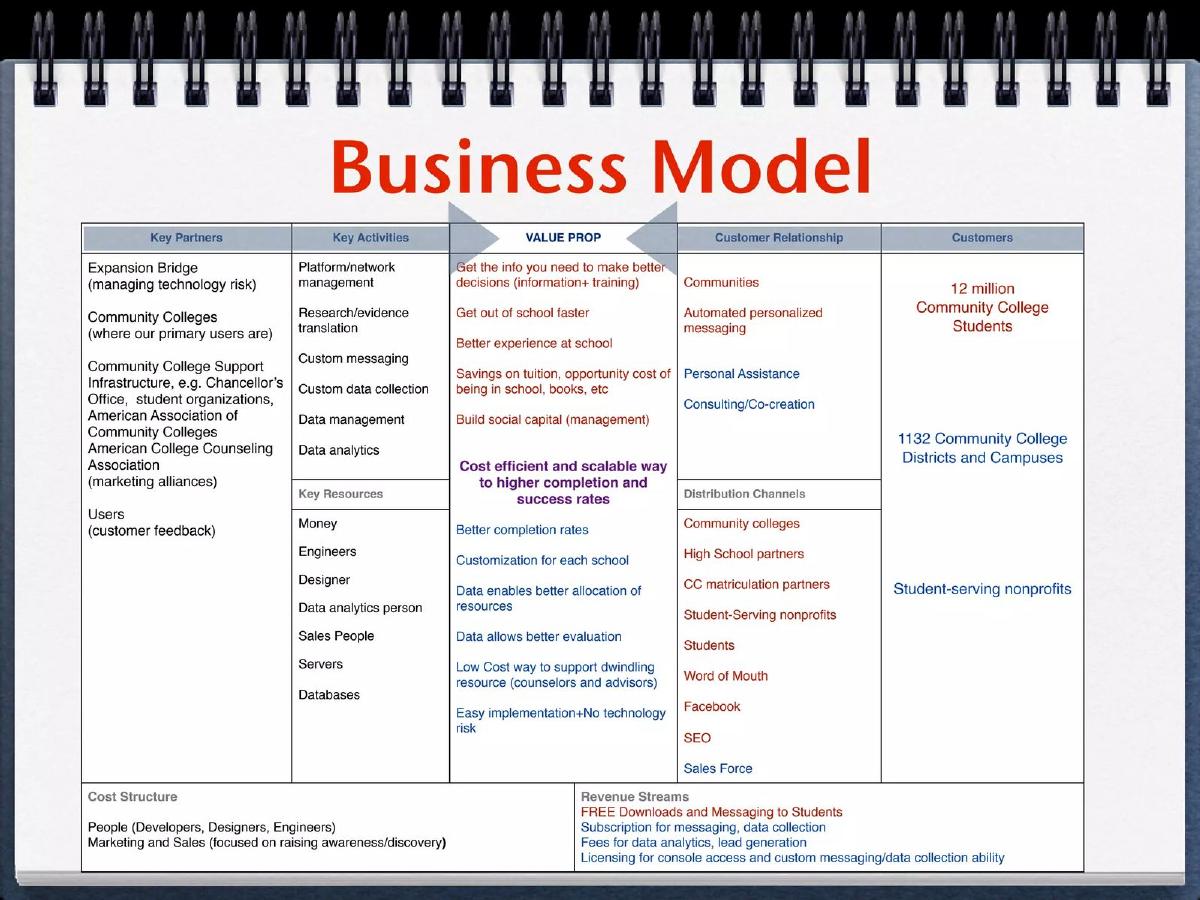
GradGears uses a standard Business Model Canvas layout. Key highlights include:
Customers: 12 million community college students across 1,132 districts and campuses. · Value Prop: Savings on tuition and opportunity costs for students; better resource allocation and evaluation for institutions. · Revenue Streams: Subscriptions for messaging/data, fees for analytics/lead generation, and licensing for console access. · Cost Structure: Primarily focused on people (developers, designers, engineers) and marketing.
Slide 6: Special Sauce
The company identifies its competitive advantages as its specific focus on community college students and its "proprietary research database of hundreds of catalogued, actionable, evidence-based 'nudges'." They also highlight a proprietary data collection system and algorithm, suggesting a level of technical and academic depth behind the simple mobile interface.
Slide 7: User Acquisition
The acquisition strategy is split between direct marketing to students (word-of-mouth, social media) and a B2B sales force targeting campus leadership. They aim to sell to Deans, Vice Presidents of Student Services, and Chancellors. They also identify student-serving nonprofits and scholarship providers as key partners for reaching their target demographic.
Slide 8: Competitive Landscape
The competition slide uses a matrix to compare GradGears against five other players. The primary differentiators claimed are its Nonprofit status and its Community College-only focus. While competitors like Blackboard Mobile and Myedu serve the broader 4-year university market, GradGears argues that the specific needs of community college students require a dedicated platform.
Slide 9: Timeline, Milestones, and Impact
This is the most data-dense slide in the deck. It provides a five-year projection (2012-2016) for users, revenue, and expenses. Key figures include:
Growth: Scaling from 11 campuses in 2012 to 600 in 2016. · Revenue: A shift from $40,000 in grants in 2012 to $1.99 million in earned revenue by 2016. · Impact: A secondary table projects the "Year of Impact" through 2021, estimating that 28,134 students will complete school one year faster, resulting in $67,107,744 in cumulative fees saved for those students.
Slide 10: Team, Board, and Advisors
The final slide lists the core team: Catalina Ruiz-Healy (CEO), Silvino Leon (CTO), and Lili Mano (Community Manager). The advisor list is extensive, featuring individuals from the Community College Research Center at Columbia University, Gryphon Investors, and the Office of the California State Comptroller. This suggests strong ties to both the academic research community and the California educational system.
What GradGears Does Well
The deck excels at framing a massive social problem with specific, cited data. By identifying the "3/4 dropout rate," they immediately establish the size of the opportunity. The inclusion of a detailed impact model (Slide 9) is a strong touch for a mission-driven organization, as it translates app usage into tangible economic benefits for students (fees saved). Furthermore, the competitive matrix (Slide 8) clearly carves out a niche—nonprofit, CC-only, mobile-push—that makes the company seem like a specialist rather than a generalist.
What is Missing from the Deck
The most glaring omission is a specific Ask . There is no slide detailing how much money the company is looking to raise, the terms of the round, or the specific milestones that the new capital will unlock. While the timeline shows headcount increasing to 14 people, it doesn't explain the funding gap required to get there. Additionally, while the deck mentions a "proprietary algorithm," there is very little detail on the actual technology stack or how the data analytics fees are justified to the institutions. Finally, the deck lacks a clear "Exit" or long-term sustainability vision beyond simply growing the number of campuses.
Founder Takeaways: Copy This
The Impact Table: Founders in the EdTech or Social Impact space should emulate Slide 9. Don't just project your own revenue; project the financial benefit your product brings to your users. GradGears' calculation of "Cumulative Fees Saved" ($67M+) is a powerful way to justify the existence of a nonprofit or social enterprise to donors and investors alike.
Institutional Validation: Including a quote from a Dean (Slide 3) is much more effective than a generic user review. In B2B2C models, you must prove that the gatekeeper (the institution) sees value in the product, not just the end-user (the student).
The Nudge Database: By calling their content a "proprietary research database of evidence-based nudges," they turn simple push notifications into intellectual property. Founders should always look for ways to frame their content or processes as proprietary assets.
Frequently asked questions
- What is the primary problem GradGears is trying to solve?
- GradGears targets the high attrition rate in community colleges. According to Slide 2, 75% of students who enter these institutions drop out. The company identifies several causes for this, including poor academic preparation, unclear paths to completion, and under-resourced institutional support. Their mission is to accelerate the path to completion and increase graduation rates nationwide.
- How does the GradGuru app actually work for a student?
- As shown on Slide 4, the app provides three main services: Information, Training, and Management. It delivers specific instructions for deadlines and 'to-dos,' sends 'nudges' based on evidence-based behaviors (like visiting a success center), and uses 'GradBadges' to enable peer-to-peer support and encouragement via social network integrations like Facebook.
- What is the revenue model for this nonprofit startup?
- Despite its nonprofit status, GradGears outlines four earned revenue streams on Slide 5: subscriptions for messaging and data collection, fees for data analytics and lead generation, and licensing for console access. Slide 9 shows they expect earned revenue to overtake grant contributions by 2014, reaching $1.99 million by 2016.
- Who are the key competitors mentioned in the deck?
- Slide 8 lists several competitors including PersistencePlus, AcademyOne’s Academic GPS, Blackboard Mobile, Myedu, and Collegesnaps. GradGears differentiates itself by being the only nonprofit in the group, the only one focused exclusively on community colleges, and one of the few offering peer-to-peer (P2P) management features.
- What are the projected growth milestones for the company?
- According to the timeline on Slide 9, the company planned to grow from 11 campuses and 1,000 downloads in 2012 to 600 campuses and 312,600 downloads by 2016. During this period, they also planned to expand their team from a founder-led operation to 14 persons on salary.