Grandomastery is an EdTech platform focused on 'integrative thinking' and creativity development, primarily positioned for the English Language Teaching (ELT) and English as a Second Language (ESL) sectors. The deck emphasizes the psychological principle of bisociation—connecting disparate concepts like art and science—to improve cognitive function. While the product is currently available as a free Android app with 36 randomized tasks, the company proposes a three-tier business model ranging from free to $299 for corporate clients. The deck relies heavily on academic concepts and a single, l…
Key takeaways
- The platform is built on the concept of 'bisociation,' aiming to connect incompatible planes like art, science, and humor (Slide 3).
- Grandomastery identifies a gap in the market for resources that prioritize abstract thinking over simple 'neurobics' (Slide 2).
- The product is positioned as a 'Minimal Perfect Product' (MPP) rather than a traditional MVP, claiming thousands of hours of content (Slide 3).
- Market validation is tied to CPD (Continuing Professional Development) accreditation and integration with Accredible for certificate sharing (Slide 4).
- The current software offering includes an Android app with 36 randomized tasks curated for ELT and ESL specialists (Slide 5).
- A future optimization involves 'ESL Treasures,' a society for creators of lesser-known ESL resources to receive recognition (Slide 6).
- The proposed business model includes a 'Premium' tier at $29.9 and a 'Corporate' tier at $299 (Slide 7).
- The deck lacks a dedicated team slide, financial history, or a specific investment ask in the provided 8 slides.
Slide-by-Slide Analysis
Slide 1: Title and Accreditation
The cover slide introduces the company name, Grandomastery, alongside a crest featuring the Latin words 'Ingenium,' 'Ars,' and 'Solletria.' Notably, the slide features two logos for 'CPD Quality Standards' and 'CPD Accredited.' This immediately positions the company as a formal educational entity rather than a casual gaming app. The contact information and website are clearly displayed at the bottom.
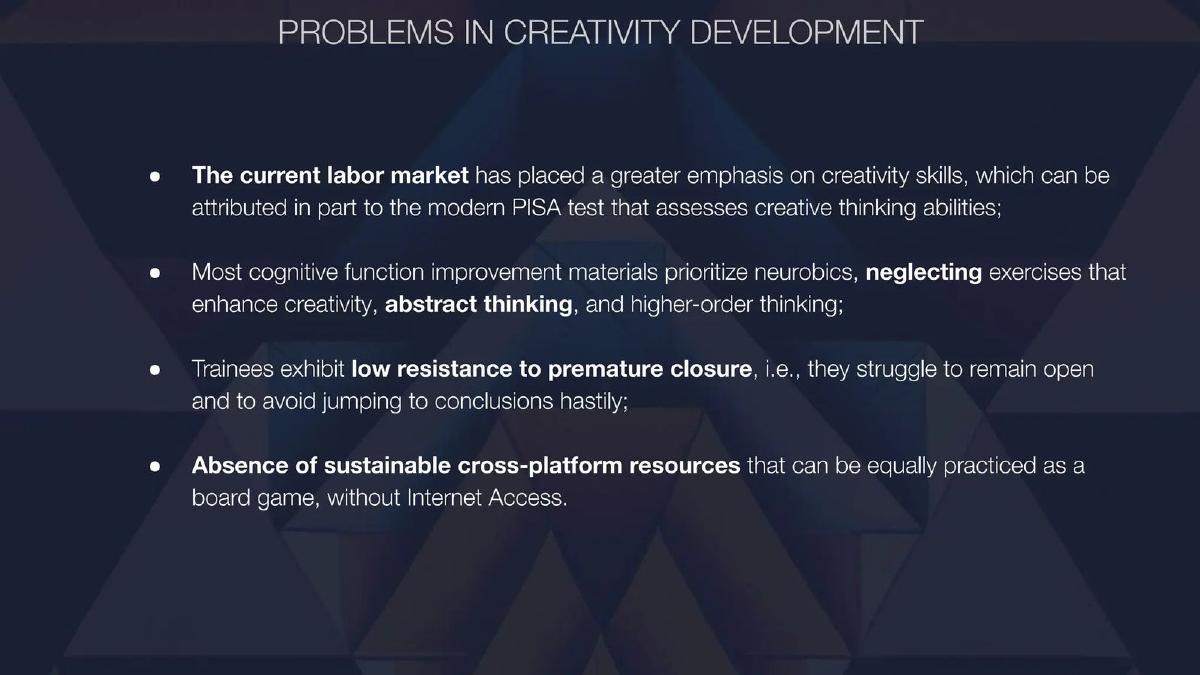
Slide 2: Problems in Creativity Development
This slide identifies four pain points. First, it cites the 'current labor market' and the 'modern PISA test' as drivers for creativity skills. Second, it claims existing materials focus on 'neurobics' while neglecting 'abstract thinking.' Third, it notes that trainees struggle with 'premature closure' (jumping to conclusions). Finally, it highlights a lack of 'sustainable cross-platform resources' that can work offline as a board game. The slide uses bold text to emphasize these gaps but lacks quantitative data to support the scale of these problems.
Slide 3: How It Works
Grandomastery introduces the concept of 'bisociation'—the overlapping of seemingly incompatible planes like art and science. The slide explains that the platform aims to 'remove constraints' and encourages the use of 'neglected or avoided social constructs.' Technically, it notes the app works on phones, desktops, smart TVs, and projectors, with audio recording capabilities. A bold claim is made here: the product is not an MVP (Minimum Viable Product) but an 'MPP (Minimal Perfect Product),' offering 'thousands of hours' of content.
Slide 4: USP & Market Validation
The Unique Selling Proposition (USP) is centered on accreditation. By granting CPD certificates through Accredible.com, the platform provides tangible professional value. The slide also argues that 'edutainment' does not require high-end graphics or AR, but rather a shared experience between teacher and student that 'reduces the disparity in their perceptions.' This is a psychological value proposition rather than a technical one.
Slide 5: Grandomastery The App
This slide provides a screenshot of the app on Download.com (hosted by CNET). It describes the interface as having two buttons: 'CYCLE' and 'RANDOM.' The description specifies that the tool is 'tailored for ELT (English Language Teaching) and ESL (English as a Second Language) specialists.' It mentions a 'diverse repertoire of 36 randomized tasks.' This slide is critical because it narrows the broad 'creativity' focus of earlier slides into a specific vertical: language learning.
Slide 6: Future Optimizations
The deck introduces 'ESL Treasures,' described as a 'Grandomastery-based society.' This appears to be a community-building or content-curation play where creators of ESL resources can submit projects for awards and recognition. The slide includes a screenshot of a 'Certificate of Achievement' for Mojo English, dated August 2021. This suggests the company is attempting to build an ecosystem around its core product to drive organic growth and authority in the ESL space.
Slide 7: Business Model
The 'Proposed Plans' are presented in a standard three-column format. The 'Starter' plan is Free, offering basic mode and limited variations. The 'Premium' plan is priced at '$29.9' and adds access to all variations, tutorials, and printouts. The 'Corporate' plan is '$299' and adds tailor-made solutions, training sessions, and personalized support. The slide does not specify if these prices are monthly, annual, or per-user, which is a significant omission for a business model slide.
Slide 8: User Testimonials
The final slide in this selection is a wall of text from Richard Smyth, an EFL teacher with 17 years of experience. He describes the tool as a 'fantastic learning tool' for B2-C1 level classes and notes that students 'go crazy for it.' He specifically mentions using it for 'IELTS part 2 speaking practice.' While the testimonial is highly positive and detailed, the presentation—a single, long block of italicized text—is difficult to scan quickly during a pitch.
What Grandomastery Does Well
Niche Targeting: While the deck starts with broad claims about the global labor market, it quickly settles into a specific, underserved niche: high-level English Language Teaching (ELT). By focusing on B2-C1 level students and IELTS preparation, the product solves a specific problem for a defined user base.
Accreditation as a Hook: Integrating CPD accreditation and Accredible for LinkedIn sharing is a smart way to drive user retention. In the professional education space, a certificate is often more valuable to the user than the learning content itself, and Grandomastery builds this into their core USP.
Platform Versatility: The emphasis on working across devices—including projectors and smart TVs—shows an understanding of the actual environment of a classroom, where a teacher needs to display content to a group rather than having every student on an individual device.
What Is Missing from the Deck
The Team: There is no team slide in the provided selection. For an EdTech product based on specific psychological principles like 'bisociation,' the pedagogical and technical credentials of the founders are essential to establish credibility.
Financials and Traction: The deck mentions the app is on Download.com and has been used by at least one teacher, but it provides no data on total downloads, active users, or current revenue. There are no projections for how the 'Proposed Plans' will scale.
The Ask: The deck does not state how much money the company is looking to raise or what the funds will be used for. Without a clear 'Ask' slide, this functions more as a product overview than a fundraising pitch.
Competitive Landscape: The deck claims that most cognitive materials neglect abstract thinking, but it does not name or analyze any direct competitors in the ELT or brain-training space (e.g., Duolingo, Lumosity, or specialized ESL resource sites).
Founder Takeaways
Define your 'Product Stage' carefully: The term 'Minimal Perfect Product' (MPP) is used on Slide 3. While founders often want to distance themselves from the 'rudimentary' nature of an MVP, calling a product 'perfect' can be a red flag for investors who expect iterative development based on user feedback. It is better to focus on 'Feature Complete' or 'Market Ready.'
Clarify Pricing Units: When presenting a business model (Slide 7), always include the frequency of the charge (e.g., $29.99/year or $29.99 one-time). Investors need to know if this is a SaaS recurring revenue model or a transactional software sales model.
Break Up Testimonials: A single 300-word testimonial (Slide 8) is rarely read in full. It is more effective to pull 2-3 'power quotes' and place them alongside a headshot and title of the reviewer. This allows the reader to grasp the value proposition in seconds.
Bridge the Gap Between Theory and Practice: The deck spends a lot of time on the theory of 'bisociation' (Slide 3). While academic foundations are good, a pitch deck needs to show the 'UI/UX' sooner. Slide 5 starts to do this, but more screenshots of the '36 randomized tasks' would help investors visualize the actual user experience.
Frequently asked questions
- What is the primary problem Grandomastery aims to solve?
- According to Slide 2, the company addresses the lack of creativity development in the labor market. It specifically targets the neglect of abstract and higher-order thinking in current cognitive materials, the low resistance to 'premature closure' among trainees, and the absence of cross-platform resources that can function without internet access.
- How does the product actually function for a user?
- Slide 5 describes the interface as having two essential buttons: 'CYCLE' and 'RANDOM.' These buttons unlock 36 randomized tasks designed for English Language Teaching. The platform supports audio recording for responses and is accessible via phone, desktop, smart TV, or projector, emphasizing versatility in classroom settings.
- What is the significance of the CPD accreditation mentioned in the deck?
- Slide 4 highlights that Grandomastery is an accredited CPD platform. This allows the company to grant certificates to experts, trainees, and educators. By using the Accredible service, these users can upload their certificates to LinkedIn with a single click, providing a professional incentive for platform engagement.
- What are the proposed pricing tiers for the platform?
- Slide 7 outlines three plans: a 'Starter' plan which is free, a 'Premium' plan for $29.9 (presumably a one-time fee or annual, though not specified) offering all variations and printouts, and a 'Corporate' plan for $299 which includes tailor-made solutions, training sessions, and personalized support.
- Who is the target audience for this platform?
- While the problem slide speaks broadly about the 'labor market,' Slide 5 and Slide 8 clarify that the current focus is on ELT (English Language Teaching) and ESL (English as a Second Language) specialists. The testimonial on Slide 8 specifically comes from an EFL teacher with 17 years of experience.