Grapevine presents a 12-slide pitch deck (6 provided) focused on an internal chat application for small businesses, with a heavy emphasis on the restaurant industry. The deck positions the product as a 'sexy, simple, manager-friendly' alternative to expensive enterprise tools. By citing market validation from Restaurant Magazine and Bloomberg data on eatery density, Grapevine builds a case for a geographically-targeted go-to-market strategy. However, the deck relies heavily on qualitative claims, such as being a 'first mover' in a market where incumbents like Slack and HipChat already existed…
Key takeaways
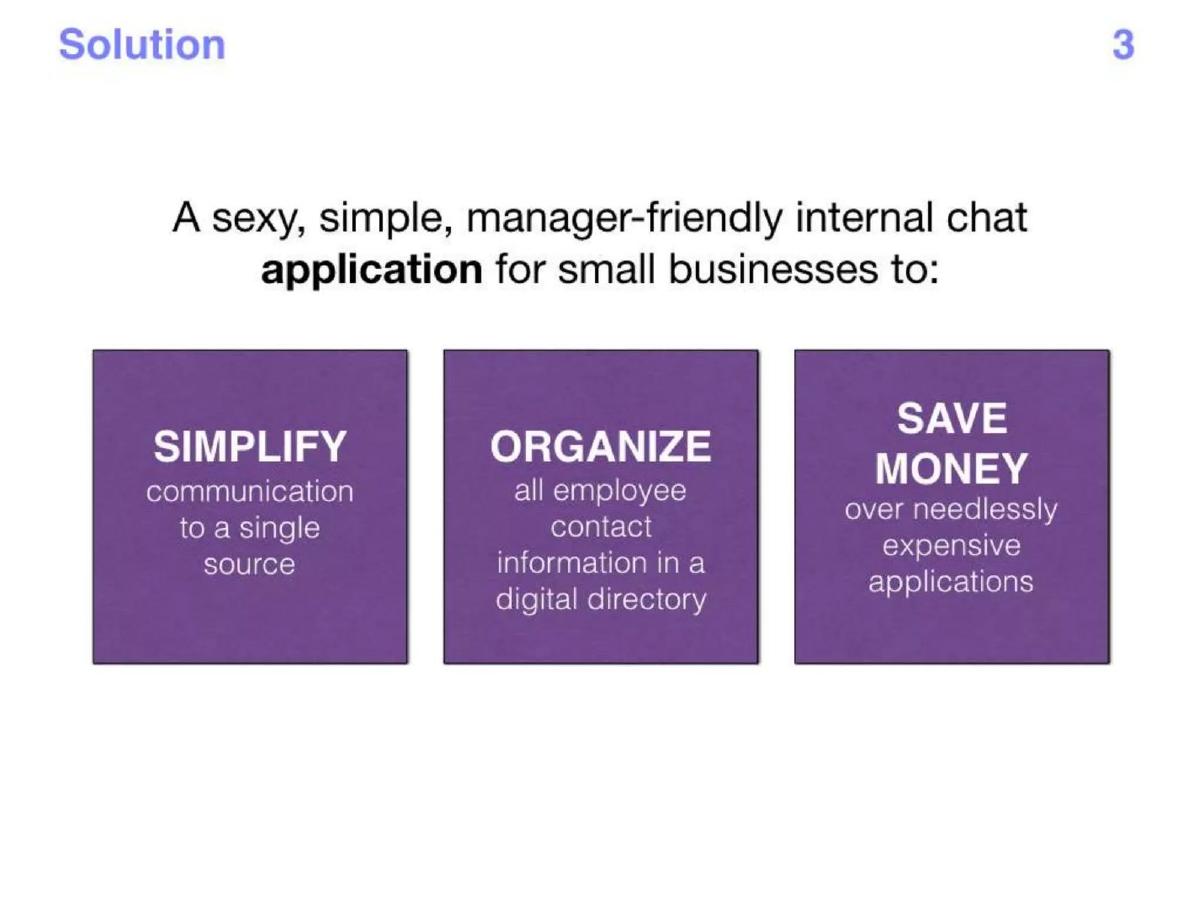
- The company identifies as an internal chat application specifically for small businesses to simplify communication and organize employee directories (Slide 3).
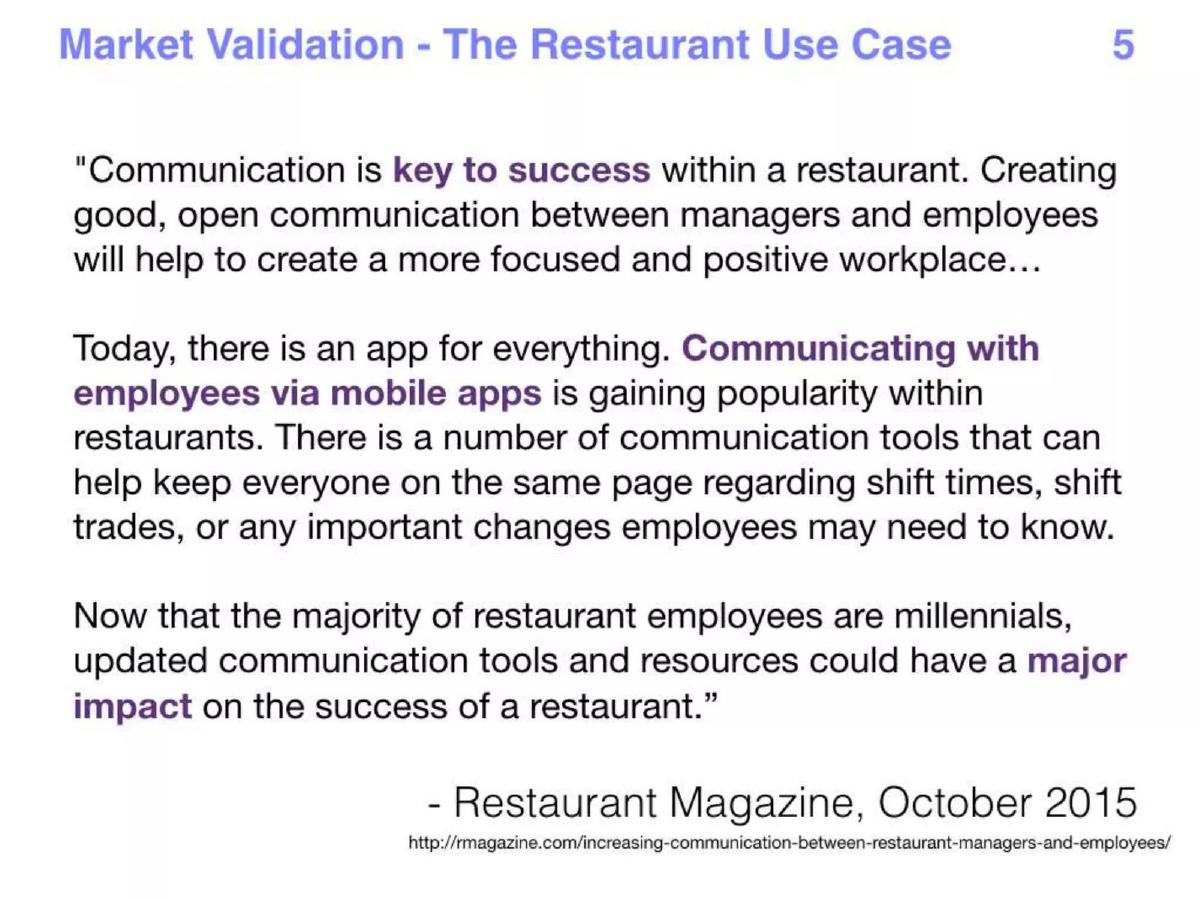
- Market validation is built on a specific use case for restaurants, citing that millennials in the workforce require updated communication tools (Slide 5).
- Product features include location-based workplace searching, team directories, and direct messaging or group chat functionality (Slide 7).
- The go-to-market strategy involves influencer marketing through platforms like niche.co and hashtagpaid, alongside industry-specific advertising (Slide 9).
- Growth is prioritized by metro area density, using Bloomberg data to rank cities like San Francisco and Seattle by eateries per 10,000 population (Slide 9).
- The deck claims a 'First Mover' advantage, asserting that no one has attempted chat for this specific market (Slide 11).
- Competitive differentiation is based on being 'Free,' a model the deck claims Slack and HipChat could never replicate (Slide 11).
- The deck explicitly positions itself against Facebook, citing manager opposition and younger users' distaste for the platform as a reason for Grapevine's adoption (Slide 11).
Grapevine Pitch Deck Analysis
The Grapevine pitch deck, dated May 2016 according to its source listing, represents a specific era of SaaS where 'unbundling' enterprise tools for niche markets was a popular thesis. The deck focuses on the 'deskless worker' and small business segment, specifically targeting the restaurant industry. While the visual design is clean, the content relies heavily on market sentiment and qualitative claims rather than hard data or proprietary technology.
Slide 1: Welcome
The title slide is minimalist, featuring the company name 'Grapevine' and the tagline: 'The chat app for YOUR business.' The use of 'YOUR' in all caps suggests a focus on personalization or a specific segment of the market that feels underserved by generic enterprise tools. There is no mention of the founders or the specific funding round on this cover page.
Slide 3: Solution
Slide 3 defines the product as a 'sexy, simple, manager-friendly internal chat application for small businesses.' It breaks the value proposition into three pillars: Simplify (communication to a single source), Organize (employee contact information in a digital directory), and Save Money (over 'needlessly expensive applications'). The emphasis on being 'manager-friendly' is a strategic choice, acknowledging that in small businesses, the manager is the primary gatekeeper and decision-maker for software adoption.
Slide 5: Market Validation - The Restaurant Use Case
This slide attempts to prove the 'Why Now?' by quoting Restaurant Magazine from October 2015. The text highlights that communication is 'key to success' and that mobile apps are gaining popularity for managing shift times and trades. Crucially, it notes that the majority of restaurant employees are millennials, implying that this demographic expects modern digital tools rather than paper schedules or fragmented SMS chains. By citing an external industry authority, Grapevine attempts to validate the necessity of their product within a specific vertical.
Slide 7: Product
The product slide displays three mobile screenshots to illustrate the user journey. The first shows a location-based search for a workplace (Apple Store Fifth Ave is used as the example). The second shows a 'Directory' and 'Front of House' team view, including employee photos, roles, and tenure (e.g., 'Don Rico, FOH Manager, 2 Years at Geraldine's'). The third shows a 'Shift Swap' chat interface where employees like Stephanie and Cory discuss covering shifts. This slide confirms the product is mobile-first and tailored for the high-turnover, shift-based environment of hospitality.
Slide 9: Market Adoption
This slide outlines the go-to-market strategy. It lists influencer marketing partners (niche.co, hashtagpaid, delmondo, speakr) and advertising targets like FSR Magazine. It also mentions 'service industry parties at local secret dives' as an event strategy. The bottom half of the slide features a 'Growth Schedule' table based on Bloomberg Data. It ranks the top 10 US metro areas by 'Eateries per 10,000 population,' with San Francisco at #1 (21.44) and Chicago at #10 (15.93). This data-driven approach to geographic expansion shows a clear plan for where to focus sales and marketing efforts to achieve maximum density.
Slide 11: Competitive Advantage
The final provided slide lists five points of differentiation. It claims 'First Mover' status, stating 'No one has attempted to do chat for this market.' It also claims 'Last Mover' advantage by learning from existing chat apps. The most controversial claim is 'Free (Slack and HipChat could never do this),' which suggests a freemium or ad-supported model, though the mechanics are not explained. It also highlights a 'Detachable Profile' for unlimited groups and takes a direct shot at Facebook, stating 'young people hate using it' and 'manager opinion is against it.' This slide is high on rhetoric but lacks a technical or structural 'moat.'
What Works in This Deck
The strongest element of the Grapevine deck is its vertical focus . By narrowing the lens to the restaurant industry, the founders can speak a specific language (shift swaps, FOH/BOH, eatery density) that generic tools like Slack do not. The use of Bloomberg data to prioritize markets (Slide 9) demonstrates a disciplined approach to customer acquisition. Furthermore, the product screenshots (Slide 7) are clear and directly address the pain points mentioned in the market validation slide, showing a tight link between the problem and the solution.
What is Missing from This Deck
The most glaring omission in the provided slides is the Team Slide . In early-stage fundraising, the 'who' is often more important than the 'what,' and there is no information regarding the founders' experience in tech or hospitality. Additionally, the Business Model is entirely opaque. While Slide 11 claims the product is 'Free,' it does not explain how the company intends to make money or reach profitability. There is also a lack of Traction Metrics ; for a deck dated 2016, investors would expect to see active user counts, retention rates, or at least a pilot program's results. Finally, the 'First Mover' claim is factually questionable, as several shift-scheduling and team-communication apps existed in the mid-2010s.
Founder Takeaways
Use Niche Data for GTM: Grapevine’s use of Bloomberg data to rank cities by restaurant density is an excellent way to show investors you know exactly where your first 1,000 customers are located. · Address the 'Why Now': Citing the shift to a millennial workforce (Slide 5) provides a demographic tailwind that makes the product feel inevitable rather than just 'nice to have.' · Be Wary of 'Free' as a Moat: Claiming that being free is a competitive advantage is dangerous without explaining the underlying unit economics. Investors will wonder how you will survive if a larger competitor decides to subsidize a similar tool. · Visual Consistency: The deck uses a consistent purple color palette and clean typography, which makes the presentation feel professional despite the relatively low slide count.
Frequently asked questions
- What is Grapevine's primary value proposition?
- Grapevine positions itself as a simple, cost-effective internal chat tool for small businesses, particularly restaurants. According to slide 3, it aims to simplify communication into a single source, organize employee contact information in a digital directory, and save money compared to 'needlessly expensive applications.' It focuses on the 'manager-friendly' aspect of the software to appeal to business owners.
- How does Grapevine plan to acquire users?
- The market adoption strategy on slide 9 outlines a multi-channel approach. This includes influencer marketing via niche.co and delmondo, advertising in industry publications like FSR Magazine, and attending service industry events. They also list potential partnerships with HotSchedules and Small Business Development Centers to gain access to their target demographic of small business owners and managers.
- What specific market is Grapevine targeting first?
- While the deck mentions small businesses generally, slide 5 and slide 9 make it clear that the restaurant industry is the primary focus. They use Bloomberg data to rank US cities by eatery density, suggesting a geographic rollout starting in high-density areas like San Francisco (21.44 eateries per 10k people) and Seattle (20.52 eateries per 10k people).
- How does Grapevine differentiate itself from Slack or HipChat?
- On slide 11, Grapevine claims its primary advantages are being 'Free' and having a 'Detachable Profile' that allows for unlimited organizations and groups. It asserts that incumbents like Slack and HipChat could never offer a free model for this market. It also claims to be the 'First Mover' in the small business/restaurant chat space.
- What critical information is missing from the Grapevine deck?
- The provided slides lack any mention of the founding team's background, which is vital for early-stage investment. Furthermore, there are no financial projections, current user traction numbers, or a clear explanation of the business model beyond the product being 'Free.' Without unit economics or a monetization plan, the sustainability of the 'Free' competitive advantage is unclear.