Grayscale's January 2023 investor deck is a highly structured overview of a mature digital asset manager. Rather than focusing on the volatility of the underlying assets, the deck emphasizes the company's operational history, starting with the Bitcoin Trust in 2013 and expanding to 17 products by 2022. The core of the presentation is the 'Product Lifecycle,' a four-step regulatory roadmap designed to convert private placements into publicly quoted, SEC-reporting ETFs. By categorizing their offerings into themes like 'Store of Value,' 'Smart Contract Platforms,' and 'Metaverse,' Grayscale posi…
Key takeaways
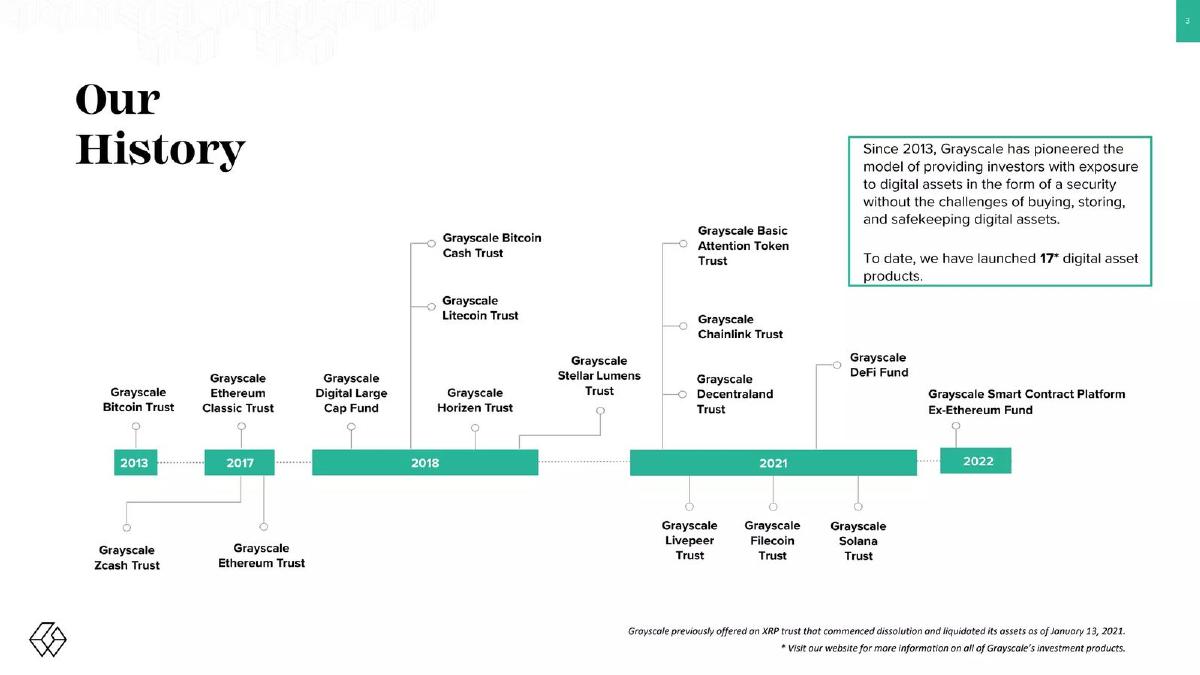
- The company has launched 17 digital asset products since its inception in 2013, as shown on the history timeline (Slide 3).
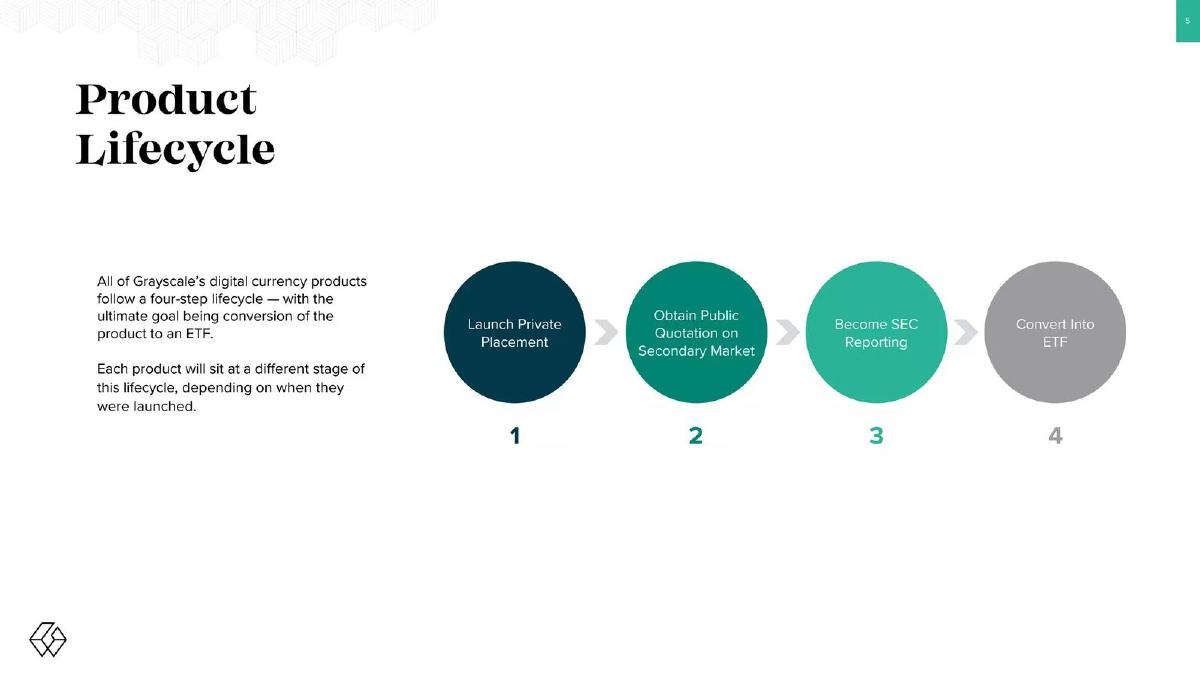
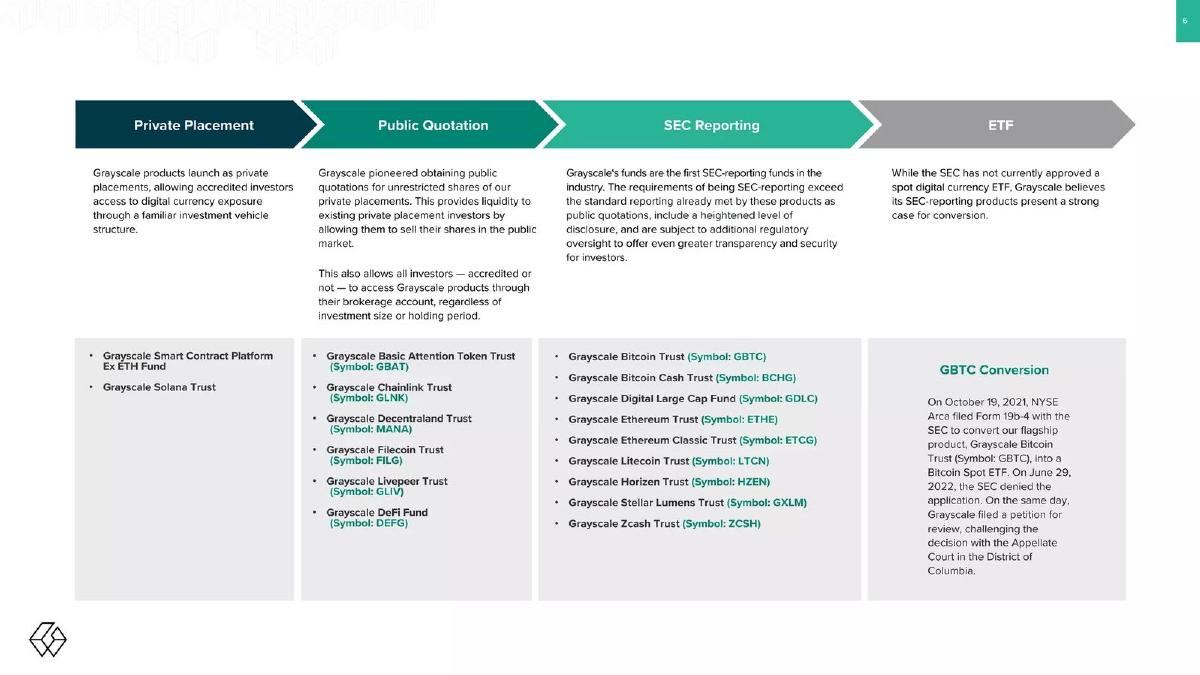
- Grayscale follows a rigid four-step product lifecycle: Private Placement, Public Quotation, SEC Reporting, and finally, ETF Conversion (Slide 5).
- Private placements require a minimum investment of $25,000 and are restricted to accredited investors (Slide 9).
- Publicly quoted shares have no minimum investment and no restricted holding period, allowing access to all investors via brokerage accounts (Slide 9).
- The product suite is organized into six thematic categories: Privacy, Data, Store of Value, Smart Contract Platforms, Payments, and Metaverse (Slide 11).
- The deck highlights a historical liquidation event, noting that an XRP trust commenced dissolution on January 13, 2021 (Slide 3).
- The vision centers on creating 'financial legacies' through exposure to digital asset innovations (Slide 13).
- The deck omits a traditional 'Team' slide, 'Financials' slide, and 'Competitor' slide in this 8-slide selection.
Slide-by-Slide Analysis
Slide 1: Title Slide
The deck opens with a minimalist, high-contrast title slide featuring the Grayscale logo and the text INVESTOR DECK | JANUARY 2023 . The background image is an architectural shot of a modern, metallic building, which evokes a sense of institutional stability and structural sophistication. There are no taglines or value propositions on this slide; it relies entirely on brand recognition.
Slide 3: Our History
This slide provides a comprehensive timeline of the company's growth. It states that since 2013, Grayscale has pioneered the model of providing investors with exposure to digital assets in the form of a security . The timeline highlights key launches: Grayscale Bitcoin Trust (2013) , Ethereum Trust (2017) , and a significant expansion in 2021 with five new products including Chainlink and Filecoin . A small footnote mentions the dissolution of the XRP trust as of January 13, 2021 , showing transparency regarding product exits. The slide notes that to date, they have launched 17 digital asset products .
Slide 5: Product Lifecycle
This is arguably the most important slide in the deck for understanding Grayscale's business model. It outlines a four-step lifecycle for their products: 1. Launch Private Placement , 2. Obtain Public Quotation on Secondary Market , 3. Become SEC Reporting , and 4. Convert Into ETF . The text clarifies that the ultimate goal is the conversion to an ETF. This slide serves to educate investors on the regulatory path and the value-add of Grayscale's legal and compliance infrastructure.
Slide 7: Digital Asset Product Suite & Features
This is a section divider slide. It repeats the architectural imagery from the cover, maintaining a consistent visual identity. It signals a shift from the company's history and structure to the specific details of their current offerings.
Slide 9: Investor Access
This slide breaks down how different types of investors can interact with Grayscale products. It compares Private Placements and Public Quotations . Private Placements are available only to accredited investors , offered periodically, have restricted holding periods (6-12 months) , and require a minimum investment starting at $25,000 . In contrast, Public Quotations are available to all investors , have no restricted holding period , and no minimum investment amount . This slide clearly defines the target audience for each tier of their service.
Slide 11: Grayscale Single Asset Product Themes
To help investors navigate the complex crypto market, Grayscale categorizes their assets into six themes. These include Privacy (Zcash, Horizen), Data (Filecoin, Chainlink), Store of Value (Bitcoin), Smart Contract Platforms (Ethereum, Solana, Cardano), Payments (Bitcoin Cash, Litecoin), and Metaverse (Decentraland). By using these traditional financial categories, Grayscale makes the assets more relatable to institutional portfolio managers who think in terms of sectors and utility.
Slide 13: Future Focus
This slide serves as the vision statement. It uses aspirational language, stating that Grayscale believes investors need to create financial legacies . The text emphasizes three pillars: invest for the future , invest in the future , and build their future in the present . While it lacks specific roadmap milestones for 2023 or 2024, it reinforces the company's long-term commitment to the digital economy.
Slide 15: Contact Information
The final slide provides the company website, Twitter handle ( @Grayscale ), and a New York-based phone number ( 212.668.1427 ). The visual remains consistent with the cover and section dividers, closing the deck with a professional, institutional feel.
What Grayscale Does Well
Grayscale excels at institutional framing . By using terms like "Product Lifecycle," "SEC Reporting," and "Thematic Investing," they translate the often-chaotic world of cryptocurrency into a language that traditional fund managers and accredited investors understand. The Product Lifecycle slide (Slide 5) is particularly effective because it turns a regulatory hurdle into a clear, value-creating roadmap. It gives investors a reason to buy in early (private placement) with the expectation of future liquidity (ETF conversion).
Furthermore, the thematic categorization on Slide 11 is a masterclass in product positioning. Instead of presenting a list of 17 random tokens, they present a diversified technology portfolio. This encourages investors to think about "Smart Contract Platforms" as a sector rather than just speculating on the price of Ethereum or Solana.
What is Missing from the Deck
The most glaring omission in this 8-slide selection is financial performance and AUM . For an investment firm, the most critical metrics are Assets Under Management, fee revenue, and the historical performance of the trusts against their underlying assets (including premiums or discounts to NAV). None of this is present here.
Additionally, there is no team slide . In the world of high-finance and crypto, the pedigree of the management team, their regulatory experience, and their technical expertise are paramount. The deck also lacks a competitive analysis . In 2023, Grayscale was facing significant competition from other ETP providers and the looming threat of spot Bitcoin ETF approvals from larger players like BlackRock, yet the deck does not address how Grayscale maintains its market share or defends its fee structure.
What You Should Copy for Your Own Deck
The Regulatory Roadmap: If your startup operates in a highly regulated space (FinTech, MedTech, Energy), use a slide like Grayscale's "Product Lifecycle" to show exactly how you will navigate from a MVP to a fully compliant, mass-market product. · Thematic Grouping: If you have a wide range of products or features, group them into "Themes" or "Sectors." This helps investors understand your strategic breadth without getting lost in the technical weeds of every individual offering. · Clear Access Tiers: If your business has different entry points for different customers (e.g., B2B vs. B2C, or Enterprise vs. SMB), use a side-by-side comparison like Slide 9 to clearly define the requirements and benefits of each. · Visual Consistency: Use high-quality, professional imagery that reflects the "vibe" of your industry. Grayscale's use of modern architecture perfectly matches their goal of being seen as an institutional pillar.
Frequently asked questions
- What is the primary goal of Grayscale's product strategy?
- According to Slide 5, the ultimate goal for all of Grayscale's digital currency products is the conversion into an Exchange Traded Fund (ETF). The deck outlines a clear four-step progression—starting from private placements and moving through public quotations and SEC reporting—to reach this final regulatory milestone, which provides the highest level of liquidity and accessibility for investors.
- How does Grayscale categorize different cryptocurrencies for investors?
- Grayscale uses a thematic approach to simplify the digital asset landscape. Slide 11 breaks their products into six themes: Privacy (e.g., Zcash), Data (e.g., Chainlink), Store of Value (Bitcoin), Smart Contract Platforms (e.g., Ethereum, Solana), Payments (e.g., Litecoin), and Metaverse (e.g., Decentraland). This helps investors understand the utility and market role of each specific asset beyond simple price speculation.
- What are the requirements for participating in a Grayscale private placement?
- As detailed on Slide 9, private placements are restricted to accredited investors only. They require a minimum investment of $25,000 and involve restricted holding periods. These periods range from six months for SEC-reporting products to one year for non-SEC reporting products, making them a vehicle for longer-term institutional or high-net-worth capital rather than retail traders.
- How long has Grayscale been operating in the digital asset space?
- Grayscale established its first product, the Grayscale Bitcoin Trust, in 2013. The timeline on Slide 3 shows a steady expansion: adding Zcash and Ethereum products in 2017, diversifying into Large Cap and Horizen in 2018, and rapidly scaling with five new trusts in 2021 and a Smart Contract Platform fund in 2022.
- What information is missing from this investor deck?
- This specific 8-slide set is focused on product structure and history. It lacks critical investment data such as Assets Under Management (AUM), management fee structures, and historical fund performance relative to benchmarks. Additionally, there is no mention of the executive leadership team or a specific 'Ask' regarding a funding round, suggesting this may be a general marketing deck for prospective fund investors rather than a venture capital pitch.