Granulate’s Series A deck is a lean, 12-slide presentation that prioritizes high-impact technical metrics over narrative fluff. By leading with specific performance promises—such as a 60% reduction in costs and 5x increase in throughput—the company establishes immediate credibility. The deck effectively frames the 'optimization challenge' as a multi-billion dollar waste problem caused by technical complexity and dynamic environments. A significant portion of the deck's strength lies in its team slide, which highlights the founders' backgrounds in Israel’s elite Talpiot program and Unit 8200.…
Key takeaways
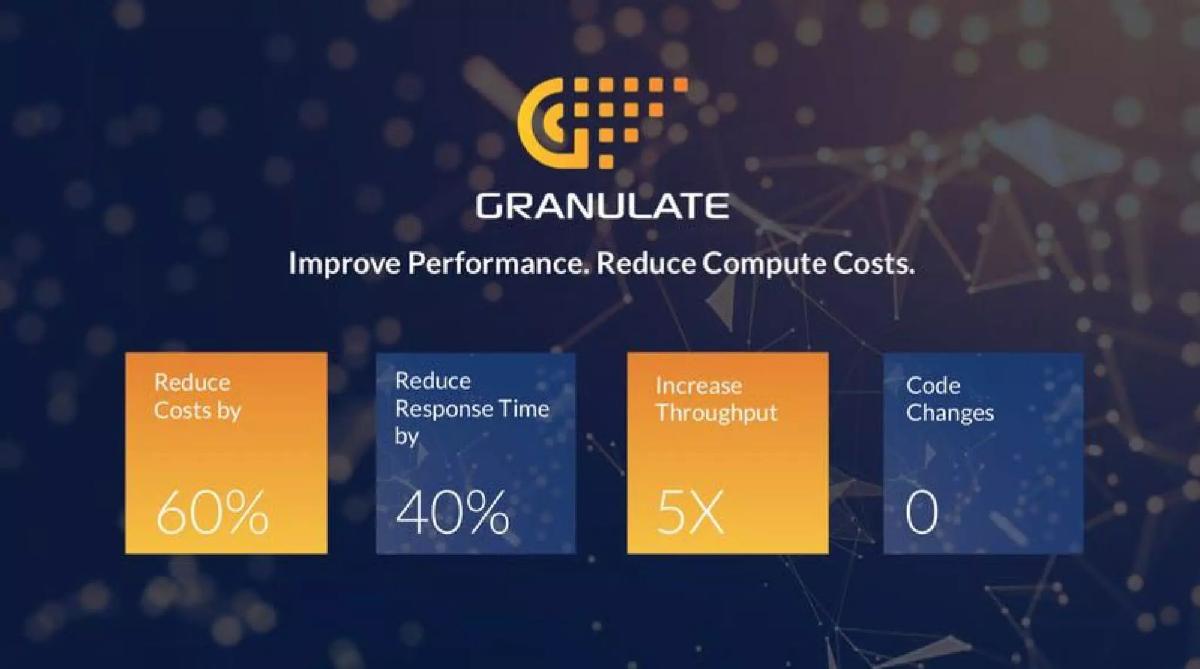
- The deck leads with four specific, quantifiable value drivers: 60% cost reduction, 40% response time reduction, 5x throughput, and zero code changes (Slide 2).
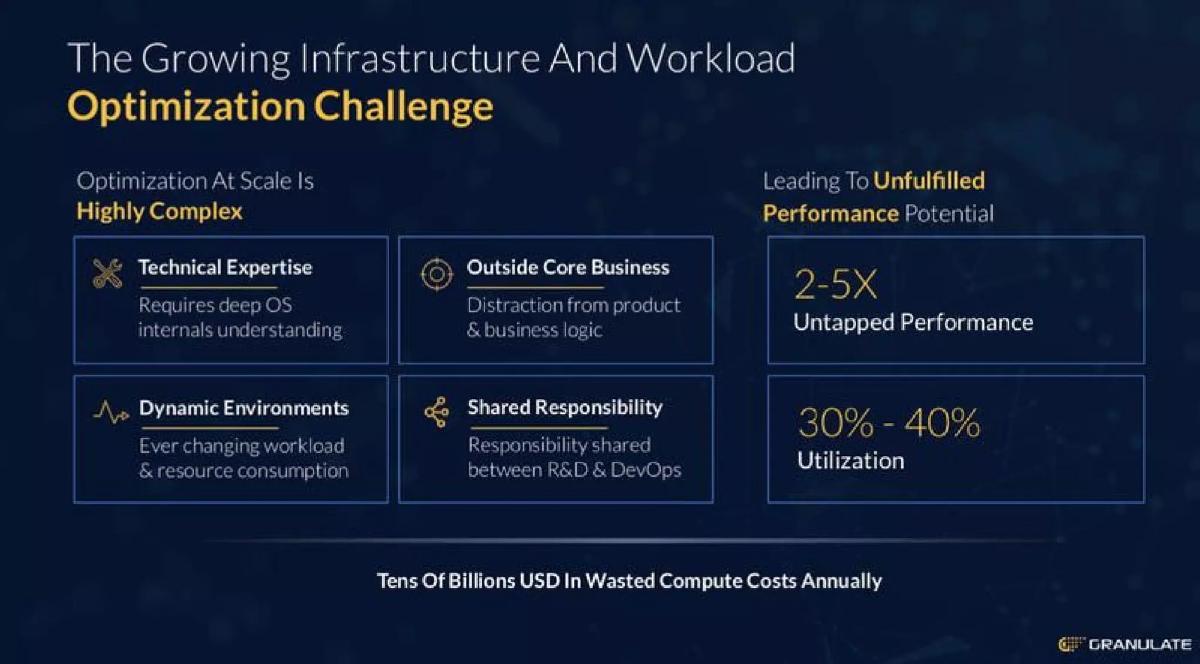
- Infrastructure waste is framed as a 'Tens of Billions USD' problem driven by low (30-40%) utilization rates (Slide 3).
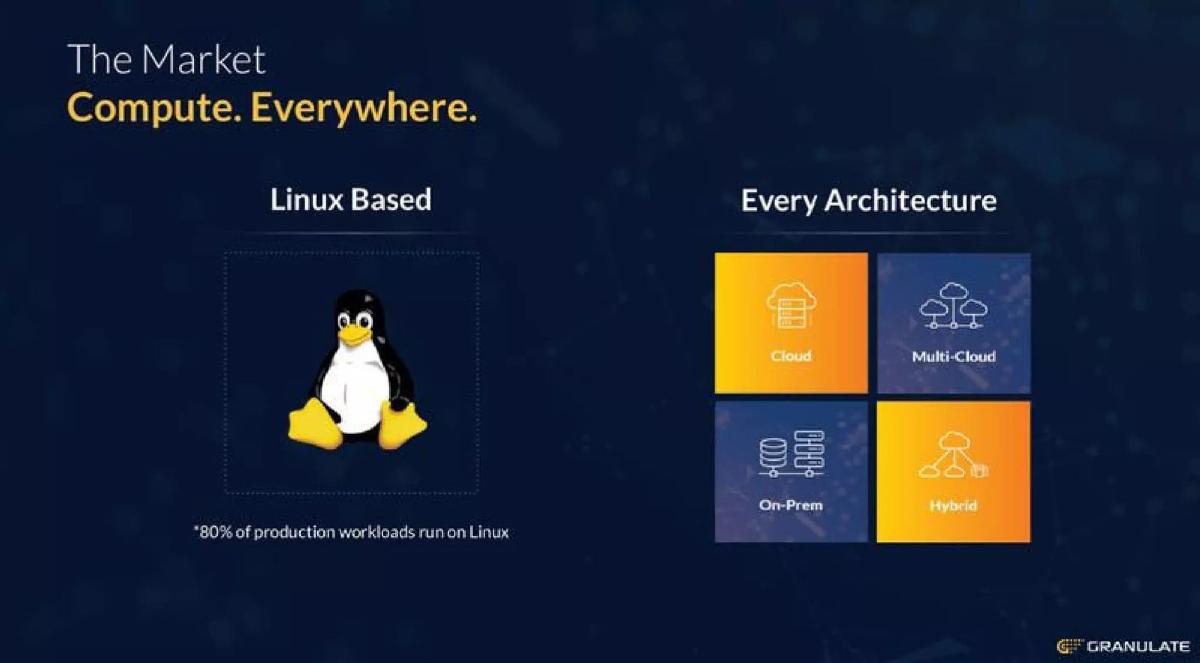
- The market opportunity is anchored in the fact that 80% of production workloads run on Linux (Slide 4).
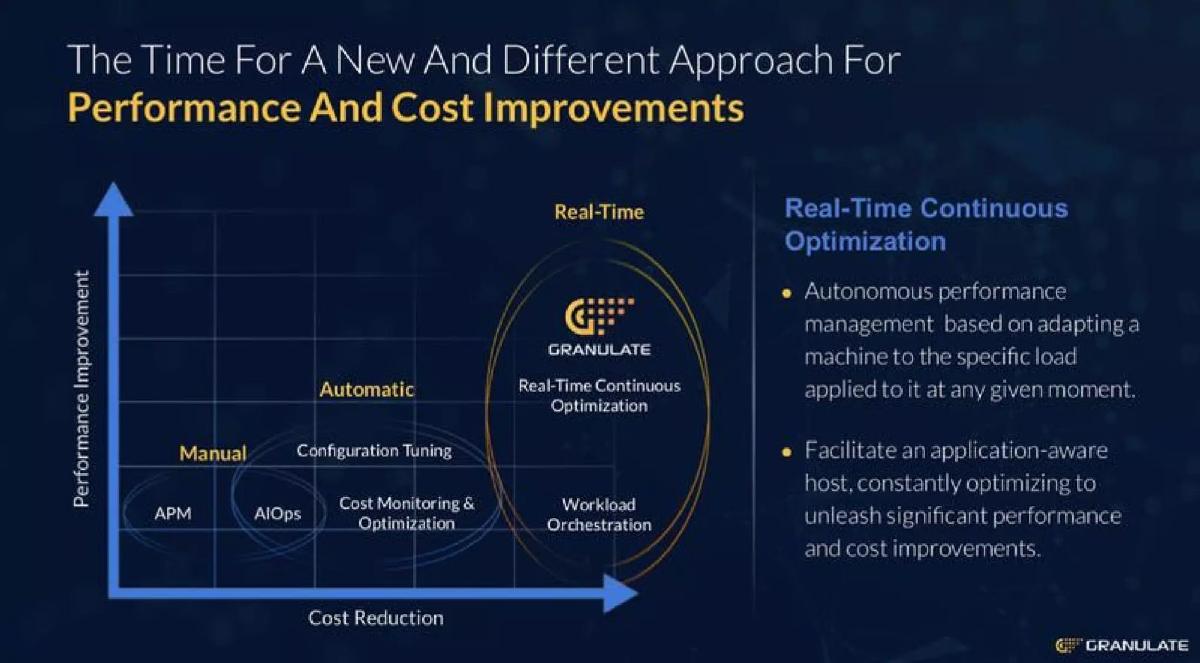
- Granulate positions itself in a 'Real-Time' category, distinct from manual APM or automatic configuration tuning tools (Slide 5).
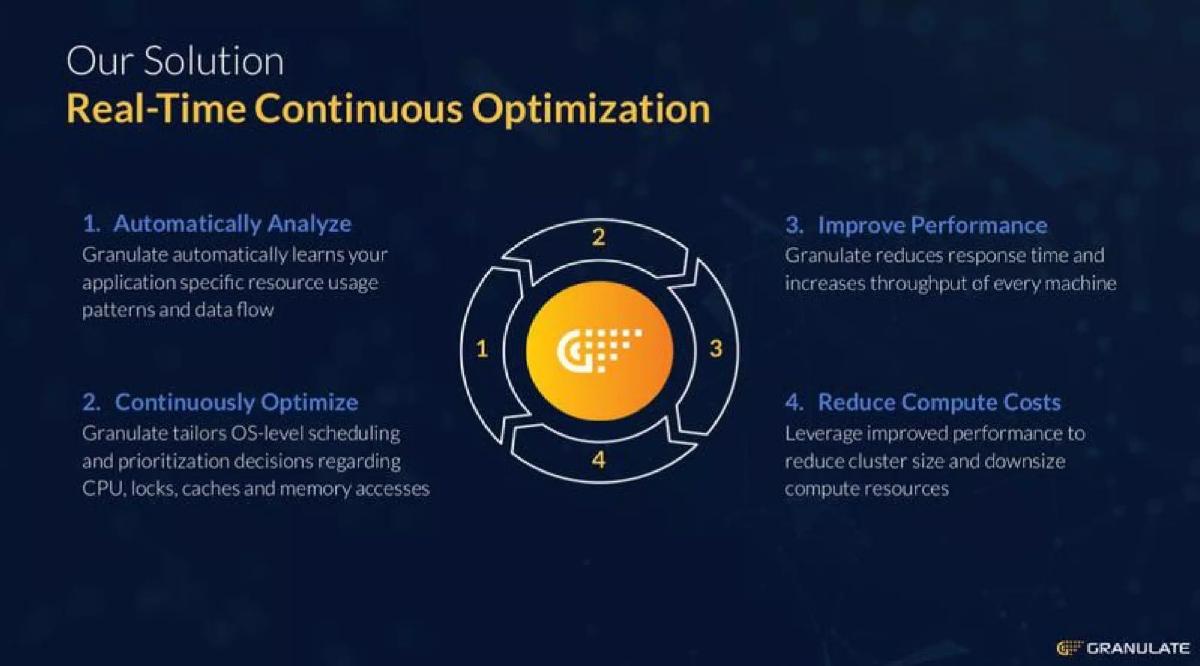
- The solution is defined as an OS-level scheduler that tailors decisions regarding CPU, locks, caches, and memory (Slide 6).
- Implementation friction is addressed by promising 'Quick Value Within Minutes' and 'Zero R&D Efforts' (Slide 7).
- The company highlights infrastructure agnosticism, showing compatibility with AWS, Azure, GCP, Docker, and Kubernetes (Slide 8).
- The founders leverage extreme technical pedigree, citing 19 combined years in Israel's elite Technological Unit 8200 (Slide 11).
Introduction: The $12M Series A Blueprint
Granulate’s 2020 Series A deck is a study in technical brevity. At just 12 slides, it avoids the common pitfall of over-explaining the 'why' of the cloud and instead focuses on the 'how' of optimization. The company, which provides an autonomous real-time computing optimization solution, uses this deck to bridge the gap between high-level business outcomes (cost savings) and deep-system technical execution (OS-level scheduling).
Slides 1-2: The Hook and The Promise
Slide 1 is a standard title slide featuring the company logo and the tagline: "Real-time Continuous Optimization." It sets a professional, technical tone without unnecessary visual clutter.
Slide 2 is arguably the most important slide in the deck. It presents four 'hard' metrics that define the product's value proposition: Reduce Costs by 60% , Reduce Response Time by 40% , Increase Throughput 5X , and Code Changes: 0 . By putting these figures upfront, Granulate answers the investor's most pressing question—"What does this actually do for a customer?"—before they even get to the problem slide. The '0 code changes' claim is a vital inclusion, as it addresses the primary objection to infrastructure software: implementation effort.
Slides 3-4: Framing the Problem and the Market
Slide 3 , titled "The Growing Infrastructure And Workload Optimization Challenge," breaks the problem into four quadrants: Technical Expertise, Outside Core Business, Dynamic Environments, and Shared Responsibility. It quantifies the pain point by stating that workloads typically see only 30% - 40% Utilization , leading to 2-5X Untapped Performance . The footer of the slide anchors the market size: "Tens Of Billions USD In Wasted Compute Costs Annually."
Slide 4 defines the addressable market through the lens of operating systems and architectures. It notes that "80% of production workloads run on Linux," which serves as a proxy for their Total Addressable Market (TAM). The slide also lists Cloud, Multi-Cloud, On-Prem, and Hybrid as the target architectures, signaling that the solution is not limited to a specific cloud provider.
Slides 5-6: Positioning and Technical Solution
Slide 5 uses a positioning matrix to separate Granulate from the legacy market. It plots "Performance Improvement" against "Cost Reduction." While existing categories like APM (Application Performance Monitoring), AIOps, and Configuration Tuning are clustered in the lower-left (Manual/Automatic), Granulate claims the top-right "Real-Time" circle. The text explains that the tool facilitates an "application-aware host," which is a key technical differentiator.
Slide 6 explains the four-step process of the solution: 1. Automatically Analyze (learning resource usage patterns), 2. Continuously Optimize (tailoring OS-level scheduling for CPU, locks, caches, and memory), 3. Improve Performance , and 4. Reduce Compute Costs . This slide is critical because it moves the conversation from 'what' to 'how,' specifically mentioning OS-level interventions which require deep technical trust from the buyer.
Slides 7-8: Integration and Agnosticism
Slide 7 focuses on the 'Ease of Installation.' It reiterates the "No Code Changes" promise and adds that users can "Start With A Single VM" and see "Quick Value Within Minutes." This is designed to lower the perceived risk of a trial or Proof of Concept (PoC).
Slide 8 is a logo wall of integrations. It shows that Granulate is "Infrastructure Agnostic," featuring logos for Microsoft Azure, Google Cloud Platform, AWS, VMware, OpenShift, OpenStack, Docker, and Kubernetes . For a Series A investor, this slide proves that the product can scale across the entire modern enterprise stack without hitting compatibility walls.
Slides 9-10: Traction and Growth
Slide 9 reinforces the value proposition by stating that "Dozens of Enterprises & Startups Adopt Granulate Because it Saves Time & Money." It repeats the 60%/40%/5X/0 metrics from Slide 2, which serves as a thematic bookend to the technical section of the deck.
Slide 10 is the traction slide, though in this version, the specific data is redacted. The headers indicate what Granulate was tracking: Revenue Growth , Customer Growth , CPU Cores Under Management , and Saved Compute Hours Per Day . The placeholder text "The graph goes up and to the right" confirms that the company had significant momentum to show during the actual pitch. The mention of "XX,000 in CPU Cores Under Management" suggests they were operating at a significant scale by 2020.
Slides 11-12: The Team and Closing
Slide 11 , "Company Snapshot," is a powerhouse team slide. It highlights CEO Asaf Ezra and CTO Tal Saiag. Both are listed as "Israel's Elite Talpiot Program Alumnus." Ezra is credited with 10 years as a Technological Group Manager in Unit 8200 , while Saiag is credited with 9 years in the same unit. This level of pedigree is often a primary driver for deep-tech investments, as it suggests the founders have handled high-stakes, military-grade performance challenges. The slide also notes a $3.6M Seed round, a Founded 2018 date, Patent Pending status, and a team of 14 Employees .
Slide 12 is a simple contact slide with the company email and website.
What Works in the Granulate Deck
The most effective element of this deck is its quantified value proposition . By leading with 60% cost reduction and 5x throughput, Granulate makes a compelling economic case immediately. The deck also does an excellent job of de-risking the technical implementation . The repeated emphasis on "Zero Code Changes" and "Zero R&D Efforts" addresses the biggest barrier to entry for infrastructure software.
Furthermore, the pedigree signaling is top-tier. In the world of cybersecurity and infrastructure, a background in Unit 8200 and the Talpiot program acts as a gold standard for technical competence. This allows the founders to make bold claims about OS-level optimization that might otherwise be met with skepticism.
What is Missing from the Granulate Deck
Despite its success, the deck has several notable omissions. There is no detailed competitive landscape . While Slide 5 shows a positioning matrix, it doesn't name specific competitors or explain why Granulate's OS-level approach is defensible against cloud native tools (like AWS's own optimization features).
There is also no 'Ask' slide . A standard pitch deck should clearly state how much capital is being raised and how that capital will be deployed (e.g., hiring, sales expansion, R&D). Additionally, the deck lacks case studies or testimonials . While it mentions "Dozens of Enterprises," showing one specific success story with a named brand would have added significant social proof.
What a Founder Should Copy
The 'Metric First' Approach: Don't bury your results. If your product saves money or time, put the exact percentages on Slide 2. · Pedigree Highlighting: If your team has elite experience (military, FAANG, or academic), don't just list the names. Explain the specific relevance of that experience to the problem you are solving. · Friction Reduction: Explicitly state how hard it is to install your product. If it requires no code changes, make that a headline. · Infrastructure Agnosticism: If you are building for the enterprise, show a logo wall of the environments you support to prove you aren't a niche tool. · Visual Consistency: The deck uses a consistent dark blue and orange palette that feels 'enterprise-ready' and professional.
Frequently asked questions
- What is the core value proposition of Granulate?
- Granulate offers real-time continuous optimization for compute workloads. According to slide 2, the software aims to reduce compute costs by 60%, reduce response times by 40%, and increase throughput by 5x. Crucially, it promises these results with '0' code changes, positioning itself as a low-friction, high-ROI infrastructure tool for enterprises and startups.
- How does Granulate differentiate itself from other optimization tools?
- Slide 5 uses a 2x2 matrix to position Granulate. While competitors in the APM and AIOps space are categorized as 'Manual' or 'Automatic' with lower performance improvement, Granulate claims the 'Real-Time' quadrant. It differentiates by being 'application-aware' at the host level, optimizing OS-level scheduling rather than just monitoring or tuning configurations.
- What technical environments does Granulate support?
- The deck emphasizes broad compatibility. Slide 4 notes that 80% of production workloads run on Linux, which is their primary target. Slide 8 further illustrates that the solution is infrastructure-agnostic, integrating with major cloud providers (AWS, Azure, GCP), virtualization layers (VMware), and orchestration tools (Kubernetes, Docker, OpenShift).
- What is the significance of the team's background in this deck?
- The team slide (Slide 11) is a major credibility signal. Both founders are alumni of Israel's elite Talpiot program. CEO Asaf Ezra and CTO Tal Saiag spent 10 and 9 years respectively at Unit 8200, Israel's top technological military unit. This pedigree suggests a deep expertise in 'military-grade' application performance and large-scale cross-platform frameworks.
- What key fundraising elements are missing from this deck?
- This version of the deck is missing a specific 'Ask' slide (how much they are raising and why), detailed unit economics (CAC/LTV), and a granular roadmap. Additionally, Slide 10 contains placeholders for revenue and customer growth, indicating that the specific traction data was redacted for public viewing or was intended to be delivered verbally.