Onto’s 2021 Series B deck is a masterclass in using comparative metrics to validate a capital-intensive business model. By positioning an electric vehicle subscription as a lifestyle service rather than a traditional car lease, Onto successfully raised $175M. The deck leans heavily on three pillars: 200% annual growth over three years, a fully digital end-to-end user journey, and a retention curve that benchmarks the company against high-frequency consumer giants like Netflix. While the deck lacks a formal team slide or detailed unit economics in the core 11-slide sequence, it compensates wit…
Key takeaways
- Onto reported a 200% annual growth rate sustained over a three-year period (Slide 3).
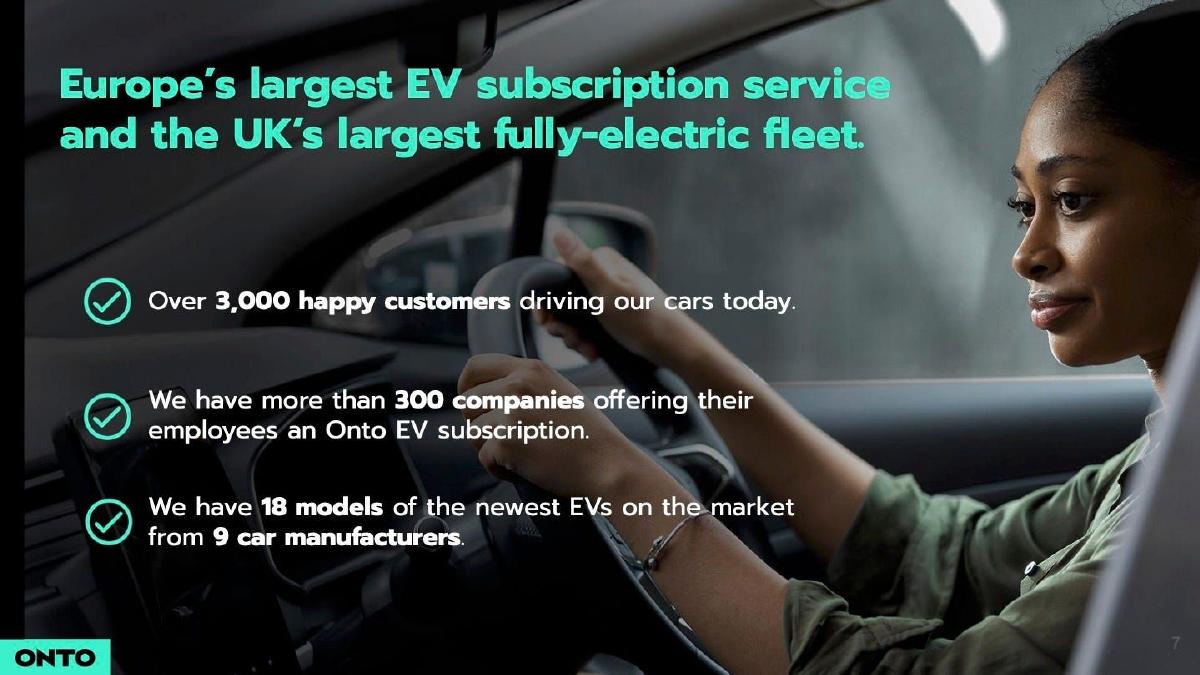
- The company positions itself as the largest EV subscription service in Europe and the UK’s largest fully-electric fleet (Slide 7).
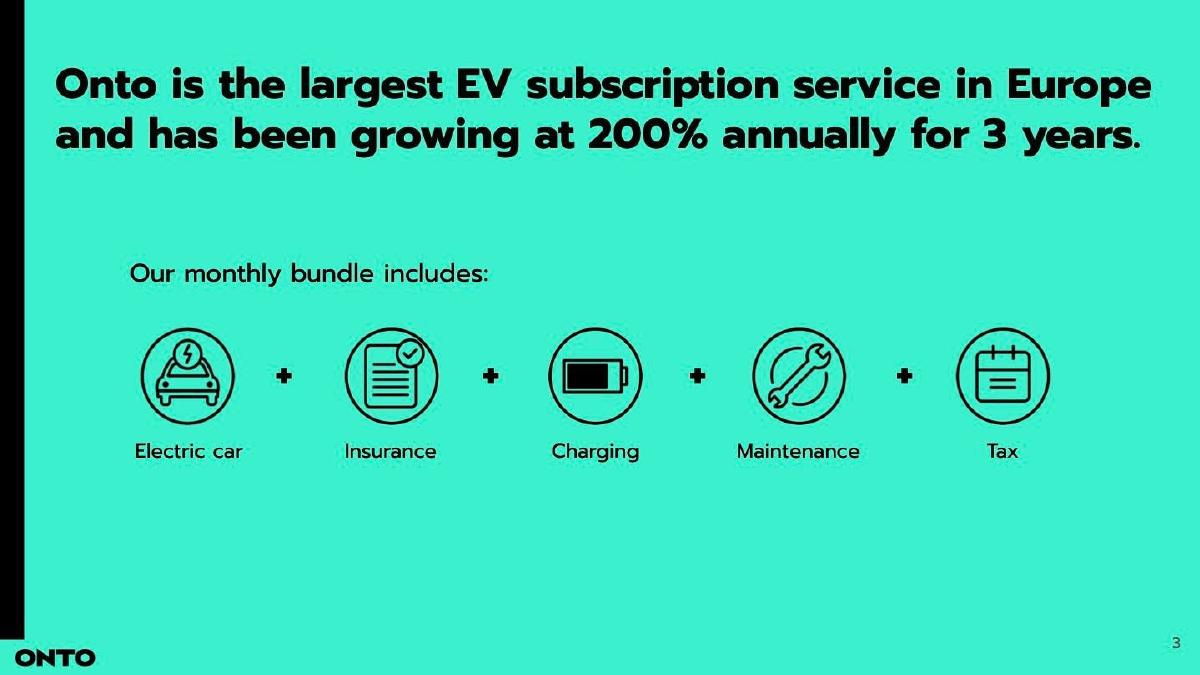
- The business model relies on an all-inclusive monthly bundle covering the car, insurance, charging, maintenance, and tax (Slide 3).
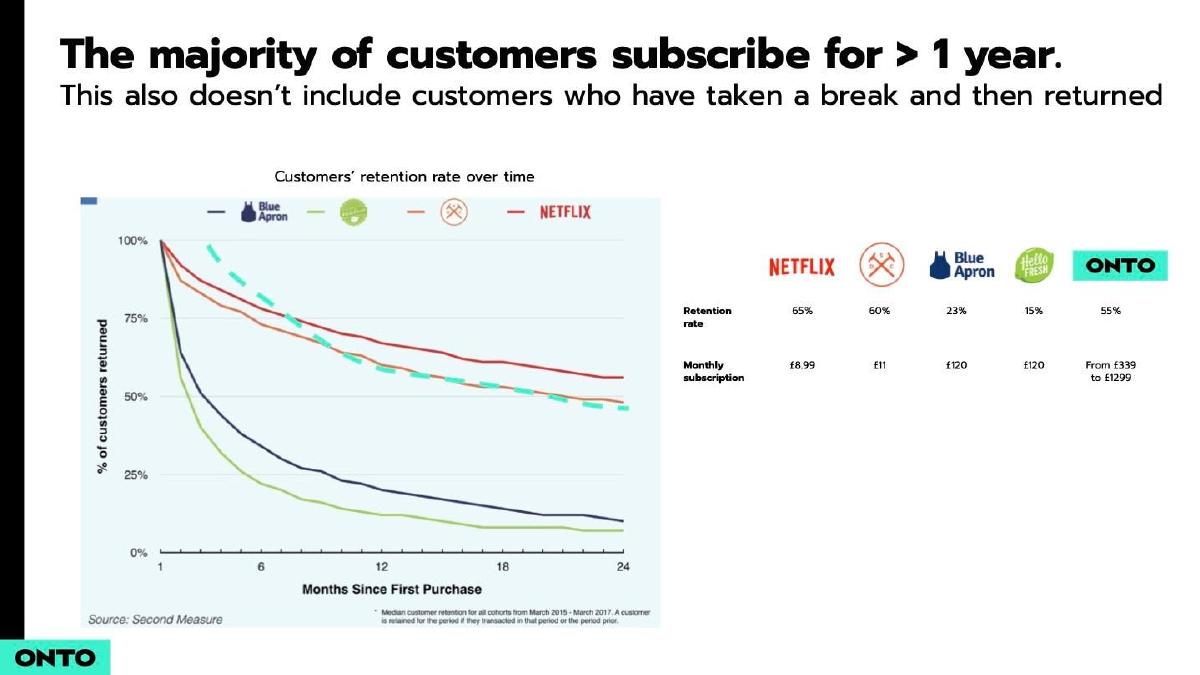
- Onto claims a 55% retention rate, which it benchmarks against Netflix (65%) and Dollar Shave Club (60%) to prove long-term viability (Slide 9).
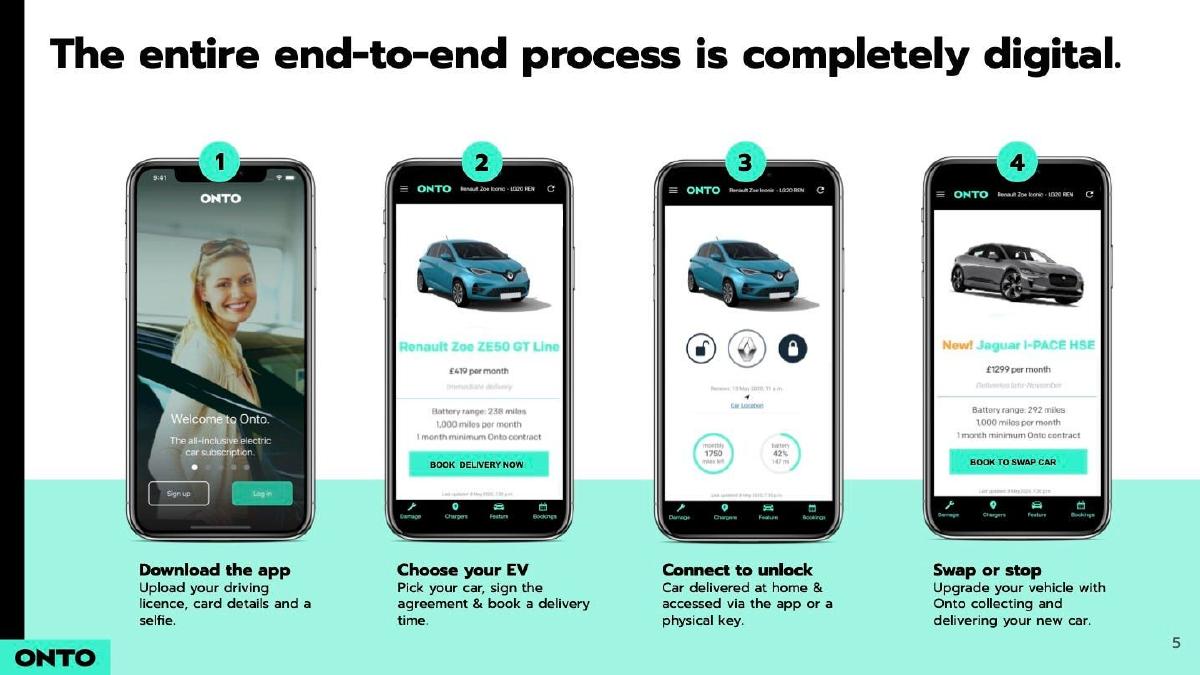
- The user experience is entirely digital, enabling car swaps and unlocking via a mobile app (Slide 5).
- The fleet diversity is a key selling point, featuring 18 different EV models from 9 manufacturers (Slide 7).
- The company has successfully expanded into B2B, with over 300 companies offering subscriptions to employees (Slide 7).
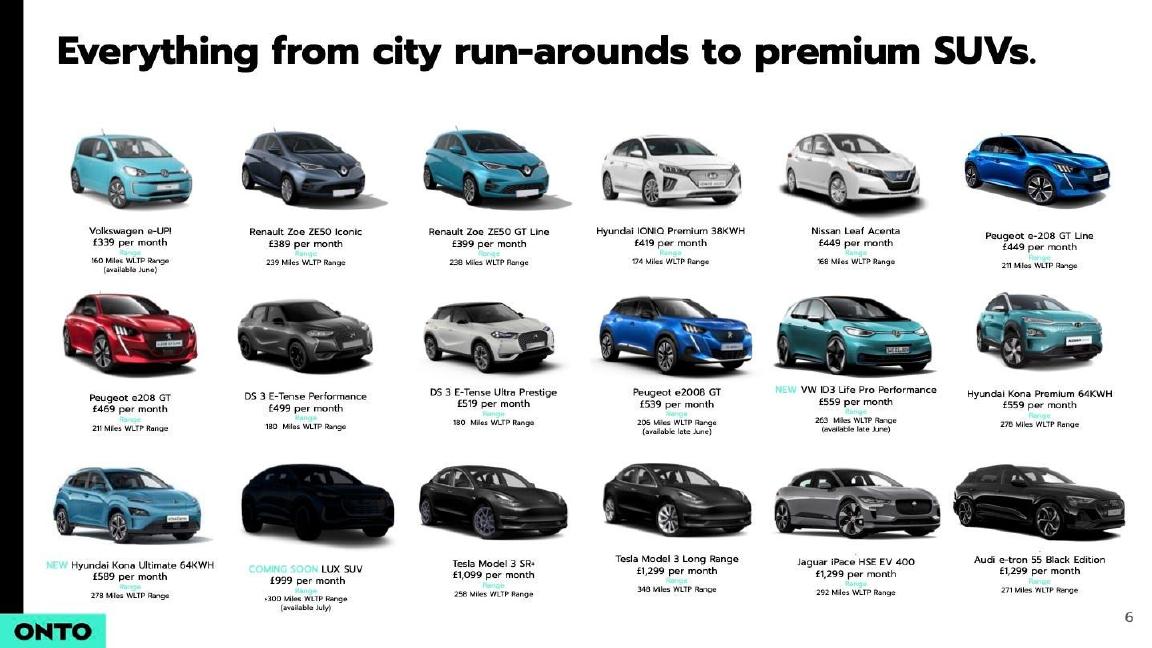
- Pricing transparency is highlighted with specific examples ranging from £419 to £1299 per month (Slide 5).
Onto: The $175M Series B Pitch Deck Analysis
Onto’s 2021 pitch deck arrived at a pivotal moment for the electric vehicle (EV) market. As consumer interest in EVs surged, the barriers to entry—high upfront costs, charging anxiety, and insurance complexities—remained significant. Onto’s deck focuses on how they have productized the solution to these barriers through a subscription model. The deck is concise, totaling 11 slides, and relies on high-level growth metrics and lifestyle branding to secure a massive $175M Series B round.
Slide 1: Title Slide
The deck opens with a high-resolution image of a user charging an EV, immediately grounding the company in the transportation and energy sector. The tagline, "the future of cars," is bold, while the sub-header, "All-in electric car subscriptions," clearly defines the category. The date, July 2021, establishes the context of the raise. The visual language is clean, using a black and teal palette that feels modern and tech-centric.
Slide 3: The Value Proposition and Growth
Slide 3 is arguably the most important slide for establishing the company's market position. It leads with a powerful headline: "Onto is the largest EV subscription service in Europe and has been growing at 200% annually for 3 years." This provides immediate validation of product-market fit and execution capability. Below the headline, the "monthly bundle" is broken down into five icons: Electric car, Insurance, Charging, Maintenance, and Tax. By explicitly stating what is included, Onto addresses the primary pain points of car ownership in one view. The simplicity of the icons mirrors the simplicity they claim to bring to the consumer experience.
Slide 5: The Digital User Journey
This slide focuses on the "how." By stating "The entire end-to-end process is completely digital," Onto differentiates itself from traditional car dealerships and leasing companies that often require physical paperwork and showroom visits. The slide uses four smartphone mockups to walk through the user flow: 1) Onboarding (license upload/selfie), 2) Selection (choosing a Renault Zoe for £419/month), 3) Access (unlocking via app), and 4) Flexibility (swapping to a Jaguar I-PACE for £1299/month). This slide effectively demonstrates the product's UI/UX while also showing the range of their inventory and the price points they command.
Slide 7: Traction and Fleet Scale
Onto uses Slide 7 to quantify their operational success. The headline reinforces their status as the UK’s largest fully-electric fleet. Three key metrics are highlighted: "Over 3,000 happy customers," "more than 300 companies" in their B2B segment, and a fleet consisting of "18 models... from 9 car manufacturers." The mention of 300 companies is particularly significant for a Series B deck, as it suggests a diversified revenue stream and a scalable B2B2C acquisition channel that can lower customer acquisition costs (CAC) compared to pure D2C marketing.
Slide 9: The Retention Benchmark
Slide 9 is a sophisticated piece of data storytelling. Instead of just showing their own retention curve, Onto benchmarks themselves against established subscription giants. The graph shows "Customers' retention rate over time" for Netflix, Dollar Shave Club, Blue Apron, and HelloFresh. Onto claims a 55% retention rate at the 24-month mark. By placing themselves just below Netflix (65%) and well above meal-kit services like Blue Apron (23%), Onto argues that their service is a "sticky" utility rather than a discretionary luxury. This is a crucial argument for a capital-intensive business; high retention justifies the massive debt and equity required to purchase and maintain a vehicle fleet.
Slide 11: The Appendix Transition
The final slide in the sequence is a simple "Thank you!" and "Appendix" marker. It features a close-up of a Peugeot EV with a custom "ON70" license plate, reinforcing the brand identity. While the core deck ends here, the mention of an appendix suggests that more granular data—likely the missing unit economics and financial projections—were available for the due diligence phase.
What Onto Does Well
1. Comparative Benchmarking: The use of Slide 9 to compare retention against Netflix is a brilliant move. It reframes a car subscription as a high-frequency digital service. Investors are often wary of automotive startups due to churn and cyclicality; Onto uses this slide to prove their model behaves more like a SaaS or premium media subscription.
2. Frictionless Narrative: The deck repeatedly emphasizes how easy the service is. From the five-icon bundle on Slide 3 to the four-step digital journey on Slide 5, the message is clear: Onto has removed every hurdle to EV adoption. This is a powerful narrative for an industry known for complex contracts and hidden costs.
3. Scale Indicators: By July 2021, having 3,000 customers and 300 B2B partners provided enough proof of concept to move from Series A to Series B. The mention of 18 different models shows they have successfully navigated the supply chain and established relationships with major OEMs (Original Equipment Manufacturers).
What is Missing from the Deck
1. Team Slide: In the 11 slides provided, there is no mention of the founders or the leadership team. For a $175M raise, investors typically want to see a team with deep expertise in logistics, automotive finance, and technology. This was likely included in the appendix or a separate document.
2. Unit Economics: While retention is shown, the deck does not disclose the Contribution Margin per vehicle, the Customer Acquisition Cost (CAC), or the Payback Period. In a business where you are buying depreciating assets (cars), these numbers are the difference between a sustainable business and a cash bonfire.
3. The Ask: The deck does not explicitly state how much money is being raised or how it will be spent. While we know from publisher reports that the round was $175M, a standard pitch deck usually includes a slide detailing the use of funds (e.g., fleet expansion, geographic growth, R&D).
Lessons for Founders
1. Use the 'All-In' Strategy: If your product simplifies a complex process, use a single slide to show everything you’ve consolidated. Onto’s Slide 3 is a perfect example of how to visualize a value proposition that replaces multiple vendors with one service.
2. Benchmark Against the Best: Don't just show your metrics in a vacuum. If your retention is good, show how it compares to the gold standards in the subscription economy. It gives investors a familiar frame of reference to judge your performance.
3. Highlight B2B as a Growth Lever: If you are primarily a D2C company but have a growing B2B segment, highlight it. It suggests a more stable, lower-churn revenue base and professional validation of your service quality.
Frequently asked questions
- What is Onto's core value proposition?
- Onto provides an all-inclusive electric vehicle subscription service. As shown on Slide 3, the monthly fee covers the electric car, insurance, charging, maintenance, and tax. The goal is to eliminate the complexities of EV ownership and traditional leasing through a single, predictable monthly payment and a fully digital user experience.
- How does Onto compare its retention to other subscription services?
- On Slide 9, Onto compares its 55% retention rate to major consumer brands. It sits just below Netflix (65%) and Dollar Shave Club (60%), but significantly outperforms meal-kit services like Blue Apron (23%) and HelloFresh (15%). This comparison is used to argue that car subscriptions are a high-stickiness consumer habit.
- What is the scale of Onto's operations according to the deck?
- As of July 2021, Onto reported over 3,000 active customers and partnerships with more than 300 companies. Their fleet includes 18 different EV models from 9 different manufacturers, positioning them as the largest fully-electric fleet in the United Kingdom (Slide 7).
- How does the digital 'end-to-end' process work?
- Slide 5 outlines a four-step digital journey: 1) App download and identity verification via selfie/license upload; 2) Vehicle selection and digital contract signing; 3) Delivery and app-based unlocking; and 4) The ability to swap or stop the subscription with vehicle collection and delivery handled by Onto.
- What key information is missing from this Series B deck?
- The deck lacks several standard components, including a team slide, a competitive landscape analysis, and detailed unit economics (CAC/LTV). It also does not explicitly state the amount being raised or the specific allocation of capital, though publisher reports confirm a $175M raise.