Onramper's 2022 Seed deck is a masterclass in explaining a technical middleware solution through clear visual metaphors. By positioning themselves as the 'single plug' for the fragmented world of fiat gateways, they successfully raised $6M. The deck focuses heavily on the friction of existing options—either building in-house or managing dozens of individual API integrations—and presents a unified widget as the antidote. While the deck is light on historical financial performance and specific customer logos, it leans into the massive growth of the crypto market, projecting a $1.77B revenue opp…
Key takeaways
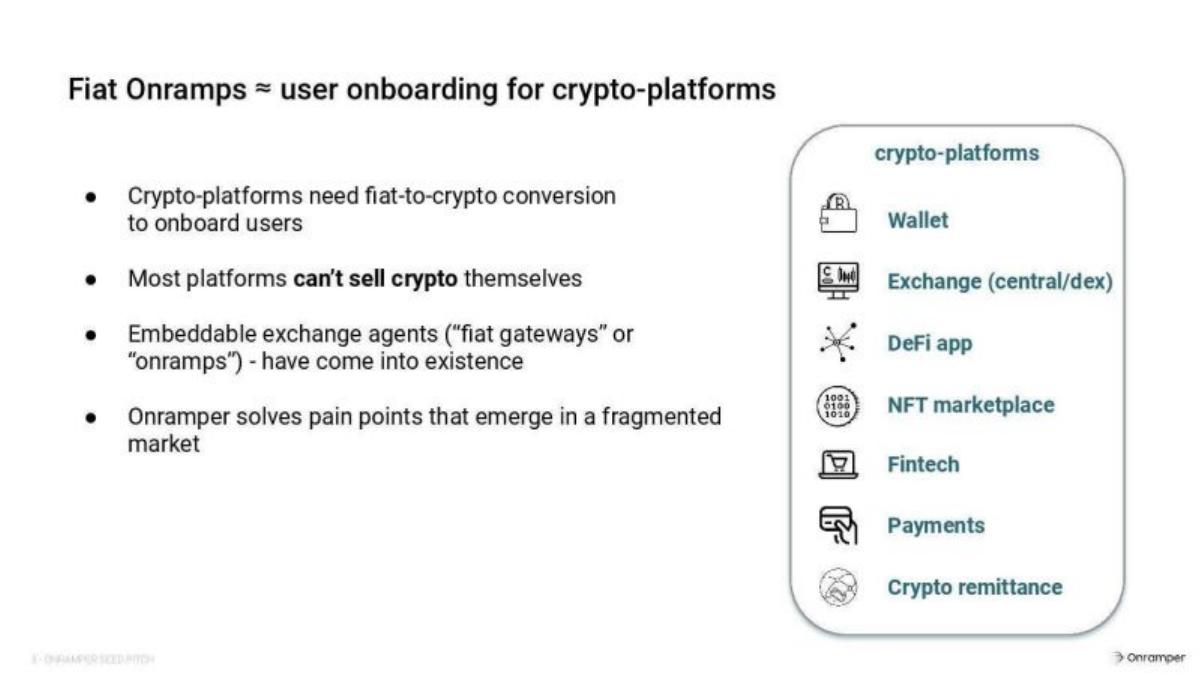
- The company positions fiat onramps as the primary bottleneck for user onboarding in crypto-platforms (Slide 3).
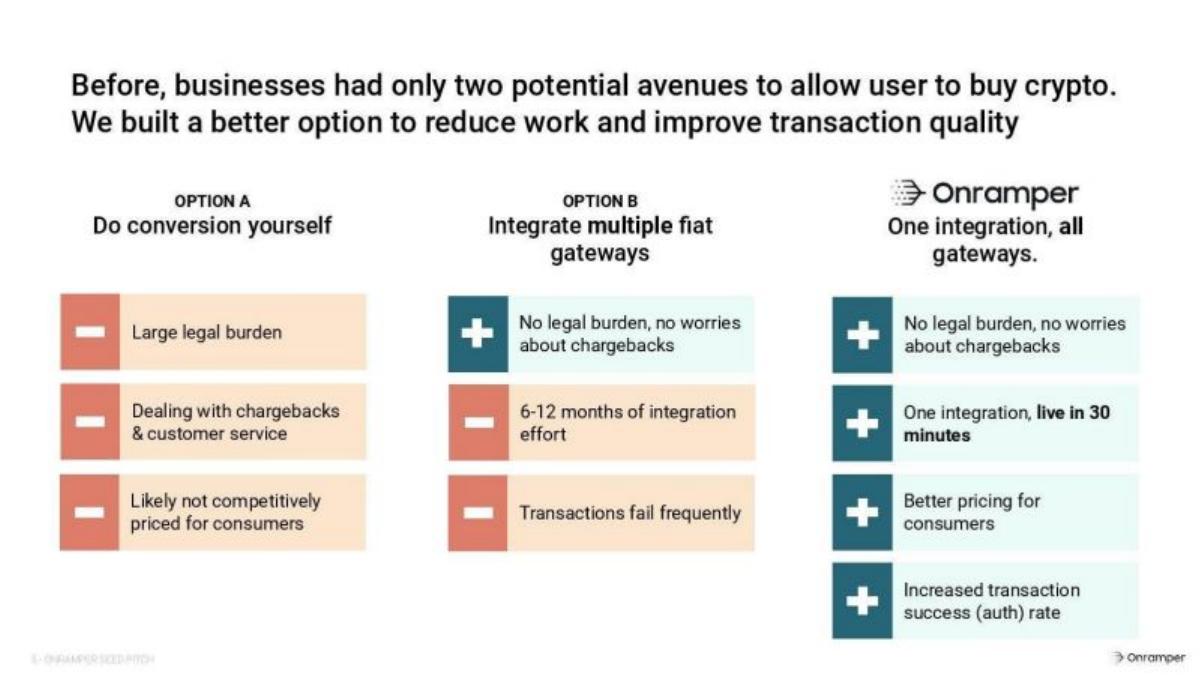
- Onramper claims their solution can be live in 30 minutes, compared to 6-12 months for manual multi-gateway integration (Slide 5).
- The business operates on a B2B2C model, charging a 1% fee on every transaction (Slide 9).
- Market sizing estimates a Serviceable Obtainable Market (SOM) of $23.8B in fiat-crypto transactions (Slide 10).
- The deck projects that a 1% fee on their 2030 SOM would result in $1.77B in obtainable revenue (Slide 10).
- User acquisition is currently driven almost exclusively by inbound volume across wallets, exchanges, and DeFi apps (Slide 11).
- The platform supports over 150 cryptocurrencies and 50+ fiat currencies across 180+ countries (Slide 8).
- The deck lacks a specific 'Ask' slide detailing the exact use of funds or the valuation sought for the $6M round.
Introduction and Vision
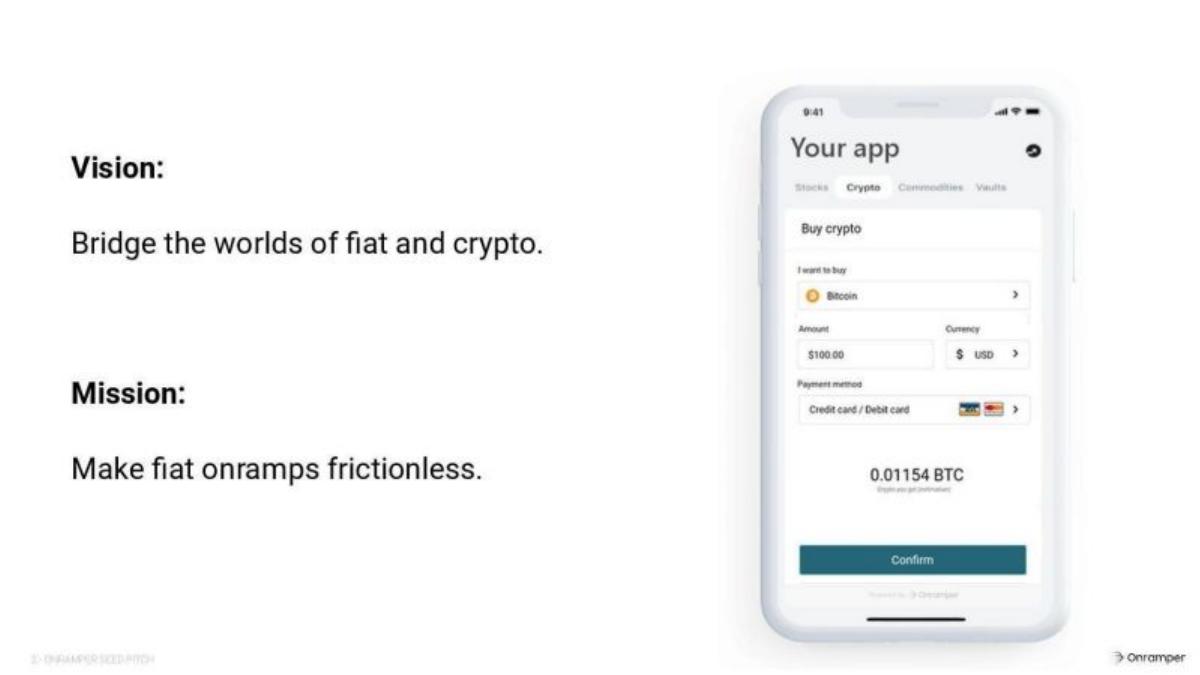
The Onramper Seed deck, used to raise $6M in 2022, begins with a minimalist aesthetic that carries through the entire 14-slide presentation. The cover slide (Slide 1) establishes the brand identity, followed immediately by a clear Vision and Mission statement on Slide 2. The vision is to "Bridge the worlds of fiat and crypto," while the mission is to "Make fiat onramps frictionless." This sets a high-level stage before diving into the technical complexities of the crypto infrastructure space.
Defining the Fiat Onramp Problem
Slide 3 serves as the educational foundation of the deck. It equates fiat onramps to user onboarding for crypto-platforms. The slide lists the types of platforms that require these services, including wallets, exchanges, DeFi apps, and NFT marketplaces. The key takeaway here is that most platforms "can't sell crypto themselves," creating a dependency on third-party gateways. This slide effectively establishes the 'Why Now' by highlighting the emergence of embeddable exchange agents.
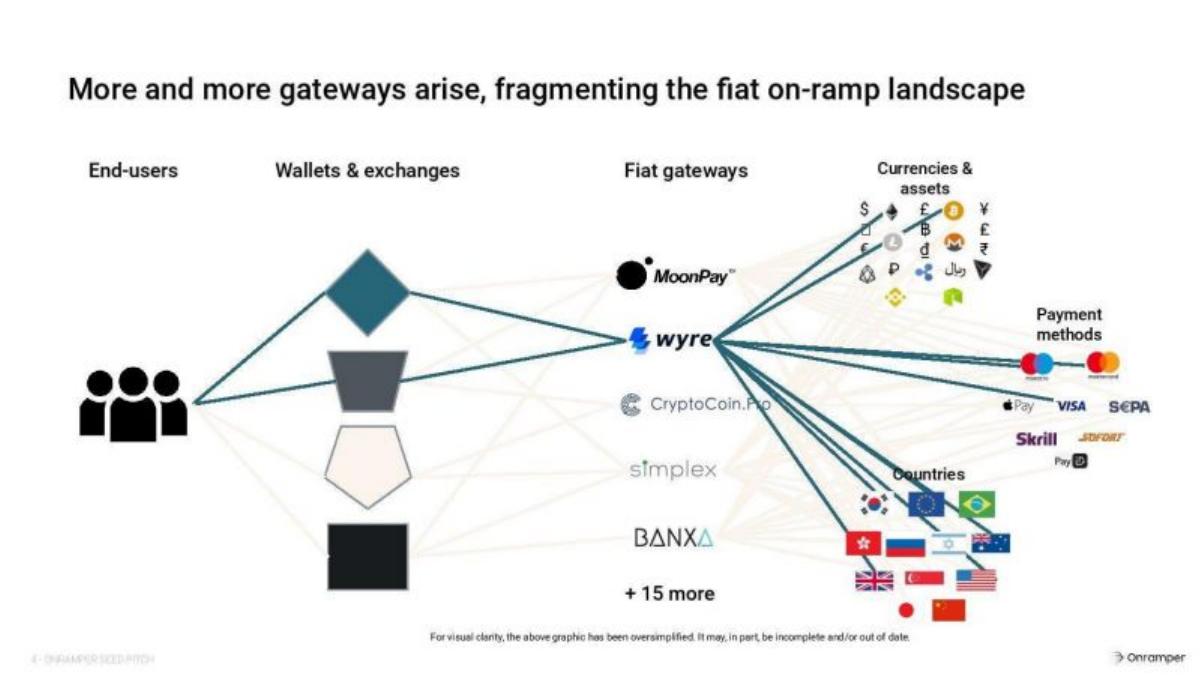
Slide 4 visualizes the fragmentation of the market. It shows a chaotic web of connections between end-users, wallets, fiat gateways (naming MoonPay, Wyre, and others), currencies, payment methods, and countries. By visualizing this complexity, Onramper makes the case for a middleware solution that can simplify these disparate connections into a single stream.
The Solution: Aggregation and Efficiency
Slide 5 is a classic comparison slide. It pits "Option A" (Do conversion yourself) and "Option B" (Integrate multiple fiat gateways) against the Onramper solution. The deck highlights the "Large legal burden" and "6-12 months of integration effort" required by the old ways. In contrast, Onramper promises a solution that is "live in 30 minutes" with better pricing for consumers and increased transaction success rates. This is a powerful value proposition for developers and product managers who are the primary decision-makers for this technology.
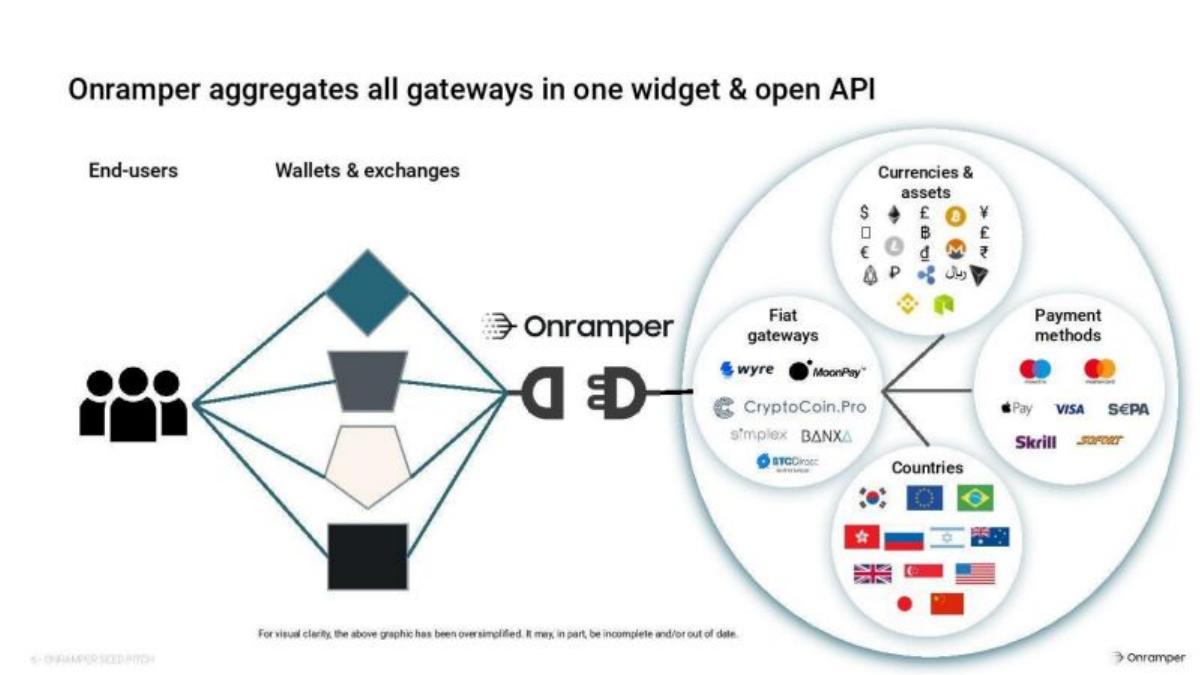
Slide 6 and 7 move into the product demonstration. Slide 6 uses a 'plug' metaphor to show how Onramper aggregates all gateways into one widget and open API. Slide 7 provides a three-step user flow: picking the currency, selecting the best gateway (optimized by Onramper), and finishing the transaction. This demonstrates that the complexity is hidden from the end-user, providing a seamless experience that looks like a native part of the host application.
Network Breadth and Business Model
Slide 8 details the current reach of the platform. It lists several "Live" gateways including MoonPay, Wyre, Xanpool, and Mercuryo, with others like Transak and BTC Direct slated for 2022. The slide also boasts impressive statistics: 17+ payment methods (Visa, Google Pay, Apple Pay, etc.), 180+ countries, 150+ cryptos, and 50+ fiat currencies. This slide is intended to prove that Onramper isn't just a concept, but a robust infrastructure with significant global coverage.
The revenue model is explained on Slide 9. Onramper describes itself as a B2B2C model. They take a 1% fee on every transaction. Crucially, they note that they "lower fiat-gateway-fees for end-users," suggesting that their volume allows them to negotiate better rates or that their routing logic finds the cheapest path, offsetting their own 1% fee. They also mention that partner wallets and exchanges can add their own fee on top, which aligns Onramper's success with the partner's ability to monetize.
Market Size and Growth Projections
Slide 10 addresses the market opportunity. It uses a concentric circle diagram to show a TAM of $52B and a SOM of $23.8B. The right side of the slide features a growth chart showing YOY market growth of over 25%. The most aggressive claim is the projection for 2030, where they estimate a SOM of $177B, leading to $1.77B in obtainable revenue for the company. This is a standard venture capital 'hockey stick' projection designed to show the potential for a massive exit.
Slide 11 provides a breakdown of their current customer base by "Types of businesses creating widget-keys." The data shows a healthy spread: DeFi apps and NFT marketplaces each represent 12.8%, followed by E-commerce at 11.8%, and Fintech at 12.8%. The headline notes that their growth has been "almost exclusively inbound," which is a strong signal of product-market fit, as it implies the market is actively seeking their solution without heavy sales spend.
Team and Conclusion
Slide 12 introduces the founders and advisors. The team includes Thijs (CEO), Salah (CTO), Maurits (CFO-COO), and Gijs. While the slide includes photos and titles, it notably lacks any text regarding their professional history, previous companies, or educational background. The advisor section includes Albert (Co-founder), Dwayne (Routing wizard), and Luc (Sales advisor). The deck concludes with a repeat of the cover slide (Slide 13) and a final promotional slide for the source library (Slide 14).
What Works in the Onramper Deck
Visual Metaphors: The use of the 'plug' icon and the 'messy web' diagram (Slide 4 and 6) makes a complex technical product immediately understandable. Investors don't need to be API experts to see that Onramper is a consolidator of a fragmented market.
Speed to Value: Highlighting that the integration takes only 30 minutes (Slide 5) is a brilliant way to appeal to the 'builder' mindset. In the fast-moving crypto space, time-to-market is a critical competitive advantage.
Broad Utility: The pie chart on Slide 11 is excellent for showing that the product isn't just for one niche. By showing usage across NFT marketplaces, DeFi, and E-commerce, they prove that their API is a horizontal infrastructure play rather than a vertical tool.
What is Missing from the Onramper Deck
The Ask: The deck does not explicitly state how much they are raising or how they plan to spend the capital. While the catalogue listing mentions a $6M Seed round, the slides themselves are silent on the financial requirements and milestones they intend to hit with the new funding.
Team Pedigree: Slide 12 is very thin on details. Investors at the Seed stage usually want to see 'founder-market fit.' Mentioning that the CTO has built similar systems before or that the CEO has a background in fintech would have strengthened the pitch significantly.
Unit Economics and Burn: While the 1% fee is clear, there is no mention of the cost to acquire a customer (CAC) or the lifetime value (LTV). Given that they mention inbound growth, showing a low CAC would have been a major selling point.
Competitive Landscape: The deck focuses on the 'old way' of doing things but ignores direct competitors who might also be aggregating gateways. A slide showing how Onramper differs from other aggregators would have provided more clarity on their moat.
Founder Takeaways
Focus on the Friction: If you are building middleware or infrastructure, your best friend is a diagram that shows how painful the current process is. Onramper's Slide 4 is the most important slide in the deck because it justifies the existence of the company by visualizing a problem that is otherwise invisible.
Standardize the Revenue Narrative: Onramper's B2B2C explanation on Slide 9 is very clean. By showing exactly where the money comes from and how it flows between the gateway, the aggregator, and the partner, they remove any ambiguity about their business model.
Leverage Inbound Interest: If your product is being pulled by the market, say so. The headline on Slide 11 ("almost exclusively inbound") is a powerful way to signal that the product solves a real, urgent pain point without needing a massive sales force to convince people to use it.
Frequently asked questions
- How does Onramper make money?
- According to slide 9, Onramper utilizes a B2B2C revenue model. They apply a 1% fee to every transaction processed through their widget or API. Additionally, the wallets or exchanges that embed Onramper have the option to set their own additional fee on top of the transaction, creating a flexible monetization layer for partners.
- What is the core problem Onramper is solving?
- The deck identifies market fragmentation as the core problem. Slide 4 illustrates a 'messy' landscape where end-users, wallets, and gateways are connected by a complex web of currencies, payment methods, and geographic restrictions. Onramper acts as an aggregator, providing a single point of entry to multiple gateways like MoonPay, Wyre, and Xanpool.
- What are the integration benefits for businesses?
- Slide 5 highlights that businesses previously had to choose between doing conversions themselves (high legal burden) or integrating multiple gateways (6-12 months of effort). Onramper claims to eliminate the legal burden and chargeback worries while reducing integration time to just 30 minutes, while also improving transaction success rates.
- How large is the market opportunity according to the deck?
- Slide 10 defines the Total Addressable Market (TAM) as $52B in fiat-to-crypto transactions. They narrow this down to a Serviceable Obtainable Market (SOM) of $23.8B. By 2030, they project the SOM will grow to $177B, which would yield $1.77B in revenue for Onramper based on their 1% fee structure.
- What kind of businesses use Onramper's technology?
- Slide 11 provides a breakdown of businesses creating widget-keys. The largest segments are DeFi apps (12.8%), NFT marketplaces (12.8%), and E-commerce (11.8%). Other users include centralized and decentralized exchanges, wallets, and fintech platforms, showing a broad horizontal application for their API.