Oomf’s 2014 Seed deck is a textbook example of positioning a marketplace through curation. In an era dominated by low-cost bidding sites like Elance and oDesk, Oomf (which later became Crew) focused on the 'premium' segment of mobile and web development. The deck uses a high-contrast design to highlight a massive disparity in project value: while the industry average was $500, Oomf projects averaged $5,000. With 30% month-over-month growth and a clear narrative of 'the talent picks the work,' the founders successfully argued that the future of work wasn't about the cheapest labor, but the bes…
Key takeaways
- Oomf positions itself as a 'premium marketplace' where talent chooses the projects, reversing the traditional power dynamic of freelance sites (Slide 4).
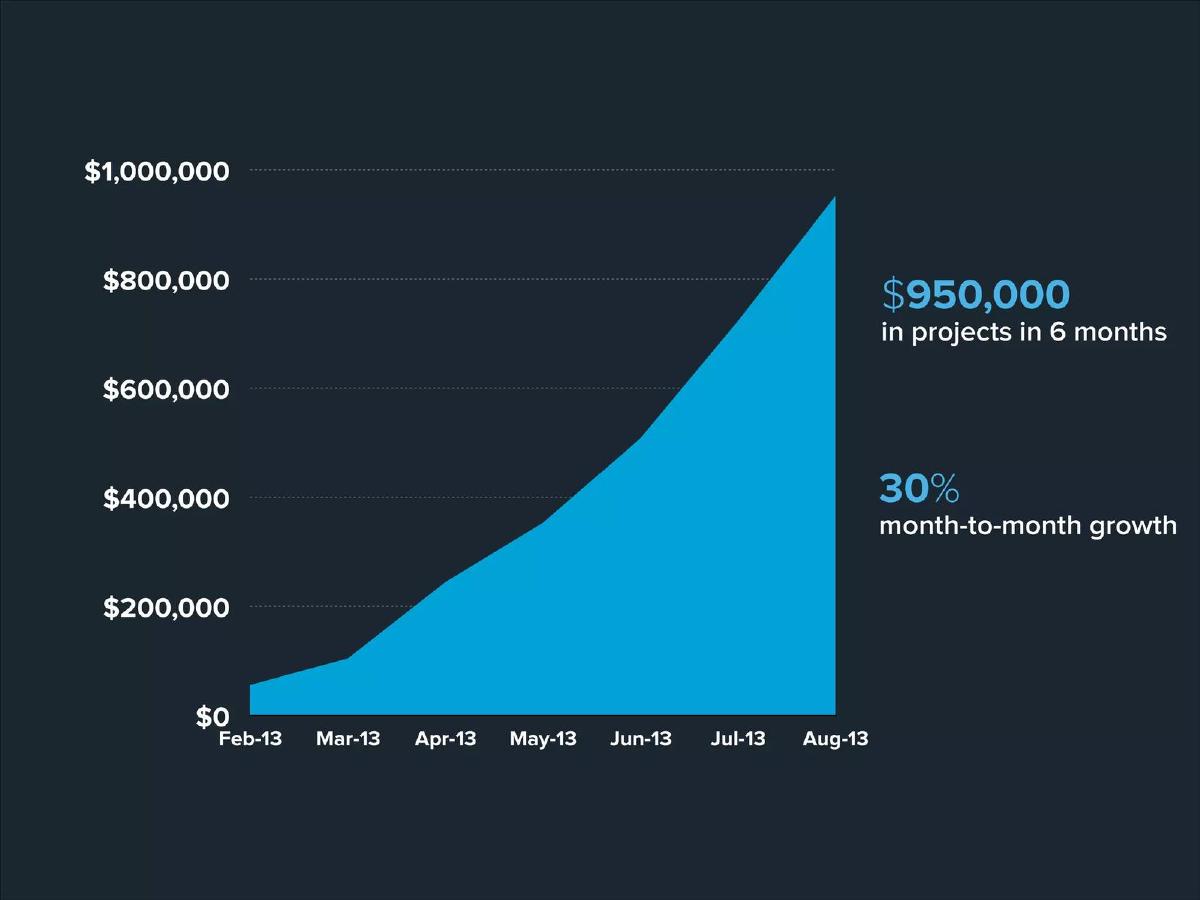
- The startup demonstrated significant early traction with $950,000 in projects booked within six months (Slide 5).
- A 30% month-over-month growth rate provided the necessary momentum for a Seed round (Slide 5).
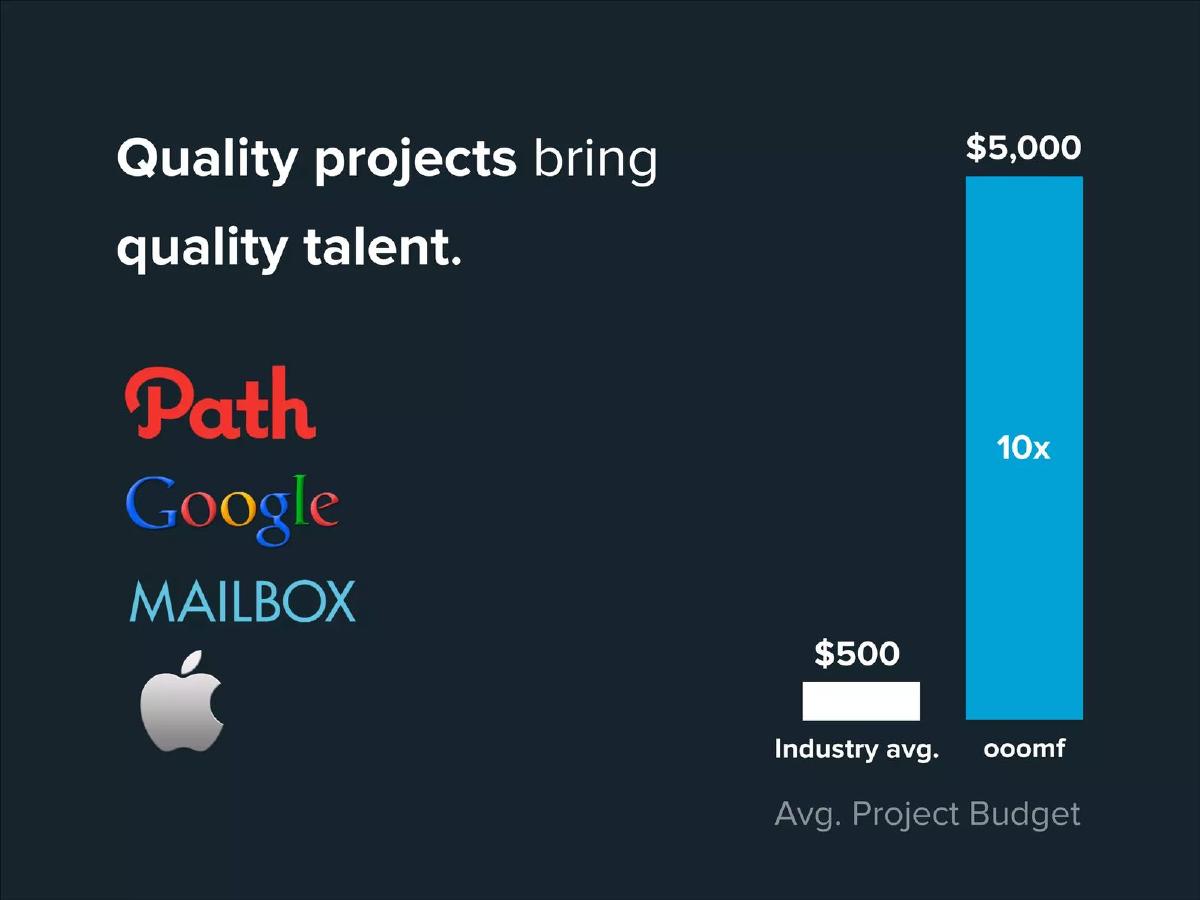
- The deck highlights a 10x difference in average project budget ($5,000 vs. $500 industry average) to prove they are capturing a higher-value segment (Slide 6).
- Product slides emphasize automation, showing a 'Budget Recommendation' tool to reduce friction in the sales process (Slide 8).
- Operational efficiency is a key selling point, with 99% of projects matching with talent within 24 hours (Slide 10).
- The market slide cites a growth in online contractor billings from $1B in 2012 to $4B in 2014, using oDesk and Elance as benchmarks (Slide 11).
- The team slide emphasizes '15+ years experience' and specific individual wins, such as building a blog to 40,000+ readers in 3 months (Slide 13).
The Narrative: Quality Over Quantity
Oomf’s pitch deck is a masterclass in minimalist design and high-impact messaging. In 2014, the freelance market was perceived as a 'race to the bottom,' with platforms like Elance and oDesk (now Upwork) facilitating low-cost bidding wars. Oomf took the opposite approach. By branding themselves as 'The future of work' on Slide 1, they set the stage for a narrative centered on premium talent and high-value outcomes. The deck doesn't just promise a better platform; it promises a better class of work.
Slides 1-4: The Hook and the Anti-Thesis
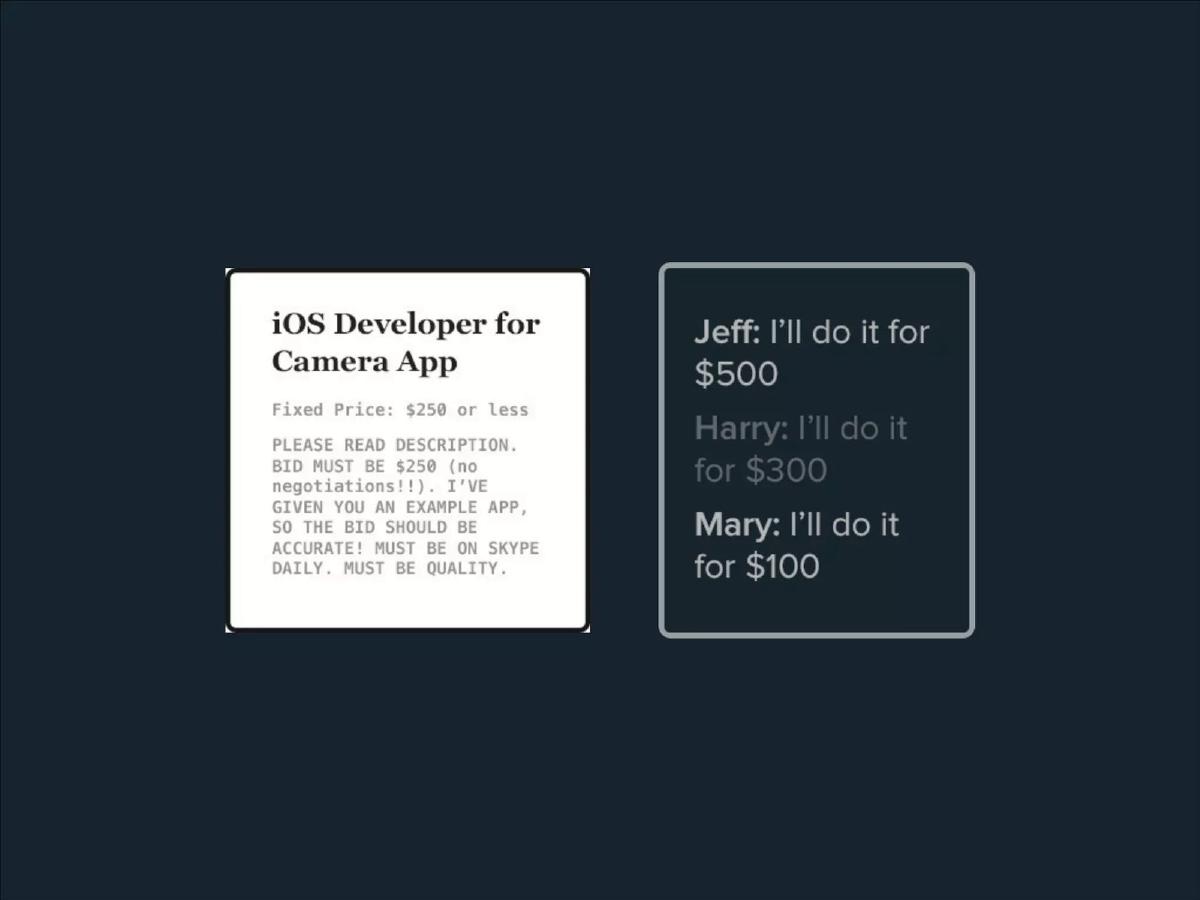
Slide 1 is a standard title slide featuring the Oomf logo and the tagline 'The future of work.' It identifies Mikael Cho as the founder. Slide 2 immediately dives into the problem without using the word 'problem.' It shows a screenshot of a typical low-quality job posting: an iOS developer requested for '$250 or less' with a 'no negotiations' demand. Next to it, three bidders (Jeff, Harry, Mary) are shown undercutting each other down to $100. This visualizes the 'race to the bottom' perfectly.
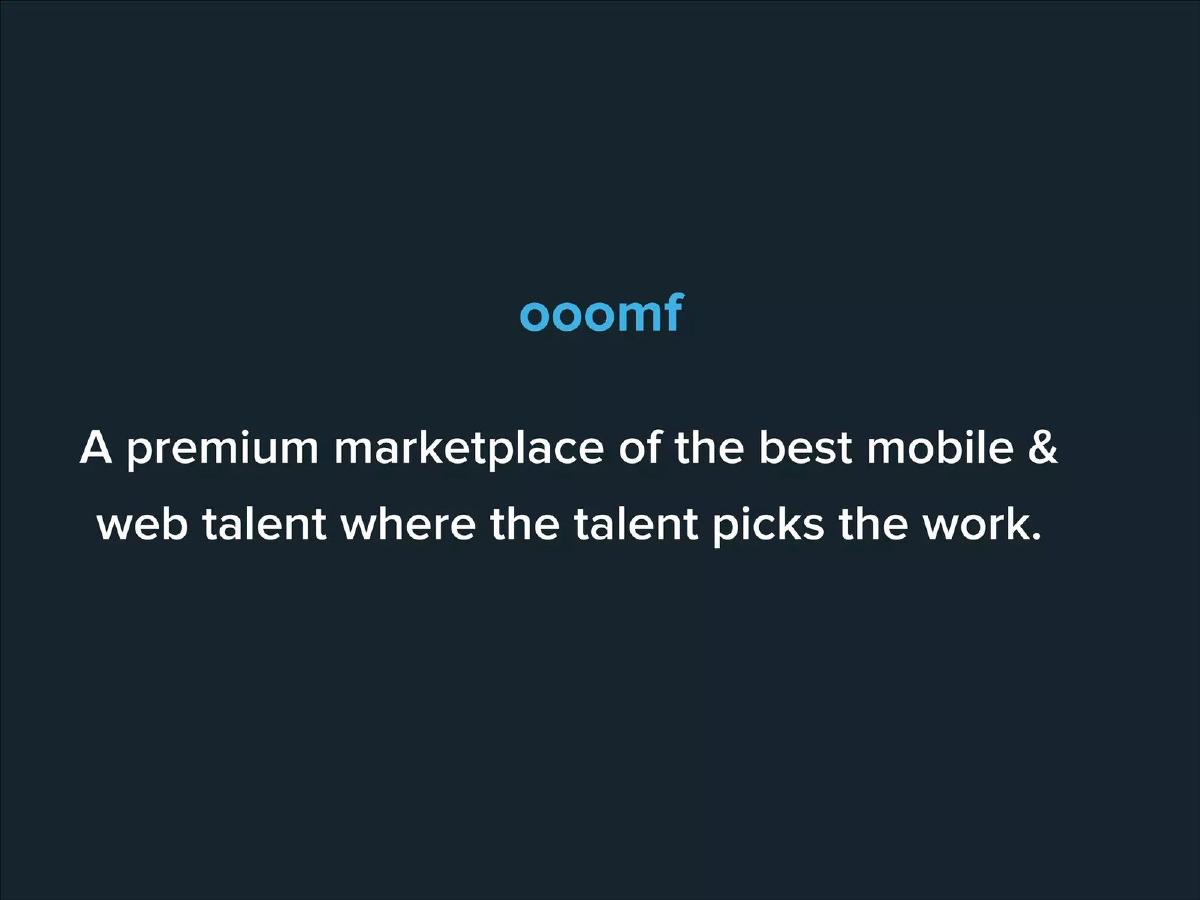
Slide 3 delivers a punchy, four-word manifesto: 'Average is over.' This acts as the philosophical bridge to Slide 4 , which defines Oomf as 'A premium marketplace of the best mobile & web talent where the talent picks the work.' This is a critical distinction—in Oomf’s world, the power resides with the high-quality supply, not just the demand.
Slides 5-6: The Traction and the Multiplier
Slide 5 provides the 'why now' for investors. It displays a steep growth curve from February 2013 to August 2013. The key figures are '$950,000 in projects in 6 months' and '30% month-to-month growth.' For a Seed stage company in 2014, these numbers were exceptionally strong, proving that there was significant demand for their curated approach.
Slide 6 is perhaps the most important slide in the deck for establishing the business's unit potential. It compares the 'Industry avg.' project budget ($500) against the 'oomf' average project budget ($5,000). By showing a '10x' difference, Oomf argues that they aren't just a slightly better version of existing sites; they are playing in an entirely different financial league. The inclusion of logos like Google, Apple, and Path adds immediate social proof, suggesting that top-tier companies already trust the platform.
Slides 7-10: Product and Process
Slide 7 introduces the user flow: '1. PITCH YOUR INSPIRATION.' The screenshot shows a clean interface where users select the platform (iPhone, iPad, Android) and set a budget range (shown as $3,000 to $20,000). Slide 8 highlights a specific feature: 'AUTOMATIC BUDGET RECOMMENDATION.' This is a clever piece of product design that helps anchor client expectations and prevents the low-balling seen on Slide 2. The slider in the screenshot is set between $13,000 and $17,000.
Slide 9 shows the result: 'THE SINGLE BEST PRO COMES TO YOU.' Instead of a list of 50 bidders, the user sees one high-quality profile (Edward Scherf, UI Designer). The profile lists impressive credentials, such as a '2008 Apple Design Award' and work for 'Apple, Path, Google, Github.' This reinforces the 'premium' branding. Slide 10 summarizes the operational benefits: 'no bidding, no spam, no price wars,' and a staggering efficiency metric: '99% of projects match within 24 hours.'
Slides 11-12: Market and Vision
Slide 11 addresses the Total Addressable Market (TAM). It uses two circles to show the growth of 'Online Contractor Billings' from $1B in 2012 to a projected $4B in 2014. It explicitly mentions competitors oDesk, Elance, and 99designs, positioning Oomf as the premium layer on top of this rapidly expanding sector. Slide 12 defines the long-term goal: 'The most trusted, collaborative labor marketplace in the world.'
Slides 13-14: The Team and Backing
Slide 13 introduces the four core team members: Mikael, Steph, Angus, and Luke. The slide leads with '15+ years experience working as independent creative professionals,' which is essential for a marketplace—the founders understand their supply side. Specific achievements are noted: Mikael built a blog to 40,000+ readers in 3 months; Steph started a profitable business at 16; Angus graduated university at 19; Luke built a product with 25,000+ monthly downloads.
Slide 14 lists 'INVESTORS & ADVISORS,' featuring Real Ventures and BDC. It also highlights Adam McNamara, whose mobile development studio was acquired by Shopify. This indicates that the company already had institutional backing and high-level mentorship before this specific pitch.
Slides 15-18: Social Proof and the Big Goal
Slide 15 and Slide 16 use a case study approach. 'MEET MILAN,' an iOS developer with a 5-star rating, who earned '$15k in one month' through the platform. Slide 16 provides a quote: 'oomf changed the way I work and with that how I live.' This humanizes the platform and proves that it provides life-changing value to the talent side of the marketplace.
Slide 17 ends on a high note with a bold projection: 'On track to book $100MM in projects by 2015.' This is a classic 'big vision' slide designed to leave investors thinking about the scale of the opportunity. Slide 18 is a repeat of the title slide, providing the founder's contact information and the website URL.
What Oomf Does Well
Visual Contrast: The deck uses the 'before and after' or 'us vs. them' strategy very effectively. By showing the messy, low-value bidding of competitors on Slide 2 and contrasting it with the clean, high-value matching on Slide 9, the value proposition becomes undeniable. · Metric Focus: They don't just say they are growing; they cite '30% month-to-month' and '$950k in 6 months.' They don't just say they are fast; they cite '99% match within 24 hours.' These specific numbers build credibility. · Supply-Side Empathy: Most marketplaces focus on the customer (the buyer). Oomf focuses on the talent. By proving they can make life better for the best developers, they ensure they will always have the supply that buyers actually want.
What is Missing
The Ask: There is no slide detailing how much money is being raised or what the milestones for the next 18 months are. While this is common in 'teaser' decks, a full pitch usually requires a clear capital request. · Unit Economics: While we see the project budgets ($5,000), we don't see Oomf's take rate. Investors would want to know if they are taking 10%, 20%, or a flat fee to calculate the actual Net Revenue. · Retention Data: The deck shows growth in new projects, but it doesn't show if customers come back. In a marketplace, 'Gross Merchandise Volume' (GMV) is great, but repeat usage is what builds a moat.
What You Should Copy
The '10x' Slide: If your product serves a higher-value segment of an existing market, create a slide like Slide 6. Comparing your average transaction value to the industry average is a powerful way to show you are building a 'quality' moat. · Manifesto Slides: Use short, bold statements like 'Average is over' (Slide 3) to signal a shift in market sentiment. It helps investors categorize your startup as a leader of a new trend rather than a follower of an old one. · Feature-Benefit Screenshots: Don't just show a screenshot of your app; label it with the benefit it provides, like 'Automatic Budget Recommendation' (Slide 8). This tells the investor why the feature matters for the business model.
Frequently asked questions
- What was Oomf's primary competitive advantage?
- Oomf’s advantage was curation and high-intent matching. Unlike 'bidding' sites where freelancers compete on price, Oomf focused on 'premium' talent and projects. Slide 10 explicitly lists 'no bidding, no spam, no price wars' as their core value proposition, which allowed them to maintain an average project budget of $5,000—ten times the industry average of $500 shown on Slide 6.
- How did Oomf demonstrate product-market fit?
- They used a combination of growth and speed. Slide 5 shows $950,000 in projects booked over a six-month period with 30% month-over-month growth. Furthermore, Slide 10 highlights that 99% of projects find a match within 24 hours, proving that their supply-side (talent) was highly engaged and the matching algorithm was effective.
- Who was the target customer for Oomf?
- Based on the logos on Slide 6 (Google, Apple, Path, Mailbox) and the product screenshots on Slide 7, the target customers were tech-forward companies looking for high-quality mobile (iPhone, Android) and web development. They weren't looking for 'cheap' labor, but for 'the single best pro' (Slide 9) to build specific, high-stakes applications.
- What is missing from this pitch deck?
- The deck is notably missing a 'The Ask' slide. There is no mention of how much capital they are raising, the valuation, or the specific use of funds. It also lacks a detailed 'Business Model' slide explaining their take rate or commission structure, though the 'Marketplace' designation in the catalogue facts implies a transaction-based revenue model.
- What happened to Oomf after this raise?
- Following this $2.1M Seed round in 2014, Oomf rebranded to Crew. The company continued to grow its marketplace for designers and developers. Eventually, the founders spun off a side project—Unsplash—which became a massive success in its own right, while the core Crew marketplace was acquired by Dribbble in 2017.