OpenFin’s 16-slide deck for its $17M Series C round in 2019 focuses heavily on the 'Innovation Gap' between traditional financial infrastructure and modern consumer tech. The narrative is built on the premise that Wall Street is trapped by legacy systems like Windows 7 and manual security reviews, costing the industry $1.5 billion annually. OpenFin positions itself as the bridge, using Google Chromium to allow HTML5 apps to run with native performance. The deck excels at demonstrating 'critical mass,' citing deployment at over 1,500 banks and buy-side firms. While it lacks granular unit econo…
Key takeaways
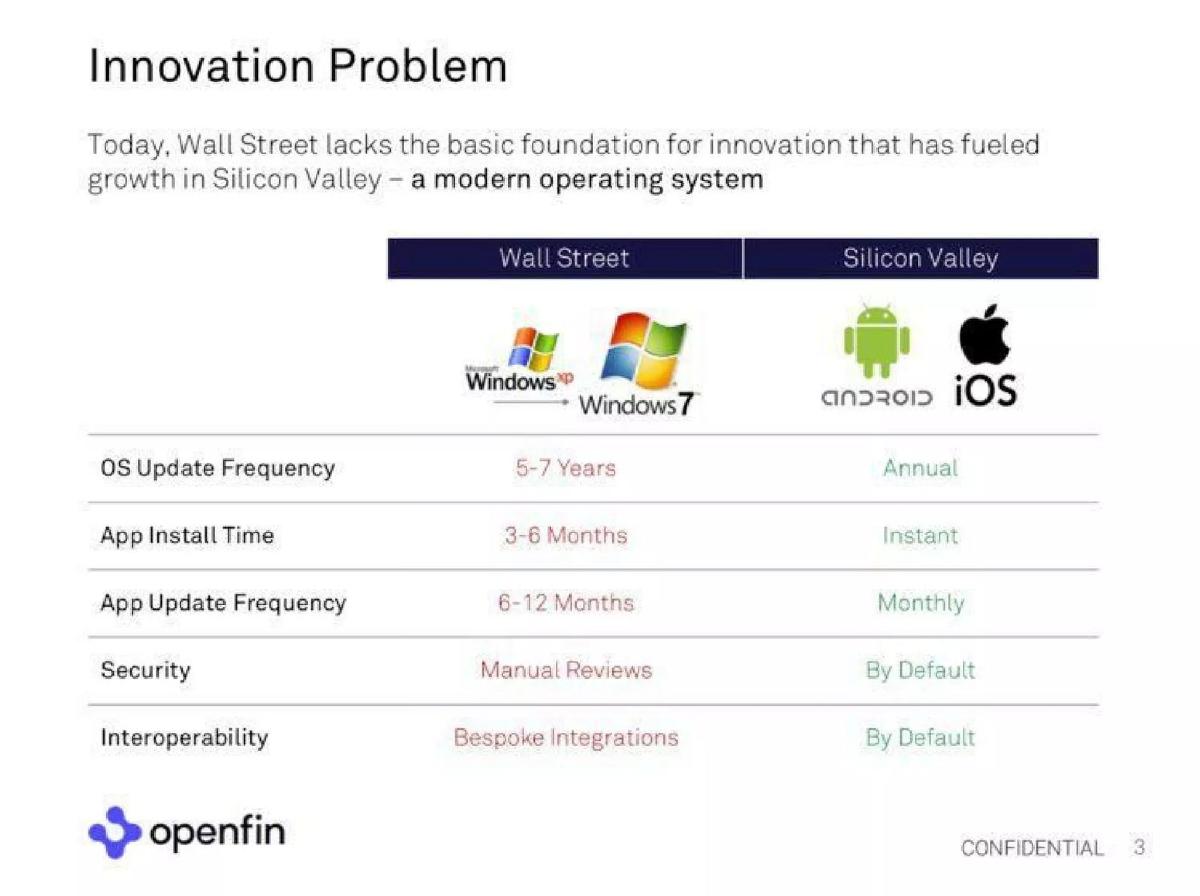
- The deck uses a direct comparison on Slide 3 to highlight that Wall Street app install times take 3-6 months versus 'Instant' in Silicon Valley.
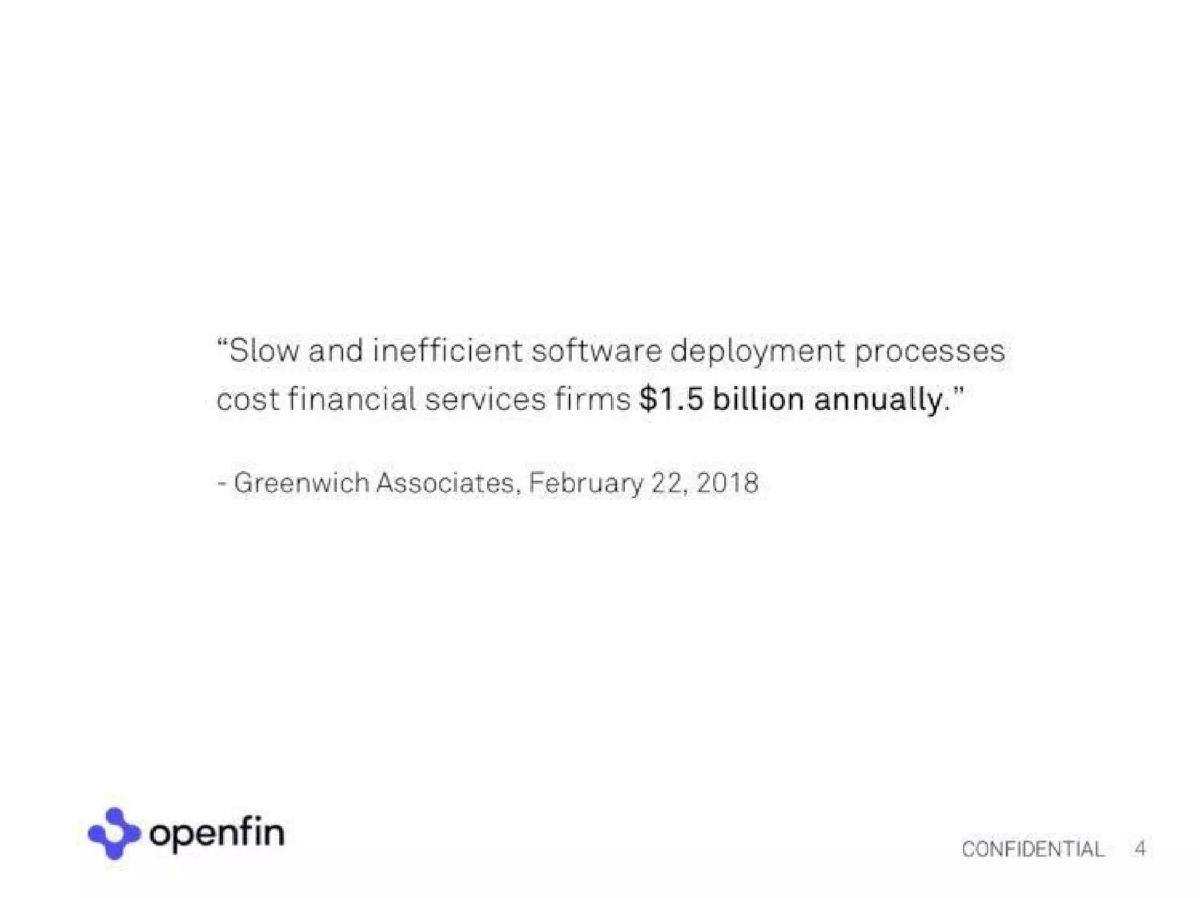
- A third-party data point from Greenwich Associates on Slide 4 quantifies the problem, stating inefficient deployment costs firms $1.5 billion annually.
- Technical architecture is simplified on Slide 7, explaining the product is built on Google Chromium to run HTML5 apps 'outside the browser.'
- Slide 8 introduces a network effect narrative, showing how Sell Side, Buy Side, and Vendors are interconnected through the OpenFin ecosystem.
- Traction is validated on Slide 11 with the claim of being deployed at over 1,500 banks and buy-side firms across 60 countries.
- The company reports a '95% first time install success rate' on Slide 11, addressing a major pain point in enterprise software deployment.
- The Total Addressable Market is segmented on Slide 14, moving from a 3 million desktop core in Capital Markets to a 50 million desktop total available market.
- The Series C 'Use of Funds' on Slide 15 is highly specific, targeting regional expansion in Europe and Asia and product features like voice and data privacy.
The Vertical OS Play: OpenFin’s Series C Teardown
OpenFin’s 2019 pitch deck is a textbook example of how to pitch 'infrastructure' to growth-stage investors. In the fintech world, infrastructure is often a hard sell because it is invisible. OpenFin solves this by framing their product not as a utility, but as an 'Operating System' that fixes a multi-billion dollar efficiency gap. This teardown examines the 16 slides that helped secure $17M in Series C funding.
The Problem: Stagnation vs. Innovation (Slides 1-5)
Slide 1: Title The deck opens with a bold claim: 'The Operating System of Finance.' This immediately positions the company as a foundational layer rather than a single-feature app.
Slide 2: The Hook A simple text slide states that Wall Street’s application infrastructure has remained stagnant while Silicon Valley continues to innovate. This sets up a 'us vs. them' narrative that is common in successful fintech pitches.
Slide 3: Innovation Problem This is the most critical slide in the first half of the deck. It uses a side-by-side comparison table to contrast Wall Street (Windows XP/7) with Silicon Valley (Android/iOS). Key metrics cited include OS update frequency (5-7 years vs. Annual) and App Install Time (3-6 months vs. Instant). By using red text for Wall Street and green for Silicon Valley, the 'bleakness' of the current state is visually reinforced.
Slide 4: The Cost To move from a qualitative problem to a quantitative one, Slide 4 quotes Greenwich Associates: 'Slow and inefficient software deployment processes cost financial services firms $1.5 billion annually.' This provides the 'Why Now' and the 'So What' for the investment.
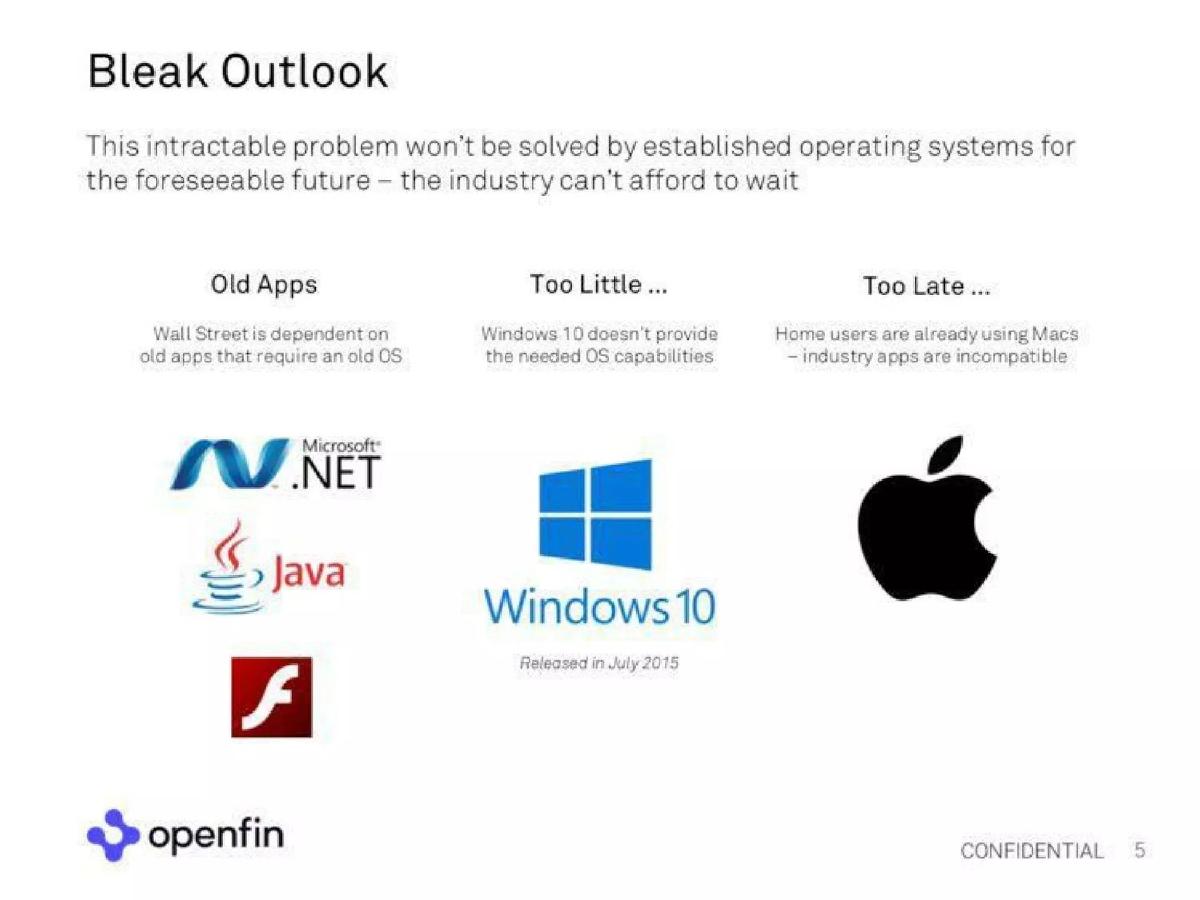
Slide 5: Bleak Outlook The company doubles down on the problem by explaining why existing giants won't fix it. It notes that Wall Street is dependent on 'Old Apps' (.NET, Java, Flash) and that Windows 10 doesn't provide the specific capabilities needed for financial workflows. This slide effectively eliminates the 'Why doesn't Microsoft just do this?' question.
The Solution: Modernizing the Desktop (Slides 6-7)
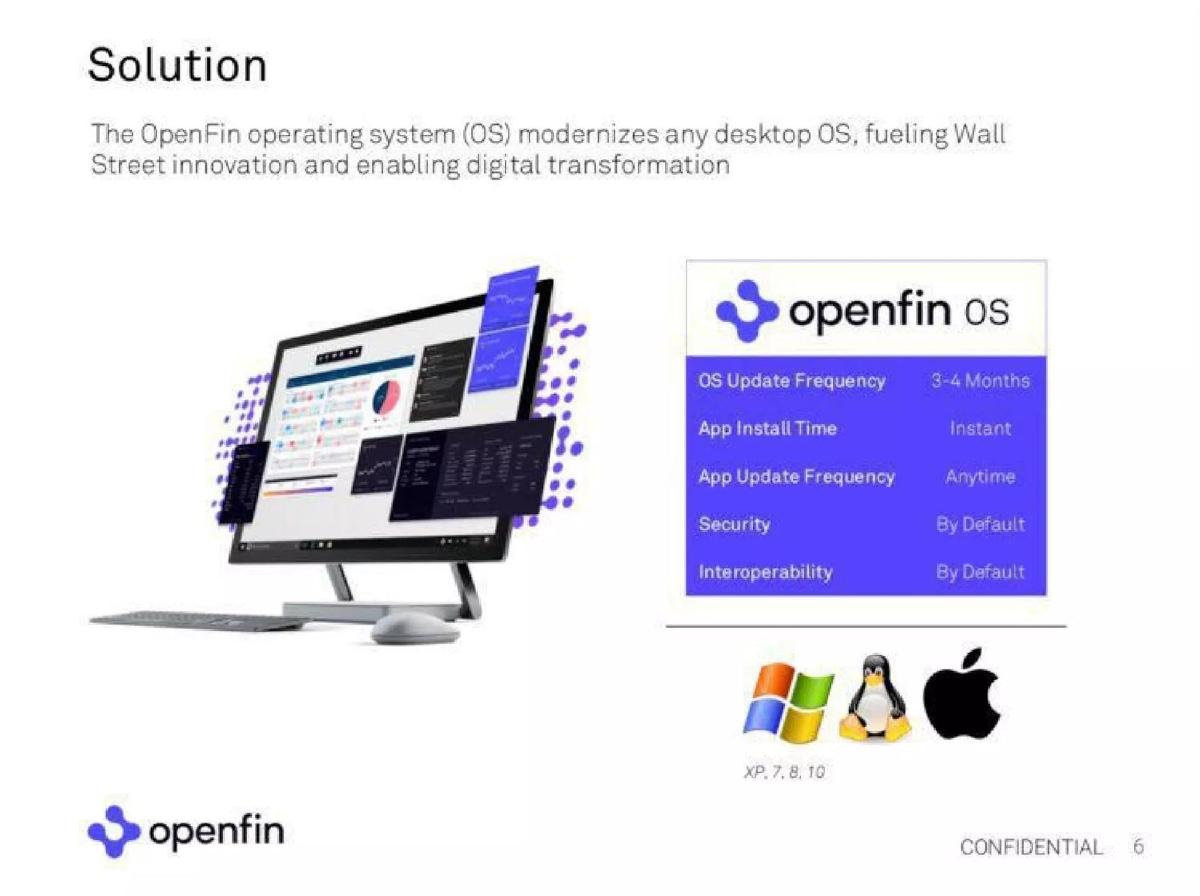
Slide 6: Solution OpenFin introduces its OS as the modernizer for any desktop. It repeats the table from Slide 3, but this time replaces 'Silicon Valley' with 'OpenFin OS,' showing that they bring 'Instant' install times and 'Anytime' update frequency to the financial desktop.
Slide 7: How It Works This is the only technical architecture slide. It explains that OpenFin is built on Google Chromium and uses HTML5. The visual shows how different app windows can live 'outside the browser' while still being managed by the OpenFin layer. It’s a simple way to explain a complex middleware solution without getting lost in code snippets.
Ecosystem and Traction (Slides 8-11)
Slide 8: Network Effect OpenFin argues that their value grows as more people use it. The slide illustrates a three-way ecosystem: Sell Side, Buy Side, and Vendors. The implication is that because the vendors are already on OpenFin, the banks must be too, and vice versa. This 'interoperability' is presented as the primary driver for firms choosing the platform.
Slide 9: Industry Adoption A transition slide claiming they have already achieved 'critical mass.' This is a bold claim that requires the immediate proof provided in the next two slides.
Slide 10: Digital Transformation This slide showcases the user interface. It highlights features like 'Curated App Stores,' 'Workflow Automation' via a local message bus, and 'Workspace Management.' It moves the conversation from 'How it works' to 'What the user actually sees.'
Slide 11: Deployment The 'Proof' slide. OpenFin lists impressive figures: deployed at over 1,500 banks, powering 1,000+ applications, in over 60 countries. They also highlight a '95% first time install success rate,' which is a direct counter to the 3-6 month install times mentioned on Slide 3. The slide includes two specific case studies: a large UK Bank FX platform (5,000 users) and a corporate bond platform (200 institutions).
The Team and The Market (Slides 12-14)
Slide 12: Team The team slide is heavy on institutional backing. While it lists the executive team (Mazy Dar, Chuck Doerr, etc.), the bottom half of the slide is dominated by the logos of J.P. Morgan, Bain Capital, and others. For a Series C company, the board and the investor list are often as important as the founders, and OpenFin leans into this social proof.
Slide 13: Opportunity A transition slide suggesting they are 'just getting started' and looking beyond capital markets.
Slide 14: Total Addressable Market (TAM) The TAM is presented as a series of concentric circles. They start with their current focus, 'Capital Markets' (3 million desktops), then move to 'Financial Services' (7 million desktops), and finally 'Other Industries' (40 million desktops). This shows a clear path from a niche leader to a horizontal giant, which is exactly what Series C investors want to see.
The Ask and The Future (Slides 15-16)
Slide 15: Use of Series C Funds The deck concludes with a detailed breakdown of how the $17M will be spent. It’s not just 'hiring'; it’s 'hiring account managers to support fast-growing existing clients' and 'hiring engineers for advanced notifications and voice features.' It also mentions regional expansion into Europe and Asia.
Slide 16: Closing The deck ends with the slogan 'Move Fast. Break Nothing.'—a clever play on the famous Facebook mantra, tailored for the risk-averse world of finance.
What Works in This Deck
The Contrast Strategy: By comparing Wall Street to Silicon Valley, OpenFin makes the technical debt of banks feel urgent and embarrassing. · Quantified Pain: Citing the $1.5 billion cost of slow deployment turns a technical inconvenience into a CFO-level priority. · Social Proof: Listing J.P. Morgan as both an investor and a user (implied by the deployment stats) creates a 'safe' bet for other investors. · Segmented TAM: They don't just claim a $100B market; they show a logical progression from 3M desktops to 50M desktops.
What Is Missing
Unit Economics: There is no mention of LTV (Lifetime Value), CAC (Customer Acquisition Cost), or churn rates. While common in Series C decks, its absence means the investor must rely entirely on the 'critical mass' narrative. · Revenue Growth: While they show 'deployment' and 'application' counts, they do not show a revenue bar chart. We don't know if these 1,500 banks are paying $1,000 or $1,000,000 a year. · Competitor Matrix: The deck assumes OpenFin is the only solution. It doesn't address competitors like Glue42 (now interop.io) or the internal build-vs-buy struggle that many banks face.
What a Founder Should Copy
The 'Innovation Gap' Table: If you are selling to a legacy industry, use a side-by-side table to show how far behind they are compared to the 'modern' world. · Specific Use of Funds: Don't just say 'Growth.' Say 'Regional Expansion in Continental Europe' or 'Hiring for Legal and HR to scale operations.' It shows maturity. · The 'How It Works' Visual: Slide 7 is a perfect example of how to explain a technical product to a non-technical investor using simple boxes and familiar logos (HTML5, Windows, Apple).
Frequently asked questions
- What is the core problem OpenFin is solving?
- OpenFin addresses the 'Innovation Problem' in finance, where legacy infrastructure prevents rapid software deployment. According to Slide 3, Wall Street typically sees OS updates every 5-7 years and app updates every 6-12 months. OpenFin provides a modern layer that allows for monthly updates, instant installs, and default security, bypassing the limitations of stagnant systems like Windows 7 or older .NET and Java applications.
- How does OpenFin's technology actually work?
- As detailed on Slide 7, the OpenFin OS is built on Google Chromium. It allows developers to write applications using any HTML5 framework. These apps then run 'outside the browser' while maintaining a native app experience. This architecture enables the software to run across various host operating systems including Windows XP, 7, 8, 10, Linux, and macOS, providing a unified environment for financial tools.
- What kind of market traction did OpenFin have at the time of this deck?
- By the 2019 Series C, OpenFin claimed significant industry penetration. Slide 11 states the OS was deployed at over 1,500 banks and buy-side firms, powering more than 1,000 applications. Their footprint spanned over 60 countries. Specific examples included a large UK Bank FX platform with 5,000 users and a corporate bond platform used by 200 buy-side institutions.
- Who are the key investors and board members supporting the company?
- The team slide (Slide 12) shows a high-pedigree syndicate. Key investors include Bain Capital Ventures, J.P. Morgan, DRW, NEX, Nyca, and Pivot Investment Partners. The board features industry veterans like Matt Harris from Bain Capital and Mark Yallop (Independent), alongside executives from NEX Euclid and Nyca, signaling strong institutional support from the very banks they serve.
- What was the intended use of the $17M Series C funding?
- According to Slide 15, the funds were earmarked for six key areas: maximizing existing client opportunities through account management hires, serving smaller banks with 'out of the box' solutions, expanding the product (voice, cloud services), regional growth in Europe and Asia, moving into adjacent segments like Wealth Management and Insurance, and scaling internal operations like Legal and HR.