OpenBuilder’s 9-slide seed deck is a masterclass in narrative-driven disruption. By identifying a specific failure point in the current 'vibe coding' trend—that non-technical users pay for tokens but still fail to launch—they position their product as a 'guaranteed to finish' solution. The deck leverages the founders' deep domain expertise (1.5M+ users at EasyCode) to justify a bold business model: free building via open-source LLMs, with monetization occurring only when users need human/expert intervention to get 'unstuck' or move to production. While the deck uses placeholders for specific…
Key takeaways
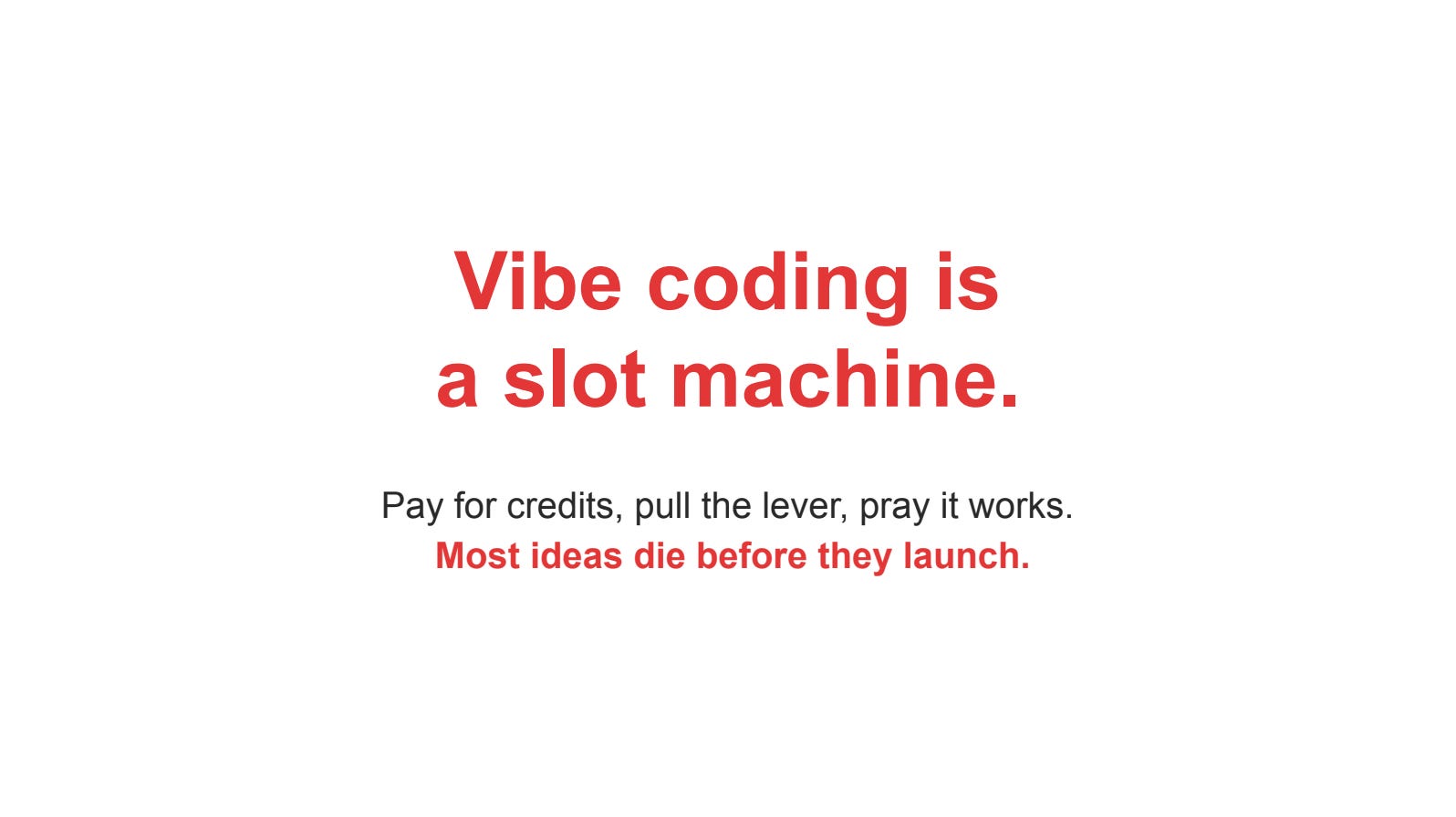
- The deck identifies a specific psychological and financial pain point: non-technical users currently 'pay for credits, pull the lever, and pray it works' (Slide 1).
- OpenBuilder positions itself against incumbents like Replit and Lovable by claiming their credit-based models are 'hard to sustain as model costs fall' (Slide 3).
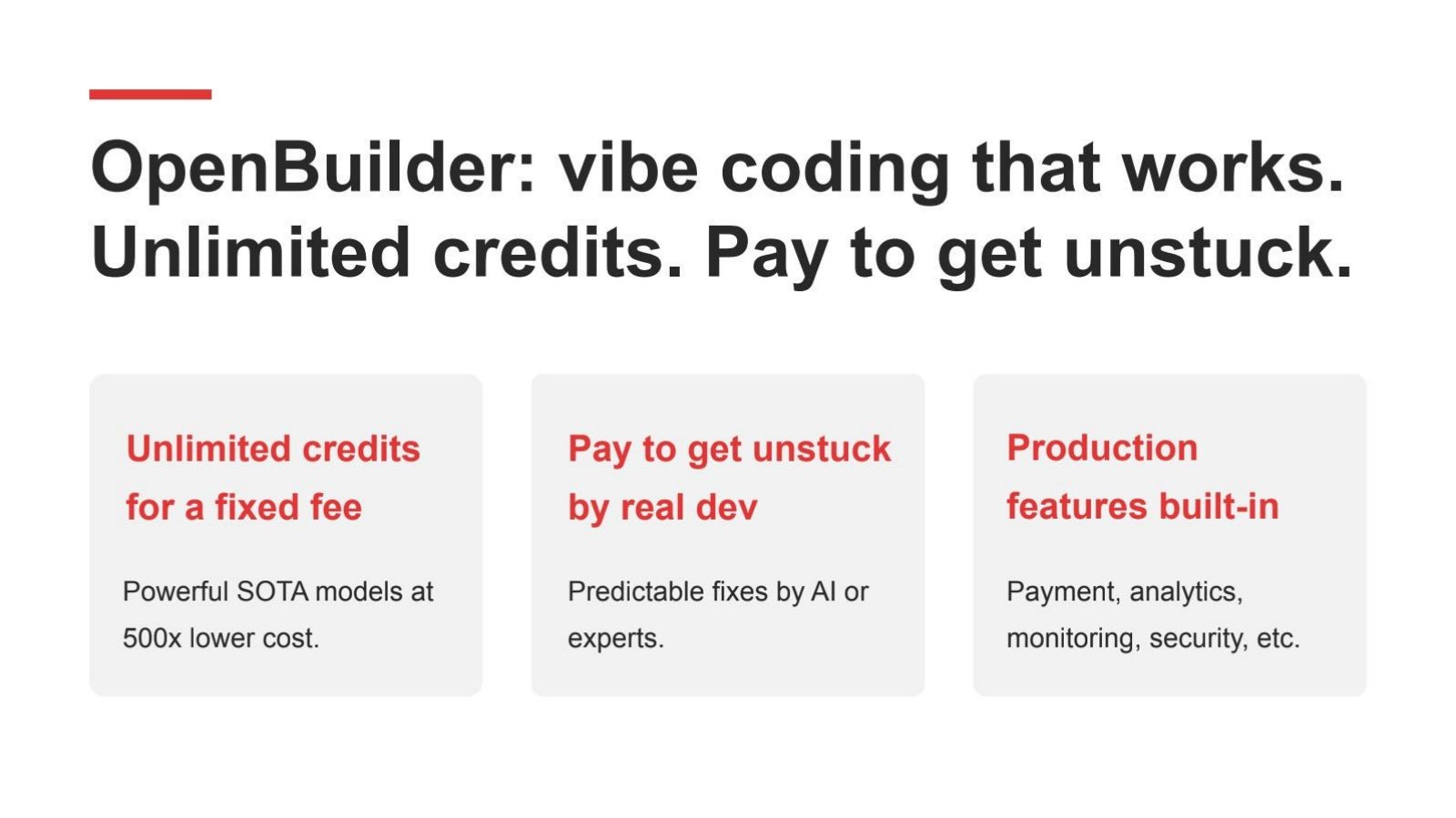
- The core value proposition is a shift from token-based billing to outcome-based billing: 'pay to get unstuck' (Slide 4).
- The startup utilizes open-source LLMs like GLM-4.7 and DeepSeek, which they claim are '500x cheaper than commercial models' (Slide 7).
- A human-in-the-loop 'data flywheel' is proposed, where human fixes improve the AI, eventually lowering the cost per fix (Slide 8).
- The founders cite significant previous success, having built EasyCode for 1.5M+ users with 30K Weekly Active Users (Slide 9).
- The deck omits a specific 'Ask' slide, financial projections, and a detailed competitive landscape beyond naming two rivals.
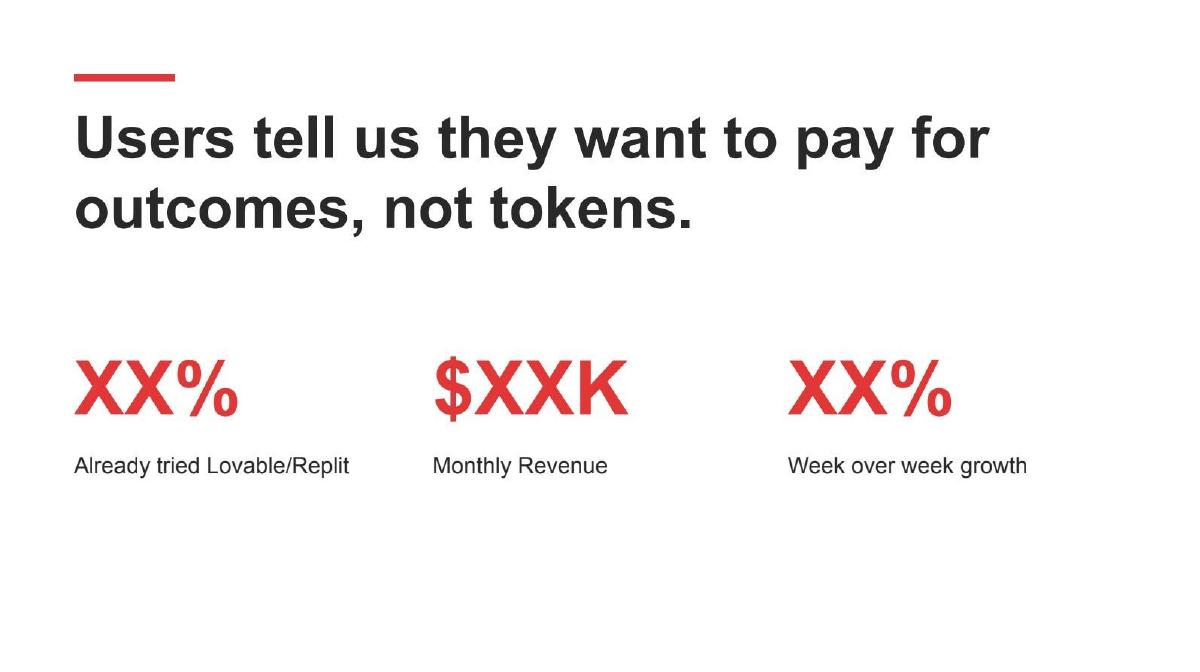
- Traction metrics on Slide 5 are represented by 'XX%' and '$XXK' placeholders, suggesting this version was a template or early draft.
The Narrative of Certainty in an Uncertain Market
OpenBuilder’s pitch deck is a concise, 9-slide argument for a paradigm shift in the AI coding space. As reported by Business Insider, the company raised $2.2M in a 2025 Seed round. The deck does not rely on complex architectural diagrams or exhaustive feature lists. Instead, it focuses on a single, powerful narrative: the current AI coding market is a gamble, and OpenBuilder is the only player offering a guaranteed win. By using the term 'vibe coding'—a colloquialism for prompt-based development—the founders signal they are deeply embedded in the current zeitgeist of the developer tools industry.
Slide 1: The Hook
The deck opens with a provocative statement: "Vibe coding is a slot machine." This slide establishes the emotional stakes immediately. It characterizes the competition not as tools, but as gambling devices where users "pay for credits, pull the lever, pray it works." The red text at the bottom, "Most ideas die before they launch," identifies the ultimate failure state for their target customer: the non-technical builder who spends money but ends up with nothing.
Slide 2: The Promise
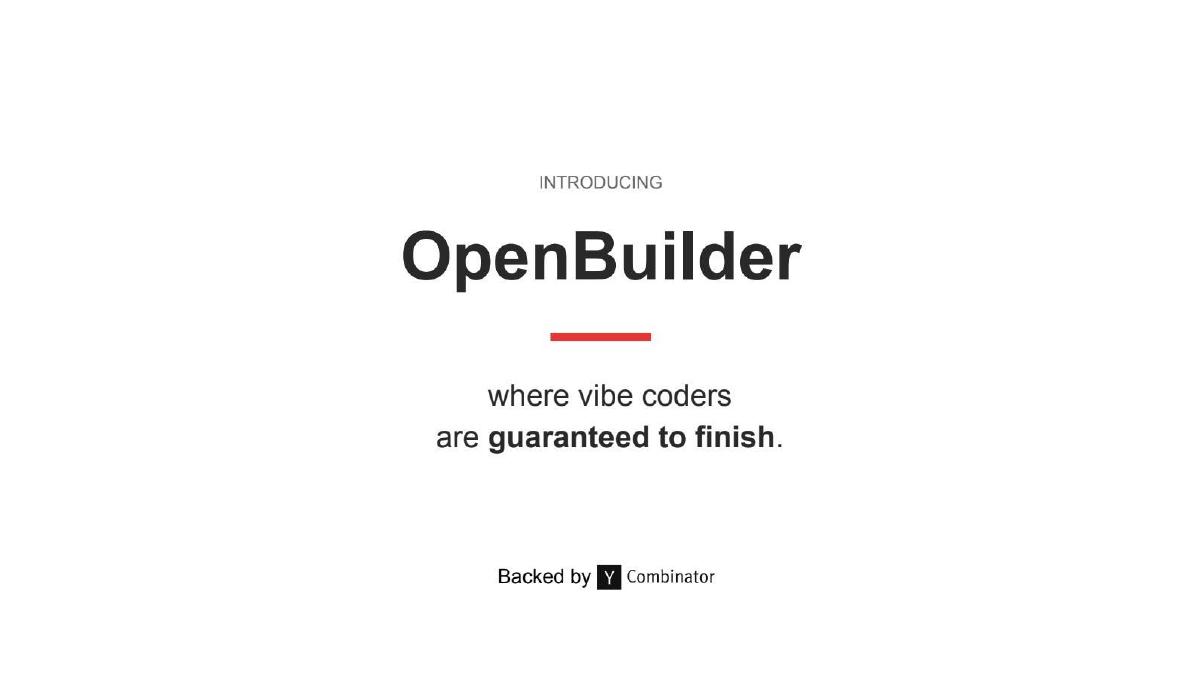
Slide 2 introduces the brand with a bold counter-claim: "OpenBuilder: where vibe coders are guaranteed to finish." This is a high-stakes promise. By using the word 'guaranteed,' they are setting a bar that traditional SaaS tools rarely meet. The slide also notes they are "Backed by Y Combinator," providing immediate institutional credibility to back up such a large claim.
Slide 3: The Market Failure
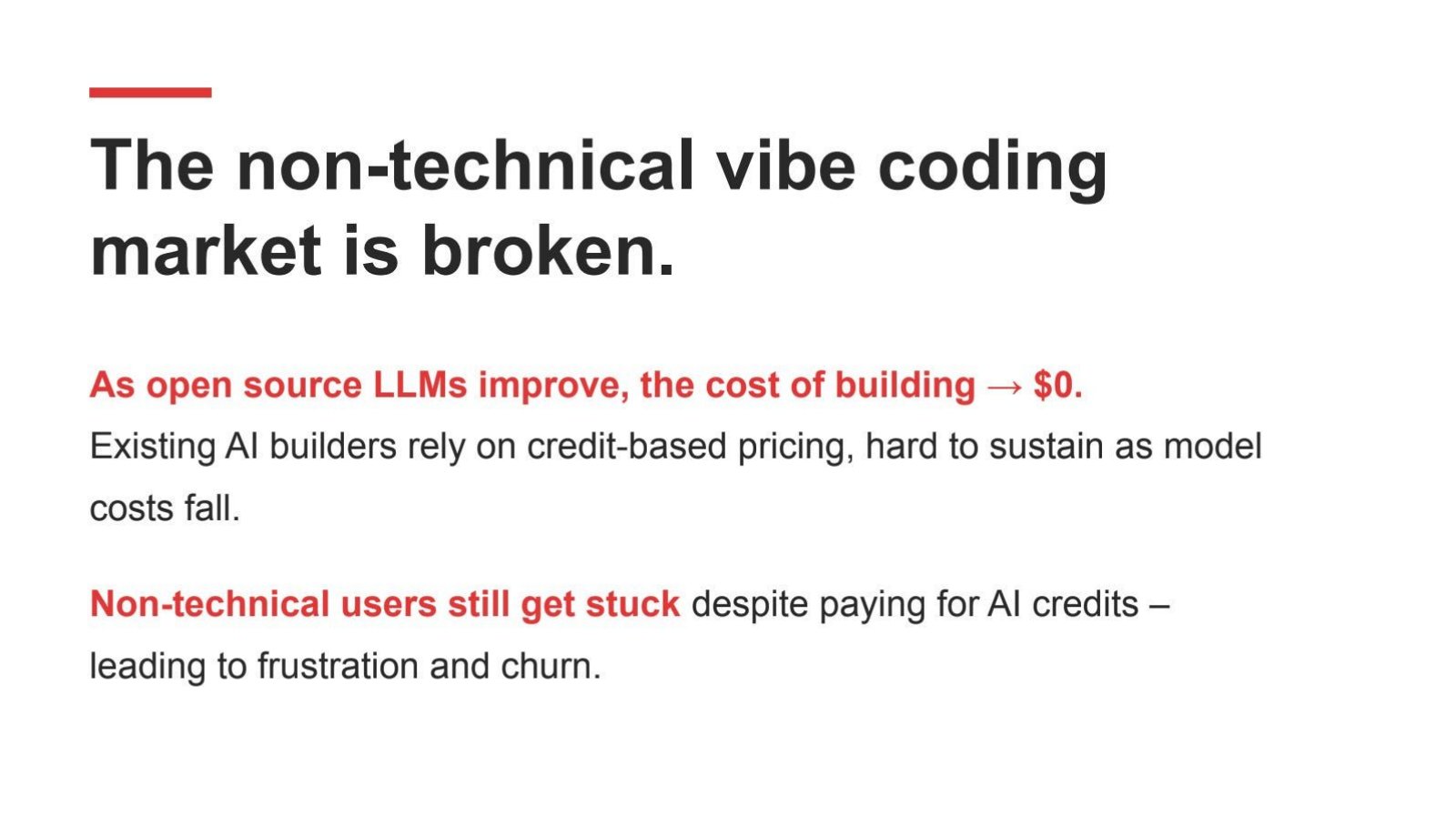
The problem slide, titled "The non-technical vibe coding market is broken," moves from emotion to economics. It makes two key points. First, that "open source LLMs improve, the cost of building -> $0." This suggests that competitors charging for tokens are fighting a losing battle against commoditization. Second, it highlights that "Non-technical users still get stuck despite paying for AI credits," which leads to churn. This identifies the 'stuck' state as the primary business opportunity.
Slide 4: The Solution
Slide 4 outlines the product pillars. The solution is three-fold: "Unlimited credits for a fixed fee," "Pay to get unstuck by real dev," and "Production features built-in." This is the first mention of the human-in-the-loop element. By offering "Predictable fixes by AI or experts," they address the 'slot machine' problem mentioned on Slide 1. They also claim to use "SOTA models at 500x lower cost," which explains how they can afford the 'unlimited' credit model.
Slide 5: The (Placeholder) Traction
Slide 5 is titled "Users tell us they want to pay for outcomes, not tokens." Interestingly, this slide contains placeholder text: "XX% Already tried Lovable/Replit," "$XXK Monthly Revenue," and "XX% Week over week growth." While the specific numbers are missing from this version of the deck, the categories chosen tell us what metrics the founders believe are most important: poaching users from incumbents and maintaining high-velocity weekly growth.
Slide 6: Customer Personas
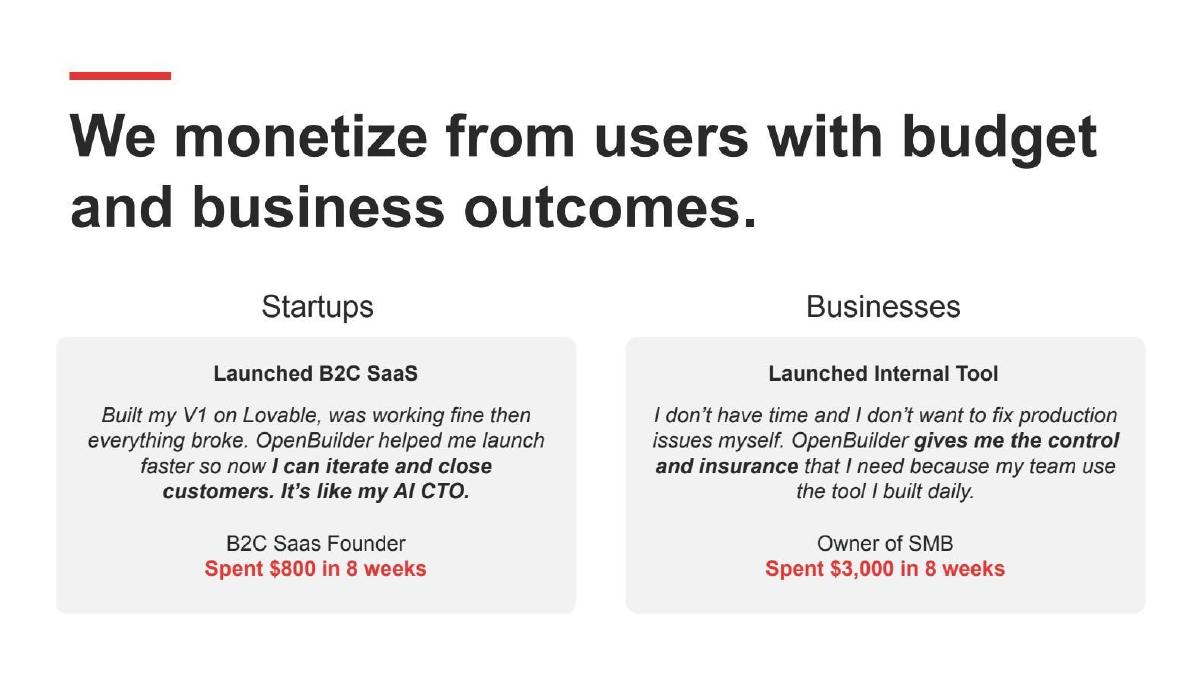
This slide provides two case studies to prove monetization. The first is a "B2C SaaS Founder" who "Spent $800 in 8 weeks" after their previous tool (Lovable) failed them. The second is an "Owner of SMB" who "Spent $3,000 in 8 weeks" on an internal tool. These figures are crucial because they demonstrate a high Willingness to Pay (WTP) for outcomes, far exceeding the typical $20-$50 monthly subscription of standard AI assistants.
Slide 7: The Economic Engine
Slide 7, "What makes our model work," explains the technical and financial arbitrage. They explicitly name "GLM-4.7" and "deepseek" as the open-source models they use, claiming they are "500x cheaper than commercial models." The workflow is described as: AI tries to fix, if it fails, it escalates to a human dev who has "fixed similar issues 100+ times." This human intervention then "improves AI," creating a closed-loop system.
Slide 8: The Competitive Moat
The 'Why we win' slide focuses on the 'Innovator's Dilemma.' They argue that "Replit/Lovable can't easily copy us" because "Going 'free to build' destroys 80% of their revenue overnight." This is a classic strategic play: attacking a competitor's core business model in a way that makes a defensive response financially suicidal for them. They also reiterate the "Data flywheel," claiming that every human fix makes the AI cheaper and more effective.
Slide 9: The Team
The final slide, "We've done it before," is the 'Why Us' slide. It features Paul Chuang Li (CEO, 2x YC Founder) and James Fan Jiang (CTO, ex-Amazon, Stanford). The most impressive metric in the deck is here: they previously "Built & scaled AI coding tools for 1.5M+ users" at "EasyCode," which had "30K WAU." This proves they aren't just theorists; they have successfully managed the scale and technical complexity of AI developer tools before.
What OpenBuilder Does Exceptionally Well
The deck’s greatest strength is its clarity of mission . In a crowded market where every company is launching an 'AI Coder,' OpenBuilder differentiates itself not by features, but by its business model. They correctly identify that for a non-technical person, a tool that is 90% accurate is 0% useful. By centering the entire pitch on the 'last 10%' (getting unstuck), they address the primary reason for churn in their industry.
Furthermore, the strategic positioning against incumbents is sophisticated. Naming Lovable and Replit directly and explaining why their revenue models prevent them from competing on price is a high-conviction move that appeals to venture capitalists looking for 'category killers.' The use of open-source models as a cost-saving measure (500x cheaper) provides a believable 'how' to their 'what.'
What is Missing from the Deck
The most glaring omission is the actual traction data on Slide 5. While the case studies on Slide 6 provide some revenue context, the lack of aggregate user numbers or growth percentages in the main traction slide suggests this deck may have been used very early in the round or as a teaser.
Additionally, there is no 'Ask' slide . A standard pitch deck should conclude with the amount of money being raised, the milestones that capital will achieve, and the current cap table or lead investors if applicable. The deck also lacks a detailed product walkthrough . While we understand the philosophy, we don't see the interface or how the 'escalation to human' actually looks for the user. Finally, there is no financial projection or long-term vision for how this scales beyond a service-heavy 'get unstuck' model into a high-margin software business.
Founder's Guide: What to Copy
Founders building in crowded AI categories should look at Slide 1 and Slide 8. Slide 1 is a perfect example of reframing the category . Instead of saying 'AI coding is hard,' they say 'AI coding is a slot machine.' This creates a villain (the current model) and a hero (OpenBuilder).
Slide 8 is a masterclass in identifying structural moats . Most founders think a moat is a feature; OpenBuilder argues their moat is their competitors' own success. If you can prove that your competitor's business model prevents them from following you into a new pricing tier or delivery method, you have a very strong case for a Seed round. Lastly, the Team Slide (Slide 9) is excellent because it links past success directly to the current problem: they aren't just 'experienced,' they are 'experienced in this exact technical niche.'
Frequently asked questions
- What is 'vibe coding' as defined in this deck?
- In the context of OpenBuilder's deck, 'vibe coding' refers to non-technical users using AI to generate code through natural language prompts. Slide 1 characterizes the current state of this market as a 'slot machine' where users pay for credits and hope the AI produces a working result, often failing before launch.
- How does OpenBuilder plan to make money if building is free?
- According to Slide 7, OpenBuilder monetizes in two ways: first, by charging users to 'get unstuck' when the AI fails and a human expert is required, and second, by charging for 'production needs' once the apps are live. This shifts the cost from the development process to the successful outcome.
- Which competitors does OpenBuilder specifically target?
- The deck explicitly names Lovable and Replit on Slides 5 and 8. OpenBuilder argues that these incumbents cannot easily copy their 'free to build' model because doing so would destroy 80% of their existing revenue streams.
- What is the technical advantage cited by the founders?
- The founders previously built EasyCode, which reached 1.5M users and 30K WAU. Slide 9 states they are 'leveraging same tech' from their previous experience in AI coding tools for JetBrains and VS Code to help the non-technical market.
- Is there a specific funding ask in the deck?
- No. The 9-slide deck provided does not include a slide detailing the amount of capital being raised, the valuation, or the intended use of funds. Publisher-reported data indicates they raised $2.2M in a 2025 Seed round.