ProSky’s 2015 pitch deck is a masterclass in brevity, utilizing only eight slides to secure a later-stage round. The deck eschews traditional sections like 'Market Size' or 'Competitors' in favor of raw traction and high-level product outcomes. With a reported $2 million run-rate and 40% month-over-month growth, the founders lean heavily on momentum. The visual style is minimalist, relying on large-scale photography and bold iconography rather than dense text. While it lacks a clear 'Ask' or financial projections, the deck successfully positions ProSky as a high-growth HR SaaS solution by sho…
Key takeaways
- The deck reports a significant $2,000,000 run-rate as of slide 7.
- Growth is highlighted as 40% Month-over-Month (M.o.M) on slides 2 and 7.
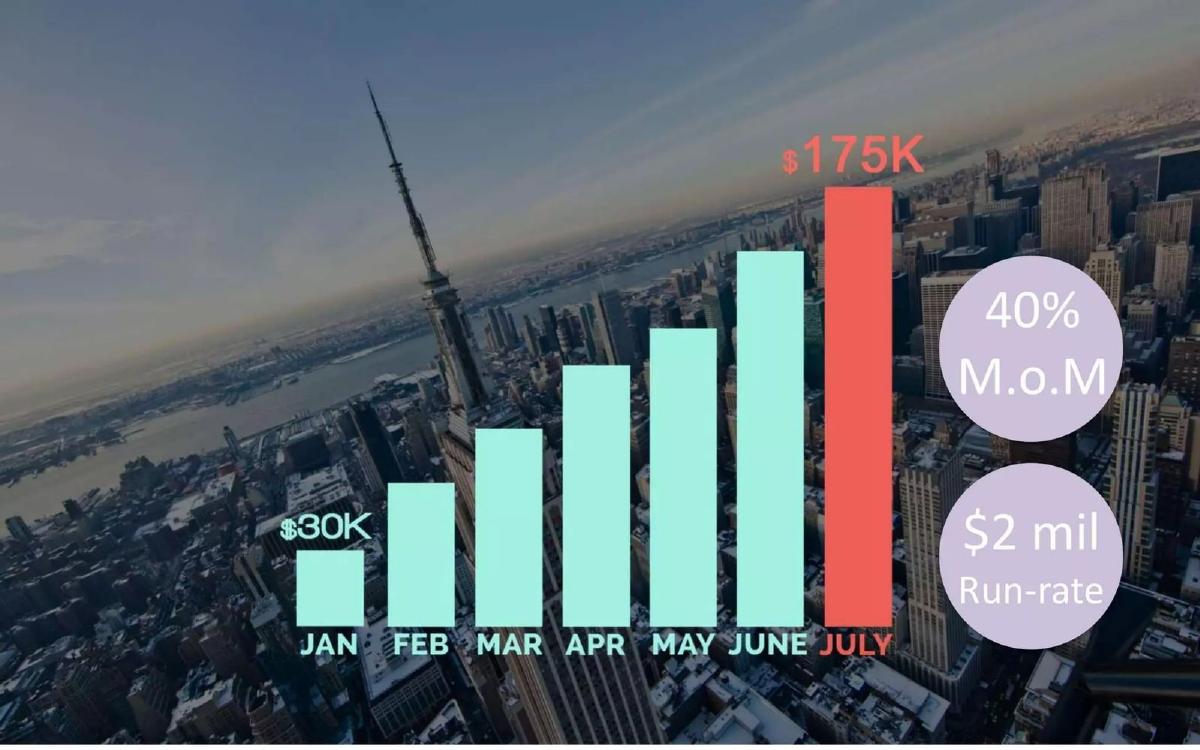
- Revenue grew from $30K in January to $175K in July, as shown in the bar chart on slide 2.
- The platform claims a 96% student completion rate and a 72% placement rate for job seekers on slide 3.
- The team slide (slide 6) features logos from Vivint, Marriott, Merrill Lynch, and Disney to establish credibility.
- The deck completely omits a formal 'Ask' slide, market size (TAM/SAM/SOM), and competitor analysis.
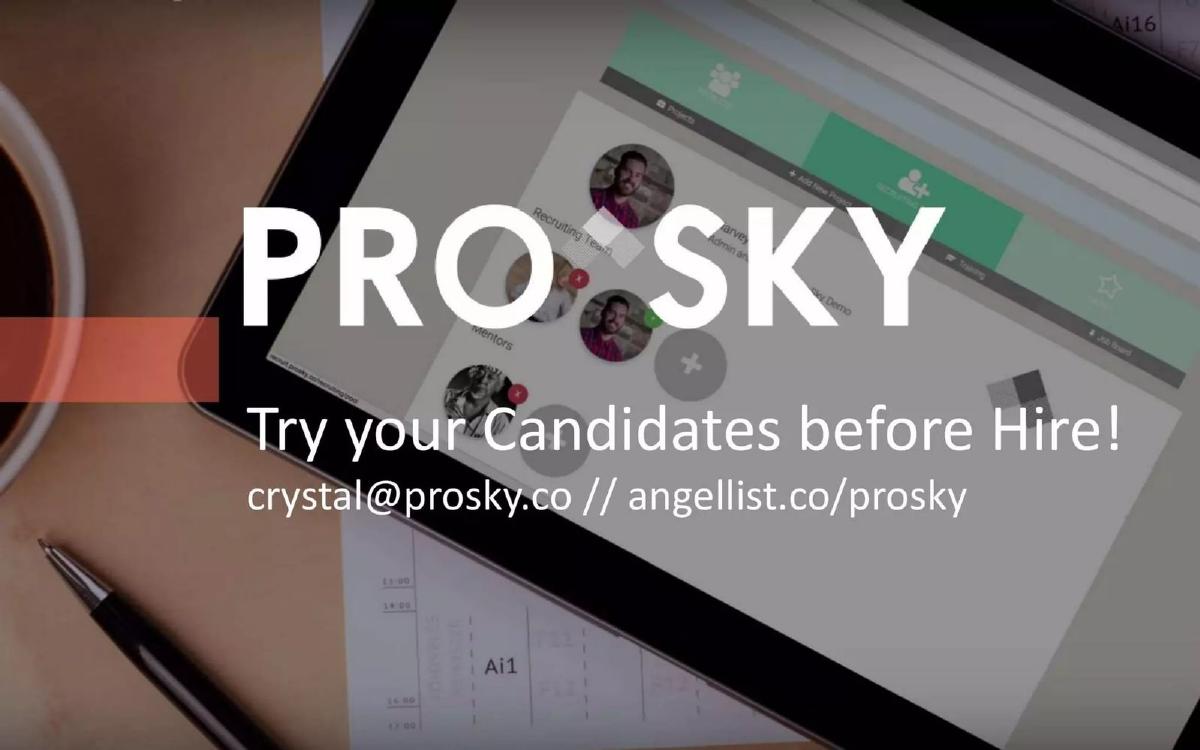
- Product utility is summarized by the tagline 'Try your Candidates before Hire!' on slide 1.
- The company has completed over 160 projects and offers 10 training programs according to slide 3.
The 8-Slide Traction Play
ProSky’s pitch deck is an anomaly in the world of venture capital. While most founders labor over 15 to 20 slides covering everything from the 'Why Now' to 'Unit Economics,' ProSky stripped their presentation down to just eight slides. This approach works primarily because the company had undeniable traction at the time of the raise. When you can show a $2 million run-rate and 40% month-over-month growth, you don't need to spend ten slides explaining why the market is big; the revenue proves the market is there.
Slide 1: Title and Hook
The cover slide is clean and functional. It features the ProSky logo over a blurred image of the software on a tablet. The primary hook is 'Try your Candidates before Hire!' which immediately identifies the problem they are solving: the uncertainty of hiring. It also includes contact information for Crystal Huang and a link to their AngelList profile. This is a standard but effective start that focuses on the core value proposition.
Slide 2: The Revenue Mountain
Slide 2 is arguably the most important slide in the deck. It features a bar chart superimposed over a New York City skyline. The chart shows monthly revenue growth from January ($30K) to July ($175K) . To the right, two callouts emphasize 40% M.o.M growth and a $2 mil Run-rate . By placing this slide second, ProSky immediately validates their business model. They aren't asking investors to believe in a future possibility; they are asking them to fuel an existing fire.
Slide 3: Engagement and Success Metrics
This slide uses a lifestyle image of someone using the platform on a tablet to host four key data points. These metrics focus on the efficacy of the platform rather than just the revenue: 10 Training Programs , 96% Student Completion , Placed 72% of Job Seekers , and 160+ Projects . These numbers are intended to prove that the 'Try before you hire' model actually works for both the candidates and the employers.
Slide 4: The Process Visualization
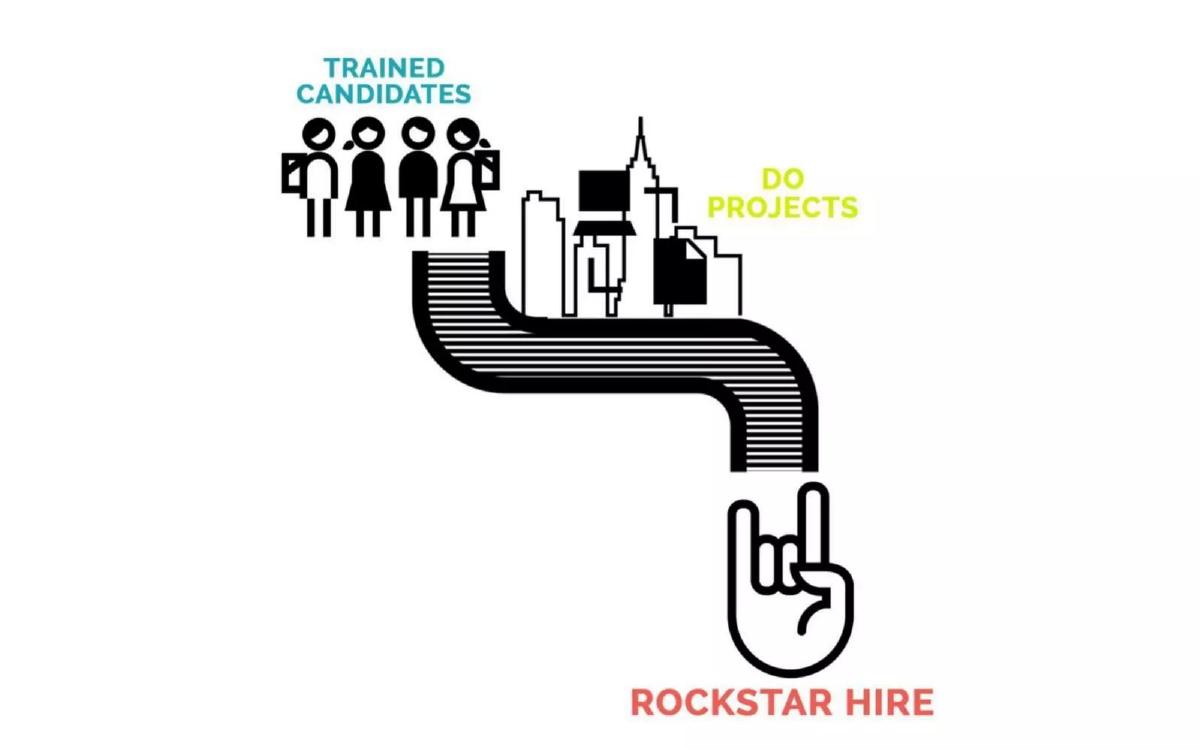
Slide 4 is a minimalist infographic. It shows 'Trained Candidates' entering a pipeline, passing through a city-scape labeled 'Do Projects,' and emerging as a 'Rockstar Hire.' This is the only slide that attempts to explain the 'how' of the product. It is light on technical detail but heavy on the conceptual flow of the platform’s 'full-stack' hiring solution.
Slide 5: The Transition
Slide 5 is a solid black screen. In a live presentation, this is typically used as a 'stage break' to allow the speaker to tell a story or transition to a new topic without the audience being distracted by a slide. In a digital deck, it serves as a visual palate cleanser before moving into the team and summary.
Slide 6: The Team
The team slide features Crystal Huang , Matt Ang , and Fabio Panettieri . Rather than long biographies, the slide uses corporate logos to establish pedigree. Logos for Vivint , MAC , Marriott , Merrill Lynch , and Disney are displayed above the founders. At the bottom, they list themselves as finalists for awards from Facebook , the Bill & Melinda Gates Foundation , and Verizon . This is a 'credibility by association' strategy that works well for a later-stage deck.
Slide 7: The Summary
Slide 7 acts as a 'TL;DR' for the entire presentation. It restates the company's identity as a 'One-Stop Training & Recruiting SaaS Company' and repeats the two biggest selling points: the $2,000,000 run-rate and 40% M.o.M growth. This slide ensures that the final takeaway for any investor is the sheer speed at which the company is scaling.
Slide 8: Closing
The final slide is a simple contact slide with the logo and the founder's email address. It mirrors the cover slide’s simplicity, providing a clean end to a very brief presentation.
What Works in This Deck
Traction Front-and-Center: By putting the revenue growth on slide 2, ProSky eliminates the need for a long 'Problem' or 'Solution' setup. The numbers prove that the problem exists and that their solution is being paid for.
Outcome-Oriented Metrics: The 72% placement rate and 96% completion rate on slide 3 are powerful. They don't just say they have users; they say their users are successful. This is a key differentiator in HR tech, where engagement is often low.
Visual Simplicity: The deck is not cluttered. It uses large fonts, clear icons, and high-quality photography. It is designed to be read in under two minutes, which is ideal for a first-pass review by a VC associate.
What Is Missing
The Ask: There is no mention of how much money ProSky is looking to raise or what the valuation expectations are. While this is often left out of 'teaser' decks, its absence in a 2015 'Later' stage deck is notable.
Market Analysis: There is no mention of the Total Addressable Market (TAM). Investors usually want to know if a company can grow from a $2M run-rate to a $200M run-rate. Without market sizing, that path is unclear.
Competitive Landscape: The HR SaaS and recruiting space is incredibly crowded. ProSky does not mention how they differ from incumbents like LinkedIn or newer entrants in the 'hire-by-doing' space.
Unit Economics: While revenue growth is shown, there is no mention of Customer Acquisition Cost (CAC) or Lifetime Value (LTV). For a SaaS company, these are the 'under the hood' metrics that determine if growth is sustainable or just expensive.
What a Founder Should Copy
The 'Logo Pedigree' Team Slide: If your team has worked at blue-chip companies, use their logos. It is much faster for an investor to process a Marriott or Disney logo than to read a paragraph about a founder's previous role as a Senior Manager.
The Growth Bar Chart: The visualization on slide 2 is excellent. It uses a clear color contrast (the red bar for the most recent month) to highlight current success. It’s a simple way to show momentum without needing a complex spreadsheet.
The One-Sentence Identity: 'One-Stop Training & Recruiting SaaS Company' (slide 7) is a perfect example of a 'high-concept pitch.' It tells the investor exactly what the business is and what industry it occupies in seven words.
Frequently asked questions
- How much did ProSky raise with this deck?
- According to the catalogue facts, ProSky raised $6,100,000 in 2015. This is particularly impressive given the deck consists of only eight slides and lacks many traditional investor deck components like financial forecasts or a detailed competitive landscape.
- What is the core value proposition of ProSky?
- The core value proposition, as stated on slide 1, is 'Try your Candidates before Hire!' The platform functions as a 'One-Stop Training & Recruiting SaaS Company' (slide 7) that uses projects to evaluate candidates' skills before they are officially hired.
- Who are the founders of ProSky?
- The team slide (slide 6) identifies three key leaders: Crystal Huang, Matt Ang, and Fabio Panettieri. Their backgrounds include experience at notable companies like Vivint, Marriott, Merrill Lynch, and Disney, and they are listed as finalists in programs by Facebook and the Bill & Melinda Gates Foundation.
- What traction metrics are included in the deck?
- ProSky showcases strong momentum, including a $2 million run-rate, 40% month-over-month growth, and a revenue jump from $30K to $175K over a seven-month period (slides 2 and 7). They also highlight a 96% completion rate for their training programs (slide 3).
- Is there a specific 'Ask' mentioned in the slides?
- No. The 8-slide deck does not include a slide detailing the amount of capital being raised, the valuation, or the intended use of funds. This suggests the deck may have been used as a teaser or in conjunction with a more detailed data room.