TexasCashFlow.com’s prospectus is a highly tactical document focused on the San Antonio real estate market circa 2015. Unlike typical tech startup decks, this is a property-by-property breakdown of a 'fix and flip' or 'fix and hold' operation. The company targets homes in the $40,000 to $75,000 range, aiming for 20% profit margins on retail flips or 8-10% returns for passive capital investors. The deck relies heavily on 'before and after' visual proof and granular transaction data, such as wholesale prices, rehab costs, and monthly payment figures. While it lacks a traditional management team…
Key takeaways
- The company operates four distinct investment models: Buy and Hold Long Term, Buy and Hold Short Term, Buy and Flip (Retail), and Invest Capital (Slide 2).
- Capital investors are offered an 8-10% rate of return on a 1-3 year term, secured by real estate (Slide 2).
- The 'Buy and Flip' model targets homes priced between $40,000 and $75,000 with a 30-day rehab guarantee (Slide 2).
- A case study at 604 West Hollywood Ave shows a 14.5% ROI with a $51,000 wholesale price and an $80,000 owner finance price (Slide 3).
- The company positions its owner-finance model as a 'philanthropic enterprise' helping blue-collar workers achieve homeownership (Slide 2).
- Project timelines are rapid, with one example at 1629 Santa Anna St. completing $10,000 in rehab in just three weeks (Slide 4).
- Retail flip examples, such as 503 Lovera Blvd., demonstrate a $15,000 investor profit on a $125,000 sale price (Slide 6).
- The deck provides specific geographic targeting, focusing on neighborhoods like Beacon Hill and Los Angeles Heights in San Antonio (Slides 3 and 4).
Executive Summary and Investment Models
Slide 1: Title and Visual Proof
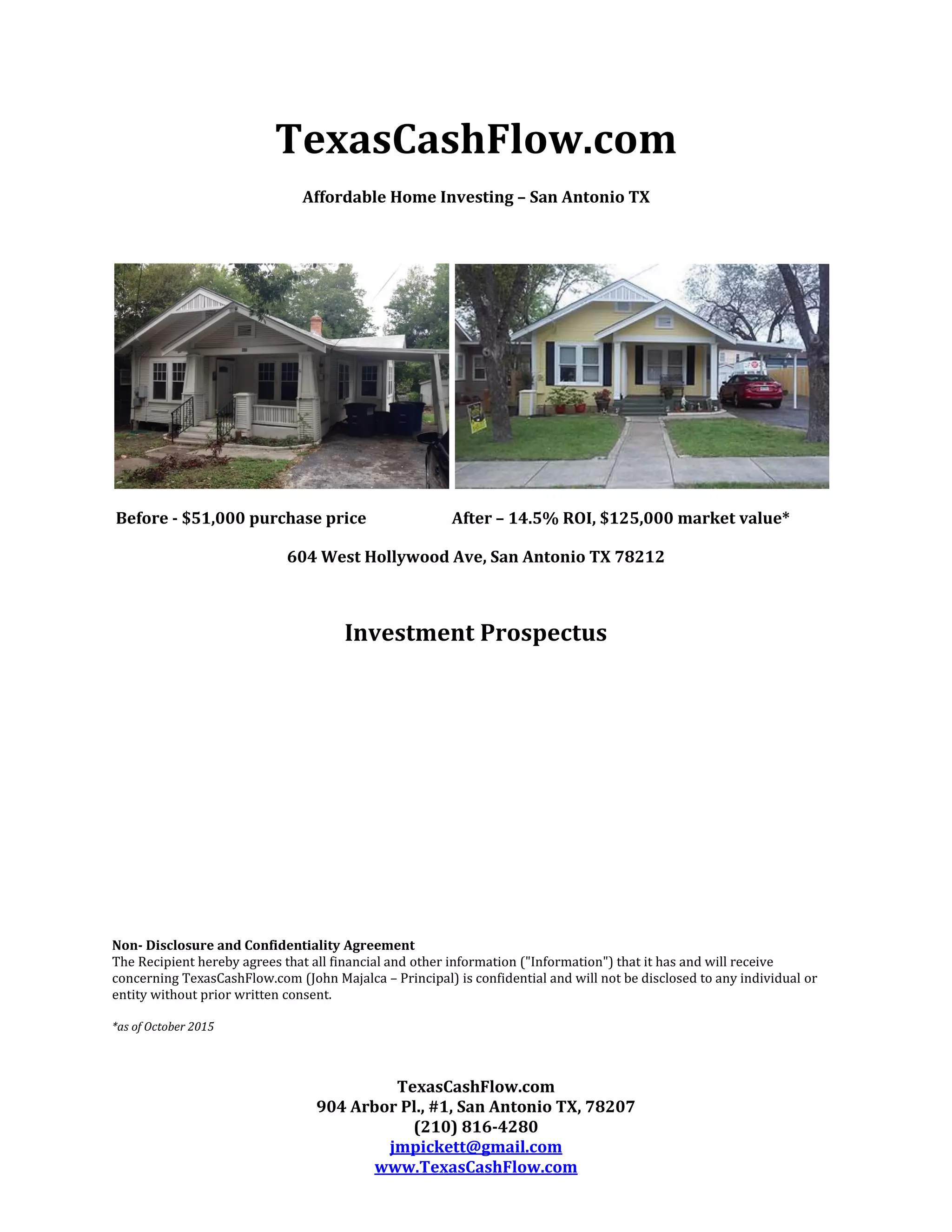
The cover slide for TexasCashFlow.com establishes the company's niche: 'Affordable Home Investing – San Antonio TX.' It utilizes a high-contrast 'Before and After' photo of a property at 604 West Hollywood Ave. The slide explicitly states a $51,000 purchase price and a subsequent $125,000 market value with a 14.5% ROI. This slide serves as an immediate validation of the business model's efficacy. It also includes a Non-Disclosure and Confidentiality Agreement, naming John Majalca as the Principal.
Slide 2: The Four Pillars of Investment
This slide outlines the four ways an investor can participate. Model I: Buy and Hold Long Term focuses on owner financing with no maintenance expenses. Model II: Buy and Hold Short Term involves selling the property note within 1-2 years or utilizing Section 8 rentals. Model III: Buy and Flip (Retail) targets a 20% profit after commissions on homes purchased between $40,000 and $75,000. Model IV: Invest Capital is for passive investors, offering 8-10% returns on $10,000-$50,000 investments secured by real estate. The slide also mentions partnerships with Nichols Home Lending for FHA financing and access to hard money lenders.
Mission and Values
Slide 2 (Continued): Philanthropic Positioning
Under the heading 'III. Our Values,' the company frames its business as a 'philanthropic enterprise.' It argues that by providing owner financing to 'blue-collar workers with steady work history,' they are revitalizing the city and helping families achieve the 'American Dream.' This narrative is designed to appeal to socially conscious investors who want a financial return coupled with community impact. The slide claims the company has rehabbed and resold 'hundreds of houses' over the last decade.
Case Study: 604 West Hollywood Ave
Slide 3: The Beacon Hill Project
This slide provides a deep dive into a project completed in March 2014. Located in the Beacon Hill area north of downtown San Antonio, the 900-square-foot home was purchased for $51,000 cash. Notably, the rehab cost is listed as 'Zero,' as the house was resold with owner financing to a buyer who would perform their own rehab. The 'Owner Finance Price' was $80,000 with a $5,000 down payment and a monthly payment of $806. This resulted in a 14.5% ROI and a 60-day 'Days on Market' (DOM) metric.
Case Study: 1629 Santa Anna St.
Slide 4 & 5: Rapid Rehabilitation
This project, completed in Spring 2015, demonstrates the company's ability to manage renovations. The three-bedroom, 1.5-bath home in Los Angeles Heights was purchased for $62,000. The company invested $10,000 in rehab (paint, flooring, foundation) over just three weeks. It was resold via owner financing for $89,900. The slide lists a 12.3% ROI and a 45-day DOM. Slide 5 provides interior photos showing the finished flooring and a map of the property's location relative to downtown San Antonio.
Case Study: 503 Lovera Blvd.
Slide 6 & 7: The Retail Flip Model
Moving away from owner financing, this slide illustrates a 'Retail Flip.' The property was purchased for $72,000 cash in June 2015. A more extensive rehab of $18,000 was performed, including kitchen granite, a new deck, and bathroom upgrades. The house sold retail for $125,000, resulting in a $15,000 investor profit. The DOM was significantly higher at 120 days, likely due to the requirements of a retail sale versus owner financing. Slide 7 provides additional interior photos and a location map.
Case Study: 650 Canyon Springs Drive
Slide 8: Manufactured Home Arbitrage
The final slide in the set showcases a project in Canyon Lake, 30 miles north of San Antonio. This was a manufactured home built in 1979. Purchased for $50,000 with a $25,000 rehab cost, it was resold for $99,970. The total profit was $18,000 with a DOM of 160 days. This example shows the versatility of the team in handling different types of residential structures and markets outside the immediate San Antonio urban core.
What Works in This Deck
Granular Data: The deck does not hide behind vague percentages. It lists exact purchase prices, rehab costs, down payments, and monthly cash flow figures for every example. · Visual Proof: The use of 'Before and After' photography is essential for real estate decks. It proves the company's ability to identify distressed assets and oversee their transformation. · Multiple Entry Points: By offering four different investment models, the company caters to both active investors (who might want to own the deed) and passive investors (who just want a secured interest rate). · Geographic Focus: The deck demonstrates a deep knowledge of specific San Antonio sub-markets (Beacon Hill, Los Angeles Heights), which builds trust in their 'boots on the ground' expertise.
What Is Missing from This Deck
Team Biographies: While names are mentioned, there are no professional bios, resumes, or headshots for the leadership team. Investors are betting on the operators as much as the assets. · Scalability Plan: The deck is a collection of past successes but lacks a forward-looking strategy. How many homes do they plan to buy next year? What is the total capital requirement? · Market Analysis: There is no data on the broader San Antonio real estate market trends, such as average appreciation rates, inventory levels, or demographic shifts that support long-term growth. · Risk Mitigation: The deck does not address what happens if a buyer defaults on an owner-financed note or if the real estate market enters a downturn. · Legal Structure: There is no mention of the specific legal entity investors would be joining (e.g., an LLC, a Limited Partnership, or direct deed ownership).
What a Founder Should Copy
The 'Unit Economics' Slide: Founders in any industry should copy the way TexasCashFlow.com breaks down a single transaction (Slide 3 and 4). Showing the 'wholesale' cost versus the 'retail' or 'financed' value is the clearest way to demonstrate a margin. · The ROI Focus: Every case study ends with a clear ROI percentage. This is ultimately what investors care about, and keeping it front and center is a winning strategy. · Social Proof through Action: Instead of saying 'we are good at rehab,' they show a $10,000 rehab completed in three weeks. Tangible evidence of operational speed is a powerful selling point.
Frequently asked questions
- What is the primary investment vehicle for passive investors?
- Passive investors can choose the 'Invest Capital' option, which requires a commitment of $10,000 to $50,000. These funds are secured by real estate and used to purchase homes that are subsequently owner-financed. The stated rate of return is 8-10% over a 1-3 year term, providing a fixed-income style return backed by physical assets.
- How does the company handle property renovations?
- TexasCashFlow.com emphasizes speed and cost-efficiency in its rehab process. For retail flips, they guarantee a rehab period of 30 days or less. In one specific case study on Slide 4, they completed $10,000 worth of work—including interior/exterior paint, flooring, and minor foundation repair—in just three weeks.
- What is the 'Owner Finance' model mentioned throughout the deck?
- Instead of selling to buyers who use traditional bank mortgages, the company often sells to 'blue-collar workers' using owner financing. The company acts as the lender, collecting a down payment (typically $5,000) and monthly interest-bearing payments. This allows them to sell properties at a premium compared to wholesale cash prices while generating long-term cash flow.
- What are the typical price points for these properties?
- The deck focuses on the 'affordable home' segment of San Antonio. Purchase prices (wholesale) typically range from $50,000 to $72,000. After renovations, these properties are either sold retail for approximately $125,000 or owner-financed with a total valuation in the $80,000 to $90,000 range.
- Is there a management team or track record listed?
- The deck mentions John Majalca as the Principal and Joseph Pickett as a contact person. While it does not include a formal 'Team' slide with biographies, it claims a track record of rehabbing and reselling 'hundreds of houses' over the last decade in the San Antonio area.