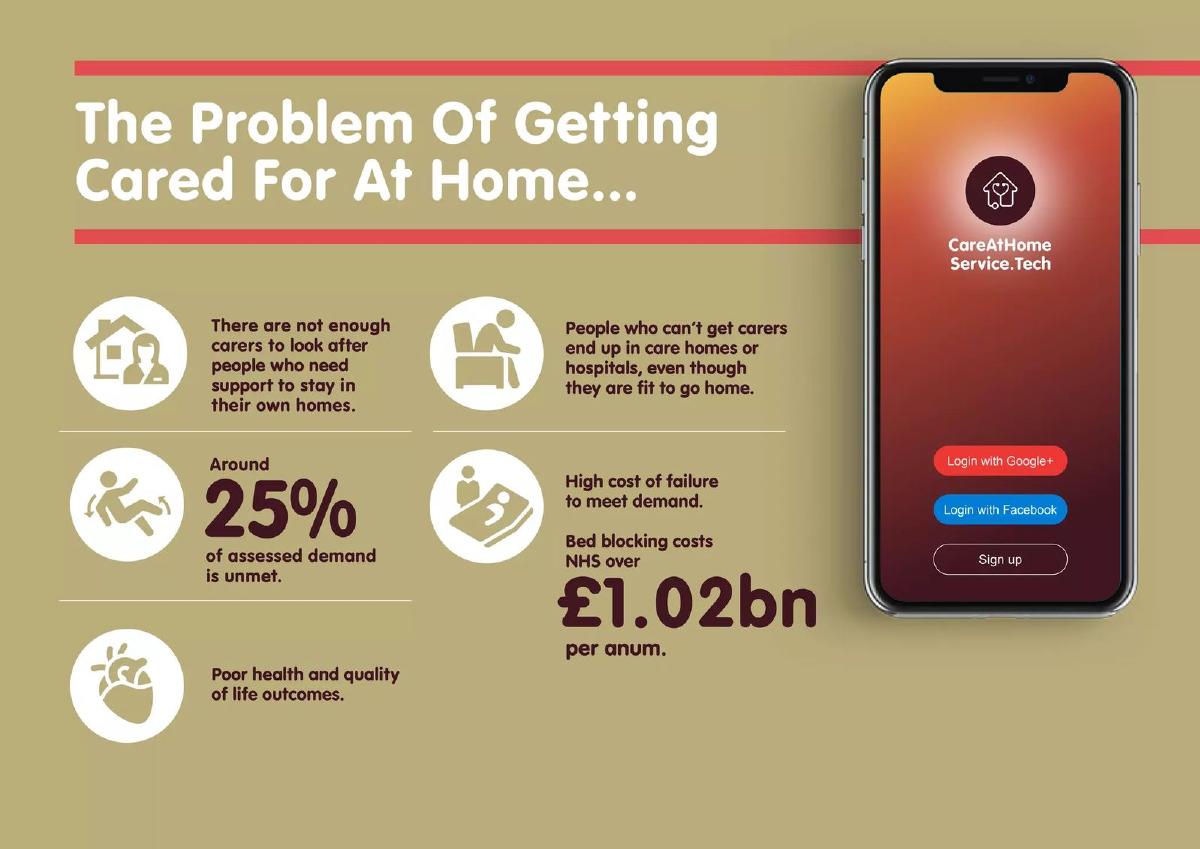
CareAtHomeService.Tech is a 2018-era proposal aiming to disrupt the UK's £5bn home care market through automation. The deck highlights a significant opportunity in the inefficiencies of local authority spending (£3.8bn in 2016) and the growing private self-funder market (£700m). The core value proposition is two-sided: providing carers with better pay, travel compensation, and flexible hours, while offering local authorities a way to reduce administrative overhead. With a pilot already agreed upon in Edinburgh, the company projects a massive scale-up to £104.8m in turnover by year 5. However,…
Key takeaways
- The company identifies a £5bn annual target market in the UK, with £3.8bn coming from local authorities as of 2016 (Slide 5).
- A pilot program has already been secured with the City of Edinburgh to validate the model (Slide 6).
- The financial model assumes reaching a 1.8% market share by year 5, resulting in £104.8m in turnover (Slide 5, Slide 7).
- The team includes high-level executive experience from Capita, Atos, and the NHS, providing necessary institutional credibility (Slide 2).
- The funding ask is structured in three stages totaling £1.7m: £450k, £550k, and £700k (Slide 7).
- The business model involves employing carers through an umbrella company to manage compliance and payroll (Slide 4).
- Projected profitability is set for Q4 2019, with a year 5 profit target of £18.4m (Slide 7).
- Acquisition strategy relies on a mix of local authority procurement cycles and high-spend consumer marketing like radio and outdoor advertising (Slide 6).
CareAtHomeService.Tech: Automating the UK Social Care Sector
The CareAtHomeService.Tech deck, produced in 2018, represents a classic 'Uber-for-X' pitch applied to the highly regulated and fragmented UK home care market. The proposal focuses on leveraging technology to bridge the gap between underpaid carers and overstretched local authorities. By removing the 'middleman' of traditional care agency administration through automation, the company promises a more efficient, cost-effective, and scalable solution.
Slide 1: Title and Branding
The cover slide establishes the company as 'CareAtHomeService.Tech Ltd' and labels the document as an 'Investor Proposal' for 2018. The branding uses a muted olive background with medical and care-related icons. A smartphone mockup displays the company logo—a house icon containing a stethoscope—signaling a mobile-first, tech-driven approach to healthcare.
Slide 2: The Team
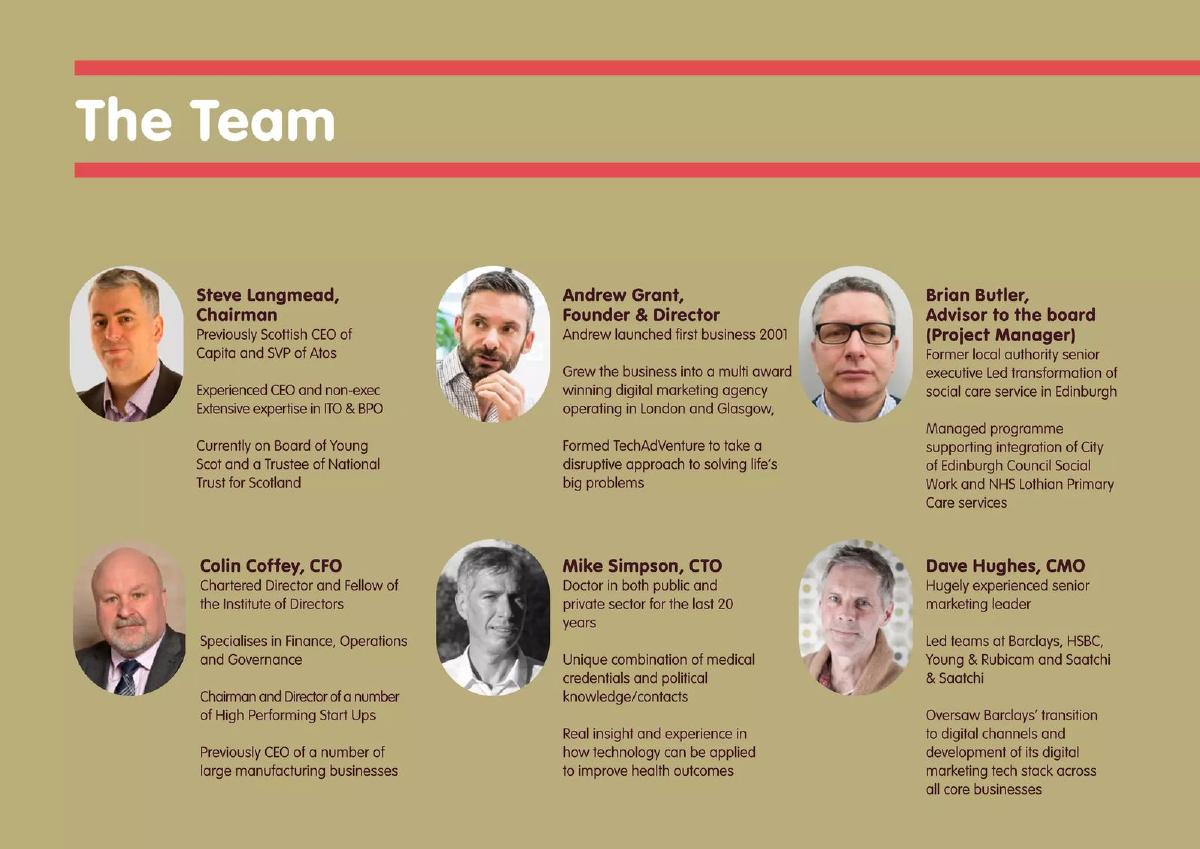
This is a strong credibility slide. The team is not composed of first-time graduates but seasoned executives. Steve Langmead (Chairman) brings enterprise experience as the former Scottish CEO of Capita. Andrew Grant (Founder) highlights his history of launching businesses since 2001. Notably, Brian Butler (Advisor) provides the 'insider' knowledge necessary for this sector, having led social care transformation for the City of Edinburgh. The inclusion of Mike Simpson (CTO) , a doctor with 20 years of experience, and Dave Hughes (CMO) , with a background at Barclays and HSBC, rounds out a team that looks capable of handling both government procurement and large-scale consumer marketing.
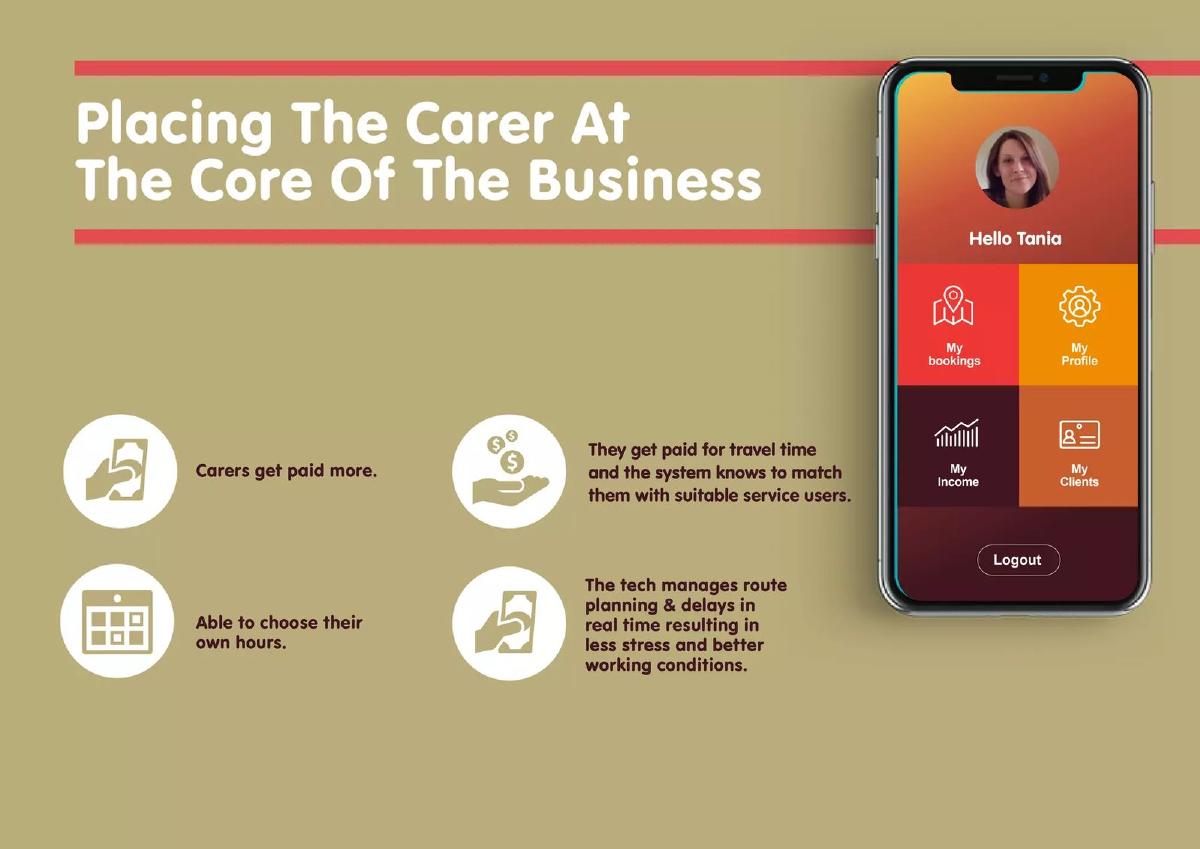
Slide 3: Placing The Carer At The Core
This slide addresses the supply side of the marketplace. The company identifies four key benefits for carers: higher pay, travel time compensation, flexible hours, and automated route planning to reduce stress. The smartphone mockup shows a 'Carer Portal' with sections for bookings, income, and clients. This focus on the carer is a strategic move, as recruitment and retention are the primary bottlenecks in the home care industry.
Slide 4: How Do We Do It?
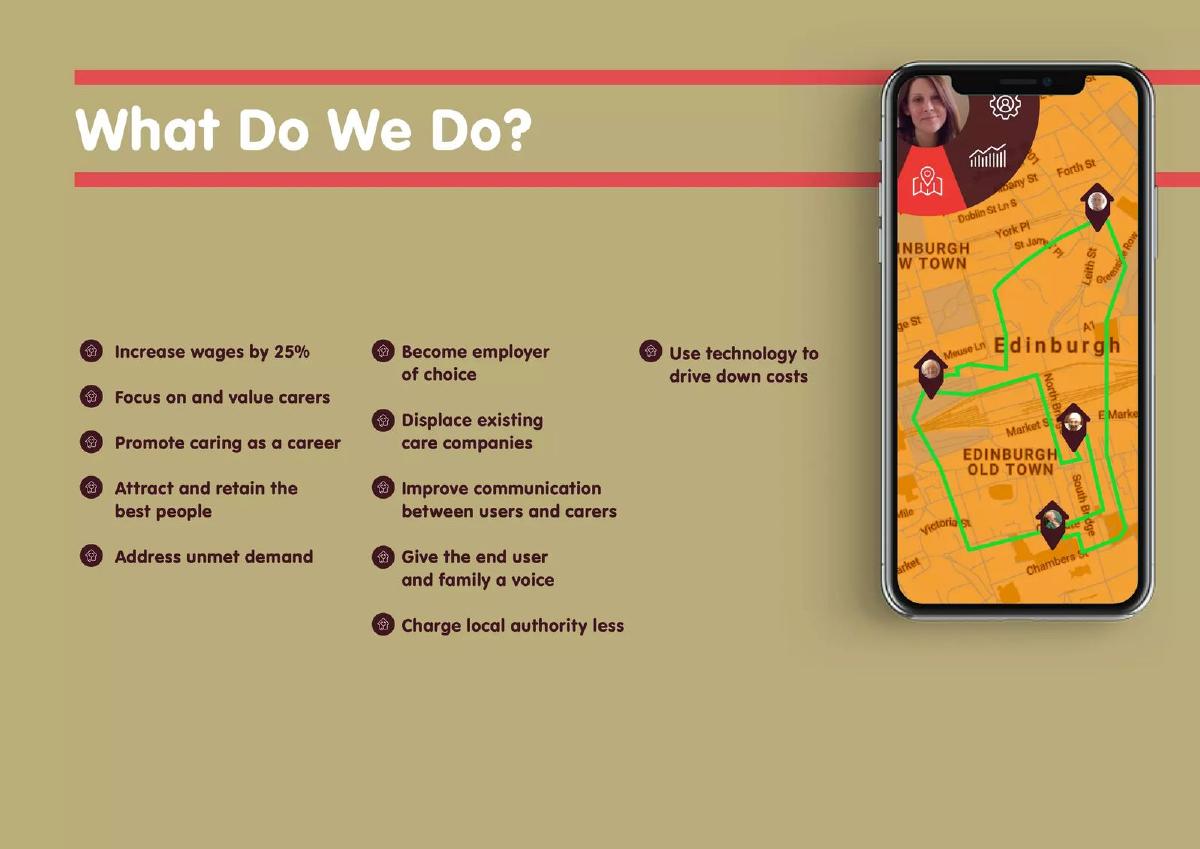
This slide outlines the operational model. The company intends to Utilise cloud-based software and Automate administrative processes to 'eliminate human involvement.' The most significant operational detail is the plan to Employ carers through an 'umbrella company.' This suggests a model where the company maintains a level of control over the workforce (likely for compliance and quality insurance) rather than operating as a pure gig-economy marketplace. The goal is to 'create headroom' to increase wages while lowering costs for partners.
Slide 5: Market Size
The deck cites a £5bn annual target market . It breaks this down into £3.8bn spent by UK local authorities in 2016, £700m from private self-funders, and an estimated £500m in unmet demand. The company sets a conservative-sounding but financially massive goal: achieving a 1.8% market share by year 5 . This slide effectively communicates the scale of the opportunity and the specific segments the company intends to capture.
Slide 6: Carer and Customer Acquisition
The acquisition strategy is split between B2B and B2C. For local authorities, the company relies on the success of its Edinburgh pilot to generate word-of-mouth and navigate the five-month procurement cycles. For private clients and carers, the strategy is more traditional: radio, outdoor advertising, and social media. The mention of 'recruitment drives at shopping centres' indicates a boots-on-the-ground approach to solving the carer shortage.
Slide 7: Profit and Financial Projections
This slide contains the 'big numbers.' The company reports £60k of cash already invested and seeks £1.7m in new funding across three stages (£450k/£550k/£700k). The projections are aggressive: reaching cash positivity by Q4 2019 and achieving a £104.8m turnover by year 5 with an £18.4m profit. The smartphone mockup on this slide shows a 'Care Portal' interface, displaying income, taxes, and payments, reinforcing the transparency of their financial system for carers.
Slide 8: Contact
The final slide provides direct contact information for Andrew Grant, including a company email and a UK mobile number. The background icons from the cover slide are repeated, maintaining visual consistency.
What CareAtHomeService.Tech Does Well
The deck excels at establishing institutional credibility . In a sector as sensitive as home care, having a former Capita CEO and an NHS/Local Authority veteran on the team is a major advantage. Investors in this space are often wary of 'tech bros' who don't understand the complexities of government procurement; this team clearly does.
The market segmentation is also clear. By distinguishing between local authority spend and private self-funders, the company shows it understands the two different sales motions required to win the UK market. The focus on 'unmet demand' (£500m) highlights a pain point that resonates with both social and financial investors.
What is Missing from the Deck
The most glaring omission is a Competitor Analysis . In 2018, companies like Cera Care and Helpling (via acquisitions) were already active in the UK market. The deck treats the space as if CareAtHomeService.Tech is the only player attempting to automate care coordination. Without a 'Why Us' vs. 'Them' slide, it is difficult to judge their technical or strategic moat.
Furthermore, there is a lack of Unit Economics . While the deck mentions 'creating headroom' for higher wages, it doesn't provide the specific take-rate, the cost of acquisition (CAC) for a private client, or the lifetime value (LTV) of a carer. For a business projecting £100m+ in turnover, these metrics are essential for validating the scalability of the model.
Founder Takeaways: What to Copy
The Staged Ask: Breaking down a £1.7m ask into three tranches (£450k/£550k/£700k) is a smart way to de-risk the investment for early backers. It suggests a milestone-based approach to funding. · The Pilot as Proof: Mentioning a specific pilot with a major city (Edinburgh) is the best way to validate a B2G (Business to Government) model. It moves the conversation from 'if' to 'when.' · Supply-Side Focus: In marketplace businesses, the supply side (carers) is often the hardest to maintain. Dedicating a full slide to carer benefits (Slide 3) shows that the founders understand where the real operational friction lies. · Clear Financial Targets: Even if the year 5 projections are ambitious, the deck clearly states the market share required (1.8%) to reach them. This makes the large turnover figure feel calculated rather than plucked from thin air.
Frequently asked questions
- What is the primary problem CareAtHomeService.Tech is solving?
- The deck identifies high administrative costs and poor working conditions for carers in the UK social care sector. By using cloud-based software to automate coordination and route planning, the company aims to eliminate 'human involvement in administration' (Slide 4), thereby creating financial headroom to pay carers more while reducing costs for local authorities.
- How does the company plan to acquire customers?
- The strategy is bifurcated. For B2B, they target local authorities, starting with a pilot in Edinburgh and planning to add one new authority every five months (Slide 6). For B2C (private clients), they plan to use traditional media like radio and outdoor advertising alongside a 'heavy social media presence' (Slide 6).
- What are the projected financials for the company?
- The company is highly ambitious, projecting a jump from £60k of initial invested cash to £104.8m in turnover by year 5 (Slide 7). They expect to be cash positive by Q4 2019 and reach a year 5 profit of £18.4m, maintaining £26.9m in the bank (Slide 7).
- Who are the key members of the leadership team?
- The team is led by Founder Andrew Grant and Chairman Steve Langmead (former Scottish CEO of Capita). It also features Mike Simpson as CTO, who has 20 years of medical and political experience, and Brian Butler, a former local authority executive who led social care transformation in Edinburgh (Slide 2).
- What is the specific funding request?
- The deck asks for a total of £1.7m in investment. This is broken down into three distinct stages: an initial £450k, followed by £550k, and a final £700k (Slide 7). The deck does not specify the equity offered or the valuation for these rounds.