Card Blanch presents a solution to 'wallet fatigue' by consolidating multiple credit, debit, and loyalty cards into a single physical or digital interface. The deck highlights a significant market opportunity in the US, citing 176 million cardholders and a projected 144 billion purchase transactions by 2025. With a business model spanning merchant cashback and user subscriptions, the company projects growing to 700,000 users and $42 million in revenue by 2024. While the deck effectively communicates the user experience and market scale, it lacks a team slide and specific details on the techni…
Key takeaways
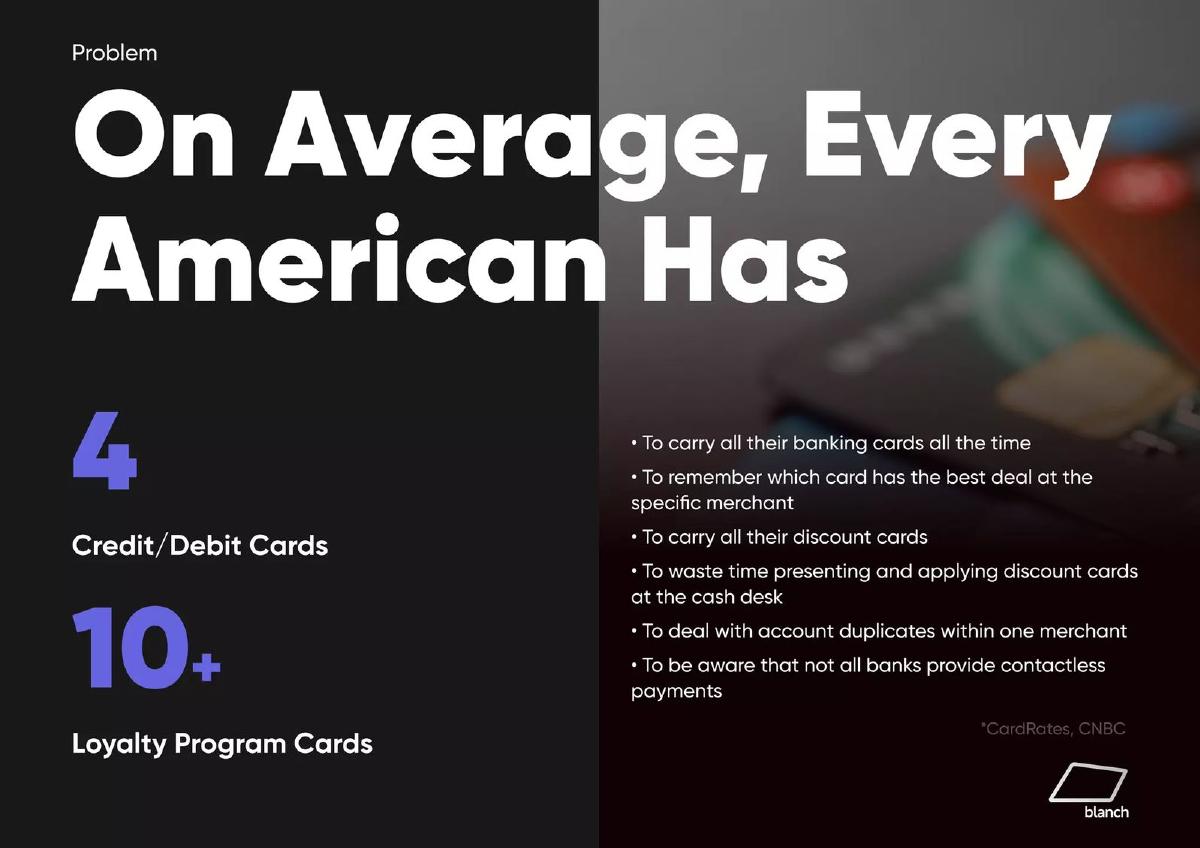
- The average American carries 4 credit/debit cards and over 10 loyalty cards, creating a fragmented payment experience (Slide 2).
- Card Blanch targets a US market of 176 million cardholders who currently use 1.06 billion cards (Slide 3).
- The product is a single ceramic or digital Visa card that uses algorithms to automatically select the best bank card for any given merchant (Slide 6).
- Revenue is diversified across four streams: merchant cashback, monthly user subscriptions, and up-selling for both rewards and banking cards (Slide 8).
- Financial projections estimate reaching 50,000 users and $3M revenue in 2022, scaling to 700,000 users and $42M by 2024 (Slide 9).
- The deck identifies Fuze, Curve, Key Ring, and Stocard as primary competitors but claims they lack integrated bank and reward management (Slide 7).
- The company is seeking a $1M Seed round after successfully raising $0.5M in angel investments (Slide 10).
- The deck entirely omits a team slide, leaving the founders' backgrounds and technical capabilities unknown to the reader.
Executive Summary: The All-in-One Wallet Play
Card Blanch enters the fintech space with a familiar but ambitious promise: the elimination of the physical wallet. By consolidating credit, debit, and loyalty cards into a single ceramic or digital Visa, the company aims to capture a slice of the billion-plus cards currently in circulation in the United States. The deck focuses heavily on the user experience and the sheer scale of the US payment market, positioning the product as a smart intermediary that optimizes every transaction for the consumer.
Slide 1: Title and Vision
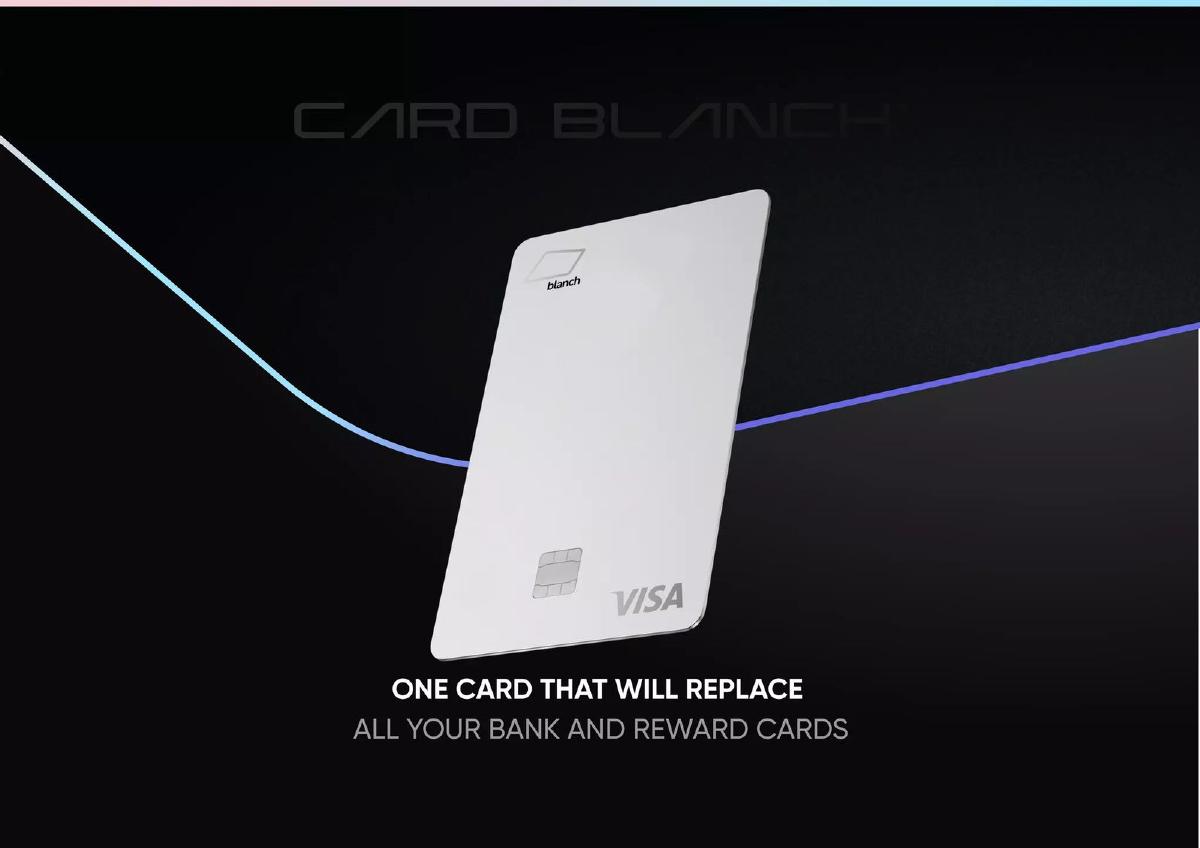
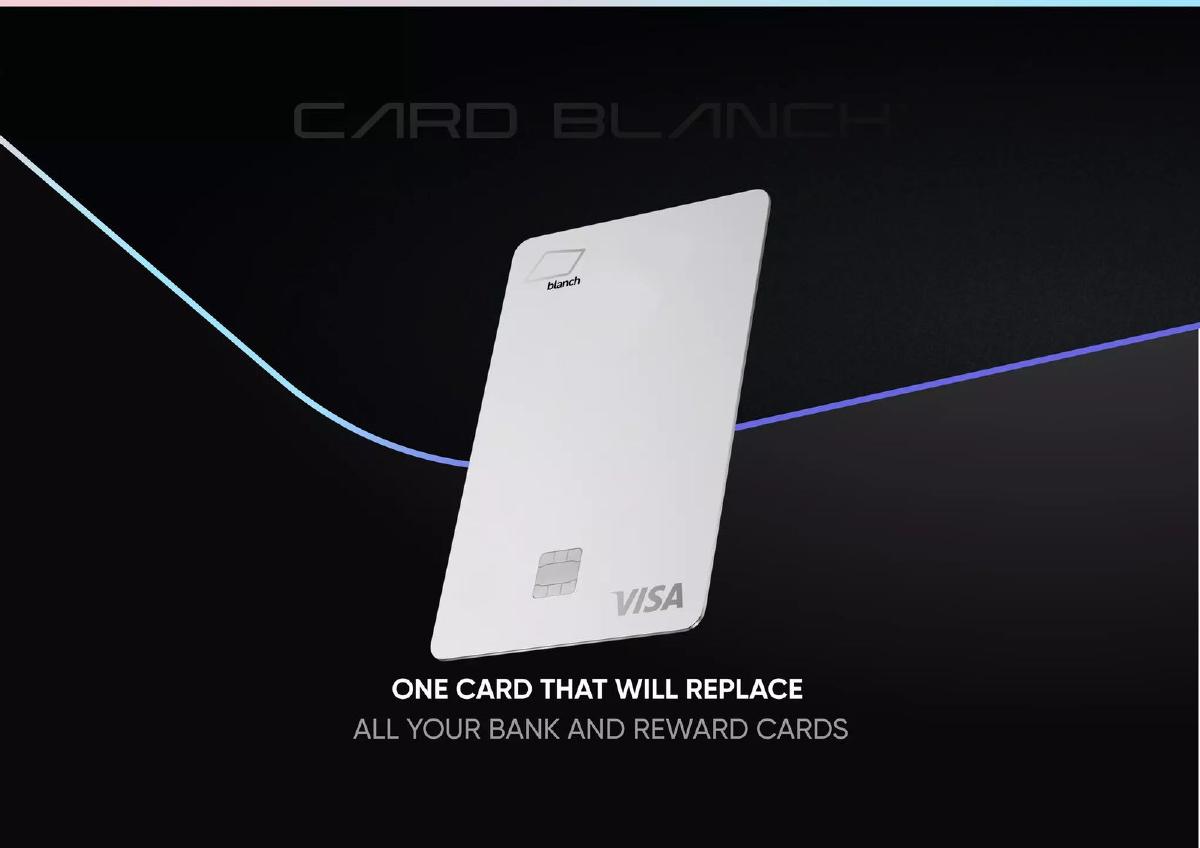
The opening slide features a high-fidelity render of a minimalist white card with a Visa logo. The tagline, "ONE CARD THAT WILL REPLACE ALL YOUR BANK AND REWARD CARDS," immediately establishes the product's primary function. The branding is clean and premium, suggesting a target audience that values design and simplicity.
Slide 2: The Problem of Fragmentation
Slide 2 quantifies the inconvenience Card Blanch aims to solve. Citing CNBC and CardRates, it states that the average American carries 4 credit/debit cards and 10+ loyalty program cards. The slide lists specific pain points, such as the need to remember which card has the best deal, the time wasted at cash desks, and the lack of contactless options at some banks. This slide effectively builds a case for "wallet fatigue."
Slide 3: Market Size and Opportunity
The market size slide focuses exclusively on the USA. It notes 176 million cardholders and 1.06 billion cards in use. A significant figure of 144 billion purchase transactions is projected for 2025. By using these large-scale macro figures, the deck attempts to show that even a small percentage of market capture would result in a massive business.
Slide 4: The Solution Visualized
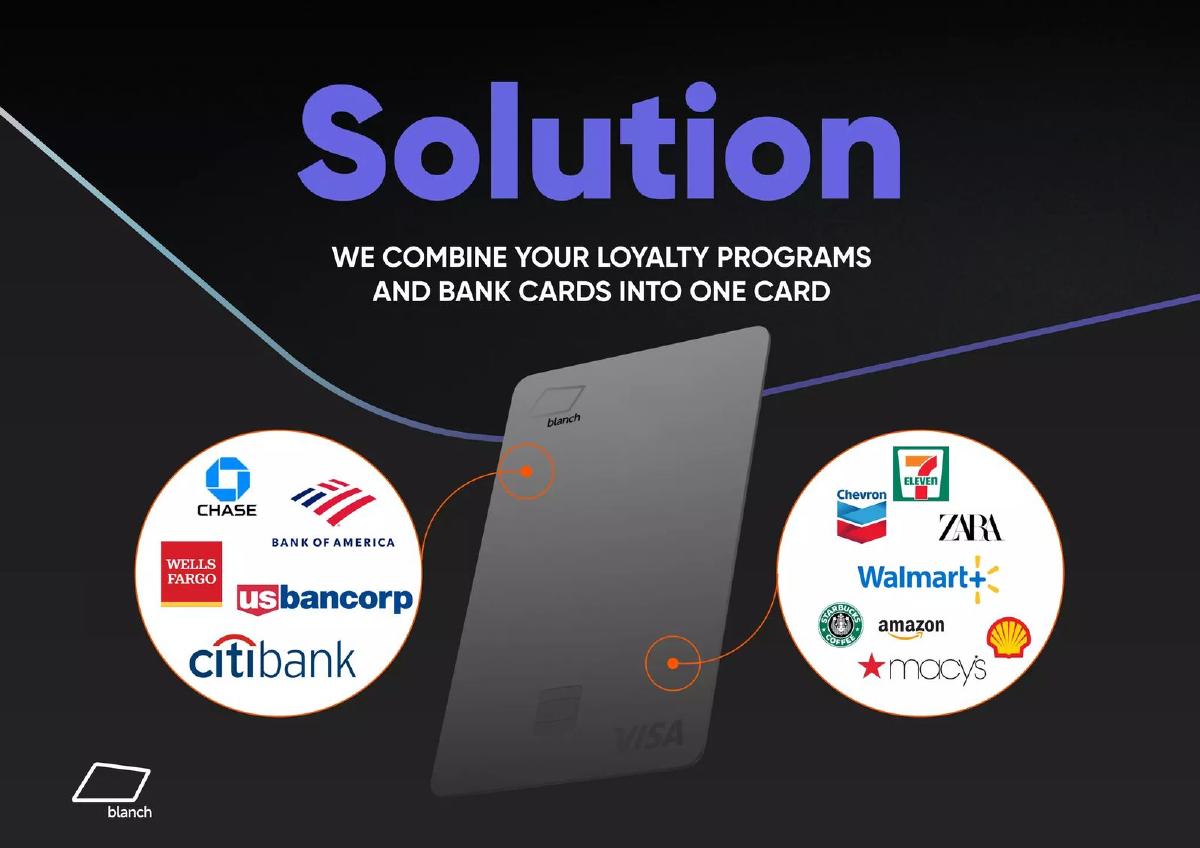
This slide uses logos from major institutions like Chase, Bank of America, Wells Fargo, and Citibank, alongside retailers like Starbucks, Walmart, and Amazon. It visually demonstrates the "Solution": combining these disparate entities into the single Card Blanch interface. It clarifies that the product bridges the gap between traditional banking and retail loyalty programs.
Slide 5: User Interface and Experience
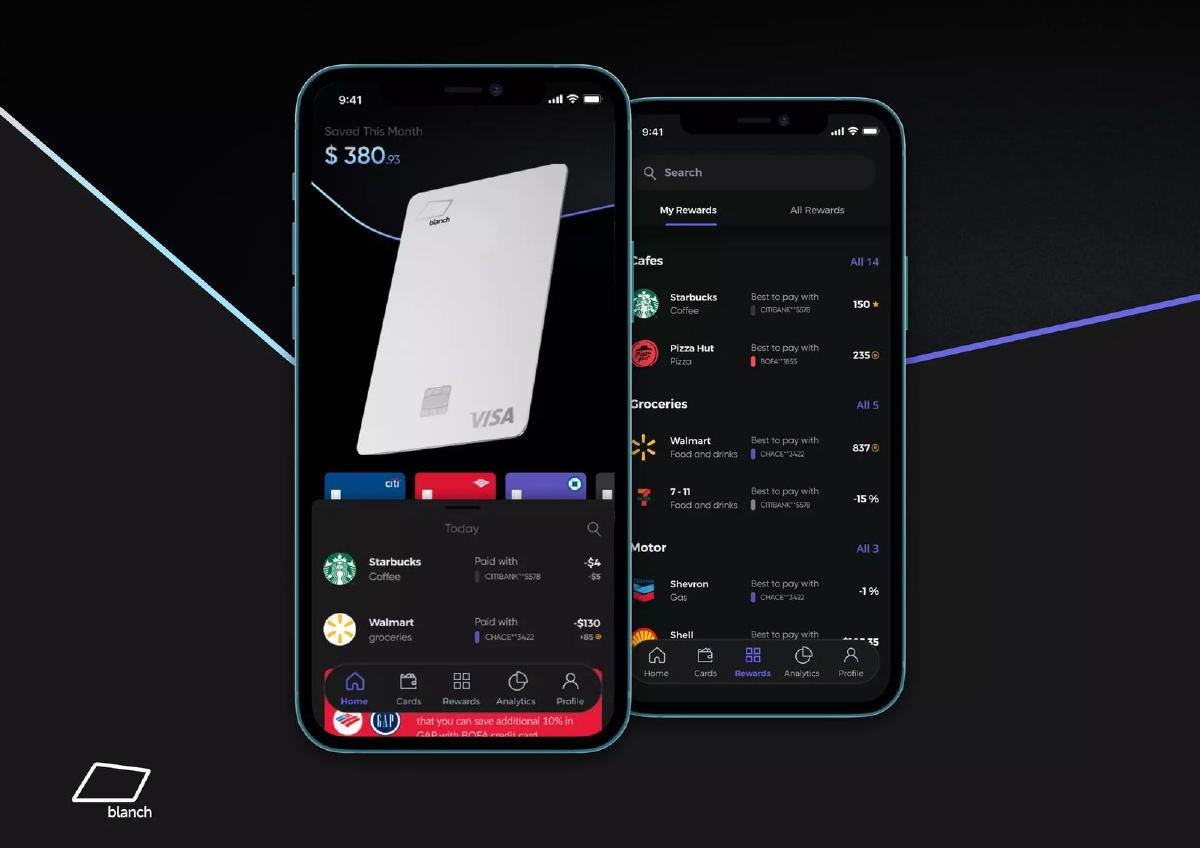
Slide 5 provides a look at the mobile application. The UI shows a "Saved This Month" metric ($380.93) and a list of rewards. It highlights features like "Best to pay with," which suggests the app's intelligence in selecting the optimal card for specific categories like Cafes, Groceries, and Motor. The design follows modern dark-mode aesthetics common in fintech.
Slide 6: Product Workflow and Features
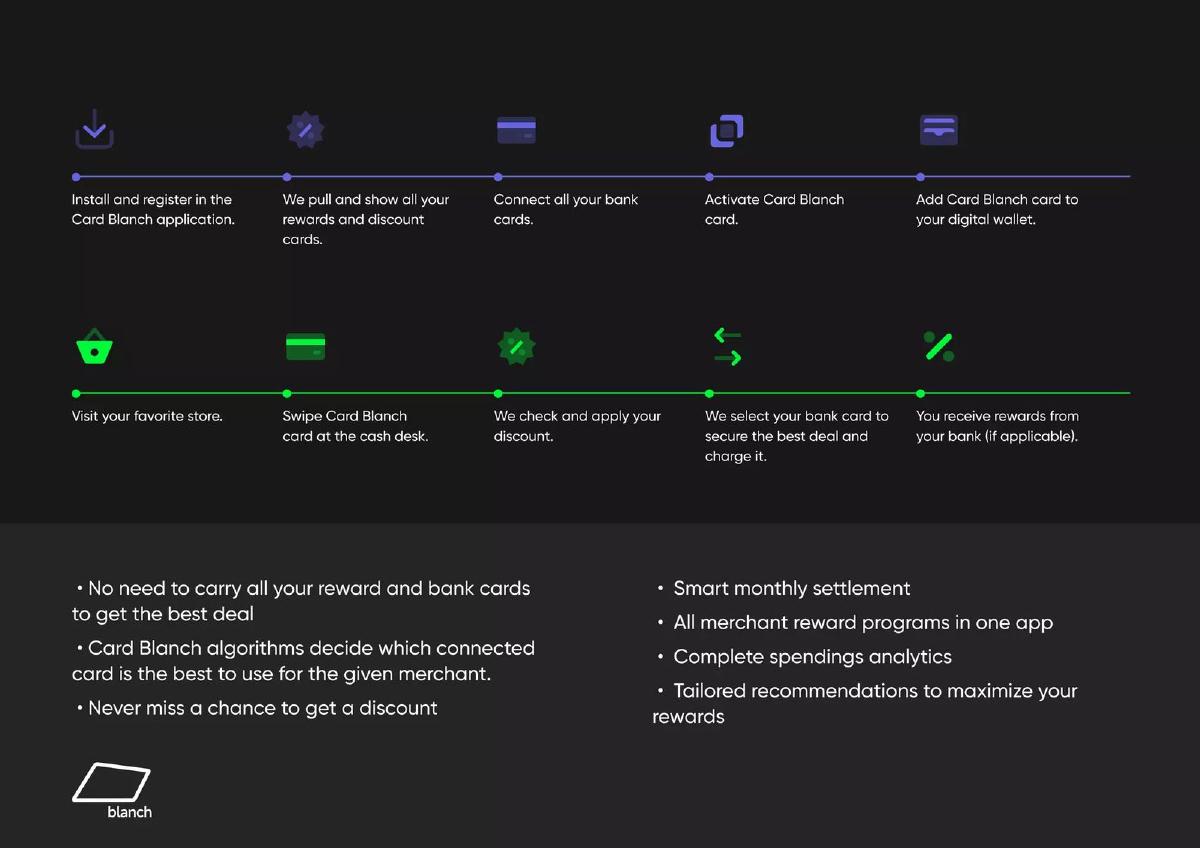
This slide outlines the user journey in two phases: Setup and Usage. The setup involves registering, pulling rewards, connecting bank cards, and adding the card to a digital wallet. The usage phase explains that the "Card Blanch algorithms" check and apply discounts and select the bank card to "secure the best deal." Key features listed include smart monthly settlement and complete spending analytics.
Slide 7: Competitive Landscape
Card Blanch identifies four competitors: Fuze, Curve, Key Ring, and Stocard. The deck argues that these solutions are insufficient because they don't integrate bank and reward cards together, lack offer management, or are "not easy to use." This is a standard competitive positioning slide, though it lacks a detailed feature-by-feature comparison matrix.
Slide 8: The Revenue Model
The business model is presented as a list of four streams: merchant cashback, a monthly subscription model for users, and up-selling for both merchant rewards and banking cards. This suggests the company is not relying on a single source of income, which can be seen as a de-risking strategy for investors.
Slide 9: Financial Projections and Market Opportunity
Slide 9 presents a $11 billion market opportunity, broken down into $1.5B from discount transactions and $10B from the subscription model. A bar chart shows aggressive growth projections:
2022: 50k users, $3M revenue · 2023: 300k users, $18M revenue · 2024: 700k users, $42M revenue
These figures are stated as projections and are not based on historical performance.
Slide 10: Next Steps and Funding Ask
The company reveals it has already raised $0.5M in angel investments and is now seeking a $1M Seed round. The "Next Steps" include finalizing product development, executing a go-to-market strategy, and signing a bank partner. Notably, the deck mentions the creation of a "patent portfolio," suggesting they view their routing algorithms as intellectual property.
Slides 11-12: Supplemental UI and Value Props
The final two slides reiterate the core value propositions with additional app mockups. Slide 11 emphasizes "Your whole wallet in one card" (digital or ceramic), while Slide 12 highlights "Complete spending analytics in one place," showing a breakdown of spending by category (Rent, Restaurants, Medicine, Groceries) across different connected cards.
What Works in This Deck
The deck is visually professional and maintains a consistent brand identity. The problem statement is relatable and backed by credible third-party data (CNBC, Statista). By showing the actual UI of the app, the founders demonstrate that the product is beyond the conceptual stage. The clear breakdown of the $1M ask and the acknowledgment of previous angel funding provide a clear starting point for investor negotiations.
What Is Missing
The most glaring omission is the Team Slide . There is no mention of who is building this company, their background in fintech, or their technical expertise. For a product that relies on "algorithms" and banking partnerships, the lack of founder profiles is a significant hurdle. Additionally, there is no mention of Unit Economics (Customer Acquisition Cost vs. Lifetime Value) or a detailed Go-To-Market plan beyond the phrase "aggressive marketing campaign." Finally, the deck does not explain the Technical Feasibility of how they will integrate with so many different bank and loyalty APIs, which is a notorious challenge in the industry.
Founder Takeaways
Founders should emulate the clean, high-fidelity visuals used here to represent their product. The use of recognizable logos (Chase, Starbucks) helps investors immediately grasp the ecosystem the product lives in. However, never omit the team slide; at the angel and seed stages, investors are often betting on the people as much as the product. If your product relies on complex integrations, include a slide that briefly explains the technology stack or regulatory compliance (like PCI DSS) to build credibility.
Frequently asked questions
- What is the core value proposition of Card Blanch?
- The core value proposition is the consolidation of all financial and loyalty cards into one. According to Slide 6, the 'Card Blanch algorithms' automatically decide which connected card offers the best deal or discount for a specific merchant, removing the mental load from the consumer while ensuring they never miss a reward.
- How does Card Blanch plan to make money?
- As detailed on Slide 8, the revenue model is multi-pronged. It includes merchant cashback, a monthly subscription fee for users, and up-selling opportunities for both merchant rewards and banking cards. Slide 9 projects that the subscription model alone represents a $10 billion revenue opportunity.
- What is the current stage of the company according to the deck?
- The company is in the 'Next Steps' phase, seeking a $1M Seed round. Slide 10 indicates they have already raised $0.5M in angel investments. Their immediate goals include finalizing product development, signing a bank partner, and creating a patent portfolio.
- Who are the main competitors identified in the pitch?
- Slide 7 lists Fuze, Curve, Key Ring, and Stocard as competitors. Card Blanch differentiates itself by claiming these alternatives do not solve the problem of managing multiple bank and reward cards simultaneously and often rely on manual processes for adding cards.
- What metrics are provided regarding market size?
- Slide 3 cites 176 million cardholders in the USA using 1.06 billion cards. It also notes a projection of 144 billion purchase transactions in the USA by 2025, sourced from Statista and Nilson Report, suggesting a massive total addressable market for a consolidation tool.