Card Blanch addresses the fragmentation of the modern consumer's wallet, noting on slide 1 that the average American carries 4 credit/debit cards and over 10 loyalty cards. Their solution is a single 'ceramic or digital' card that uses algorithms to automatically select the best payment method for any given merchant to maximize rewards. The deck highlights a massive $11 billion market opportunity and sets ambitious growth targets, projecting 700,000 users and $42 million in revenue by 2024. While the deck is visually polished and clearly defines the user journey, it lacks a team slide and det…
Key takeaways
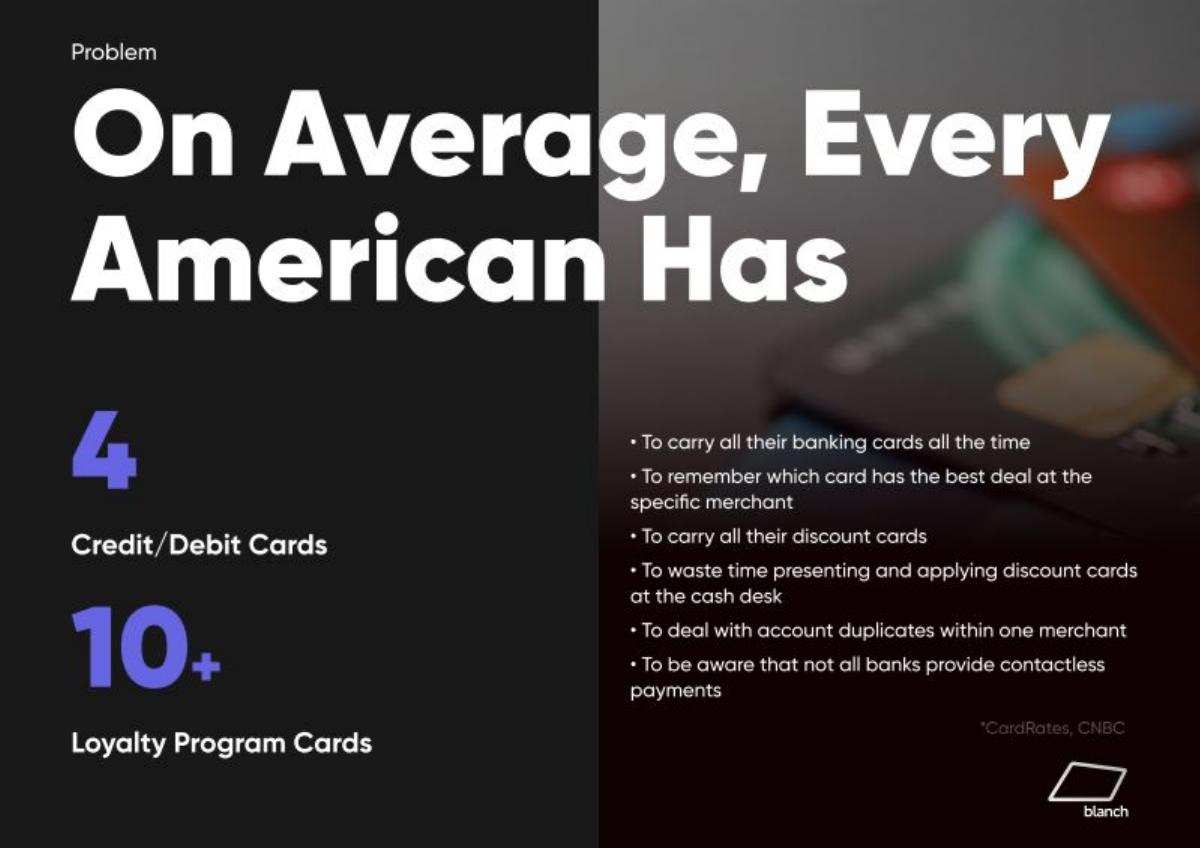
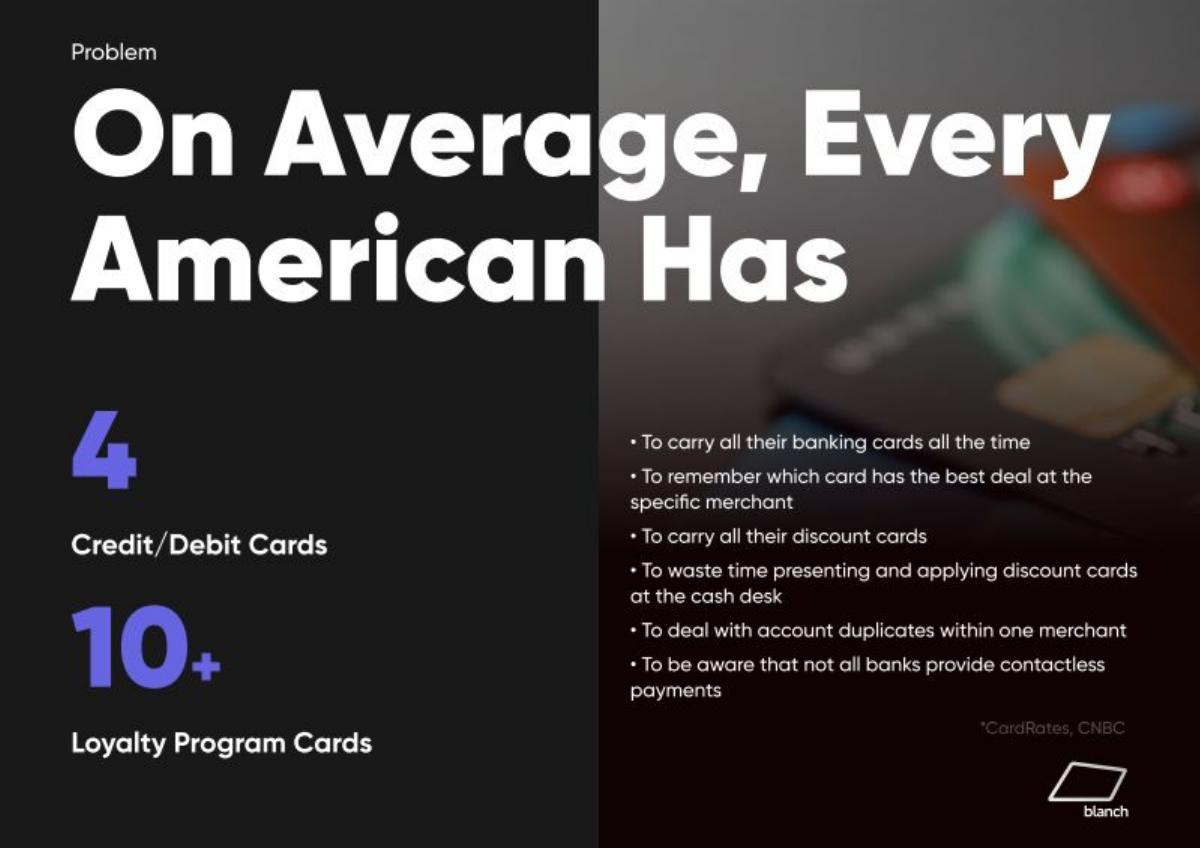
- The average American carries 4 payment cards and 10+ loyalty cards, creating a complex management problem (Slide 1).
- The total addressable market in the USA includes 176 million cardholders and 1.06 billion cards in use (Slide 2).
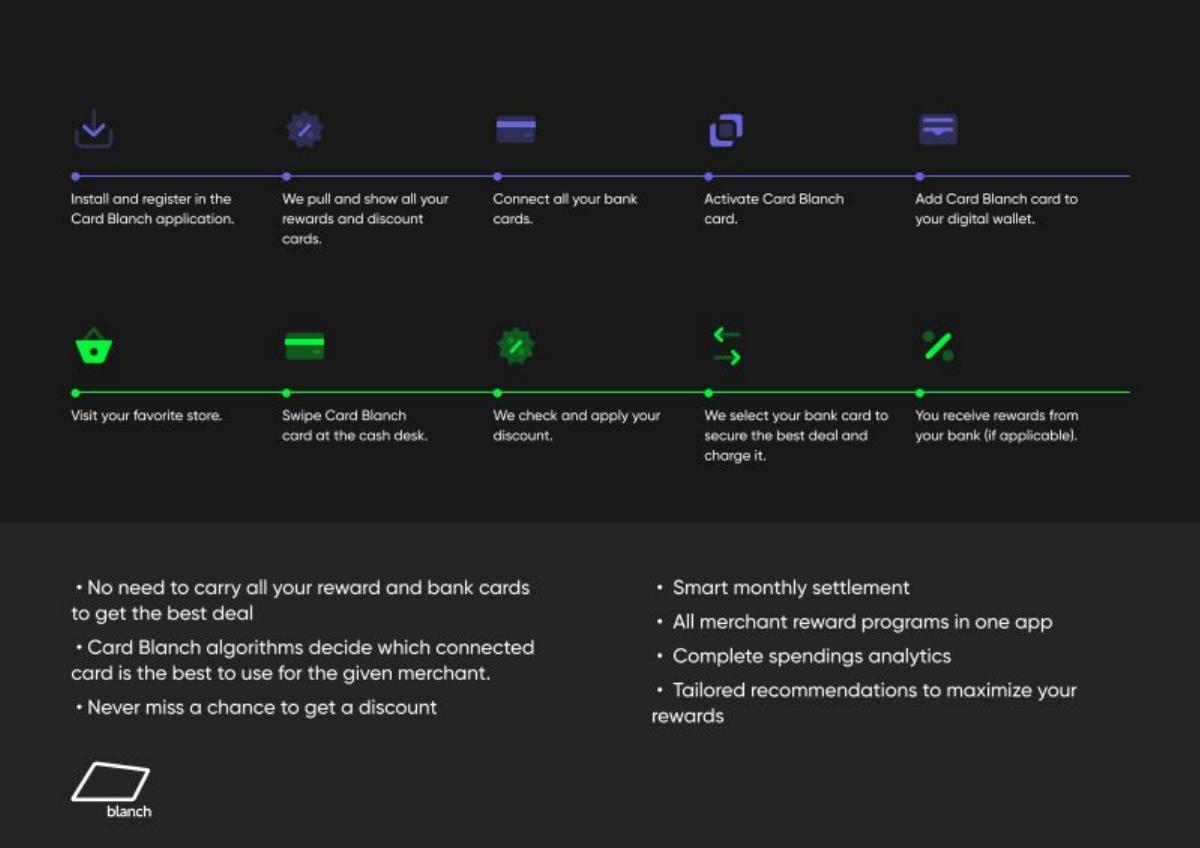
- Card Blanch uses algorithms to automatically select the optimal connected card for a specific merchant to secure the best deal (Slide 5).
- The revenue model is diversified across merchant cashback, user subscriptions, and up-selling reward/banking products (Slide 7).
- The company estimates an $11 billion total market opportunity, with $10 billion attributed to the subscription model (Slide 8).
- Financial projections target $42 million in revenue from 700,000 users by the end of 2024 (Slide 8).
- The startup successfully raised $0.5M in angel investments prior to seeking a $1M Seed round (Slide 9).
- The product offers '360 angle insights' on spending, replacing the need for separate budgeting apps or spreadsheets (Slide 11).
Executive Summary
Card Blanch is a fintech startup operating in the payment aggregation space. Their 12-slide deck, used during their 2022 fundraising efforts, presents a vision of a consolidated financial life. By merging the functionality of multiple credit, debit, and loyalty cards into one interface, they aim to capture a slice of the massive US payments market. The deck focuses heavily on the user experience and the sheer scale of the opportunity, though it leaves several critical business questions unanswered.
Slide 1: The Problem
The deck opens by quantifying the 'wallet bloat' experienced by US consumers. Citing sources like CardRates and CNBC, the slide notes that the average American has 4 credit/debit cards and over 10 loyalty program cards. The pain points listed include the physical burden of carrying cards, the cognitive load of remembering which card has the best deal, and the time wasted at the cash desk. This slide effectively establishes a relatable problem for a broad consumer base.
Slide 2: Market Size
Card Blanch targets the USA as its key market. The slide presents two massive figures: 176 million cardholders with 1.06 billion cards in use, and a projection of 144 billion purchase transactions by 2025. By framing the market through the number of cards rather than just total spend, they emphasize the scale of the fragmentation they intend to solve.
Slide 3: The Solution
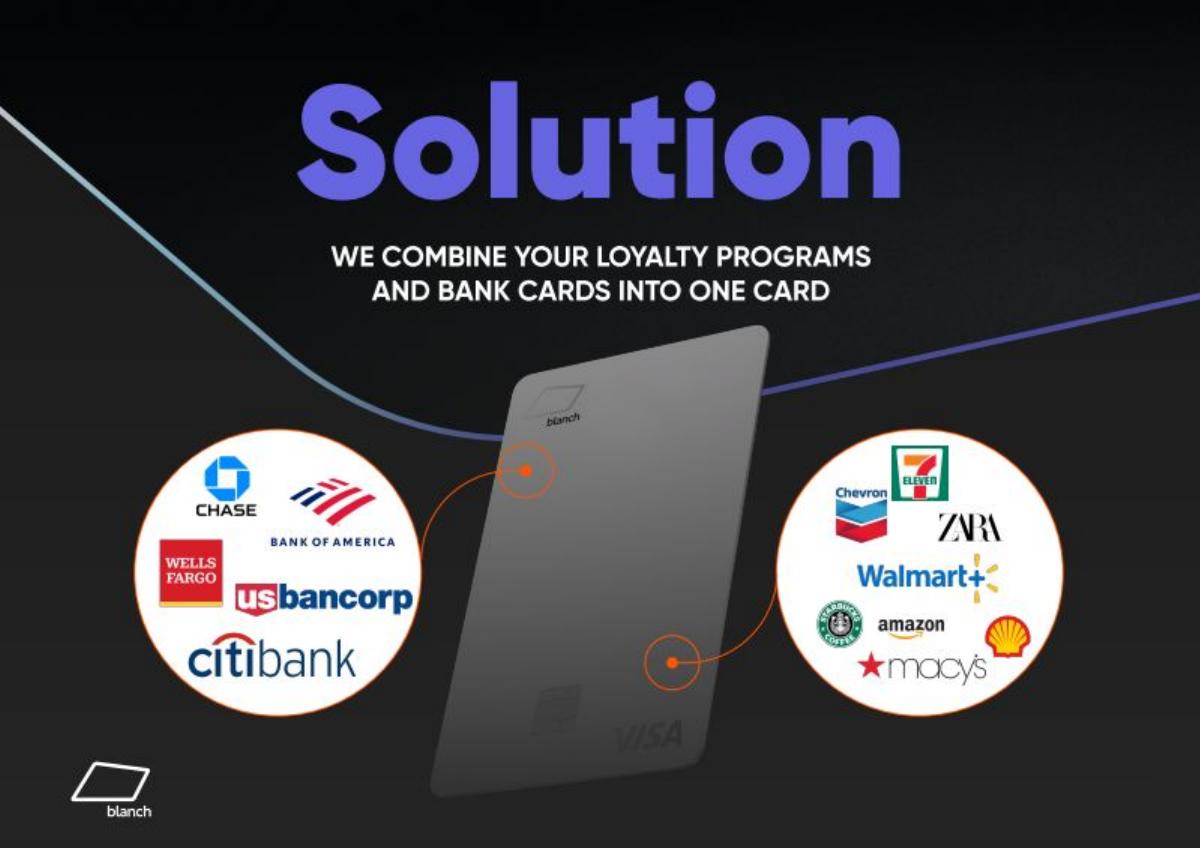
The solution is presented as a single card (branded with the Card Blanch logo) that acts as a bridge. On one side, it connects to major banks like Chase, Bank of America, Wells Fargo, US Bank, and Citibank. On the other, it integrates with retailers like Walmart, Amazon, Starbucks, and Zara. The value proposition is simple: 'We combine your loyalty programs and bank cards into one card.'
Slide 4: Product Interface
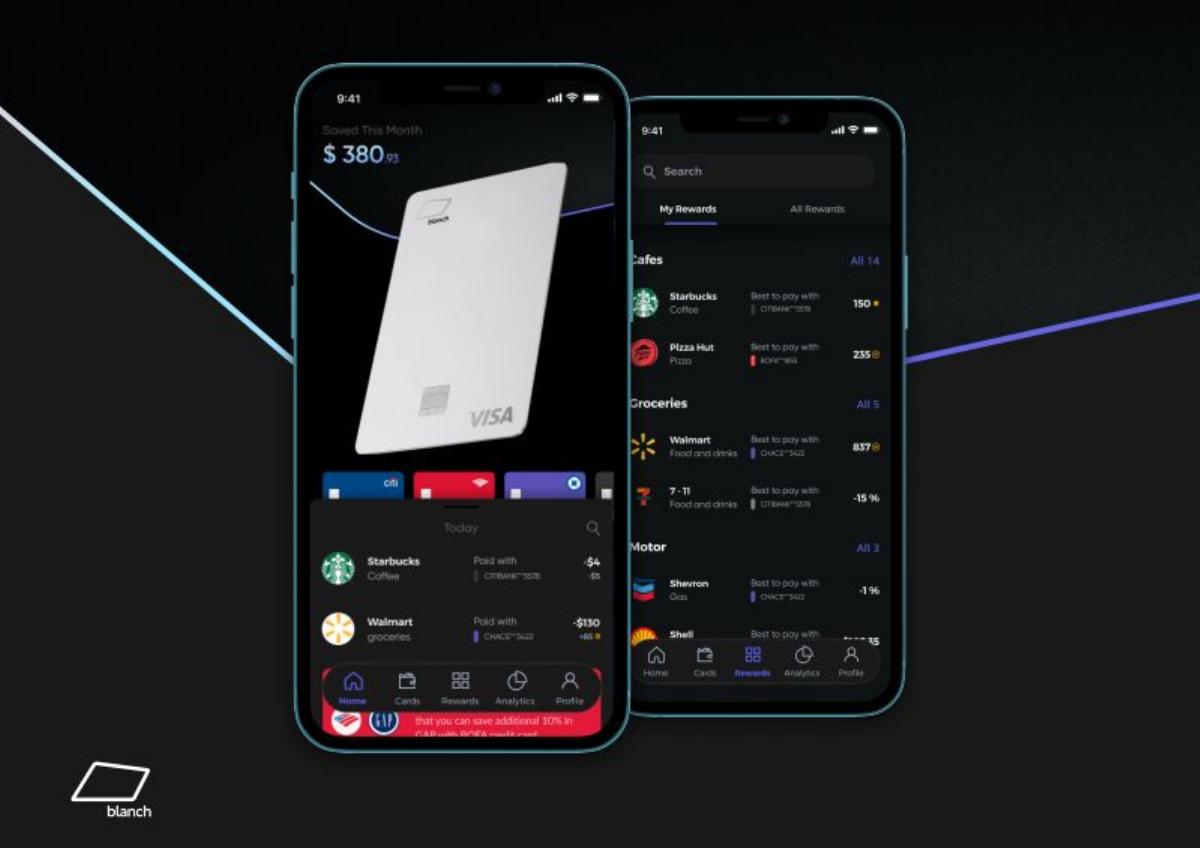
This slide provides a visual look at the mobile application. It shows a 'Saved This Month' metric ($380.93) at the top, emphasizing the financial benefit to the user. The UI displays a list of recent transactions at Starbucks and Walmart, showing which underlying bank card was used for each and the rewards earned. This helps investors visualize the 'smart' nature of the platform.
Slide 5: How It Works
The user journey is broken down into two phases: Setup and Usage. Setup: Install app, pull rewards, connect bank cards, activate Card Blanch card, and add to digital wallet. Usage: Visit store, swipe Card Blanch card, the system checks for discounts, selects the best bank card, and the user receives rewards. The slide also mentions a 'Smart monthly settlement' and 'Tailored recommendations,' suggesting a layer of financial advisory services.
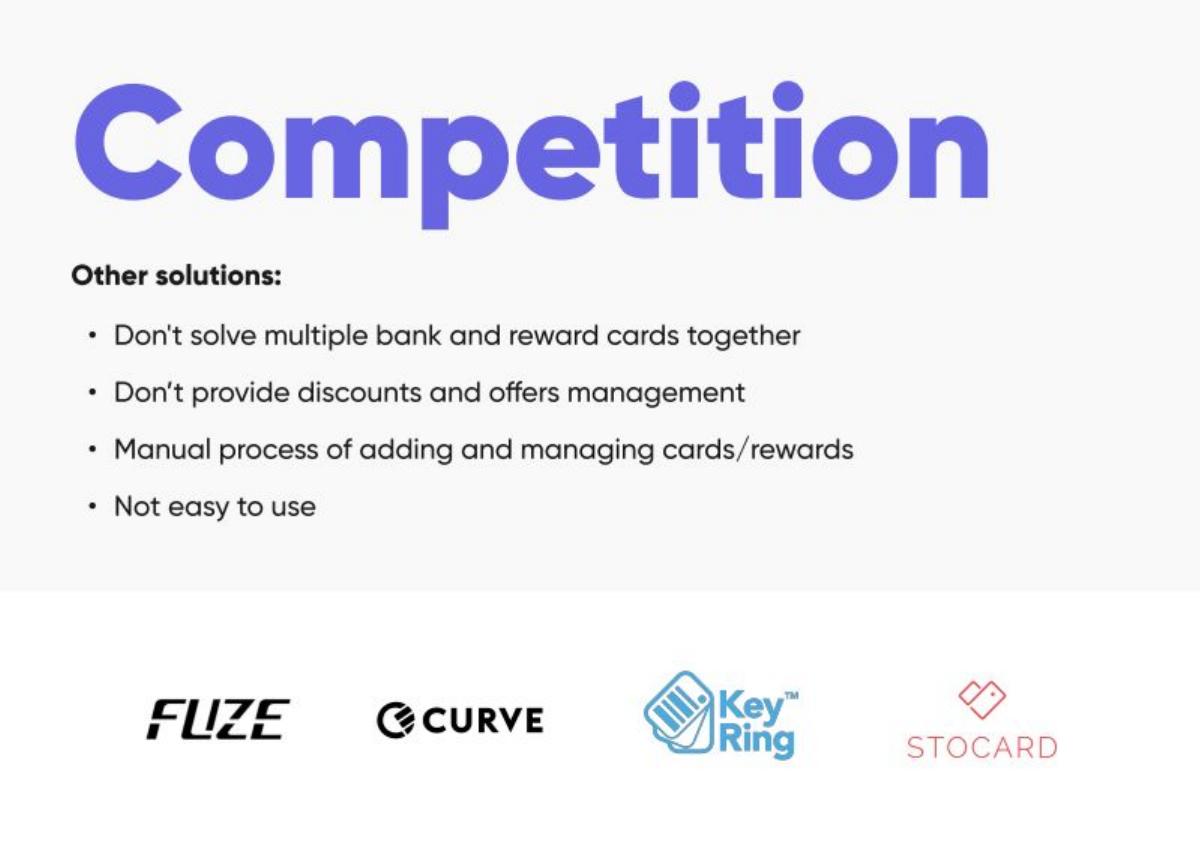
Slide 6: Competition
The competitive landscape includes Fuze, Curve, Key Ring, and Stocard. Card Blanch's critique of these competitors is that they are either too manual or fail to bridge the gap between banking and loyalty. By positioning themselves as the only 'all-in-one' automated solution, they attempt to carve out a unique niche in the crowded fintech sector.
Slide 7: Revenue Model
Merchants cashback · Users monthly subscription model · Up-sale for merchant rewards · Up-sale for banking card
This suggests they aren't relying solely on interchange fees, which are often squeezed in the payment space, but are looking toward a SaaS-style recurring revenue model from the end-user.
Slide 8: Market Opportunity and Projections
This is the most ambitious slide in the deck. It claims an '$11 Billion Market Opportunity,' with $10 billion coming from subscriptions and $1.5 billion from discount transactions. The bar chart projects rapid growth: 50k users/$3M revenue in 2022, 300k users/$18M revenue in 2023, and 700k users/$42M revenue in 2024. These are 'forward looking projections' and represent a high-growth 'hockey stick' curve.
Slide 9: Next Steps and Funding
The 'Ask' is clearly defined here. Having already raised $0.5M in angel investments, the company is seeking a $1M Seed round. The milestones for this capital include finalizing product development, launching an 'aggressive marketing campaign,' and signing a partnership with a bank partner. The mention of creating a 'patent portfolio' suggests they are looking to build a defensive moat around their selection algorithms.
Slide 10 & 11: Product Deep Dive
These slides reiterate the product's core features. Slide 10 emphasizes the 'ceramic or digital' nature of the card, while Slide 11 focuses on 'Complete spending analytics.' The analytics view shows spend by category (Rent, Restaurants, Medicine, Groceries) and by card, positioning Card Blanch as a replacement for budgeting tools like Mint or Excel.
What Works in This Deck
Clarity of Vision: The deck does an excellent job of explaining a complex technical process (real-time card switching and reward optimization) in simple, consumer-friendly terms. The 'How It Works' slide is particularly effective at demystifying the product.
Visual Design: The use of high-quality mockups and a consistent dark-themed aesthetic gives the impression of a polished, market-ready product. This is crucial for B2C fintech, where user trust and UI/UX are paramount.
Problem Validation: By using specific numbers (4 cards, 10 loyalty programs), the founders ground the problem in a reality that most investors can personally relate to.
What Is Missing
The Team Slide: This is the most glaring omission. In an angel or seed-stage round, investors are primarily betting on the founders. Without a team slide, there is no information on who is building this, their background in fintech, or their ability to navigate the complex regulatory and partnership requirements of the banking industry.
Unit Economics: While the deck mentions a subscription model, it doesn't specify the price point or the Customer Acquisition Cost (CAC). For a B2C app planning an 'aggressive marketing campaign,' understanding the LTV/CAC ratio is vital.
Regulatory and Technical Hurdles: Aggregating bank cards in real-time often requires sophisticated 'fronting' technology or specific banking licenses. The deck mentions the need to 'Sign partnership with a bank partner' as a next step, which suggests the core infrastructure may not be fully secured yet.
Founder Takeaways
Focus on the 'Why Now': Card Blanch effectively uses the 'wallet fatigue' narrative. Founders should always look for a relatable 'anchor' problem that can be quantified with simple stats.
Show, Don't Just Tell: The inclusion of detailed app screens (Slides 4, 10, 11) helps prove that the product is more than just a concept. Even if the backend isn't finished, high-fidelity front-end designs show a commitment to the user experience.
Be Transparent About Traction: While the projections are bold, the deck would be stronger if it showed current beta user numbers or waitlist signups to justify the jump to 50,000 users. If you have raised money previously, as Card Blanch did ($0.5M), highlighting that success builds immediate credibility with new investors.
Frequently asked questions
- What is the primary problem Card Blanch is solving?
- According to slide 1, Card Blanch solves the inconvenience of carrying multiple banking and loyalty cards. It addresses the mental load of remembering which card offers the best deal at specific merchants, the time wasted at checkout applying discount cards, and the lack of contactless support across all legacy bank cards.
- How does the Card Blanch card actually work for a user?
- Slide 5 outlines a 10-step process. Users register in the app, connect their bank and reward cards, and receive a Card Blanch card (digital or physical). When they swipe at a store, Card Blanch's algorithms check for discounts and then select the specific linked bank card that provides the best rewards for that transaction.
- What are the main revenue streams for the company?
- Slide 7 identifies four revenue streams: cashback from merchants, a monthly subscription fee for users, and up-selling opportunities for both merchant rewards and third-party banking cards. Slide 8 suggests the subscription model is the primary driver, estimated at a $10 billion opportunity.
- Who are the competitors mentioned in the deck?
- Slide 6 lists Fuze, Curve, Key Ring, and Stocard as competitors. Card Blanch differentiates itself by claiming these 'other solutions' do not solve for both bank and reward cards together, lack automated offer management, and require manual processes for adding cards.
- What are the company's immediate funding goals?
- Slide 9 states that the company is seeking a $1M Seed round. This follows a successful $0.5M angel raise (noted as $460K in catalogue facts). The funds are intended for finalizing product development, executing a go-to-market strategy, and signing a bank partner.