Capdesk’s 2020 pitch deck is a tactical document designed to secure a £5M Series A extension for European expansion. The deck successfully transitions the company’s narrative from a standard equity management tool to a critical piece of financial infrastructure for private markets. By highlighting a 500% MRR growth rate in 2019 (Slide 10) and a total market cap of over £20bn managed on the platform (Slide 11), the founders demonstrate significant product-market fit. The inclusion of a detailed appendix on secondary transactions (Slides 15-19) signals a strategic move toward capturing commissi…
Key takeaways
- The company reported a 500% MRR growth in 2019, providing strong momentum for the extension round (Slide 10).
- Capdesk manages over £20bn in market cap across more than 500 companies, including notable clients like Nutmeg and Gousto (Slides 10, 11).
- The business model is evolving from pure recurring annual subscriptions to include variable commissions on transactions (Slide 9).
- The 'Why Now?' slide leverages macro trends, noting that UK employee-owned businesses are growing 10% year-on-year (Slide 7).
- The deck explicitly names high-value exits in the space, such as Solium's $900M acquisition and Carta's $1.7B valuation, to validate the market (Slide 8).
- The primary use of the £5M raise is geographic expansion into Scandinavia, France, and Germany (Slide 13).
- A significant portion of the deck (5 slides) is dedicated to an appendix explaining the mechanics of secondary transactions (Slides 15-19).
- The management team features founders with backgrounds from FundedByMe and Netcompany, alongside a CFO with 13+ years in finance (Slide 12).
Introduction
The Capdesk 2020 pitch deck is a 19-slide presentation used to secure a £5M Series A extension. At a time when the private equity landscape was shifting toward longer hold periods and increased employee ownership, Capdesk positioned itself not just as a cap table tool, but as the underlying infrastructure for private market liquidity in Europe. The deck is notable for its clean design, heavy reliance on third-party market validation, and a clear strategic pivot toward transaction-based revenue.
The Vision and The Problem (Slides 1-3)
Slide 1 serves as a standard title page, identifying the deck as the 2020 version with a direct contact email for the CEO. Slide 2 immediately establishes the high-level ambition: "The infrastructure for private equity." This is a significant framing choice; they aren't just selling software; they are building a foundational layer for an entire asset class.
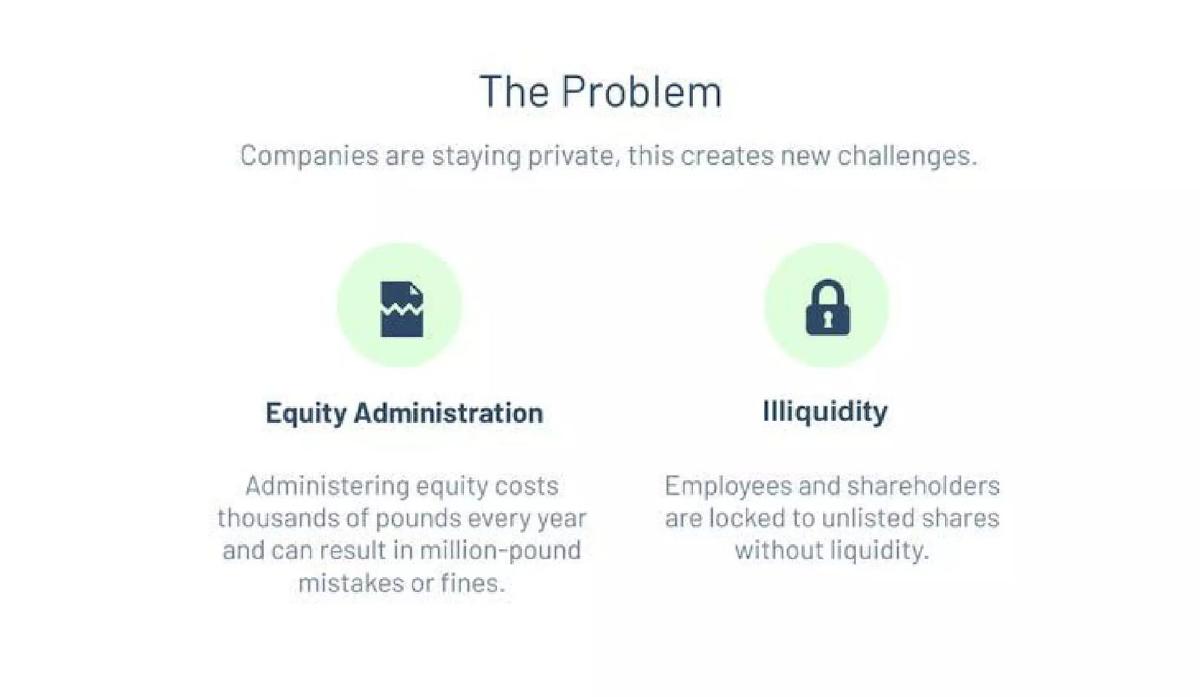
Slide 3 defines "The Problem" through two lenses. First, Equity Administration , which they claim costs companies thousands of pounds and risks "million-pound mistakes or fines." Second, Illiquidity , noting that employees and shareholders are "locked" into unlisted shares. This dual-problem approach allows Capdesk to sell to two different stakeholders: the CFO (who cares about admin costs/fines) and the employees/investors (who care about liquidity).
The Solution and Product Deep-Dive (Slides 4-5)
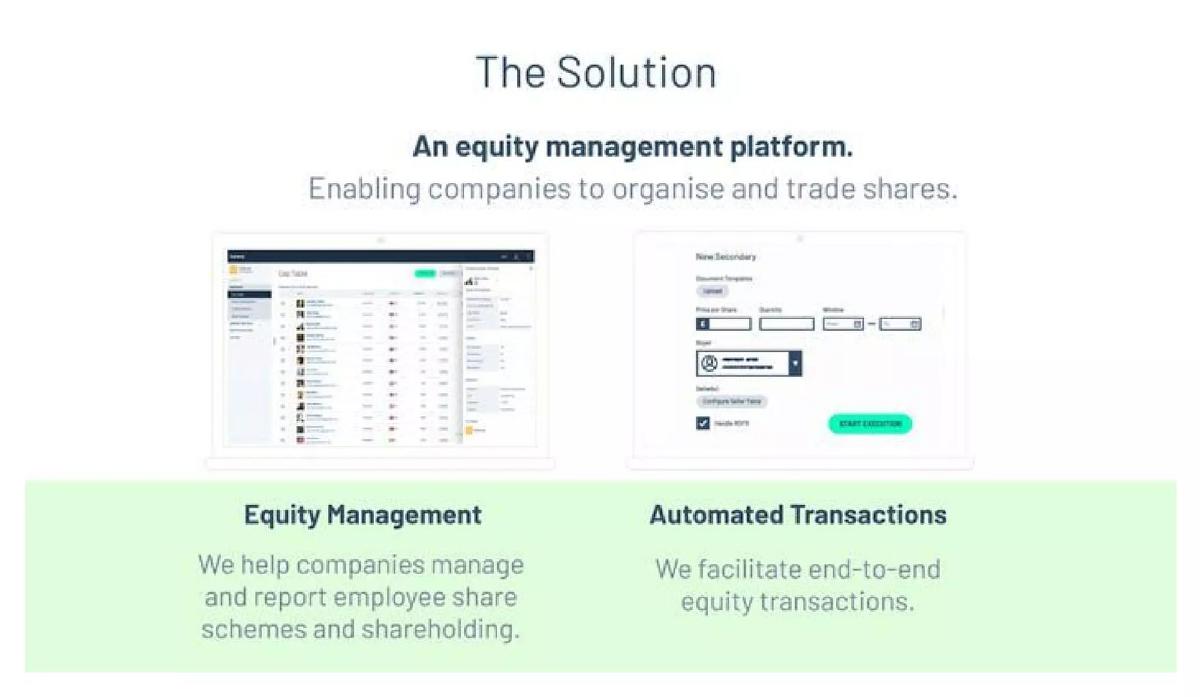
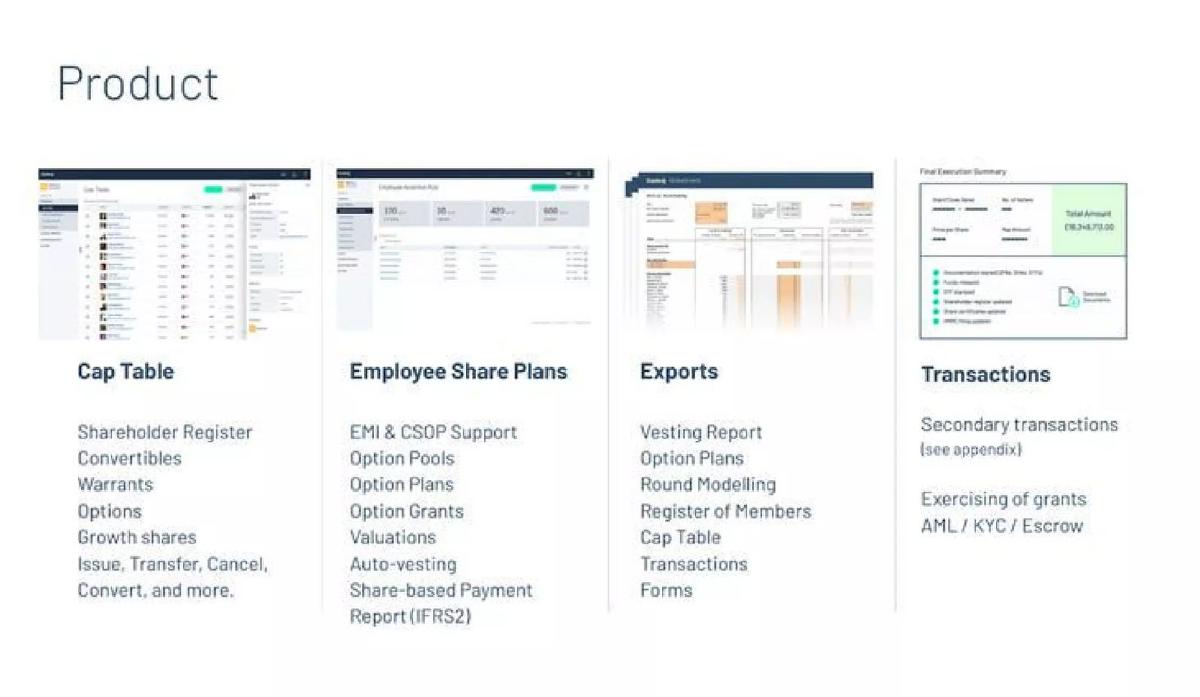
Slide 4 introduces the platform as a tool to "organise and trade shares," featuring two clean UI mockups. Slide 5 provides a granular breakdown of the Product . It is divided into four categories: Cap Table, Employee Share Plans, Exports, and Transactions. Notably, it mentions support for specific UK tax-advantaged schemes like EMI & CSOP , signaling their deep localization for the European market—a key differentiator against US-based competitors like Carta.
Roadmap and Market Timing (Slides 6-8)
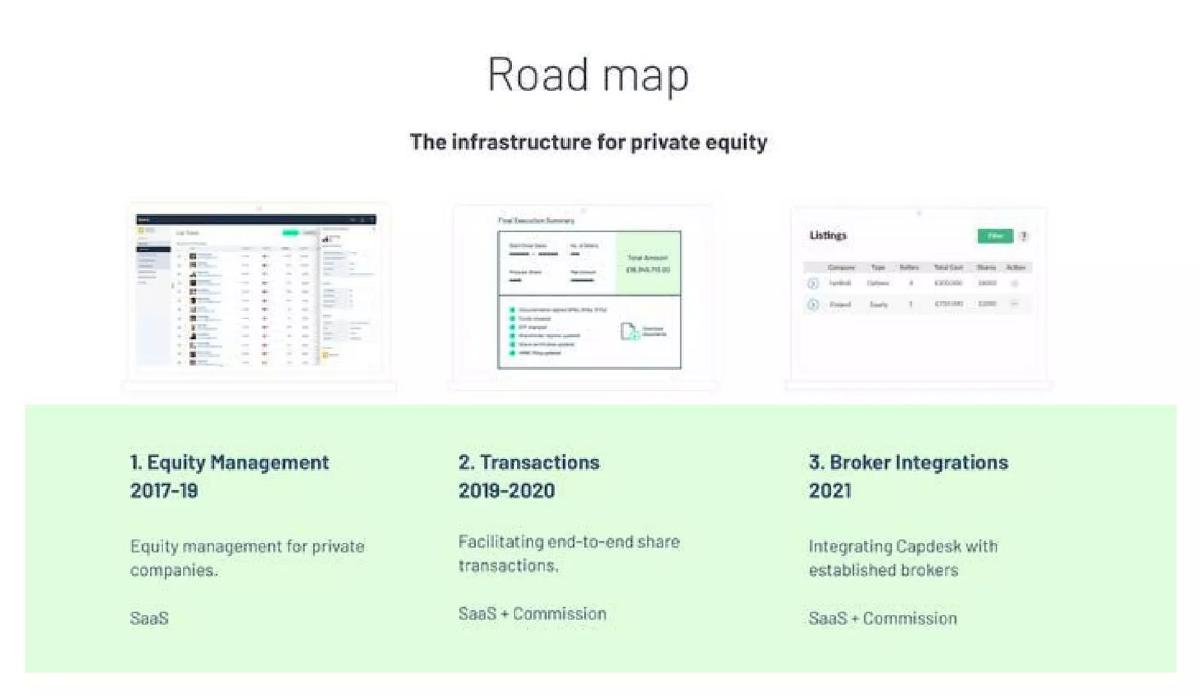
Slide 6 presents a chronological Road map . It shows a clear evolution: 2017-19 was about SaaS-based Equity Management; 2019-20 introduced Transactions (SaaS + Commission); and 2021 targets Broker Integrations. This progression demonstrates a clear path toward becoming a marketplace rather than just a utility.
Slide 7, "Why Now?", uses data from The Economist, Bain & Company, and CBS Insights to argue that private markets are at a tipping point. They cite that uncalled PE capital is at its highest yet and UK employee-owned businesses are growing 10% year-on-year. Slide 8 reinforces this with "Perfect Timing," listing massive exits and valuations for Solium ($900M), Carta ($1.7B), and Equatex. This slide is designed to trigger FOMO (fear of missing out) by showing that the global equity management market is "hotting up."
Business Model and Traction (Slides 9-11)
Slide 9 is a minimalist Business Model slide. It confirms the shift from a pure subscription model to a hybrid model that includes a "Variable fee on all transactions." This is the "kicker" for investors—it suggests that as the market cap on the platform grows, the revenue potential scales exponentially beyond seat-based pricing.
Slide 10, Traction , is the strongest slide in the deck. It lists four massive metrics: +£20bn market cap on the platform, +500 companies , +100,000 investors , and a staggering +500% MRR Growth in 2019 . The right side of the slide includes Capterra reviews with 5/5 ratings, providing social proof. Slide 11 supports this with a logo wall of high-profile European clients like Nutmeg and Gousto.
The Team and The Ask (Slides 12-13)
Slide 12 introduces the Team . The founders have relevant backgrounds in fintech and engineering (FundedByMe, Netcompany). The inclusion of "Key Team Members" like the CCO, a second CTO, and a CFO with 13+ years in finance suggests a mature leadership structure ready for scaling. Slide 13 delivers the Ask : £5M to scale into Scandinavia, France, and Germany. The map highlights the UK and Ireland in green, showing their current stronghold, while the rest of Europe is shaded in grey as the target territory.
The Secondary Transactions Appendix (Slides 14-19)
The final five slides are dedicated to an Appendix on Secondary Transactions. This is essentially a product walkthrough of how a secondary sale works on Capdesk. It covers:
Step 1: Configure Secondary (Slide 16) – Choosing a fund, agreeing on price, and handling pre-emption rights. · Step 2: Monitor Execution (Slide 17) – E-signing, escrow accounts, and vested option exercise. · Step 3: Close Secondary (Slide 18/19) – Releasing funds and automatically updating the cap table and HMRC filings.
This level of detail on a single feature indicates that secondary liquidity is the core of their Series A extension narrative.
What Works in This Deck
1. The "Infrastructure" Framing: By positioning themselves as infrastructure (Slide 2), Capdesk moves away from being viewed as a replaceable SaaS tool. Infrastructure implies high switching costs and a central role in the financial ecosystem.
2. Hard Traction Metrics: The 500% MRR growth (Slide 10) is a "drop the mic" moment. In a Series A extension, investors are looking for proof that the initial model works and is ready for more capital to be poured in.
3. Market Validation by Proxy: Since Capdesk was likely smaller than Carta at the time, using Carta’s $1.7B valuation (Slide 8) as a benchmark helps investors understand the potential upside without Capdesk having to prove the entire category's worth from scratch.
What Is Missing From This Deck
1. Unit Economics: While the deck mentions 500% MRR growth, it omits CAC (Customer Acquisition Cost), LTV (Lifetime Value), and Churn rates. For a Series A extension, investors usually want to see that the cost of acquiring those 500 companies is sustainable.
2. Competitive Landscape: There is no slide addressing competitors directly. While they mention Carta and Solium as market validators, they don't explain why a European company would choose Capdesk over a US giant moving into the region, other than a brief mention of EMI/CSOP support.
3. Detailed Use of Funds: Slide 13 says they want to scale into Scandinavia, France, and Germany, but it doesn't break down how the £5M will be spent (e.g., % to sales, % to engineering, % to regulatory licensing).
What a Founder Should Copy
1. The "Why Now" Slide (Slide 7): This is a textbook example of how to use macro trends to create urgency. Don't just say your product is good; show that the world is changing in a way that makes your product inevitable.
2. The Transactional Appendix: If your business model is shifting (e.g., from SaaS to Marketplace), use an appendix to prove you have the technical workflow already built. It turns a theoretical revenue stream into a tangible reality.
3. Logo Grouping: Slide 11 doesn't just show logos; it groups them under a "total market cap managed" figure. This turns a simple client list into a metric of trust and scale.
Conclusion
Capdesk’s deck is a highly professional, metric-driven document that successfully argues for the necessity of a European-specific equity solution. It balances the "boring" but necessary administrative side of the business with the "exciting" high-margin transaction side. For founders in the fintech or SaaS space, this deck provides a clear blueprint for how to use a funding extension to double down on a successful geographic or product pivot.
Frequently asked questions
- What is the specific funding ask in this deck?
- On Slide 13, Capdesk explicitly states they are raising £5M. This is framed as an extension of their Series A from July 2020. The primary stated goal for these funds is to scale operations into Scandinavia, France, and Germany to cement their position as Europe's leading equity management platform.
- How does Capdesk differentiate its revenue model from standard SaaS?
- Slide 9 outlines a dual-revenue strategy. While they maintain a 'Recurring Annual' subscription for equity management, they are moving toward 'Commission on transactions.' This involves a variable fee on all transactions made through the platform, which is further detailed in the secondary transaction appendix.
- What evidence of market validation does the deck provide?
- Slide 8 focuses on 'Perfect Timing' by citing major industry moves: Morgan Stanley’s $900M acquisition of Solium, Carta’s $1.7B valuation led by Andreessen Horowitz, and Computershare’s acquisition of Equatex. It also mentions that Capdesk has already been approached by several acquirers.
- Who are the key clients mentioned in the deck?
- Slide 11 showcases a 'Clients' gallery featuring prominent European startups and scale-ups. Named logos include Nutmeg, Gousto, Secret Escapes, Voi, Chattermill, Billie, and Plum Guide. The slide notes these clients represent a combined market cap exceeding £20bn.
- What specific product features are highlighted?
- Slide 5 breaks the product into four pillars: Cap Table management (shareholder registers, convertibles), Employee Share Plans (EMI & CSOP support), Exports (vesting reports, round modeling), and Transactions (secondary trades, exercising grants, and AML/KYC/Escrow services).